Pacific Islands Monthly
pp. 26-28 · Read in the full issue
Elections Will Put Fiji's Multi
Racial Dream To The Test
From JOHN CARTER, in Fiji
Fiji goes to the polls in April in the first general election for the House of Representatives since inde pendence came in October, 1970.
By mid-March the pattern emerged as the two main parties cleared the decks for action, the action being polling between April 15 and 29, with the crunch coming on or about May 1 when the results are expected.
It’s expected that the Alliance Government will be returned to power with a smaller majority. But how small? That’s the $64 question.
The gloomiest Alliance Jeremiah forecasts almost a win for the National Federation Party led by Mr.
Siddiq Koya, but even Jeremiah won’t go as far as saying the NFP will win. “The Alliance will have a majority of about four” says Jere miah.
Then you have the optimists on both sides, with Prime Minister Ratu Sir Kamisese Mara prominent among the Alliance optimists. He forecasts a majority of 22, but he must have been feeling a super-optimist when he spoke to PIM because the week before the most he hoped for was a majority of “between six and 10”. The opti mists in the NFP think the party could just win by a head.
Before the jockeying for party tickets began the issue was clear.
The Alliance would retain most of its supporters and maybe gain a little support in the Indian com munity, though there was a slight drift by Fijians away from the Alliance and towards the NFP.
That changed when the party tickets were handed out. Both parties had no shortage of candidates for the honour of carrying the party banner in one constituency or an other. But they all couldn’t be chosen. There were winners and
losers and the losers have reacted forcefully.
Most of them, and the majority Alliance men, decided to fashion their own banner and fight as inde pendents. For the Alliance that could be something of a disaster. Even if no independents should win, they will split the vote. In some constituencies neither party can afford to lose votes.
Ratu Mara’s reaction to these de fections was to warn that any defector who managed to win on his own ticket would not be wel comed back into the party. There’s precedent for that, though. Before the last election. Minister of Com munications, Works and Tpurism Mr.
Charles Stinson was denied a ticket.
He fought as an independent, won, was welcomed with open arms by the Alliance and made a minister. In those days, however, party politics were still in the egg and most felt
the Alliance committee which rejected Charles Stinson wanted its head examined.
Nowadays, the party has become more adult, but with so many mem bers taking the huff and writing their own tickets in opposition to the party, it looks as if it needs more discipline within its ranks.
Of course, there’s more to it than the honour of carrying the banner for either party. The successful candidate can expect an MP’s salary of about $4,000. Money talks, and that is one reason for so many independents taking the field in defiance of party discipline.
The NFP has also been subjected to defections, for the same reason and for others, and there are many stories going the rounds of power struggles, petty jealousies and splits.
A grain of salt is needed with some of the stories. In the past many have
turned out to be wishful thinking on the part of political opponents. The party exercises a much stronger dis cipline on its members.
Two leading Gujeratis (the Indian merchant section, or caste, which has strongly supported and financed the party) announced within days of each other in March that they were leav ing the party. But here again, it’s not a conversion to the tenets of the Alliance. The Gujeratis are becoming increasingly disenchanted with the inner workings of the party under Mr.
Koya’s leadership. The Old Guard, lieutenants under the founder, the late A. D. Patel, are firmly in the saddle along with their own interests and they’ve seen to it that the safe seats in the communal sector are theirs.
They are staunch and vociferous advocates of common roll but to the chagrin of some of the members, none of them has opted for a National seat where the electors are of all races, as against a communal seat with its electors confined to the one race. There’s a risk for any candidate running for a National seat as is the case with Ratu Penaia Ganilau, Minister for Land, Home Affairs and Minerals. Many have forecast that he will be voted out of office in the National constituency where he is challenged by a fellow- Fijian, ex-Army Captain Atunaisa Maitoga.
Many point to his example, to his guts in risking his seat and scoff at the Old Guard in the NFP. But there’s another side to that. They argue that with the Old Guard’s ex perience of parliament their services are needed.
But the Gujeratis are chafing at the bit. There are several warring fac tions in the NFP with two main con tenders for power, one group led by party Whip Mr. K. C. Ramrakha and the other led by Mr. R. D. Patel, brother of the late leader. In be tween is the present leader Mr. Koya, who is managing to hold the reins of power and will do so, at least until after the election. He may find his leadership challenged if the party loses ground at the polls.
These struggles are disgusting the Gujeratis who are also regretting the lack of a party platform.
All this, on both sides of the political front adds up to a growing band of people, ex-one party or the other, searching for a political home.
Should an independent emerge as a forceful political figure another political party may be born in Fiji, one which will meet the conditions suggested necessary by Ratu Mara for a genuine political party—one that has been formed for reasons
other than racial. Its beginnings, however, may be its weakness, for among its first members would be some who put self-interest first.
Many are holding their breath until the result is known. Then, they whisper fearfully, things won’t be as peaceful as they have been.
They point to the tense racial situ ation which existed in 1968 when the nine Federation men, who had forced a by-election by walking out of the Legislative Council, were literally swept back into the council by the overwhelming vote of the Indian com munity. They had been optimistic enough to think that many Indians would turn their backs on the NFP leaders and support the Alliance.
How they were mistaken. They said they had been misled by the Indians and for a short time there was a racial tension which had never existed before and has since almost died away.
They fear its revival if the NFP does so well at the polls that it is clear the Indian community thought and voted as a race. If there is in creased support for the Alliance, it will be a triumph for the beliefs and policies of Ratu Mara, ever struggling for a multi-racial, united country.
If not, many will despair and regard his aims as unattainable, in the face of a declared intention of the Indian community to keep their voting power within their own com munity.
There are those who see little threat to peace in all this. The truth of the matter is that there is more talk and more is written overseas about impending trouble in Fiji, than ever there is in Fiji.
One local view that I heard was that the only threat to public peace were the divisions among the Fijians.
The traditional position of the chiefs within the Fijian community is being challenged more and more, which is why a growing number of Fijians are willing to challenge their chiefs in the elections—a thing unheard of 20 years ago—nay, 10 years ago.
If this opposing faction makes its weight felt in the elections there may be trouble between those who support the chiefly tradition and the New Thinkers. That is why many people feel that on polling days the hotel bars should remain closed. Drink could inflame tempers already volatile in such a situation.
Where do the part-Europeans stand in all this? At long last, mainly through the efforts of Dr. Felix Emberson, a part-European whose family has ties with Tonga’s royalty, they are organised into the Part- European Association (PEA), through which they are hoping to find a political identity of their own.
Founder of the PEA Dr. Emberson believes the part-Europeans have an important part to play in the running of the country. Come to think of it,
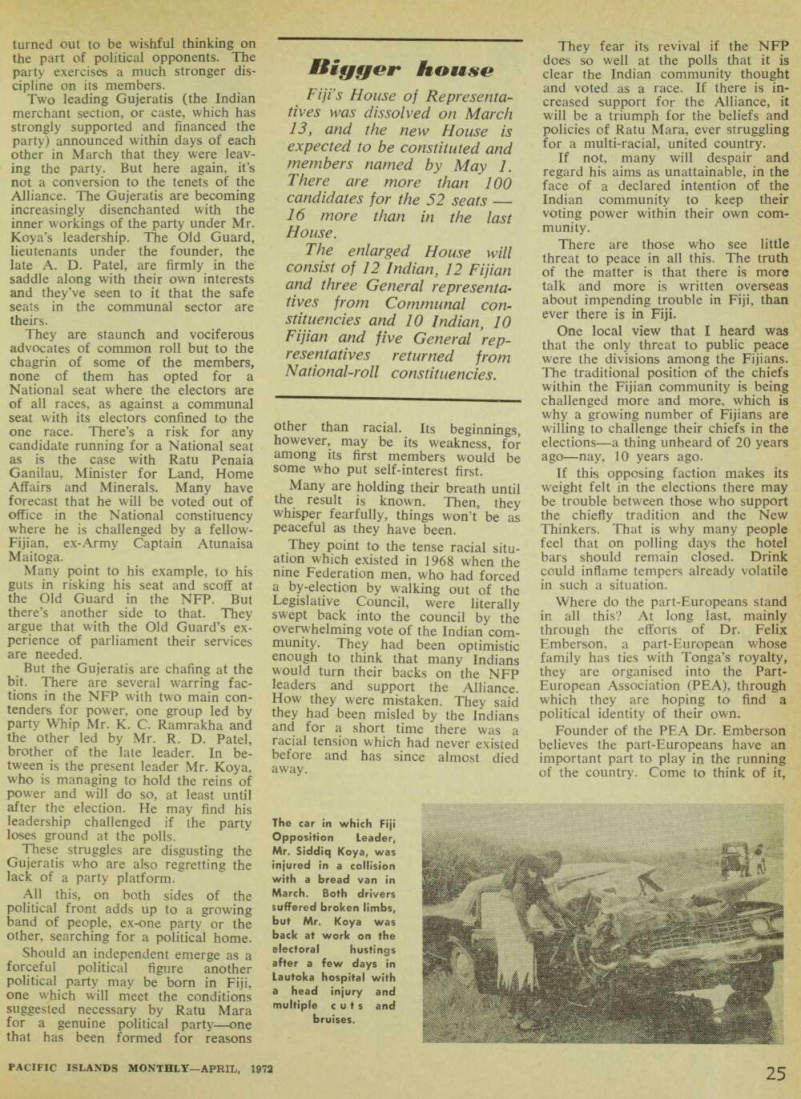
The car in which Fiji Opposition Leader, Mr, Siddiq Koya, was injured in a collision with a bread van in March. Both drivers suffered broken limbs, but Mr. Koya was back at work on the electoral hustings after a few days in Lautoka hospital with a head injury and multiple cuts and bruises.
if Ratu Mara’s doctrine becomes a solid fact, future generations will con sist mainly of “parts”.
The part-Europeans through the PEA, hold the balance of power, believes Dr. Emberson. “Up to now,” he said, “political leadership has been provided by the European but our present part-European leaders see the need for organising the part- Europeans politically.
“There is an urgency about the whole business of getting our people involved, and for the first time in our history we will have people stand ing for almost every available seat.
Some are with the Alliance, some with the NFP and some independent.
I believe we have done sufficient work to be able to call on these people to present a united front on matters affecting part - Europeans, party allegiance taken into considera tion, of course.
“The part-European, being neither one race nor another, is very often overlooked in the plans for the future of this country. Therefore, we must organise and play our part in the running of Fiji.”
Well, that’s the stage set for the election. Well into March little real political activity had developed.
Pictures appeared in the Press, es pecially of the NFP candidates taking the oath of allegiance to the party.
As a lawyer, A. D. Patel believed in doing the job “according to the law”.
Perhaps that is why party discipline is so strong. At any rate, an oath taking ceremony with a little solemnity about it creates a kind of “mystique” and that’s something which impresses the Indian com munity.
But they’ll need more than mystique in this election. Mr. Koya, who had been injured in a car accident in the middle of March, was unavailable for comment or a fore cast. He did say, however, to The Fiji Times a little before that his party would “surprise” everybody.
Ratu Mara was a little more definite. His forecast to me was: “There are going to be 12 Fijian com munal seats. I will be very surprised if we don’t win them all. At the worst I might lose one or two. Split the difference—l think we’ll get 11.
I may be able to get 10 Fijian National seats. I have a feeling I will also get the 10 Indian National seats. If you are doubtful, give me eight. I think I will get all eight General Elector’s seats. That totals 17 nut of 52.”
He wasn’t so super-optimistic that he hoped for even one of the Indian communal seats. Win only one of those and he’s on the way to seeing his dream come true.