O'er mountain, thru jungle
pp. 123-129 · Read in the full issue

and swamp, it's been hard going for PNG's politicians
By DONALD WOOLFORD in Port Moresby
The timing of self-government and independence, the nominal major issue in Papua New Guinea’s third general election now in progress, is being largely forgotten as candidates encounter the realities of village politics.
Despite the development of political parties and the imminence of major constitutional change, the election, like its predecessors in 1964 and 1968, is primarily a “roads and bridges” affair.
Three major parties are contesting the election—the United Party, the People’s Progress Party and the Pangu Party. The United Party is the only one with any real prospects of winning a majority in the 100member House.
It draws the bulk of its support from the densely-populated, relatively unsophisticated Highlands. It enjoys substantial support from white busi ness and planter interests and can afford a more lavish campaign than its rivals.
Its main aim is to delay self government as long as it can. It also emphasises the need for tougher law and order measures and wants an Australian-style, private enterprise economy.
People’s Progress is in the middle.
It largely agrees with the United Party on constitutional change, but takes a more critical attitude towards Australian Government policies and tends to attract the better-educated minority.
On the left is Pangu, which for the last four years has been demanding
immediate self-government and which emphasises the need for special help to boost indigenous participation in the economy.
In a nutshell, the United Party argues that more time is needed for the territory to develop with the help of Australian skills and money while Pangu maintains that PNG people can only learn to govern themselves by actually doing it and the time for starting is overdue.
It stresses that self-government and independence will not mean the flight of Australians and their capital, but also makes clear that only a certain sort of Australian—the one with the special skill or the willingness to adapt his life to local standards—will be welcome.
In the big towns, especially Port Moresby, the self-government issue looms as the major one. But in the bush, where the great majority of votes are to be gleaned, such con siderations mean virtually nothing.
Despite the parties’ national cam paigns, what will determine the fate of many of the 611 candidates will be religion, tribal affiliation, “big man” status and personality.
A new road, bridge, school or aid post is worth all the constitutional theory in the world.
Most candidates, however, are wary of making promises, even parochial ones. In previous elections many pledges were made and many of them were not kept. Villagers have long memories for broken promises.
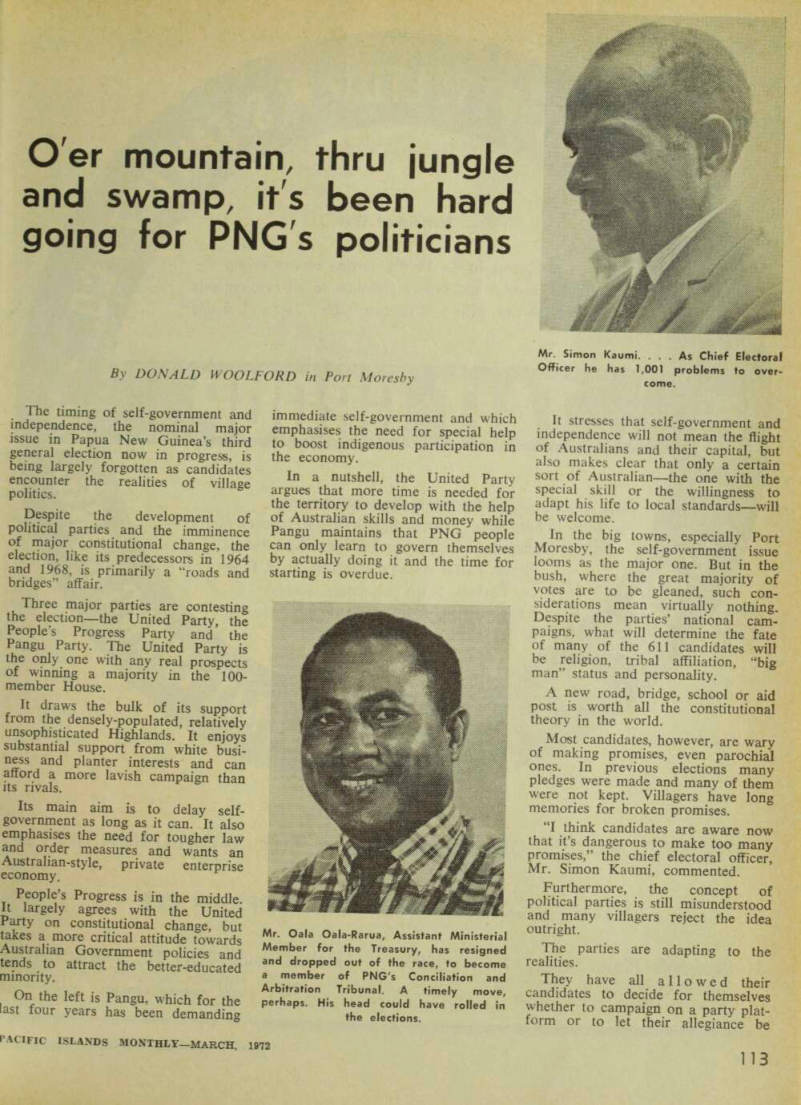
“I think candidates are aware now that it’s dangerous to make too many promises,” the chief electoral officer, Mr. Simon Kaumi, commented.
Furthermore, the concept of political parties is still misunderstood and many villagers reject the idea outright.
The parties are adapting to the realities.
They have all allowed their candidates to decide for themselves whether to campaign on a party plat form or to let their allegiance be
Mr. Oala Oala-Rarua, Assistant Ministerial Member for the Treasury, has resigned and dropped out of the race, to become a member of PNG's Conciliation and Arbitration Tribunal. A timely move, perhaps. His head could have rolled in the elections.
Mr. Simon Kaumi. . . . As Chief Electoral Officer he has 1,001 problems to over come.
Party squabbles
quietly forgotten. Many have chosen the latter course.
Joe Langro, the sitting member for West Sepik regional has struck so much anti-party feeling he has publicly resigned from Pangu. Party officials in Port Moresby are certain he will, if re-elected, immediately join up again. There is confusion in some electorates over which candidate be longs to which party.
The United Party claims more than 300 candidates are its men—in some electorates virtually everyone running is said to be a member—but has refused to publish a complete list.
Pangu has divided its men into en dorsed candidates, party members and sympathisers.
Only People’s Progress has an nounced a firm list of 25 candidates.
Several candidates are being claimed by more than one party.
The United Party is confident it can win a majority. It expects to sweep the Highlands and most of the less developed areas of the other mainland districts. It would then need to pick up only the odd seat on the coast and in the islands to get home.
But, even if it gains a majority, many observers doubt its ability to mould all its members into a cohesive, well-disciplined governing party.
Pangu expects to dominate the towns and do well right along the coast. It hopes the National Party, a splinter Highlands movement with which it is loosely associated, will win a few seats from the United Party.
Furthermore, it expects regional movements like the militant Mataun gan Association on the Gazelle Peninsula and Napidakoe Navitu on Bougainville to do well and generally support it in the House.
People’s Progress, which is prob ably strongest in the islands, aims to win the balance of power and join the United Party in a governing coalition. The election should also clarify such regional issues as the jazelle Peninsula crisis. It will pro vide the first real test of the popular support enjoyed by the Mataungans md their opponents, the Gazelle -ouncil.
On Bougainville, it should indicate stren B t h of secessionist feeling.
Vhat many observers fear is that here will be a political split along egional lines. If the Highlands go >ne way and the more sophisticated reas the other, the regional sus icions that already trouble Papua Jew Guinea politics will be worsened.
Probably the most difficult job is
2,000 polling places
that of ensuring that all the 1,500,000 eligible electors have the chance to cast their vote. This is the significant challenge which is now being met by Simon Kaumi, the young Papuan chief electoral officer.
Unlike most countries, in PNG the polls must go to the people. There are about 2,000 polling places, most of them mobile and some having to reach almost inaccessible villages.
Voting has been going on since February 19 and ends on March 11, and to collect the votes, polling teams, comprising nearly 5,000 people drawn from all government depart ments, are using light planes, heli copters, launches, canoes and, most frequently, their feet, to reach the voters in this land of 800' islands, 14,000 ft mountains, almost im penetrable jungle and swamps.
They patrol into areas where Western life has, as yet, made no impact, into, for example, the wild upper reaches of Papua’s Western District where only a few months ago an unknown tribe was discovered.
“We have patrols that walk for four days just to reach one small village,” Kaumi said, “and when they get there they’ll get perhaps 60 votes.”
Such patrols require a team of carriers for their supplies, portable polling booths and blood-red ballot boxes.
Even in areas of relative sophistica tion, the problem of illiteracy is still widespread. Hundreds of thousands of voters may know who they prefer, but will be unable to read the ballot paper. In the two previous elections they had to tell a polling official who they wanted so he could mark the paper.
To reduce this “whisper vote — widely criticised because of its poten tial for abuse—ballot papers this time also carry the photographs of all candidates.
However, many are expected to still vote verbally.
The government has budgeted $500,000 for the election. Kaumi has no idea if it will be enough.
One of his chief fears is heavy ram during the voting period which would disrupt patrolling and force him to rely more on planes and helicopters.
Accidents are always possible. In the 1968 election a canoe carrying a box of ballot papers overturned on the Sepik River, and a government official’s wife spent the following night operating a hair-dryer over the box to dry out the papers.
Kaumi, 35, is determined the com-
The candidates
plex operation will be successful. He sees it as the most important test an indigenous public servant has yel faced.
The balding father of four from Popondetta he was deputy to an Aus tralian officer in 1968. He became chief electoral officer in 1970. A man who admits to having once had political ambitions himself, he is now content to direct the machinery that will decide so many other political fates. He said, “It’s a tough job that’s being run for the first time by local people. I know many people say we aren’t capable of doing this sort of job yet.
“So I’m very aware how important it is for the image and self-confidence of ail local public servants that it goes off well.”
What of the candidates? According to the campaign manager of one candidate, villagers are “saying that politicians are like pigs. They only come snuffing round when they’re hungry”.
As the candidates have cam paigned, they have found the most common village reaction ranges be tween apathy and downright hostility.
The villagers have now had eight years’ experience of being represented in the House of Assembly. They tend to be sceptical of its value.
All over the country they have been accusing politicians of deserting them once elected. A frequent re action has been: “We haven’t seen you since you came asking for our vote four years ago. Why should we vote for you again?”
This attitude works against sitting members and few observers will be surprised if more than half the faces m the House which opens on April are new.
The ministerial and assistant minis terial members, whose work has kept them in Port Moresby and away from their electorates for much of the last four years, will be particularly hard The candidates vary as much as the country and the people they wish to represent. Many candidates, particu larly m the Highlands, are illiterate subsistence farmers. At the other end of the scale are men like Dr. Reuben laureka, one of the territory’s first medical graduates and a senior officer p t] ? e Public Health Department, and Raul Pora, an economics graduate and Reserve Bank research officer.
On the whole, Mr. Kaumi said, the :andidates are markedly younger and better educated than those of 1968 Ihe majority are indigenes but there
Young voters '
are 39 Europeans and a handful of mixed race and Chinese.
There are also four women and one of them, Papuan health officer Miss Josephine Abaidjah, is given a fair chance of ending the complete male dominance of the House.
There is, in many areas, the begin ning of anti-white feeling. There were 20 Europeans in the old House, but few will be surprised if that num ber is sharply reduced this time despite the addition of 16 new seats.
Kevin Fletcher, the assistant general secretary of the Public Service Asso ciation, who is running for Central Regional, says he has met anti-
Australian feeling.
“I ploughed through mud up to my knees for half a day to get to a village in the Mekeo,” he said.
When I got there an elder told me I should go back to Australia if I to be a politician. ‘Right then I reckoned it was the best advice I’d ever had.”
Candidates are finding that patience is the quality they need most. Gavera Rea, an Australian-educated personnel officer and trade union leader, said he usually has to wait in a village for several hours before a group gathers.
“You go in and pass the word around that you want to talk to them, he said. “Then there’s nothing you can do but sit down and wait until they’re ready.”
And once the speech has begun, the candidate has to compete with fowls' Children ’ pigs ’ d °gs and One of the big unknowns is how the estimated 225,000 18 to 20-year olds, enfranchised for the first time are voting.
As they represent the best-educated sector of the country, there is a general assumption that they tend to favour the young, well-educated and more radical candidates, but some candidates are reporting trouble reaching them. , , tnany areas, candidates are nil ’ b V lH ? ge P rotocol > to speak n the villages ceremonial meeting *°vS j In some areas ’ youngsters are orbidden entry to these houses.
It works similarly for women. In .ome villages Miss Abaidjah is re ported to have met hostility from nen and been unable to contact the vomen. Some candidates doubt if here is much point trying to preach o the women. vote the way their men ell them, said one candidate.