city
pp. 101-102 · Read in the full issue
London: it's everyone's city
A LTHOUGH the British rightly -C* regard London as their capital city, today, as never before, the rest of the world claims London as its own.
For London, straddled across the River Thames, hub of BOAC’s world wide air network, belongs to every body.
From all quarters of the globe, visitors in their hundreds of thousands flock there every year.
Nowhere else in the world are there so many places and so many people of interest concentrated in such a small area—from Leicester Square, with its gay theatre-land, and Lambeth and its ecclesiastics, to Petticoat Lane, (the cheapjack
market) on Sunday mornings and Piccadilly in the rush hour.
London is full of palaces and parks, royalty and Wren architecture, tycoons and tradition, pomp and pageantry.
And for the visitor who cannot find time for the real thing, there is the biggest waxworks in the world Madame Tussaud’s, which, in any case, is well worth a look.
It is a city of lovable Cockneys— that is what the real Londoners are called—and colour. Of red double decker buses, sleek silver underground trains, and green long-distance
coaches. Its black taxicabs are unique.
And there is nothing like Piccadilly Circus by night—though Tokyo’s Ginza is a very close runner up. Or the elegance of Mayfair.
Central London’s square mile, known as Soho, contains more night life—real nightlife—than any other square mile in the world. And, despite restrictive British licensing hours, it is possible to drink alcohol right round the clock in London, by making use of special concessions available in the areas of the markets—Covent Garden (fruit and vegetable), Smith field (meat), and Billingsgate (fish).
There are more licensed premises, newspapers, magazines and news agencies concentrated in Fleet Street than in any other street in the world.
London has its own very special mediaeval fortress—the Tower of
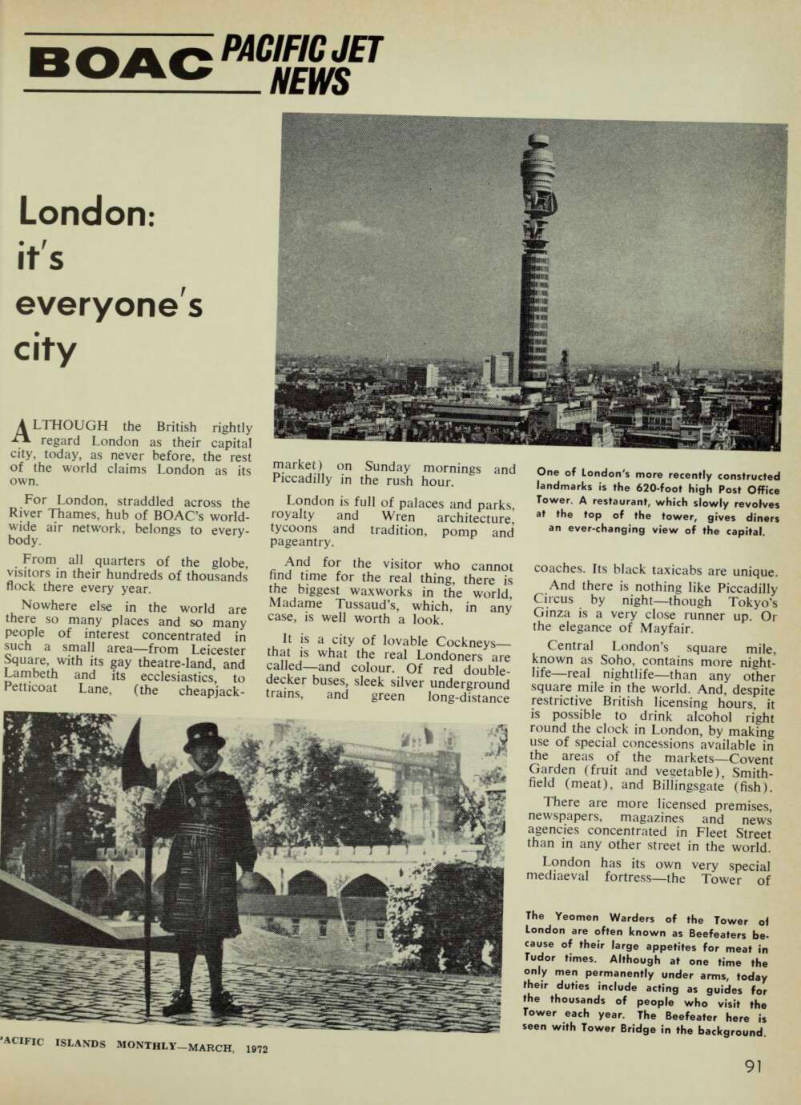
One of London's more recently constructed landmarks is the 620-foot high Post Office Tower. A restaurant, which slowly revolves at the top of the tower, gives diners an ever-changing view of the capital.
The Yeomen Warders of the Tower of London are often known as Beefeaters be cause of their large appetites for meat in Tudor times. Although at one time the only men permanently under arms, today their duties include acting as guides for the thousands of people who visit the Tower each year. The Beefeater here is seen with Tower Bridge in the background.
London—which contains the Crown Jewels guarded by uniformed men called Beefeaters. They earned their name in Tudor times.
And, at Buckingham Palace, where Queen Elizabeth lives when she is in London, as well as St. James’s Palace just around the corner, there are the colourful ceremonies of Changing of the Guard.
Some of the world’s most fashion able shops are situated in Piccadilly, Bond Street, Knightsbridge and Oxford Street.
And, for entertainment, there are cinemas, theatres and museums by the dozen —one of the biggest zoos in the world (at Regent’s Park and one of the finest gardens in the world (at Kew).
Nearly 11 million people of every race, creed and colour have been peacefully and happily absorbed by this great metropolis. Everybody loves London, but nobody really knows it all—not even the Ixmdoners themselves!
And it’s not much more than a day’s travelling time away from Fiji.
There are VC 10 services five times weekly via Honolulu, Los Angeles and New York.
And, if you want to go the other way around, you can join BOAC’s
services over Singapore or Hong Kong and through India and the Middle East, at Sydney.
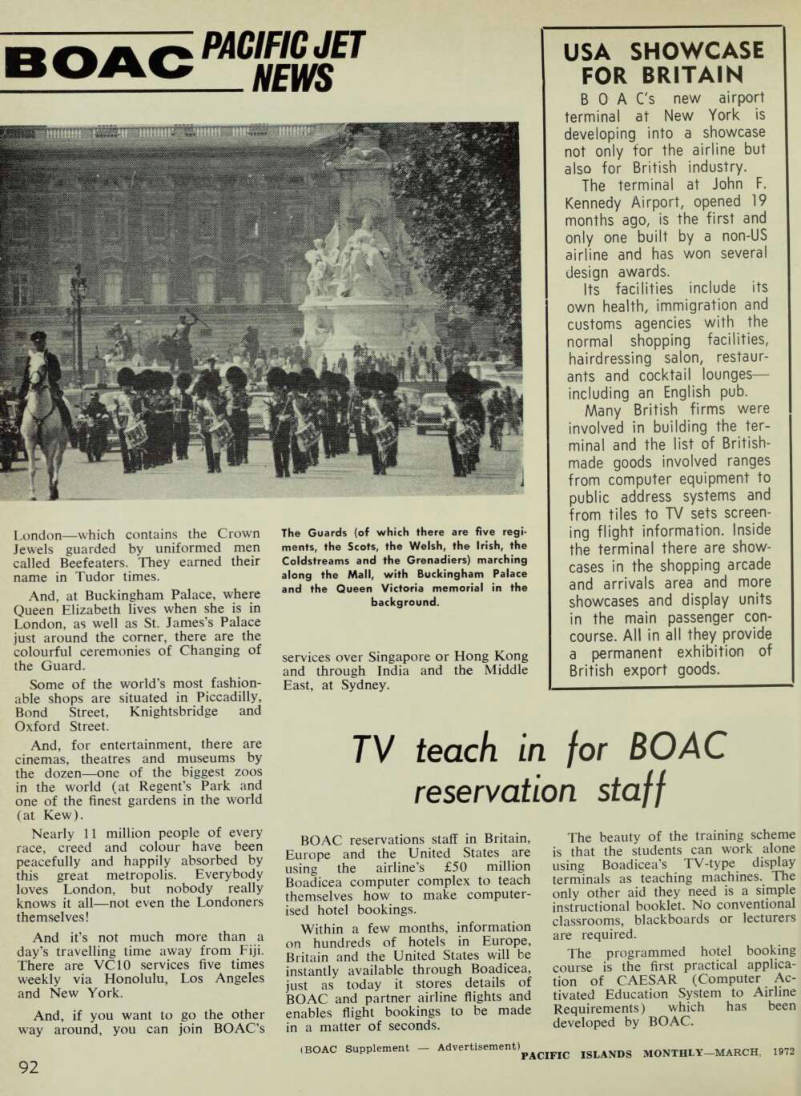
The Guards (of which there are five regi ments, the Scots, the Welsh, the Irish, the Coldstreams and the Grenadiers) marching along the Mall, with Buckingham Palace and the Queen Victoria memorial in the background.