Boac
p. 99 · Read in the full issue
Pacific Jet
News
The Vc10 Is My
Delight
By Captain NORMAN BRISTOW, Flight Train ing Manager, VC10s, BOAC.
The VClo—which BOAC operates through Fiji providing services to the USA and UK in one direction and to New Zealand and Australia in the other—is undoubtedly a pilot’s air craft.
I first flew it during its development trials. I still think, as I thought then, that it is the best aeroplane I have ever flown. It is a delight to handle.
Despite its size and the enormous power available it is extremely docile under all flight conditions.
The first impression the crew has on entering a VClO’s flight deck is that, compared to other aircraft, it is spacious, has good instrument lay out and generous window areas.
From our large, individual seats we hnd it easy to operate all the controls —m particular the much-used auto pilot and radio switches—without continually having to reach up to the roof as in some other types.
To the layman the mass of con trols and dials must seem, at first sight, too complex to understand.
They are, in fact, in carefully planned and logical sequence around the flight deck, depending on who uses them—the captain, first officer or engineer.
From the flight deck we hear the engines only as a remote hum. In tact, when we start up engines on the ground we have to rely on the starter and ignition lights to tell us that we are actually “alight”.
D T, he D pOWer of the VClO’s four Kolls-Royce Conway engines—and ne design of the cleanswept wings mables the aircraft to take off at .peeds some 20 mph slower than comparable types, and after a shorter am.
She lifts easily to 30,000 feet in eight mmutes, enabling her to stay
well within the very precise noise abatement restrictions imposed at most airports.
Despite this very high rate of climb the pressurisation system is so good that neither we nor the pas sengers ever experience any sensation m the ears.
All our flying control surfaces elevators, rudders, ailerons, flaps and air brakes—are powered and have either duplicated or even triplicated systems. We believe in belt as well as braces—and safety pins too!
As is normal in a modern aircraft the electrical systems are also dup licated or triplicated. In point of fact something like 70 separate functions would have to fail simultaneously to make the aircraft unmanoeuvrable.
When I land a VC 10 anywhere in the world it is at a speed about 20 mph less than my colleagues in other types. That is a valuable margin of advantage to me.
Some of the first crews to come to me for training on VC 10s were cautious when they heard veteran pilots eulogise its virtues. One senior pilot said to me soon after completing his training: “I took their talk with a pinch of salt at first, but this really is a wonderful aircraft”.
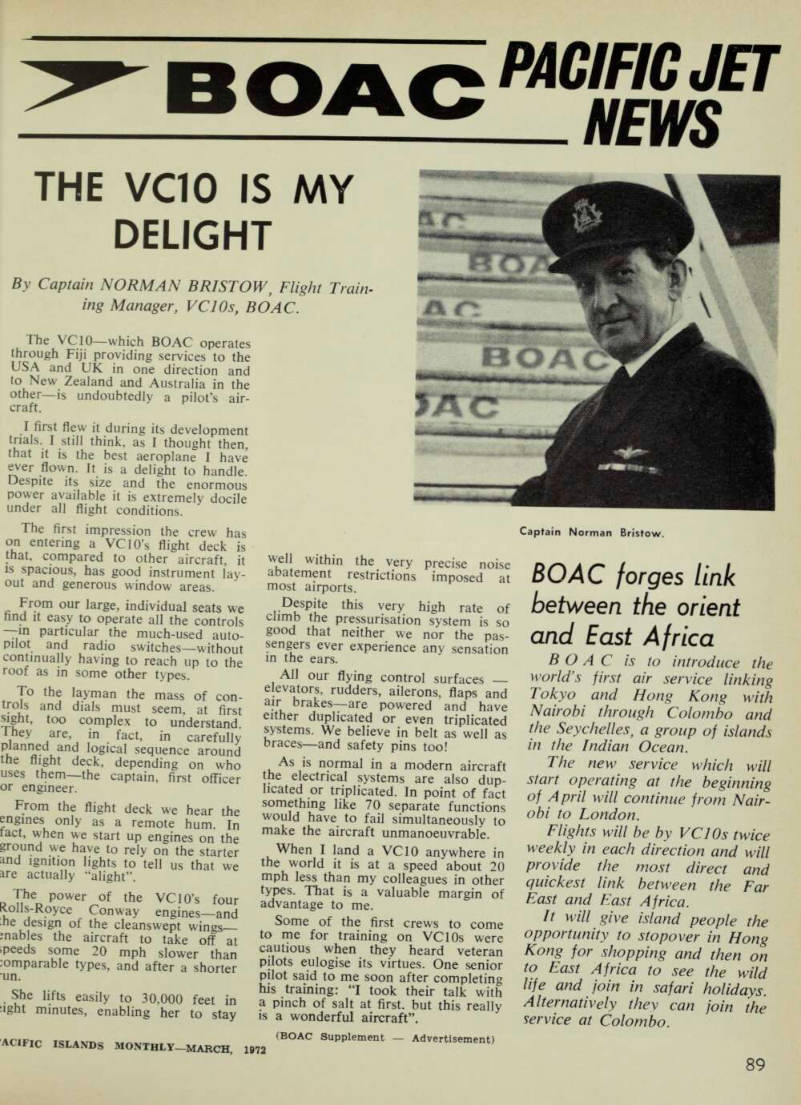
Captain Norman Bristow.