Magazine Section
pp. 77-79 · Read in the full issue
Mat making is not so much an Arts Festival chore as a Tongan way of life
Living history will be well in evidence at the South Pacific Festival of Arts to be held in Fiji from May 6 to 20. A particular case is the con tribution from Tonga of demonstrations of two traditional crafts which are still part of everyday life in the kingdom. These are the making of tapa cloth and the weaving of fine mats.
The women of Tonga are celebrated mat weavers, and among them those of the Ha’apai group and the remote northern islands of Niua Fo’ou and Niua Toputapu are acknowledged to be outstanding in their patient production of par ticularly fine mats. Sixteen of them will co-operate in making four Tongan fala (mats), each six feet by four feet, during the festival. The mats go by the traditional names of Fala Paongo, Fala Toua and Fala Fihu.
The material comes from the leaves of various species of pandanus, which are cured and woven in a number of specific patterns. The Fala Paongo is a mat normally made for people of noble rank and presented to them by their people. There is a Paongo species of pandanus, which dries out to a reddish-brown colour which characterises this mat. Fine strips of leaf are woven double thickness to make it a specially valuable possession.
The same leaf is used by the Niua Fo’ou women for weaving their speciality, the Fala Tui.
The white tofua leaf makes an effective contrast in the pattern. A much thicker mat is woven separately and attached as an underlay, resulting in a very strong and practical product.
The other two mats are made from the tofua pandanus which is white or off-white in colour. (over)
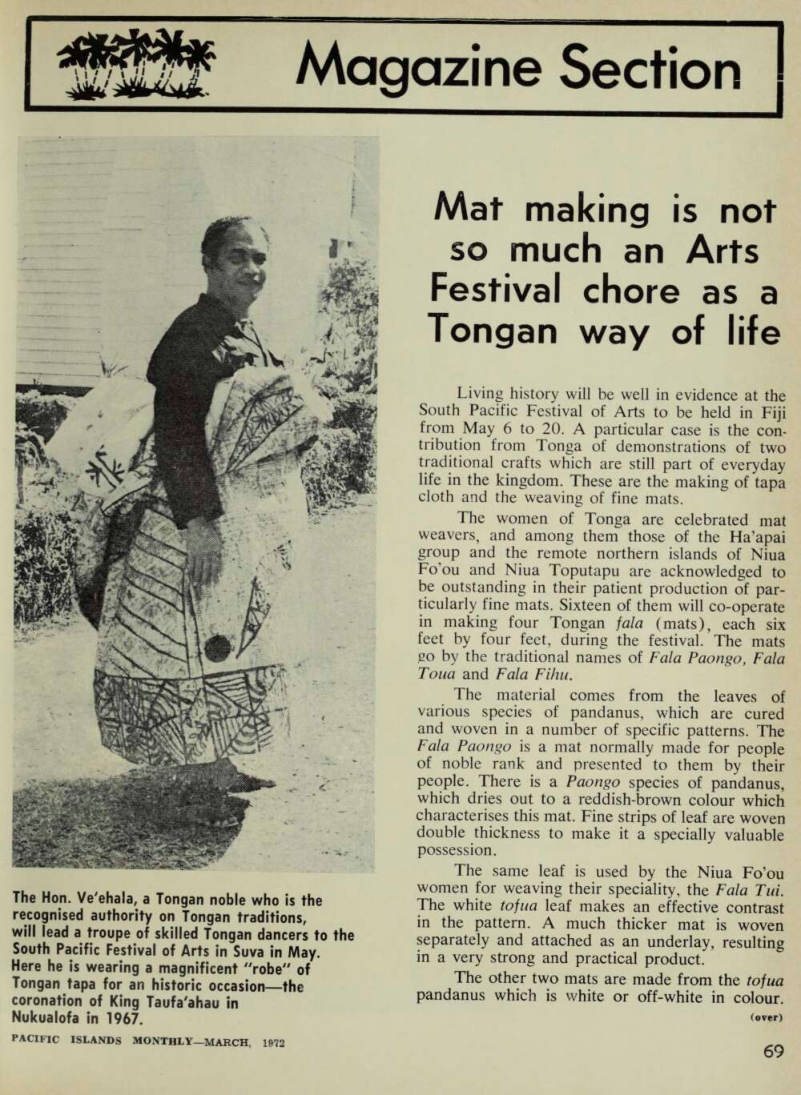
The Hon. Ve'ehala, a Tongan noble who is the recognised authority on Tongan traditions, will lead a troupe of skilled Tongan dancers to the South Pacific Festival of Arts in Suva in May.
Here he is wearing a magnificent "robe" of Tongan tapa for an historic occasion—the coronation of King Taufa'ahau in Nukualofa in 1967.
Curing makes the difference between the two mats. The Fala Fihu is very fine, soft and white, being made only from the soft inner strip of the leaf. It is either boiled or baked, then soaked in sea water, softened and bleached in the sun. Very fine strips are then cut and woven with great care.
In Tonga, where mat weaving is part of everyday life, women often gather together to make light of the routine by talking and singing while the work goes on, and to help one another with the weaving. There are always large numbers of mats pre sented on great occasions including births, weddings and funerals. Fine mats are always treasured.
Mats are used for floor covering and bedding, but there are uses which are quite peculiar to Tonga, like the wearing of the mat called ta’ovala around the waist as a sign of respect.
The background to this custom is said to be that in times long past, men returning from a long sea voyage would cut the mat sails of their canoes to cover their nakedness before appearing before their chief.
There are ta’ovala which are hundreds of years old and carefully retained by Tongan families.
Tapa cloth is likewise a Tongan speciality of great note, although, of course, it is made elsewhere. Also a communal enterprise, the finely beaten bark cloth is given in large quantities to everyone as he passes a major milestone of life, like being born, marrying or dying. Vast amounts are made for presentation
to the king, noblemen, and the church, and it is also a daily use item for beds and bedding, and makes partitions and decorations for It is worn as a costume in Tongan dancing.
Tongans make more use of the material than anyone else in the Pacific.
Tapa cloth is made from the bark Q f t h e hiapo, a kind of mulberry tree xhe trees are cultivated for cut-
ting down at an appropriate time, when they Tark l and night. The bark is stripped olt ana
the°uter layer re^ d b^k th^
s th After an overnight soaking it ? for beating 8 8 18 ieaQ y lor ° CcUUIs - It is placed on a tutua, a nar wooden surface, where it is beaten with a wooden mallet called an ike.
Separate pieces are beaten out by the women to the number required tor
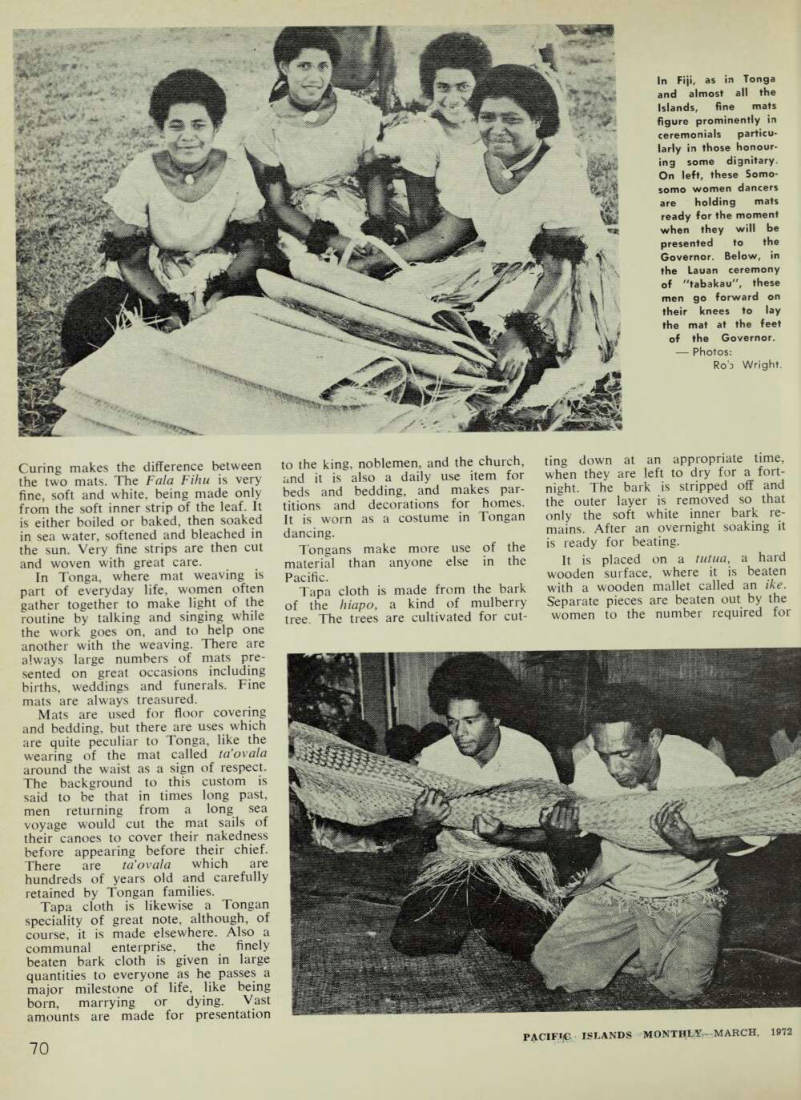
In Fiji, as in Tonga and almost all the Islands, fine mats figure prominently in ceremonials particu larly in those honour ing some dignitary.
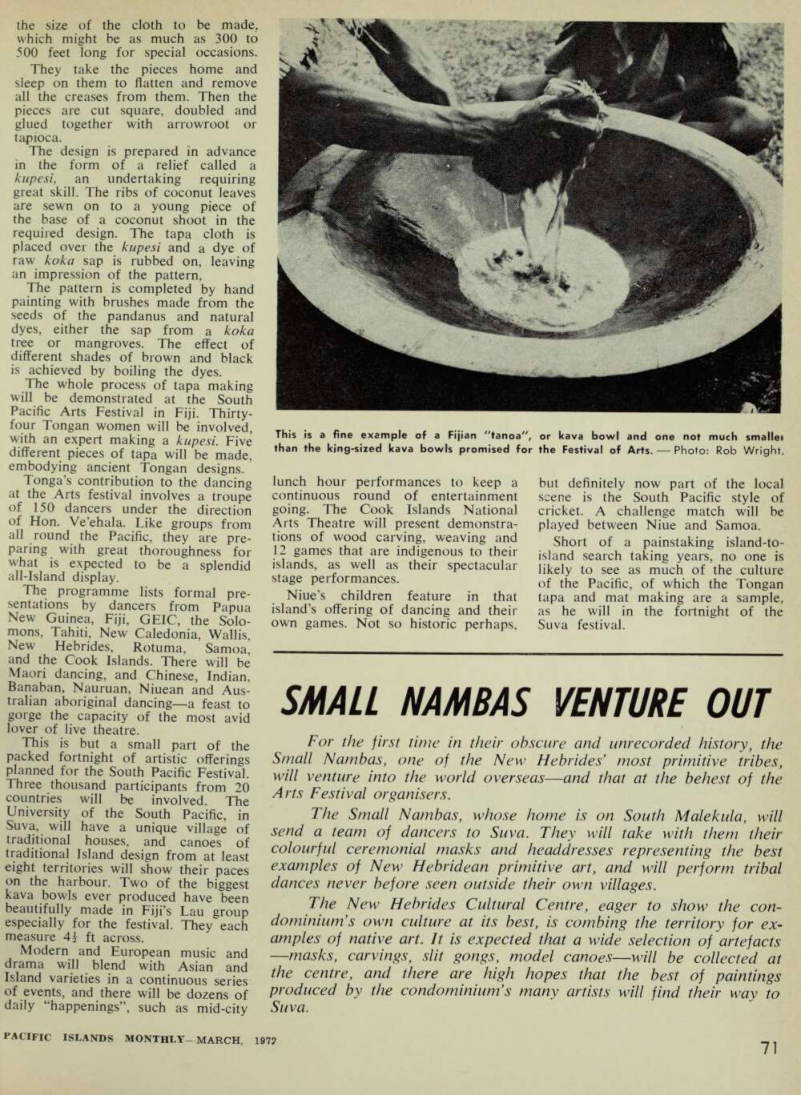
On left, these Somo somo women dancers are holding mats ready for the moment when they will be presented to the Governor. Below, in the lauan ceremony of "tabakau", these men go forward on their knees to lay the mat at the feet of the Governor.
Photos: Rob Wright.
the size of the cloth to be made, which might be as much as 300 to 500 feet long for special occasions.
They take the pieces home and sleep on them to flatten and remove all the creases from them. Then the pieces are cut square, doubled and glued together with arrowroot or tapioca.
The design is prepared in advance in the form of a relief called a kupesi, an undertaking requiring great skill. The ribs of coconut leaves are sewn on to a young piece of the base of a coconut shoot in the required design. The tapa cloth is placed over the kupesi and a dye of raw koka sap is rubbed on, leaving an impression of the pattern, The pattern is completed by hand painting with brushes made from the seeds of the pandanus and natural dyes, either the sap from a koka tree or mangroves. The effect of different shades of brown and black is achieved by boiling the dyes.
The whole process of tapa making will be demonstrated at the South Pacific Arts Festival in Fiji. Thirty four Tongan women will be involved, with an expert making a kupesi. Five different pieces of tapa will be made, embodying ancient Tongan designs.
Tonga’s contribution to the dancing at the Arts festival involves a troupe of 150 dancers under the direction of Hon. Ve’ehala. Like groups from all round the Pacific, they are pre paring with great thoroughness for what is expected to be a splendid all-island display.
The programme lists formal pre sentations by dancers from Papua New Guinea, Fiji, GEIC, the Solo mons, Tahiti, New Caledonia, Wallis, New Hebrides, Rotuma, Samoa, and the Cook Islands. There will be Maori dancing, and Chinese, Indian, Banaban, Nauruan, Niuean and Aus tralian aboriginal dancing—a feast to gorge the capacity of the most avid lover of live theatre.
This is but a small part of the packed fortnight of artistic offerings planned for the South Pacific Festival.
Three thousand participants from 20 countries will be involved. The University of the South Pacific, in Suva, will have a unique village of traditional houses, and canoes of traditional Island design from at least eight territories will show their paces on the harbour. Two of the biggest kava bowls ever produced have been beautifully made in Fiji’s Lau group especially for the festival. They each measure 4i ft across.
Modern and European music and drama will blend with Asian and Island varieties in a continuous series of events, and there will be dozens of daily “happenings”, such as mid-city
lunch hour performances to keep a continuous round of entertainment going. The Cook Islands National Arts Theatre will present demonstra tions of wood carving, weaving and 12 games that are indigenous to their islands, as well as their spectacular stage performances.
Niue’s children feature in that island’s offering of dancing and their own games. Not so historic perhaps,
but definitely now part of the local scene is the South Pacific style of cricket. A challenge match will be played between Niue and Samoa.
Short of a painstaking island-to island search taking years, no one is likely to see as much of the culture of the Pacific, of which the Tongan tapa and mat making are a sample, as he will in the fortnight of the Suva festival.
This is a fine example of a Fijian "tanoa", or kava bowl and one not much smaller than the king-sized kava bowls promised for the Festival of Arts. Photo: Rob Wright.