Sample New Guinea's Delights
pp. 61-67 · Read in the full issue

Along The Shoestring Route
By John Eccles
As soon as I announced that I was going to travel to Papua New Guinea from Australia, people warned me that it would cost me $3O a day and that I would be lucky if I spent more than half a day outside hotels that could just as easily have been built in Sydney, San Francisco or Tokyo.
Due to their own laziness, they were wrong.
Papua New Guinea has turned out, for me, to be one of those places that is expensive for some tourists, but if you are prepared to dig below the surface, spend a little time looking for cheaper hotels, walk the streets in search of a tucked-away restaurant, it will be worthwhile.
For instance, I and my wife decided to visit the territory with the specific intention of seeing the Mt. Hagen Show and climbing the highest moun tain in Australian territory, Mount Wilhelm, and we wanted to do it cheaply.
We didn’t fly from Sydney direct to Port Moresby therefore. Instead we organised a car ride for the 1,600 miles to Cairns along the Queensland coast, and then we jumped on a Burns Philo-arranged charter flight to Hagen via Daru, in Papua.
The DC3 flight was as smooth as
the sea below. Passing over the tail end of the Barrier Reef we reached the green lushness of Daru, an island port of entry off the Western District coast. Luckily, Daru was having one of the half-dozen days a year when humidity was down to 80 per cent.
Our pilot told us we had a couple of hours to sightsee.
Half of us made off for the pub.
I decided that 10 a.m. was too early for me and took a ride in an airport truck around the waterfront. Facing the sea I found one of the great characters of Dam; George Craig, crocodile hunter in the territory for 15 years, and now owner of a pros perous looking trade store which sports native artefacts and over 60 live crocs of all shapes and sizes, in the back.
George’s store is the nearest thing to a tourist attraction in Daru and he doesn’t know it. He will take visitors right round his croc farm, describe artefacts to them and yarn about life in the territory; and more often than not his visitors will depart without buying as much as a bar of chocolate.
George told me he felt it was time to call it a day in the territory. He was leaving for Cairns and takine his
crocs and artefacts with him to open a “marineland” on Green Island. He would return to Daru about three times a year to supervise his store— and that was all.
Back on the plane we were off flying first low over the ocean, then the huge entrance of the Fly River and then north over the rugged Southern Highlands to Mt. Hagen.
I had never been to the territory before and the show was an unfor gettable experience. I was told later there were 50,000 Highlanders for the festivities, as well as an estimated 10,000 tourists bent on photographing every one of them.
We paid $2.50 a night to sleep on the floor of the local school because accommodation had been booked up a year earlier, but that didn’t matter; it didn’t matter that sometimes it looked like the tourists might overrun the natives in sheer numbers; it didn’t matter that the restaurants were sell ing poor food for fantastic prices.
What mattered was that I had sud denly been plunged into the Stone Age. However cynical Territorians might get about the Hagen Show’s concessions to tourism, it must rank as one of the seven tourist wonders of the world, alongside the Trooping
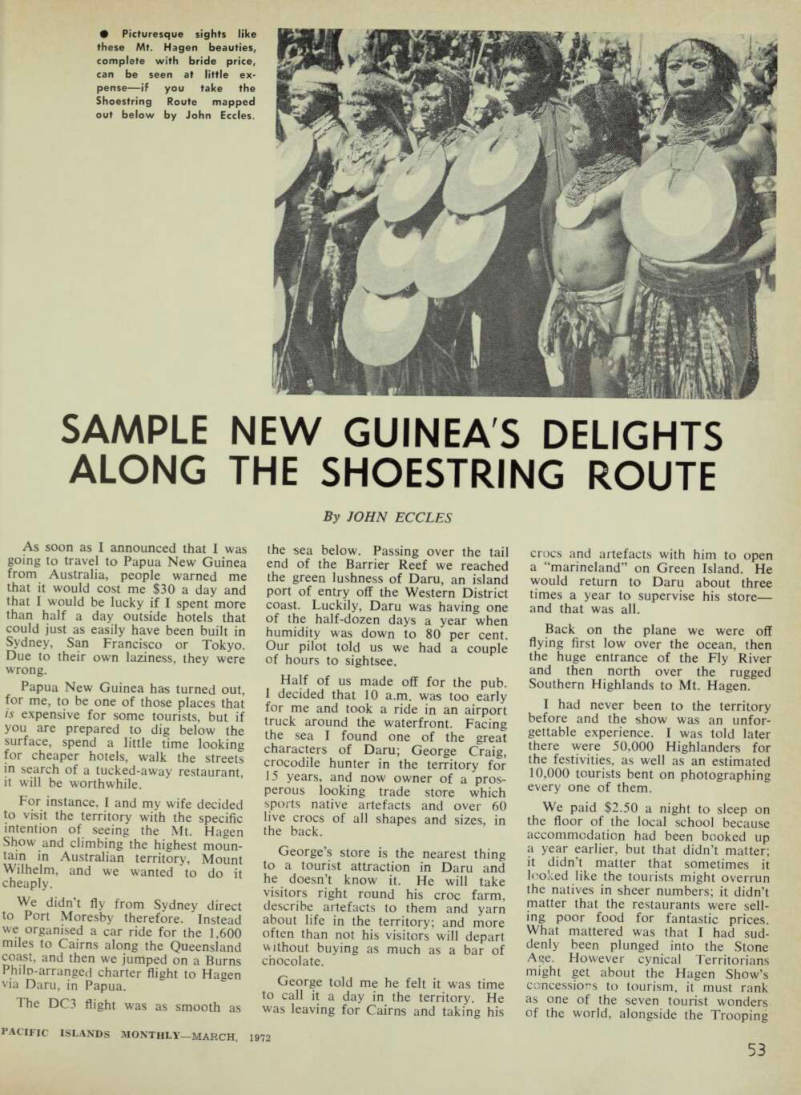
• Picturesque sights like these Mt. Hagen beauties, complete with bride price, can be seen at little ex pense—if you take the Shoestring Route mapped out below by John Eccles.
Great pressures
of the Colour, a climb up Mount Fuji, visiting Ayers Rock, gazing at the Statue of Liberty and sitting in the coolness of the Taj Mahal.
That evening, sitting over a cold “stubbie” of beer in the Country Club, I was told by one local that beneath the apparent gaiety of the show great pressures were simmering.
It was not for nothing, he told me, that lan Downs in his book The Stolen Land, had ended with warriors at the show declaring general may hem; it was not for nothing that a helicopter was kept continually circling the showground laden with tear gas; it was not for nothing that the police riot squad had put on a special performance of their handling of troublemakers in the ring on the first day of the show. He told me that whatever I did, I was not to get caught between groups of Wabags and Hagen men for they had a ven detta.
He kept that up until I failed to buy the next shout; and then he began telling another visitor that he wouldn’t leave the Highlands for any thing. Funny people.
There was no trouble of any signifi cance at the show although I was told that one man who had encouraged natives to throw spears at Europeans had been conveniently locked up in custody for the duration of the show.
Police could be seen wherever there were large concentrations of natives, but the natives themselves looked appreciative of police organisational abilities. In short, the show was a great success; and the next show is expected to be bigger and better.
The day after the show Hagen was quiet again. My wife and I decided to hitch down the Highlands Road right through the centre of New Guinea to Lae but there was very little traffic. A young man working for a mission stopped in a petrol truck and took us 20 miles along some rough but spectacular road.
Ten minutes later a New Guinean driving an Administration car picked us up and gave us a smooth ride to Kundiawa, crossroads to Mt. Wilhelm.
Many people, I know, deplore hitch hikers in the Islands. If he can t afford to take the bus and keep out of our way, they say, he shouldn’t come here in the first place. I don’t subscribe to this. I think if a young couple are decently presentable, are prepaied to carry on a reasonable conversation with a driver and are
prepared to pay their own way, then there is nothing more sensible than a driver providing a seat in his car.
But we were now in Kundiawa, with no significant chance of hitching a further ride on what Keith Willey in his book New Guinea calls “what must be the most hazardous road in New Guinea”, the road to Kegsugl.
We therefore talked three other like minded people into hiring a TAL push-pull aeroplane for a hair-raising 10 minute flight to the Kegsugl air strip. At $6 a head it was a bargain.
Not only did we catch a glimpse of Wilhelm, but landed on the highest airstrip in the territory (8,250 ft) and the second highest for light aircraft in the Southern Hemisphere.
We had made one mistake. As it was then evening we could not start climbing the mountain immediately.
Instead we made our way down to the Catholic Mission, 900 ft below the airstrip, and were given per mission to sleep in one of the native huts. If the mission should erect a guesthouse, it could make a fortune.
For the past few months it has been deluged by increasing numbers of tourists wanting accommodation. I understand that cheap accommodation is to be built at the airstrip in the near future, but for the time being,
if tourists go to stay at the mission let them at least, as we did, pay a contribution to mission funds.
There is a strong alpine feeling about the mission and indeed many of the occupants are German. They were wonderfully hospitable people.
We hired Chimbu porters at $1 a day and began climbing the 14,793 ft mountain. We first tramped past the airstrip, then up a river bed, and then there was the hard bit—l,ooo ft of sheer rain forest, which we negoti ated with sweat running down our faces and mud and vines impeding our feet.
Such people as patrol officers, of course, take this sort of thing in their stride, but I was a journalist with a paunch and my wife was no athlete.
But no excuses; we made the top of the mountain (but not at that stage the peak) and then hiked the rela tively easy distance to a glacier lake, one of two, at the foot of the main peak. We were then at 11,900 ft and had the choice of sleeping on the bare boards of a local council “A”-frame shed for $2 a night, or sleeping in the comfort of a native bush hut with a fire to warm our toes. We chose the bush hut because it was free; but we were disturbed by a
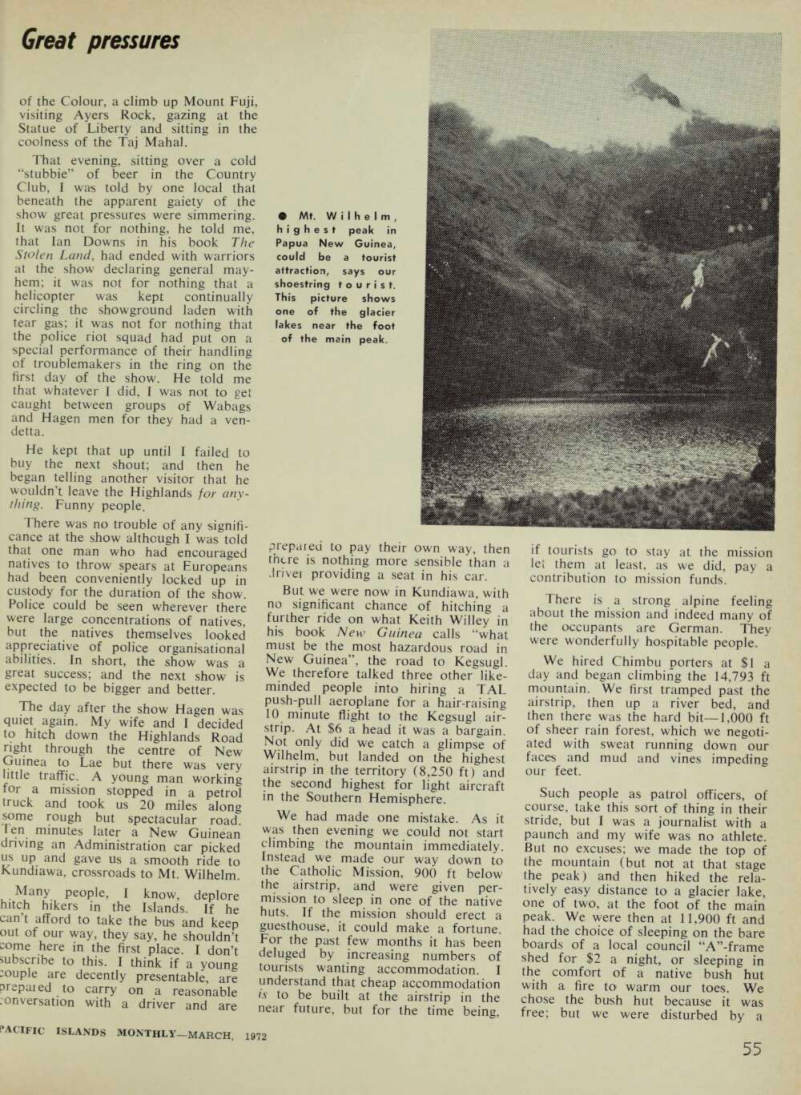
• Mt. Wilhelm, highest peak in Papua New Guinea, could be a tourist attraction, says our
shoestring tourist.
This picture shows one of the glacier lakes near the foot of the main peak.
Altitude exhaustion
local native who had been ordered by the powers-that-be (whoever they were) to cut down all bush huts in an effort to make tourists stay in the empty “A” shed. Where the native carriers would then have stayed I don’t know, but for our two nights there they slept with us for warmth.
Next morning before light we were off (without my wife) to climb the remaining 3,00 J rarified feet to the summit. We climbed sheer for 1,000 feet and I learnt it was here that many people drop out through altitude exhaustion, as they take the climb too fast. I took it very slowly.
We passed the shattered remains of an American bomber that had crashed on the mountain during the war.
Below we could see the two lakes cut by some huge glacier, it’s believed about 10,000 years ago.
Climbing along the ridge I was told by my more experienced companions to keep walking and never to sit down, because at this altitude I might not be able to get up again. All the while the views were magnificent. I could quite clearly see the Ramu River in the distance and beyond that, New Guinea’s northern coast.
Soon, however, cloud began to close in and the last 1,000 ft were climbed in such darkness that I couldn’t take photographs. It didn’t matter, as I didn’t reach the summit.
After climbing and groaning for three hours I had finally neared the rocky outcrop which I believed to be the top. But no-one had told me you had to be a rock climber to handle the last six feet, in which you must edge your way round a corner with a 1,000 ft drop immediately below. I had to sit and watch my companions sign my name for me, because I wasn’t going to jump into space to sign my name in a rotten book. I learnt later that if my guide had been a little brighter he could have led me round the back of the rock, where there was a fairly simple way of reaching the top. My companions planted a stick announcing a new summit height at the top (we had been asked to carry it up) and then we headed down again.
With the significant increase in tourists to tackle the mountain, local kiaps are talking in terms of building proper cooking and sleeping facilities at the lakes, accommodation at the airstrip and improving the path to the top.
What with Wilhelm’s natural
Continued on p. 59
scenery and its abounding wild life— giant rats, wild dogs, black birds and honey eaters —I don’t see how it can stop being a major tourist attraction for long.
Back down the mountain we were invited by the local kiap to drive with him and the local Lutheran missionary to Kundiawa some 37 miles away.
And what a ride. Although we had flown it in 10 minutes it takes the best part of 3i hours to drive the distance. I have never been on a more beautiful road—or a more dan gerous one. The sides of the moun tains up to the road are cultivated with coffee by the local Chimbus.
The angle gets as steep as 70 degrees but such is over-population in the Chimbu that the locals have to hang on the sides of the mountain to grow their crops.
Back in Kundiawa we were only too pleased to get going again. It has what can only be called a bad atmosphere. It’s a boom town—but the boom has done nothing to bring smiles to the faces of the local popu lation.
It was getting dark in Kundiawa when we stopped a native “taxi truck” and offered him a dollar each for the trip to Goroka. We climbed in the back and spent the next four haurs looking into a sheet of black rain and wondering when the pro verbial night hijackers were going to
jump aboard and kidnap the truck on the Daulo Pass. We had heard bad reports about hijacking of merchan dise in these parts and to make matters worse I realised after a while that we were driving without lights —to fool any ambush, I presume.
We did arrive in Goroka, how ever, and made for the local council hostel, a worthy place of refuge that offers a clean bed and a hearty break fast for the cheap price, by territory standards, of 53.75 a night. Because it was so reasonably priced it was virtually packed with everybody.
It hurts to leave such a gem of a hotel but we were back on the road again the next day, and after a long wait by the side of it, we received a lift from a coffee grower to the delightful town of Kainantu. The coffee grower was as pessimistic about the future of the territory as most of the Highland Australians I had met. But like most Australians I met m the territory he talked of the country in a love-hate fashion I
found fascinating,
H e could talk of “the blacks” and “us” in a way that would make Vorster beam with pride, but the next moment spoke of New Guinea and its people with a sensitivity that the English, with all their colonial pre tentions, have perhaps never achieved, and I’m English. It strikes me that the Australian in New Guinea, for all
his rough ways, is a good deal closer to the indigenous people than he realises; and because he is close to them he is rough in talking about tnem.
From Kainantu we hopped aboard a truck heading for the new township of Yonki, 20 miles away. You won’t find it on the map because it hardly exists yet. Morobe Constructions are in the process of building a temporary township there for workers on the Ramu River hydro-electric scheme.
The first part of the scheme calls for a temporary township, the second for a dam and the third for a permanent home for workers at the dam, of 120 homes. When the dam is completed all the surrounding area will be flooded, but the scheme will provide electricity as far away as Madang and Hagen.
We stayed a welcome night at the temporary camp and were treated to a hearty meal. The next day we con tinued on our way on the truck.
Over the Kassam Pass and down to the flat plains surrounding Lae, and finally to Lae itself. We had come a road distance of 350 miles from Hagen and here it was as hot as Hagen was cool. What a magnificent road, and what a magnificent ex perience.
We had come from Sydney right through New Guinea for less than some people would pay for a week at a 'Honolulu hotel.