Letters
pp. 127-133 · Read in the full issue
Art forms of the Solomons
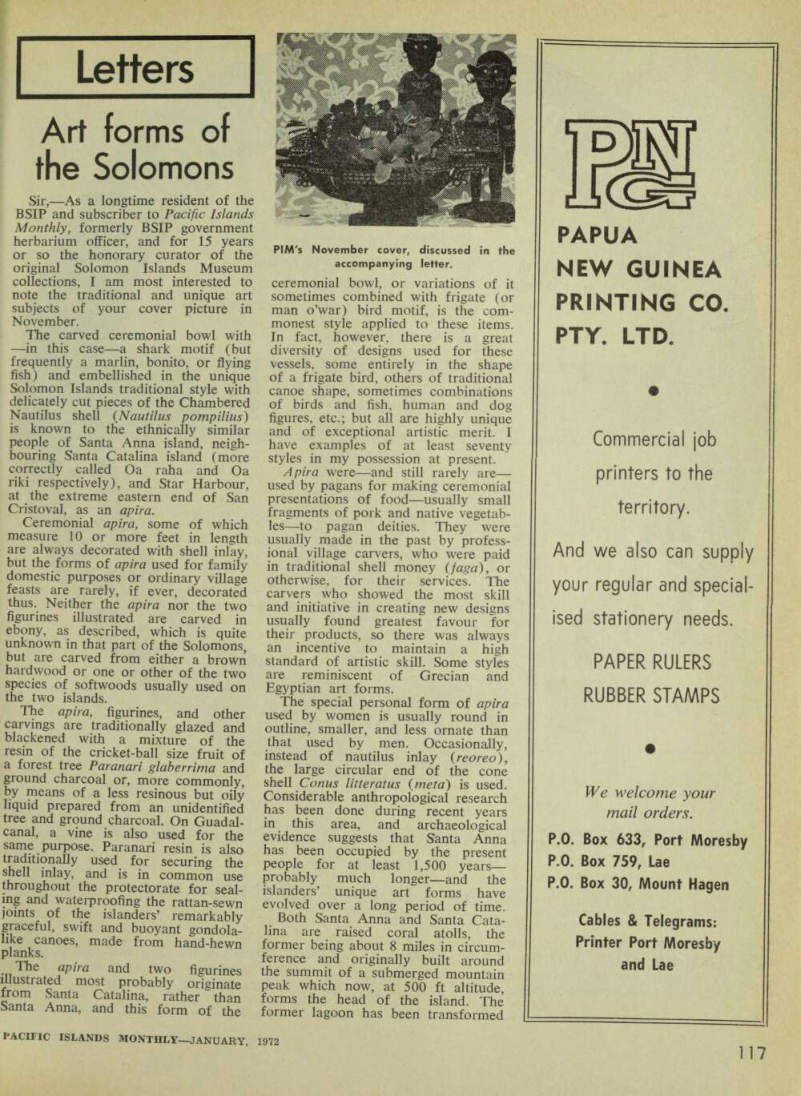
Sir, —As a longtime resident of the BSIP and subscriber to Pacific Islands Monthly, formerly BSIP government herbarium officer, and for 15 years or so the honorary curator of the original Solomon Islands Museum collections, I am most interested to note the traditional and unique art subjects of your cover picture in November.
The carved ceremonial bowl with —in this case—a shark motif (but frequently a marlin, bonito, or flying fish) and embellished in the unique Solomon Islands traditional style with delicately cut pieces of the Chambered Nautilus shell ( Nautilus pompilius) is known to the ethnically similar people of Santa Anna island, neigh bouring Santa Catalina island (more correctly called Oa raha and Oa riki respectively), and Star Harbour, at the extreme eastern end of San Cristoval, as an apira.
Ceremonial apira, some of which measure 10 or more feet in length are always decorated with shell inlay, but the forms of apira used for family domestic purposes or ordinary village feasts are rarely, if ever, decorated thus. Neither the apira nor the two figurines illustrated are carved in ebony, as described, which is quite unknown in that part of the Solomons, but are carved from either a brown hardwood or one or other of the two species of softwoods usually used on the two islands.
The apira, figurines, and other carvings are traditionally glazed and blackened with a mixture of the resin of the cricket-ball size fruit of a forest tree Paranari glaberrima and ground charcoal or, more commonly, by means of a less resinous but oily liquid prepared from an unidentified tree and ground charcoal. On Guadal canal, a vine is also used for the same purpose. Paranari resin is also traditionally used for securing the shell inlay, and is in common use throughout the protectorate for seal ing and waterproofing the rattan-sewn joints of the islanders’ remarkably graceful, swift and buoyant gondola like canoes, made from hand-hewn planks.
The apira and two figurines illustrated most probably originate from Santa Catalina, rather than Santa Anna, and this form of the
ceremonial bowl, or variations of it sometimes combined with frigate (or man o’war) bird motif, is the com monest style applied to these items.
In fact, however, there is a great diversity of designs used for these vessels, some entirely in the shape of a frigate bird, others of traditional canoe shape, sometimes combinations of birds and fish, human and dog figures, etc.; but all are highly unique and of exceptional artistic merit. I have examples of at least seventy styles in my possession at present.
Apira were—and still rarely are— used by pagans for making ceremonial presentations of food—usually small fragments of pork and native vegetab les—to pagan deities. They were usually made in the past by profess ional village carvers, who were paid in traditional shell money ( faga ), or otherwise, for their services. The carvers who showed the most skill and initiative in creating new designs usually found greatest favour for their products, so there was always an incentive to maintain a high standard of artistic skill. Some styles are reminiscent of Grecian and Egyptian art forms.
The special personal form of apira used by women is usually round in outline, smaller, and less ornate than that used by men. Occasionally, instead of nautilus inlay ( reoreo ), the large circular end of the cone shell Conus litteratus (meta ) is used.
Considerable anthropological research has been done during recent years in this area, and archaeological evidence suggests that Santa Anna has been occupied by the present people for at least 1,500 years— probably much longer—and the islanders’ unique art forms have evolved over a long period of time.
Both Santa Anna and Santa Cata lina are raised coral atolls, the former being about 8 miles in circum ference and originally built around the summit of a submerged mountain peak which now, at 500 ft altitude, forms the head of the island. The former lagoon has been transformed
PIM's November cover, discussed in the accompanying letter.
into two picturesque lakes, widely separated—Wairafa, which is almost a mile diameter and 100 ft deep, and Waipiapia, merely a few feet deep and surrounded by a narrow belt of swamp and moss forest, of particular botanical interest, which is bedecked with a considerable number of orchid species. Santa Catalina, less than half the area of Santa Anna, has no surface water, and drinking water is obtained from several wells.
Apart from a small area of fertile volcanic soil at 400-500 ft altitude on Santa Anna, the soils of both islands are poor and impoverished as a result of intensive gardening by large communities over a long period, and the present 1,100 or more islanders —who are apparently of mixed Melanesian and Polynesian ancestry (the latter being particularly obvious on Santa Catalina where many of the people are tall, fair skinned and blond-haired) and are a very hospitable, dignified, clean living and intelligent community— are unable to produce sufficient copra from which to obtain a reason able monetary income, so necessary for the payment of taxes, school fees and passages, etc. for their children receiving secondary education in distant places, apart from the few civilised luxuries they enjoy.
Many have migrated to other parts of the protectorate as government and private employees, and, as such, have reached high positions of trust and responsibility. An outstanding example is Mr. Silas Sitai, MBE, a Santa Anna man, who is chairman of the BSIP Governing Council and Honiara Town Magistrate.
Until a year or two ago, traditional wood-carving on the two islands and in the Star Harbour was a dying art, retained by only a few of the older men, particularly on Santa Catalina island. I know of only one wood carver in Star Harbour at present.
The fact that it was carried on until recent years was mainly due to the encouragement given by the late Mrs.
Augusta Kafagamurironga Kuper, locally and affectionately known as Kanana (Mother), descendant of the former paramount chief on Santa Anna, who died about two years ago.
She was the widow of German national, Mr. Henry Kuper, and both she and her husband were always highly respected by the communities of both islands, and Star Harbour.
As a result of more recent interest shown by small yacht visitors from overseas, occasional visiting BSIP residents, and particularly my own personal efforts to encourage a strong revival of these unique art forms by my offer to find local and overseas outlets for all fine quality items
traditionally handcrafted, it has been most gratifying, during the recent three months that I have lived with my Santa Anna friends as a member of the community, to see the manner in which many younger men on both islands are commencing to follow, with pride, the artistic skills of their elders and ancestors, while seeking— on my advice—to maintain, and even improve on, their high standards.
I have managed to sell a limited number of the apira and other traditional carvings to art con noisseurs and appreciative visitors passing through Honiara, but I am jarnestly endeavouring to establish m overseas interest and demand for hese original works of art on behalf md at the request of these fine slanders, so they may have a firm md continued income from their werseas sales and an incentive for hem to retain their precious skills. therefore write this letter—and I pologise for its prolixity—in the lope that you will kindly give it space a your columns and that some of our more discerning readers may e sufficiently interested to contact ie in relation to this art which, at ne present time, is only sparsely re resented overseas almost solely in mseums.
.O. Box 376, Foniara, BSIP.
G. F. C. Dennis.
Niue Fights Back
Sir,—Why is it that whenever the ibject of aid to the Pacific Islands raised, Niue is always quoted as ceiving more than its fair share, nd why is it also that whenever tie Niue is mentioned, the aid is in inably referred to as a “handout”— aplymg I suppose that we grovel at e feet of a rich uncle, grabbing in ir grubby little hands any juicy tie tit-bits which he may care to ipart and appropriately showing our atitude by much bowing and fore ck tugging! (PIM, Nov., p. 32, lotmg a NZ Foreign Affairs officer)!
Niue has often been referred to as e Cinderella of the South Pacific; e butt of some rather unkind jokes!
Jt throughout this ribbing we have eferred to remain silent, for the nple reason that we have far better ings to do than involve ourselves petty parochial bitching. We’re agmatists ... we leave the talking others. Verbal diarrhoea is not e of our failings.
If that “respected citizen of Suva” s any doubts as to the wisdom of r tnbal wisemen to spend $1 mil n, let me assure him that the money not being dissipated on worthless ejects such as building a new air
port, up-grading roads, electric power reticulation, land development, and other such mundane matters. No sir!
We prefer to spend it on extremely profitable undertakings such as developing a new variety of water proof spinach for skin-divers, staging a lavish musical production by the Niue Youth Orchestra accompanied by Roy Rogers on “Trigger”, etc.
It’s as well, I think, to recall the words of the late Senator Robert Kennedy when he said: Some men see things as they are and say why . . I dream of things that never were and say why not!
Hima Douglas.
Wellington, NZ.
Jimmy Stephens
Sir, —My friends Charlene and her husband Jacques Gourghechon, just having left for France, I would like to reply to Mr. W. G.
Chester’s letter (PIM, Nov., p. 28).
As he is in doubt about whether Charlene has a good understanding of the people of the Pacific, I can inform him that Charlene spent several years around these islands.
Two were spent in the New Hebrides, where she did not “study” natives in Santo or Vila towns, but lived for months amongst them in the bush, and so learned probably more about them than Mr. Chester’s letter suggests.
The strange part of it all is that when she first came to the Hebrides she defended Jimmy Stephens.
What positive results has Jimmy produced?
Roads, hospitals, schools are all provided by the Administration and missions; the numerous co-ops are thriving, all native-owned and making profits.
Mr. Chester talks about a cruising store ship and says that this service had been worked out through Jimmy Stephens’ efforts. Well, this is big news, as about a dozen of these ships are running around here, some native owned, and even two 400 tonners are providing the native co-ops with the goods, even delivering ice-cream to the faraway Torres Islands.
I don’t know Mr. Chester or the organisation he claims he belongs to, but I have been here for 17 years, and happen to know Jimmy Stephens very well, and I would advise Mr.
Chester to come here and have a closer look. He may change his mind, like Charlene did.
Just in case Mr. Chester thinks the wrong thing about me writing this letter, I do not own one square foot of land and I have a New Hebridean wife.
E. W. Lamberty.
Santo, New Hebrides.