Tropicalities
pp. 107-109 · Read in the full issue
The politics of culture
There is much interest locally in what appears to be the New Hebrides’ first political party, which as PIM indicated in December has mutated rapidly out of the New Hebrides Culture Association.
That association’s journal, New Hebridean Viewpoints, appeared for the first time in August, and the New Hebridean National Party published its manifesto and constitution in the second issue of Viewpoints.
The manifesto is brief and to the point: “To promote, to preserve, to revive and encourage New Hebridean culture. To seek the advancement of New Hebrideans socially, educat ionally, economically and politically in relation with New Hebridean cul ture and Western civilisation.”
However, primary unwritten aim of the party, says its president Mr.
Aiden Garae, is to replace the Na- Griamel movement as leader organisa tion for New Hebrideans.
“Na-Griamel is anti-government and non-productive,” says Mr. Garae.
“What we want is to advise and try to guide the government.”
The National Party’s immediate target is Na-Griamel leader Jimmy (President Moses) Stephens, whose semi-religious hold over his followers seems to be the only thing holding together a now shaky and disap pointed organisation. Several feelers have been put out by National Party leaders but as yet Mr. Stephens has given no indication of his intentions.
If he accepts the invitation to join forces it will mean to some extent the eclipse of his star. On the other hand it will give to Na-Griamel fol lowers the intellectual leadership they have so far lacked. (It is worth ad ding that it would also give the National Party an “instant member ship” of several thousand).
Aiden Garae is a shy man, soft spoken and almost retiring, but he has a first-class brain and—more rare the ability to apply it to achieve ms ends. He is also far from being the only bright young man involved, and the eight officers and other lead ing figures in the party constitute a useful assembly of brainpower.
At present the National Party is centred on Santo, the second town ship of the New Hebrides, but if it is to achieve national importance it will have to diversify and, preferably, obtain its committee members from different parts of the group. As in so many parts of the Pacific there is a considerable tendency to identify, if no longer with a village, then with an island, and “Man Tanna” is not yet content to be led by “Man Santo”.
That the political pace on the other side has not slowed, is assured by a statement in the October issue of the New Hebrides’ other new journal, Nakamel, that a second political party, the Union of New Hebridean Peoples (Union des populations Neo- Hebridaises) will be publishing its manifesto shortly.
In at least one aspect it will be more enlightened than the opposition —it assures a welcome to all races and nationalities whereas only New Hebrideans can be full members of the National Party. The statement promises that the Union party’s objectives will be social, economic and political but, if Nakamel is any thing to go by, political objectives are likely to take second place to a fairly narrow set of economic aims.
The crunch for both parties comes in the shape of the 1914 Protocol which still, with minor amendments, shapes the constitution of the con dominium. Unless there are some radical changes made shortly in the Protocol, politics will lack a forum.
An advisory council, which is the form the New Hebrides legislature takes, is hardly the vehicle for active politics.
Ice-cooled king
breaks protocol
Four thousand pounds of ice helped cool King Taufa’ahau of Tonga dur ing. the University of the South Pacific’s first graduation ceremony on December 3—but 2,000 guests felt the heat in what must have been one of the most unusual graduation halls ever.
The ceremony, which tried to be stiffly formal but somehow slipped in to South Pacific-style informality, took place in the masi and palm leaf
• Continued on p. 98.
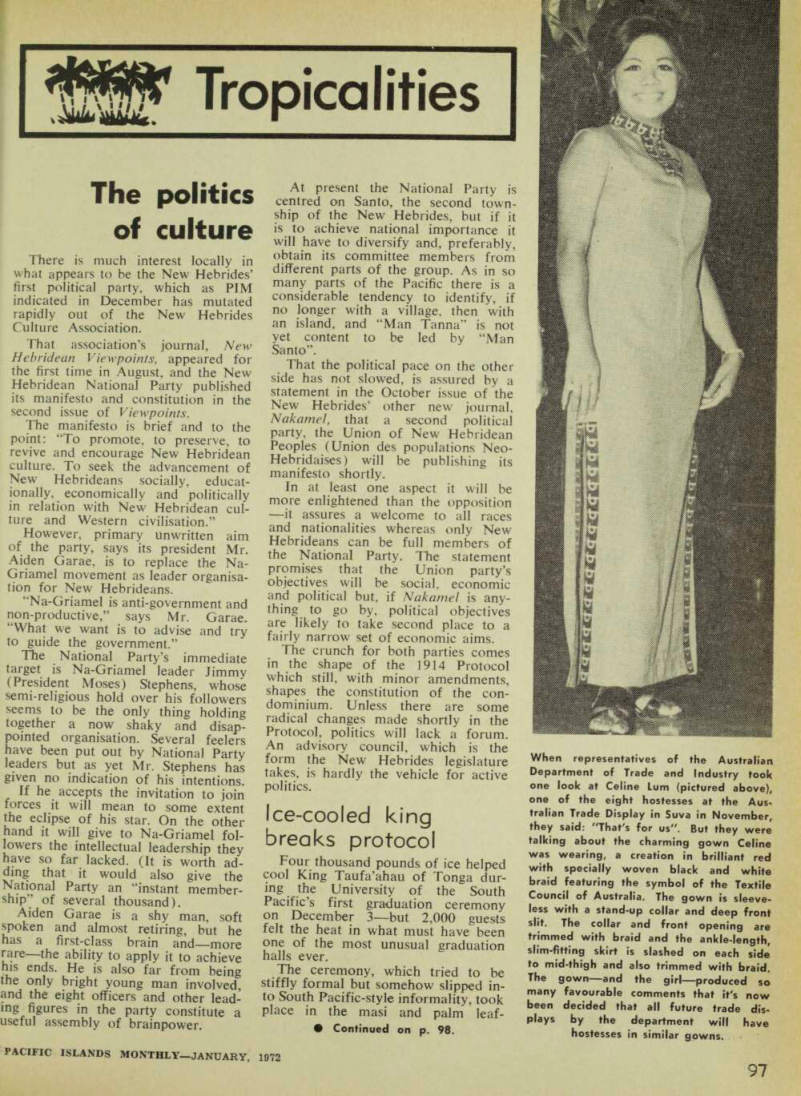
When representatives of the Australian Department of Trade and Industry took one look at Celine Lum (pictured above), one of the eight hostesses at the Aus tralian Trade Display in Suva in November, they said: "That's for us". But they were talking about the charming gown Celine was wearing, a creation in brilliant red with specially woven black and white braid featuring the symbol of the Textile Council of Australia. The gown is sleeve less with a stand-up collar and deep front slit. The collar and front opening are trimmed with braid and the ankle-length, slim-fitting skirt is slashed on each side to mid-thigh and also trimmed with braid.
The gown—and the girl—produced so many favourable comments that it's now been decided that all future trade dis plays by the department will have hostesses in similar gowns.
decorated Laucala Bay hangar, a great bam of a place which once housed Sunderland flying boats of the RNZAF.
The ice. brought from a local butcher who reported that the order had cleaned him out, was used in an air-cooling system which lowered the temperature for VIPs on the dais.
It was the King’s first visit to the university, of which he is chan cellor—and for the 43 graduates and for university officials it was the first tangible milestone in the USP’s progress.
Unexpectedly, the King rose to ad dress the gathering, stood throughout his 20-minute speech and then for another 20 minutes, shaking hands with the graduates and presenting their diplomas and certificates.
The Fiji Times interpreted the King’s action as “having broken protocol, because it is not the normal thing for a King to deliver an address standing up”.
The university started in 1968 with 54 foundation students. During 1971, 630 were doing full-time stud ies and by 1974, the figure is expected to reach 1,000. About 20 per cent, of the student population comes from outside Fiji.
Fiji lawyers object
to Australian as CJ.
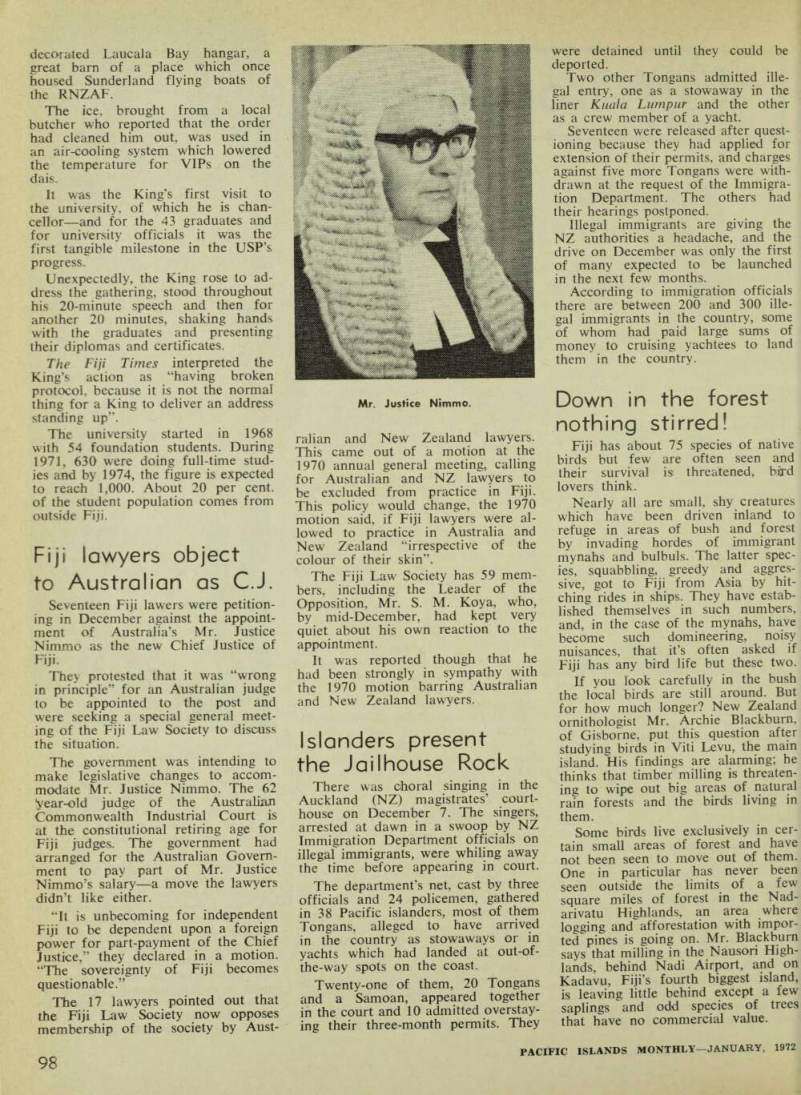
Seventeen Fiji lawers were petition ing in December against the appoint ment of Australia’s Mr. Justice Nimmo as the new Chief Justice of Fiji.
They protested that it was “wrong in principle” for an Australian judge to be appointed to the post and were seeking a special general meet ing of the Fiji Law Society to discuss the situation.
The government was intending to make legislative changes to accom modate Mr. Justice Nimmo. The 62 •year-old judge of the Australian Commonwealth Industrial Court is at the constitutional retiring age for Fiji judges. The government had arranged for the Australian Govern ment to pay part of Mr. Justice Nimmo’s salary—a move the lawyers didn’t like either.
"It is unbecoming for independent Fiji to be dependent upon a foreign power for part-payment of the Chief Justice,” they declared in a motion.
“The sovereignty of Fiji becomes
questionable.”
The 17 lawyers pointed out that the Fiji Law Society now opposes membership of the society by Aust-
ralian and New Zealand lawyers.
This came out of a motion at the 1970 annual general meeting, calling for Australian and NZ lawyers to be excluded from practice in Fiji.
This policy would change, the 1970 motion said, if Fiji lawyers were al lowed to practice in Australia and New Zealand “irrespective of the colour of their skin”.
The Fiji Law Society has 59 mem bers, including the Leader of the Opposition, Mr. S. M. Koya, who, by mid-December, had kept very quiet about his own reaction to the appointment.
It was reported though that he had been strongly in sympathy with the 1970 motion barring Australian and New Zealand lawyers.
Islanders present
the Jailhouse Rock
There was choral singing in the Auckland (NZ) magistrates’ court house on December 7. The singers, arrested at dawn in a swoop by NZ Immigration Department officials on illegal immigrants, were whiling away the time before appearing in court.
The department’s net, cast by three officials and 24 policemen, gathered in 38 Pacific islanders, most of them Tongans, alleged to have arrived in the country as stowaways or in yachts which had landed at out-of the-way spots on the coast.
Twenty-one of them, 20 Tongans and a Samoan, appeared together in the court and 10 admitted overstay ing their three-month permits. They
were detained until they could be deported.
Two other Tongans admitted ille gal entry, one as a stowaway in the liner Kuala Lumpur and the other as a crew member of a yacht.
Seventeen were released after quest ioning because they had applied for extension of their permits, and charges against five more Tongans were with drawn at the request of the Immigra tion Department. The others had their hearings postponed.
Illegal immigrants are giving the NZ authorities a headache, and the drive on December was only the first of many expected to be launched in the next few months.
According to immigration officials there are between 200 and 300 ille gal immigrants in the country, some of whom had paid large sums of money to cruising yachtees to land them in the country.
Down in the forest
nothing stirred!
Fiji has about 75 species of native birds but few are often seen and their survival is. threatened, bird lovers think.
Nearly all are small, shy creatures which have been driven inland to refuge in areas of bush and forest by invading hordes of immigrant mynahs and bulbuls. The latter spec ies, squabbling, greedy and aggres sive, got to Fiji from Asia by hit ching rides in ships. They have estab lished themselves in such numbers, and, in the case of the mynahs, have become such domineering, noisy nuisances, that it’s often asked if Fiji has any bird life but these two.
If you look carefully in the bush the local birds are still around. But for how much longer? New Zealand ornithologist Mr. Archie Blackburn, of Gisborne, put this question after studying birds in Viti Levu, the main island. His findings are alarming; he thinks that timber milling is threaten ing to wipe out big areas of natural rain forests and the birds living in them.
Some birds live exclusively in cer tain small areas of forest and have not been seen to move out of them.
One in particular has never been seen outside the limits of a few square miles of forest in the Nad arivatu Highlands, an area where logging and afforestation with impor ted pines is going on. Mr. Blackburn says that milling in the Nausori High lands, behind Nadi Airport, and on Kadavu, Fiji’s fourth biggest island, is leaving little behind except a few saplings and odd species of trees that have no commercial value.
Mr. Justice Nimmo.
According to him the rate at which rain forests are being slashed down could have dire consequences, not only on native flora and fauna, but even on the climate of major forest areas. There was no policy which would ensure the replanting of log ged areas and it seemed unlikely that the forest would regenerate naturally, he said.
Acting Conservator of Forests Mr.
A. N. Loweth isn’t worried. He doesn’t think they would mill for ests beyond recovery and regenera tion, and so far 9,000 acres of natural forest have been preserved as nature reserves.
But that doesn’t relieve the gloom oyer the Fiji Museum whose assistant director, Mr. Fergus Clunie, is afraid that “large-scale timber felling must be regarded as constituting a very probable threat to the survival of many forest-dwelling birds”.
Sex films, long hair
upsetting Samoa MPs
Sex films, long hair, beards and mini-skirts are upsetting Western Samoa’s MPs, who called for more censorship for films and new laws banning long hair, beards and short skirts when parliament met in Decem ber.
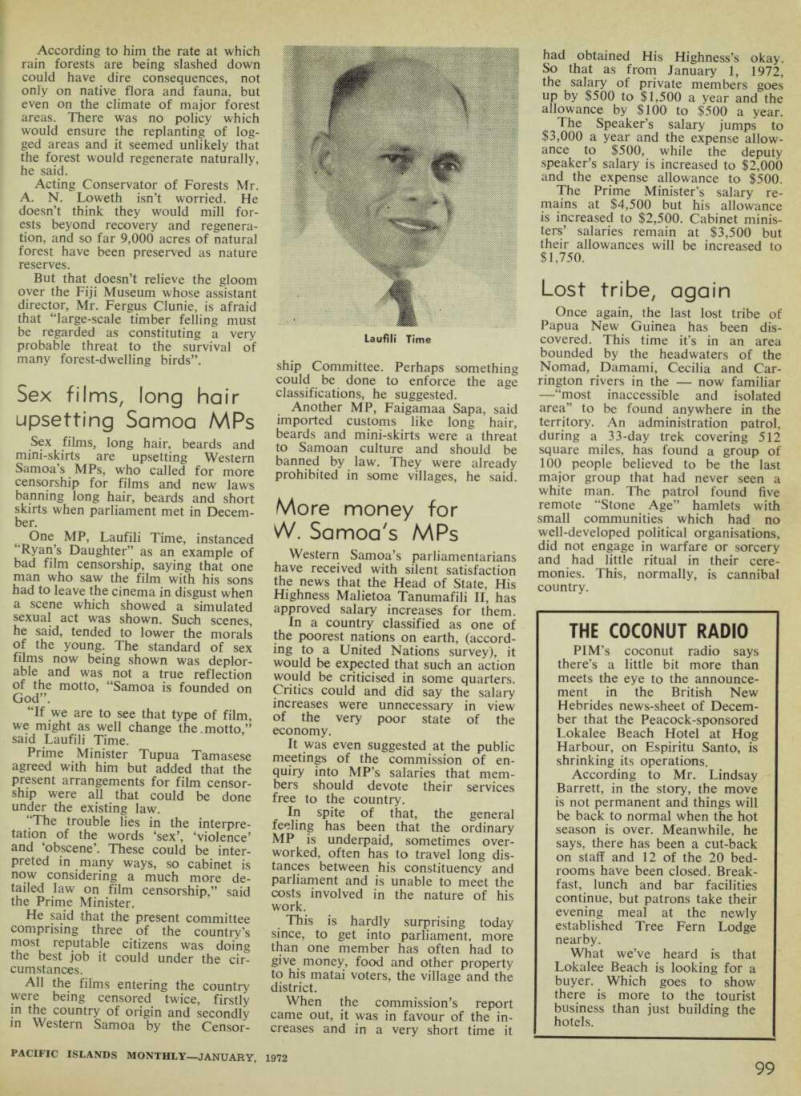
One MP, Laufili Time, instanced “Ryan’s Daughter” as an example of bad film censorship, saying that one man who saw the film with his sons had to leave the cinema in disgust when a scene which showed a simulated sexual act was shown. Such scenes, he said, tended to lower the morals of the young. The standard of sex films now being shown was deplor able and was not a true reflection of the motto, “Samoa is founded on God”.
“If we are to see that type of film, we might as well change the.motto,” said Laufili Time.
Prime Minister Tupua Tamasese agreed with him but added that the present arrangements for film censor ship were all that could be done under the existing law.
The trouble lies in the interpre tation of the words ‘sex’, ‘violence’ and ‘obscene’. These could be inter preted in many ways, so cabinet is now considering a much more de tailed law on film censorship,” said the Prime Minister.
He said that the present committee comprising three of the country’s most reputable citizens was doing the best job it could under the cir cumstances.
All the films entering the country were being censored twice, firstly in the country of origin and secondly in Western Samoa by the Censor-
ship Committee. Perhaps something could be done to enforce the age classifications, he suggested.
Another MP, Faigamaa Sapa, said imported customs like long hair, beards and mini-skirts were a threat to Samoan culture and should be banned by law. They were already prohibited in some villages, he said.
More money for
W. Samoa's MPs
Western Samoa’s parliamentarians have received with silent satisfaction the news that the Head of State, His Highness Malietoa Tanumafili 11, has approved salary increases for them.
In a country classified as one of the poorest nations on earth, (accord ing to a United Nations survey), it would be expected that such an action would be criticised in some quarters.
Critics could and did say the salary increases were unnecessary in view of the very poor state of the economy.
It was even suggested at the public meetings of the commission of en quiry into MP’s salaries that mem bers should devote their services free to the country.
In spite of that, the general feeling has been that the ordinary MP is underpaid, sometimes over worked, often has to travel long dis tances between his constituency and parliament and is unable to meet the costs involved in the nature of his work.
This is hardly surprising today since, to get into parliament, more than one member has often had to give money, food and other property to his matai voters, the village and the district.
When the commission’s report came out, it was in favour of the in creases and in a very short time it
had obtained His Highness’s okay.
So that as from January 1, 1972, the salary of private members goes up by $5OO to $1,500 a year and the allowance by $lOO to $5OO a year.
The Speaker’s salary jumps to $3,000 a year and the expense allow ance to $5OO, while the deputy speaker’s salary is increased to $2,000 and the expense allowance to $5OO.
The Prime Minister’s salary re mains at $4,500 but his allowance is increased to $2,500. Cabinet minis ters’ salaries remain at $3,500 but their allowances will be increased to $1,750.
Lost tribe, again
Once again, the last lost tribe of Papua New Guinea has been dis covered. This time it’s in an area bounded by the headwaters of the Nomad, Damami, Cecilia and Car rington rivers in the now familiar —“most inaccessible and isolated area” to be found anywhere in the territory. An administration patrol, during a 3 3-day trek covering 512 square miles, has found a group of 100 people believed to be the last major group that had never seen a white man. The patrol found five remote “Stone Age” hamlets with small communities which had no well-developed political organisations, did not engage in warfare or sorcery and had little ritual in their cere monies. This, normally, is cannibal country.
Laufili Time