Pacific Shipping
pp. 97-103 · Read in the full issue
Tonga s big success story
From a Nukualofa correspondent
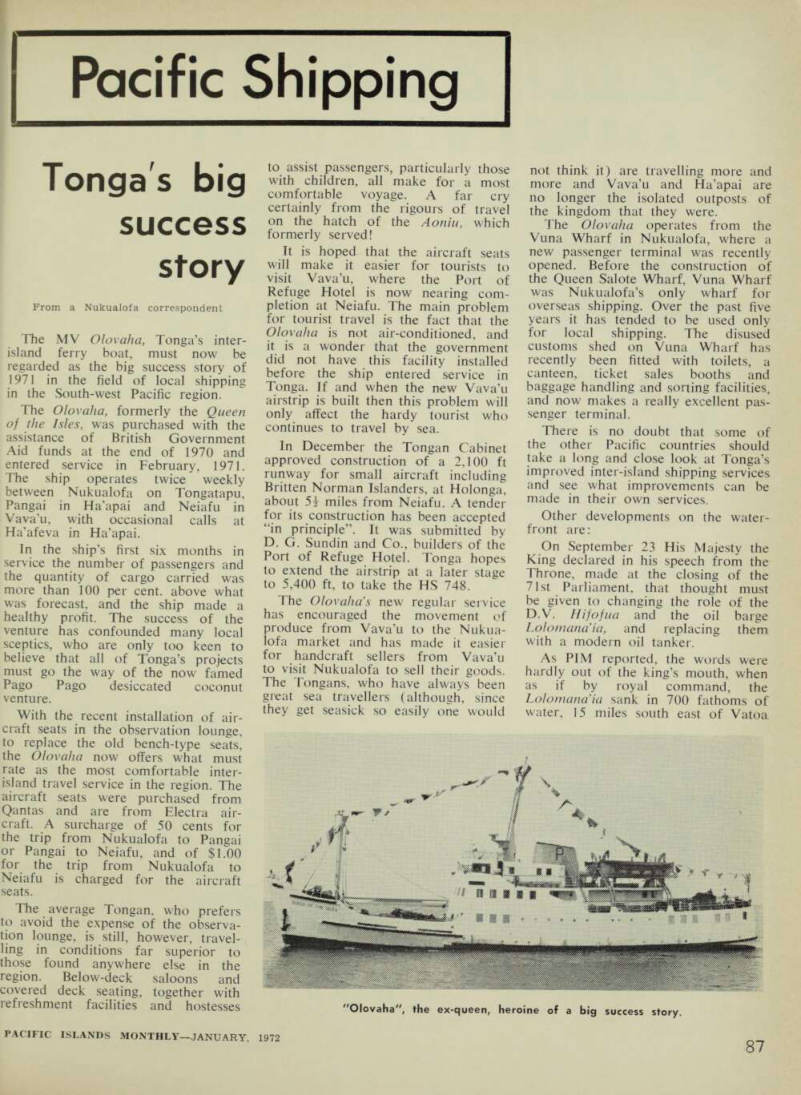
The MV Olovaha, Tonga’s inter island ferry boat, must now be regarded as the big success story of 1971 in the field of local shipping in the South-west Pacific region.
The Olovaha, formerly the Queen of the Isles, was purchased with the assistance of British Government Aid funds at the end of 1970 and entered service in February, 1971.
The ship operates twice weekly between Nukualofa on Tongatapu, Pangai in Ha’apai and Neiafu in Vava’u, with occasional calls at Ha’afeva in Ha’apai.
In the ship’s first six months in service the number of passengers and the quantity of cargo carried was more than 100 per cent, above what was forecast, and the ship made a healthy profit. The success of the venture has confounded many local sceptics, who are only too keen to believe that all of Tonga’s projects must go the way of the now famed Pago Pago desiccated coconut venture.
With the recent installation of air craft seats in the observation lounge, to replace the old bench-type seats, the Olovaha now offers what must rate as the most comfortable inter island travel service in the region. The aircraft seats were purchased from Qantas and are from Electra air craft. A surcharge of 50 cents for the trip from Nukualofa to Pangai or Pangai to Neiafu, and of $l.OO for the trip from Nukualofa to Neiafu is charged for the aircraft seats.
The average Tongan, who prefers to avoid the expense of the observa tion lounge, is still, however, travel ling in conditions far superior to those found anywhere else in the region. Below-deck saloons and covered deck seating, together with refreshment facilities and hostesses
to assist passengers, particularly those with children, all make for a most comfortable voyage. A far cry certainly from the rigours of travel on the hatch of the Aoniu, which formerly served!
It is hoped that the aircraft seats will make it easier for tourists to visit Vava’u, where the Port of Refuge Hotel is now nearing com pletion at Neiafu. The main problem for tourist travel is the fact that the Olovaha is not air-conditioned, and it is a wonder that the government did not have this facility installed before the ship entered service in Tonga. If and when the new Vava’u airstrip is built then this problem will only affect the hardy tourist who continues to travel by sea.
In December the Tongan Cabinet approved construction of a 2,100 ft runway for small aircraft including Britten Norman Islanders, at Holonga, about 5i miles from Neiafu. A tender for its construction has been accepted “in principle”. It was submitted by D. G. Sundin and Co., builders of the Port of Refuge Hotel. Tonga hopes to extend the airstrip at a later stage to 5,400 ft, to take the HS 748.
The Olovaha’s new regular service has encouraged the movement of produce from Vava’u to the Nukua lofa market and has made it easier for handcraft sellers from Vava’u to visit Nukualofa to sell their goods.
The Tongans, who have always been great sea travellers (although, since they get seasick so easily one would
not think it) are travelling more and more and Vava’u and Ha’apai are no longer the isolated outposts of the kingdom that they were.
The Olovaha operates from the Vuna Wharf in Nukualofa, where a new passenger terminal was recently opened. Before the construction of the Queen Salote Wharf, Vuna Wharf was Nukualofa’s only wharf for overseas shipping. Over the past five years it has tended to be used only for local shipping. The disused customs shed on Vuna Wharf has recently been fitted with toilets, a canteen, ticket sales booths and baggage handling and sorting facilities, and now makes a really excellent pas senger terminal.
There is no doubt that some of the other Pacific countries should take a long and close look at Tonga’s improved inter-island shipping services and see what improvements can be made in their own services.
Other developments on the water front are: On September 23 His Majesty the King declared in his speech from the Throne, made at the closing of the 71st Parliament, that thought must be given to changing the role of the D.V. Hifofua and the oil barge Lolomana’ia, and replacing them with a modern oil tanker.
As PIM reported, the words were hardly out of the king’s mouth, when as if by royal command, the Lolomana’ia sank in 700 fathoms of water, 15 miles south east of Vatoa
"Olovaha", the ex-queen, heroine of a big success story.
Island in Fiji’s Lau Group. The Lolomana’ia, in the tow of the Hifofua, has for the past 10 years supplied Tonga with bulk fuel supplies from the Vuda Point fuel depot in Fiji. The kingdom’s oil requirements are now being supplied by the Pacific Mariner, a modern oil tanker which serves the S.W. Pacific area and is operated by the Dilmun Navigation Co.
Appropriately enough, 14 of the 16 crew members of the Pacific Mariner are Tongans, supplied under a recent crewing agreement. The ship’s first call to Tonga was made recently and the vessel discharged her cargo through a new pipeline to the oil storage tanks, whilst lying alongside the Queen Salote Wharf.
Formerly, fuel oil was unloaded in Touliki Harbour, but this will no longer take place because of the new Queen Salote Wharf pipeline. Touliki Harbour may well now be made available to the ever-increasing number of yachts which call at Tonga. The future of the Hifofua is now very uncertain and she is likely to be offered for sale in the near future.
Essential to Tonga’s policy of ex panding its merchant marine, and of providing crews for foreign shipping companies, is the availability of good quality trained crews.
Over the past year, with the com missioning of the fishing vessel M.F.V.
Ekiaki and the Olovaha, together with the provision of Tongan crews for foreign-owned ships such as the Pacific Mariner, there has been quite an acute shortage of well-trained seamen. The solution to this problem is now in sight with the recent an nouncement that the government has approved Tonga’s Marine Depart ment chartering a training ship.
The Walborg is an 87 ft long, broad beam top-sail schooner which was built in Denmark in 1897. The ship is owned by Mr. Desmond Sanft, a Tongan who until August, 1970, was resident in New Zealand.
Mr, Sanft sailed the Walborg to Tonga from New Zealand via Fiji, and announced even before his arrival that he would offer it to the Tonga Government.
The Walborg is now to be put under the charge of one of the Tonga Marine Department’s ex perienced masters and will fulfil a valuable service in training seamen for a future career at sea. This is certainly an imaginative solution to the marine training problem which all Pacific countries either have or must face at some time or another.
Another Name-Change
For The 'Tsingtao'
The Tsingtao will go into service mid-January, with a Tongan name on the Tonga-Australia service, which also takes in boths Samoas and Fiji.
She has been chartered from the China Navigation Co., with an option to purchase. It is likely that the charterers, the Tonga Shipping Agency, will exercise the purchase option this year.
The Tsingtao will replace the Niuvakai, which will go to Japan in January for extensive refit. The Niuvakai, on her return to Tonga, will take up some other service.
The Tsingtao, 5,156 tons, was once the Island Chief, operating between Australia and New Guinea ports for the New Guinea Australia Line. She was on the run before the present Island Chief. She is a sideport loader, and has first-class accommodation for six passengers.
On the initial run, after dry-dock ing in Hong Kong, she will sail from Melbourne to Sydney, Suva, Lautoka, Pago Pago, Apia and Nukualofa. The charter was arranged by Captain Chris Hill-Willis, manager and super intendent of the Tonga Shipping Agency. Captain Hill-Willis went to Hong Kong for the delivery voyage with a Tongan skipper who will be master on the regular service. The ship will be crewed by Tongans.
The Tsingtao has almost double the capacity of the Niuvakai, which will be welcome as her Australian agents.
Burns Philp, have often had to turn away cargo. Unfortunately, on the outward voyage from Nukualofa little cargo is offering.
Png Govt. May Fix
Coastal Freight Rates
Papua New Guinea coastal ship ping companies, operating on feeder routes, will have maximum rates set by the Administrator, Mr. L. W.
Johnson, unless they can justify increases of up to 34 per cent, imposed in November. The Admin istrator is empowered to fix maximum freight rates for the coastal trade.
Rejecting the idea of a govern ment-owned national shipping line, a commission of inquiry into coastal shipping in Papua New Guinea has, instead, advocated the formation of a National Shipping Finance Corpora tion to buy a $1 million share in the territory’s coastal shipping trade over the next four years.
In that way, the commission, under Captain J. W. Lewin, of Melbourne, argued, coastal shipping would be come identified with local industry.
The corporation would be a sub sidiary of the PNG Investment Cor
poration. The commission suggested the National Shipping Finance Corporation should buy a quarter share in the companies operating the main inter-port services.
Those companies which did not wish to come into the scheme would have to pay a tax of 1.5 per cent, of their gross freight charges. Such a tax would place them at a dis advantage with competitors who had joined the corporation.
One other advantage of the finance corporation would be to give the government a better idea of what maximum freight rates on the main inter-port routes should be.
Until such a corporation was
formed, the commission recom mended, there should be interim in ? creases in freight rates of five and 10 per cent, on a limited number of routes. These are mainly the routes out from Port Moresby, the Lae- Vanimo and Madang-Port Moresby routes, up five per cent, and the Madang-Kieta route, up 10 per cent.
The rates for all inter-main port I shipping were fixed to operate from f January 1, The new corporation is seen as “the thin end of the wedge to socialise all forms of private enter prise” by Mr. H. D. Underwood, managing director of Steamships Trading Co. Ltd.
Mr. Underwood said that if the commission's recommendations re garding the “penalty” tax on com panies opting out of the scheme were established, the way would be open to tax all forms of commercial activity to enforce “local equity”.
But his company agreed completely with the encouragement of native participation in commerce.
Administrator Mr. Johnson has promised that the government will have a close look at the scheme.
Fierce Competition
For New Service
Shipping circles in Australia and Papua New Guinea have their doubts about a new Australia-PNG service, which Refrigerated Express Lines plans to launch in February. This will put at least 17 ships on the service, some of which carry on to other PNG* BFOUpS after dischar g in g in The new service will start at a time when ships on the run are leaving Australian ports only two-thirds to three-quarters full. The depressed copra market is having an adverse effect on development in PNG.
A representative of one Australian shipping company said that at present there was not “one decent contract for building or further development”.
It was the materials for such projects which helped to fill their ships.
Shipping at present offering a service from Melbourne, Sydney and Brisbane to Papua New Guinea com prises: Conpac, 2; New Guinea Aus tralia Line. 3; Amplex, 1: Karlander, 5; Nauru, 2.
Refrigerated Express Lines proposes to start a Sydney-Brisbane-Port I Moresby service with the Moresby !
Express, and a Sydney-Brisbane-Lae service with the Lae Express. In the melting pot is another one—Sydney- Bnsbane-Kieta with the Kieta Express. I
but if it does eventuate it will not be till later this year.
Mr. Peter Dent, managing director of REL, told PIM that as Melbourne shippers had shown interest in the proposed new services, it was possible that at least one would be extended to take in that city. The new ships had been specifically designed for the Australia-PNG trade. Their speed and modern cargo handling equip ment would allow each ship to main tain a three-weekly schedule, giving 17 voyages a year. They will carry unitised and general cargo and Aus tralian-built 20-ton containers for both dry and reefer cargo. The ships were built in Holland, have been chartered from their West German owners, Terra Schiffarts GMBH and will carry German officers and crews.
Keen competition on the Australia- PNG service is likely to become fierce when REL starts. But it will not become cut-throat for REL intends to apply conventional rates.
However, REL will offer an alter native—an all-inclusive door-to-door tariff for Australian exports, enabling Australian shippers to quote beyond cif.
The service will operate as New Guinea Express Line, a division of
Rel.
Cruise News Good
News For Cooks
When Matson Line sold the Mariposa and Monterey to Pacific Far East Line a year ago, Raro tongans, saddened at the thought that a 10-year friendship had ended, were told by the liners’ officers and crews that they would do their best to con vince the new owners that the Raro tonga stop should be reinstated. The last call was in November, 1970.
Now, Pacific Far East Line Inc. has announced that the two ships will be calling again on the Cook Islanders. The first is scheduled for January by the Monterey and there will be eight calls during 1972.
The Cook Islanders welcomed a new caller on December s—Westours MV West Star, which was making the first of 14 regular visits, a cruise programme regarded by the Cook Islands Tourist Authority as a “major breakthrough”.
But it was Sunday, and the visiting Americans, who fly from the United States to either Papeete or Suva to join the ship, were told by the wel coming Minister of Internal Affairs and Tourism, Mr. T. A. Henry, that, in the Cook Islands, Sunday was still observed as a day of rest.
About 40 of the 220 passengers were ashore for 4i hours for a tour round the island, a swim and a pro gramme of religious songs by the Seventh-day Adventist choir and the Pue Youth Club.
With his swimming gear in his hand, Westours’ director, Mr. Koval, told Mr. Henry he would sooner have heard more hymn singing than swam. • Two New Hebrideans studying at the Honiara Technical Institute have been awarded their master’s certificate at the end of a six-months course. They are Captain Johnson Vuti and Captain Leith Nasak.
No Priority In Bsip
For Side-Loaders
A new system of booking wharf berths has been introduced in the BSIP. Any type of ship will be given a berth reservation, provided the scheduled time of arrival is advised at least 14 days ahead and $2OO is paid. The new system follows break down of a trial reservation system under which side-loading container ships were given priority.
If more than one application for a berth is received for a particular day the rule of “first received, first reserved” will apply. The ship granted a reservation will be allowed six hours after scheduled time of arrival to take
up the berth. After six hours the reservation will lapse.
The Ports Authority will not recognise amendments to arrival times after the 14 days’ advance notice is given, though $lOO will be refunded if the ship does not take up its reservation.
There is a final proviso that the refund scheme will be subject to the approval of the Financial Secretary.
Shipping circles have generally welcomed the new system.
Tnt Reduces Its
Stake In Tasman Union
Thomas Nationwide Transport will own one-third of Tasman Union Ltd., previously the Union Steam Ship Co. of NZ Ltd. The earlier intention was that it should own half of the com pany, with NZ interests controlling the other half. Two other Australian shareholders in Tasman Union are Adelaide Steamship Co. and Mc llwraith McEacharn Ltd. A big NZ shareholder is RAO Holdings Ltd., of Tauranga, which has subscribed $1 million. RAO Holdings showed an interest in the USS Co. soon after the original TNT takeover bid.
Fourth Time Unlucky
For 'Rogovoka'
The Fiji Government ship, Rogovoka, was damaged by fire on November 30. The main engine caught fire and the smoke caused lamage in the cabins. The Degei, another Government ship, was in the irea, carrying the Prime Minister, Ratu Sir Kamisese Mara. She went o the Rogovoka’s assistance and took )ff eight passengers. When the fire vas out, the Rogovoka sailed to Suva it reduced speed. It was the fourth ime the Rogovoka had been in a nishap. Once she was trapped by ides, and twice earlier she was lam aged by fire.
►Hips Leave After
F Ila Harbour Collision
Temporary repairs were made in 'ila to two ships, the Northbank, nd the Woltersum, after they coi ned in the harbour. The Northbank fas badly damaged in the bow, and ie Woltersum was holed on the port ide. After temporary repairs, the forth bank sailed for Japan and the / oltersum for Santo and Marseilles.
Rial Run For
He 'Robert Debrum'
The US Trust Territory vessel MV obert Deßrum could earn up to 5,000 a voyage carrying produce irgoes through the Ponape and tarshall Islands districts, think gov •nment officials who conducted a
feasibility study for a regular ship ping service for the outer islands.
The Robert Deßrum’s trial run began and ended at Ponape with calls at Pingelap, Kusaie, Ebeye, Majuro and Ujelang. The Kusaie- Ebeye leg was worth about $l,OOO, half of which was as cash transac tions with the Kusaie Farmers’ As sociation and the other half concerned with private shipments to families and relatives in the Marshalls.
Trawler Grounds
On Sepik Reef
A trawler from the Indonesian Department of Fisheries ran aground on Vanimo village reef in the West Sepik District of New Guinea on December 9. The captain and crew of 11 were all brought safely ashore early the following morning. The vessel’s propeller shaft broke after noon outside Djayapura and the ship drifted until it grounded on Vanimo reef.
Concrete Hulls
Favoured In Bsip
Two Solomon Islands companies have ordered concrete-hulled ships.
A new company, the Ysabel Develop ment Company, has ordered a 50 ft cargo carrier capable of carrying 40 tons and having cabin space for 22 bunks. It will be in service early this year.
A 30 ft vessel has been ordered by Mr. Patresio Bubuli, of Balo, Guadal canal for general cargo and passenger traffic. His company is also building a 27 ft boat for game fishing and passenger traffic. It will be open for charter,
Where Have All
The Masters Gone?
The masters of Burns Philp ships were well known in many parts of the South Pacific as part of the local scene. Since Burns Philp started to run down its fleet a few years ago, these masters have had to look else where.
Some are still operating to the Pacific Islands with other shipping lines, others have become pilots, and still others have taken on supervisory stevedoring work. This is the break down of what the last eight masters are now doing: Masters —Brett Hilder (Karlander), Mai Lawson (Nauru Pacific).
NSW pilots —J. Ealey, Mick Costelloe.
Supervising stevedores {in Sydney ) D. Barr, R. Ashen, J. Munden.
Burns Philp marine superintendent —C. Cole.
The tradition of the sea dies hard.