of Fiji
pp. 46-49 · Read in the full issue
Fantastic fire-walkers of Fiji
From VIJENDRA KUMAR, in Lautoka
It is an hour before sunrise. In the courtyard of the Waiyavi Kali Temple, near Lautoka in Fiji, hun dreds of spectators brave the chill morning breeze and crane their necks towards a 33 ft long and 6 ft wide pit of fire glowing with red-hot embers.
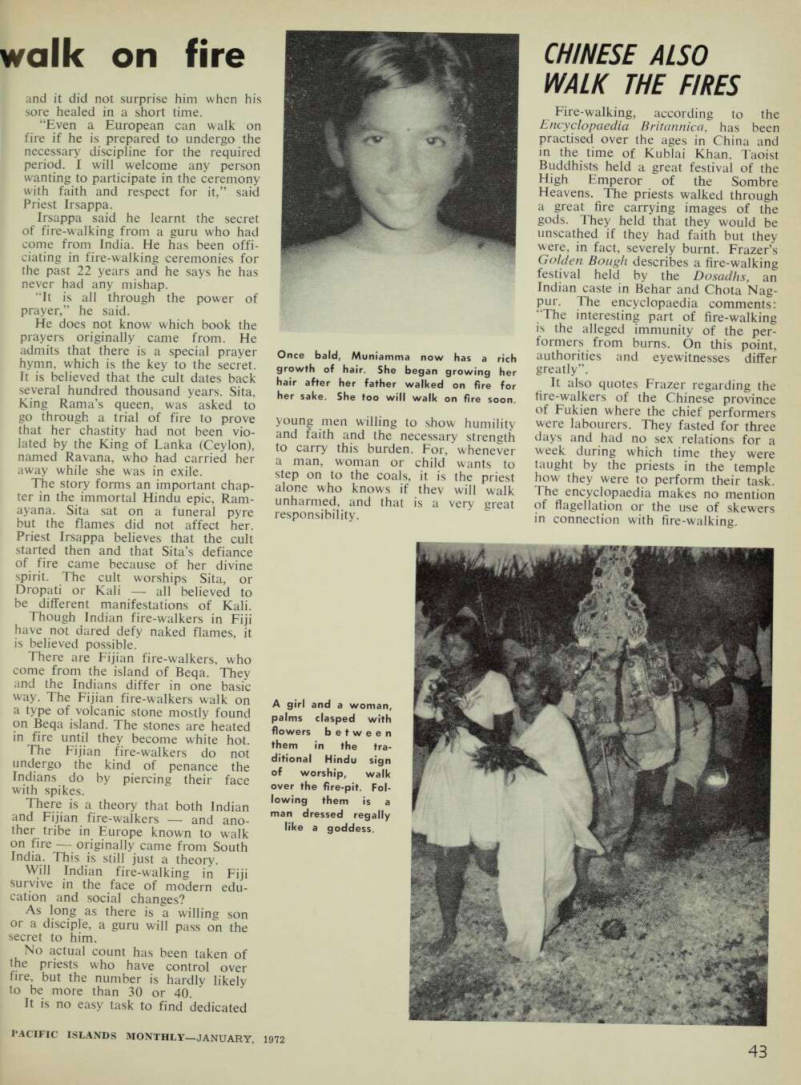
A saffron-robed Hindu priest steps out from a tiny, domed temple, with a ball of marigold flowers in his hands. Following him are a dozen zombie-like men and women and an 11-year-old girl. Each is wearing a simple saffron-coloured robe and carries over the head a small bam boo-framed spire decked with flowers.
Pierced through the earlobes of some are small silver tridents. Some have the sharp spikes pierced through their tongues, cheeks and noses.
The strange procession reaches the fire-pit, which has been burning for three days. Thirteen tons of dogo mangrove trunks have burnt to
red-hot embers and the heat is so intense that some spectators have beads of sweat on their brows. The priest pauses at one end of the fire pit and chants some ancient Vedic invocations. He then throws the ball of marigolds into the bed of fire.
Miraculously, the tender flowers remain utterly unsinged. The golden flowers are as fresh as the golden rays now struggling to rise over the mountains to the east of Lautoka.
The priest, whose name is Irsappa, nods his head and the 11-year-old girl unhesitatingly steps on to the bed of fire. Her naked brown feet contrast with the red embers. There is no acrid smell of burning flesh, or heart-rending cries of pain. She walks slowly across the pit and steps out unharmed at the other end.
Others follow, one after another in this ritualistic ceremony which lasts from 15 to 30 minutes. The priest now steps into the fire and gently
he picks up the ball of marigolds.
They are still unsinged.
Is it a miracle or magic? Or is it grand deception?
I cannot fully explain the phen omenon. But it is no hoax, as the most sceptical spectators who have seen the fire-walkers in action all agree.
I have talked to some of the men and women who have walked on fire and the priest, Irsappa, and I am convinced fire-walking is a cult whose secret is known and closely guarded by only a few. The secret was brought to Fiji by some of the indentured labourers who were brought from India a hundred years ago to work on the sugar plantations.
It has been passed from generation to generation by word of mouth, and is still alive in Fiji.
The fire-walkers begin living in the temple grounds 21 days before the ceremony of the hot coals. They live on
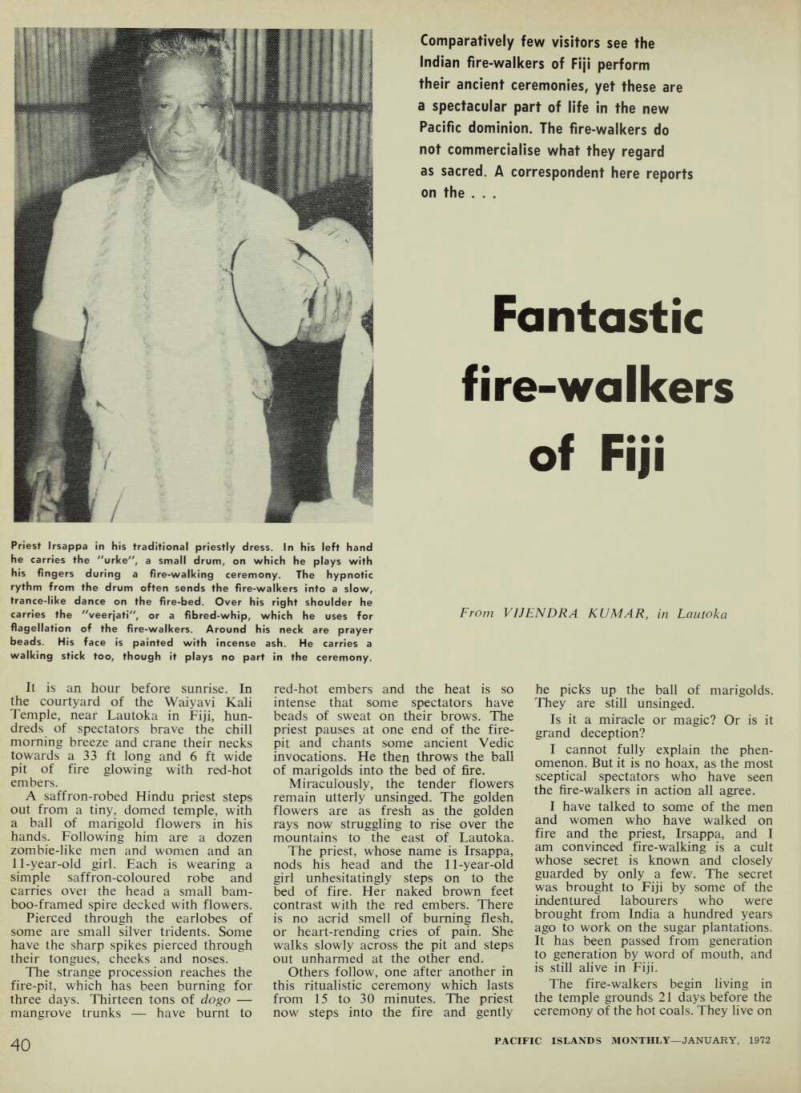
Priest Irsappa in his traditional priestly dress. In his left hand he carries the "urke", a small drum, on which he plays with his fingers during a fire-walking ceremony. The hypnotic rythm from the drum often sends the fire-walkers into a slow, trance-like dance on the fire-bed. Over his right shoulder he carries the "veerjati", or a fibred-whip, which he uses for flagellation of the fire-walkers. Around his neck are prayer beads. His face is painted with incense ash. He carries a walking stick too, though it plays no part in the ceremony.
Comparatively few visitors see the Indian fire-walkers of Fiji perform their ancient ceremonies, yet these are a spectacular part of life in the new Pacific dominion. The fire-walkers do not commercialise what they regard as sacred. A correspondent here reports on the . . .
simple, vegetarian meals and are led in their daily prayers by the temple priest. Strict taboos on sex, smoking, liquor and meat during this period impose an inflexible discipline on the participants.
This period may be described as the ‘conditioning phase’. Persons who have some incurable illness or have been ill and have vowed to walk on fire usually volunteer. The temple has either a wooden or bronze idol of the goddess Kali goddess of death and destruction in her several manifestations representing various aspects of life. The devotees concentrate upon her during the pray ers and gradually attain a trance-like state.
On the eve of the fire-walking ceremony, the priest prepares a ball of marigold flowers and places it on the idol’s head. Then begins the long ordeal of prayer, in which members of the public are freely invited, to obtain the goddess’ blessing to walk on fire. One of the strangest things in this strange ritual is the manner in which the goddess signifies her blessing. Observers have said that the idol actually moves slightly so that the ball of flowers drops into the priest’s lap. This is an indication that the fire-walking can proceed without any risk.
At about three in the morning, the devotees and the priest go to a river to bathe. They then have the tridents driven into them, as we see on our front cover picture.
They pick up the kargam the bamboo-framed spire covered in flowers. This is their cross which they must carry through the fire.
They then walk in procession to the temple, with the tridents through their flesh, and begin the fire-walk ing.
Priest Irsappa told me that none of the fire-walkers felt any pain when the tridents were driven in. There was no blood, he said, and one dubious doctor from Lautoka Hos pital had examined some fire-walk ers for signs of scars. He found none.
Fire-walkers themselves have told me they felt nothing when walking on fire. In fact, they spoke of a par ticular coolness on their soles. No one has ever seen any burn marks on their soles.
Any person irrespective of race, religion or sex can safely walk on fire provided he or she faithfully observes the instructions of the priest. One literally places one’s fate in the hands of the man who alone holds the secret of fire-walking. There are no such beings as professional fire-walkers. “Miraculous cures” of illness or affliction have been repor ted by men and women who
have crossed the fiery bed. I have spoken to several fire-walkers whose faith in the healing powers of fire and of the officiating priest is unshakeable, and here are the stories of some of those interviewed by me.
RENUKA DEVI, a 13-year-old local school girl, took a vow that she would walk on fire for five successive years because Western medicine failed to cure her of some complicated chest ailment. She has already walked thrice once each year.
“Almost immediately after I fin ished walking through the fire the first time, my pains stopped,” she told me. Though I’m completely cured, I must fulfil my vow, other wise the goddess would get angry and punish me.”
Asked how it felt walking the bed of burning embers, Renuka said she did not feel anything on her feet.
AMBIKA PRASAD, a 12-year-old schoolboy, had pains in his knee and despite several injections at the hospital, he found difficulty in walk ing and playing because of the con tinuing pains. He also has walked on fire three times and has two more walks ahead of him.
“I had no feeling in my soles.
I was not scared. I had complete faith in the priest,” he told me.
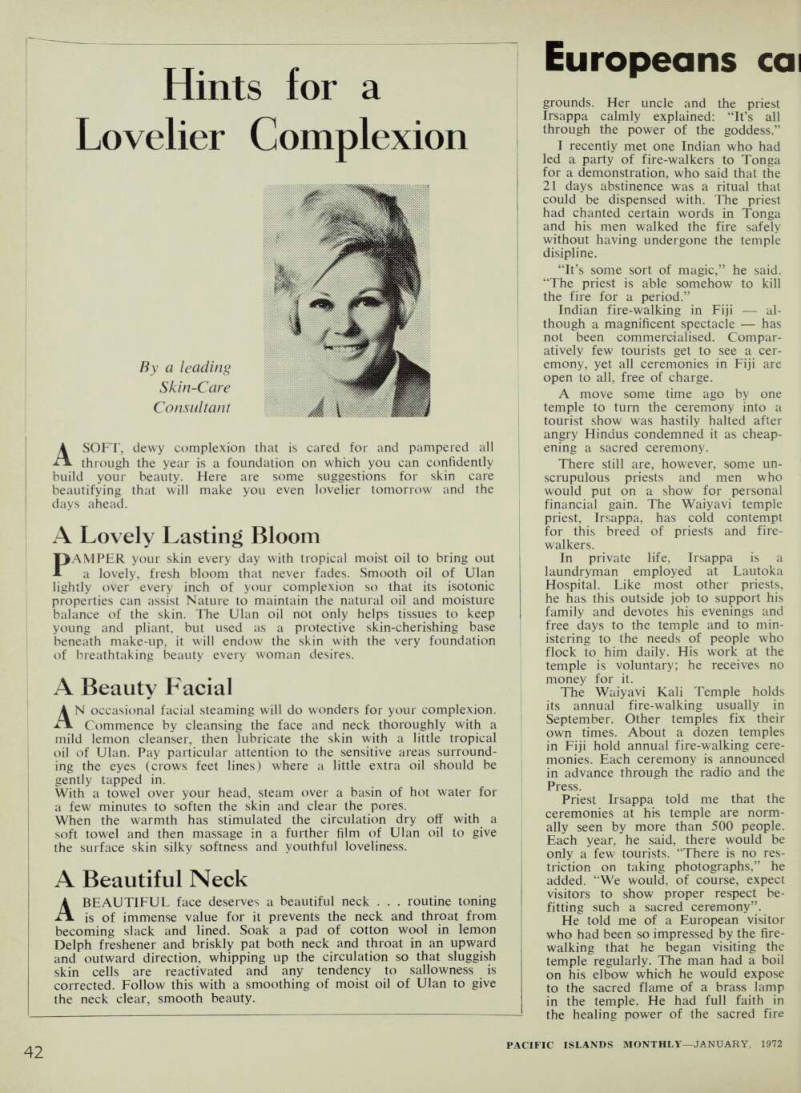
RANGA SWAMY, a 32-year-old carpenter in normal life, took a vow to walk on fire for five years for the sake of his daughter, seven-year old Muniamma. She had lost all her hair and was almost completely bald.
Within a year after his first walk, the girl began growing hair and now has a luscious cascade of black hair. She too will walk on fire for five years, starting next year, Ranga Swamy said that when walk ing through the fire-bed he felt as if he was crossing a cool watery stream.
“I was fully concious and knew that I was walking on fire. Through the power of the goddess, I was pro tected,” he said.
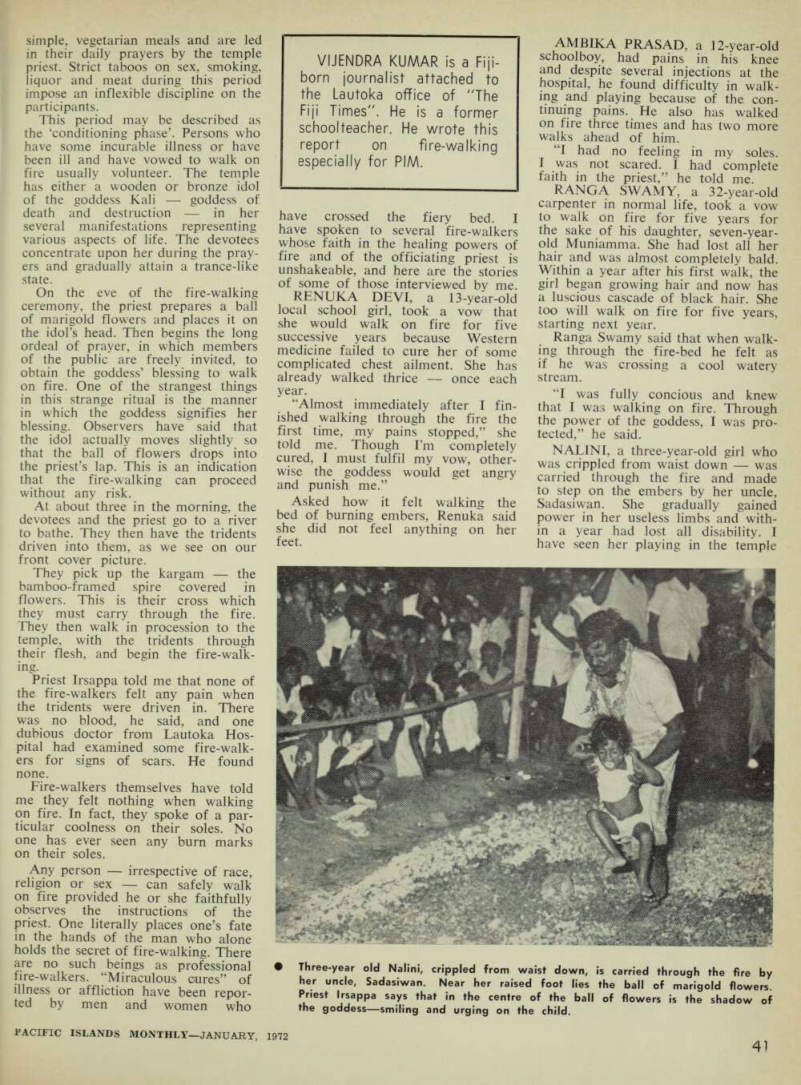
NALINI, a three-year-old girl who was crippled from waist down was carried through the fire and made to step on the embers by her uncle, Sadasiwan. She gradually gained power in her useless limbs and with in a year had lost all disability. I have seen her playing in the temple
• Three-year old Nalini, crippled from waisf down, is carried through the fire by her uncle, Sadasiwan. Near her raised foot lies the ball of marigold flowers Priest Irsappa says that in the centre of the ball of flowers is the shadow of the goddess—smiling and urging on the child.
Europeans cai
grounds. Her unde and the priest Irsappa calmly explained: “It’s all through the power of the goddess.”
I recently met one Indian who had led a party of fire-walkers to Tonga for a demonstration, who said that the 21 days abstinence was a ritual that could be dispensed with. The priest had chanted certain words in Tonga and his men walked the fire safely without having undergone the temple disipline.
“It’s some sort of magic,” he said.
“The priest is able somehow to kill the fire for a period.”
Indian fire-walking in Fiji al though a magnificent spectacle has not been commercialised. Compar atively few tourists get to see a cer emony, yet all ceremonies in Fiji are open to all, free of charge.
A move some time ago by one temple to turn the ceremony into a tourist show was hastily halted after angry Hindus condemned it as cheap ening a sacred ceremony.
There still are, however, some un scrupulous priests and men who would put on a show for personal financial gain. The Waiyavi temple priest, Irsappa, has cold contempt for this breed of priests and fire walkers.
In private life, Irsappa is a laundryman employed at Lautoka Hospital. Like most other priests, he has this outside job to support his family and devotes his evenings and free days to the temple and to min istering to the needs of people who flock to him daily. His work at the temple is voluntary; he receives no money for it.
The Waiyavi Kali Temple holds its annual fire-walking usually in September. Other temples fix their own times. About a dozen temples in Fiji hold annual fire-walking cere monies. Each ceremony is announced in advance through the radio and the Press.
Priest Irsappa told me that the ceremonies at his temple are norm ally seen by more than 500 people.
Each year, he said, there would be only a few tourists. “There is no res triction on taking photographs,” he added. “We would, of course, expect visitors to show proper respect be fitting such a sacred ceremony”.
He told me of a European visitor who had been so impressed by the fire walking that he began visiting the temple regularly. The man had a boil on his elbow which he would expose to the sacred flame of a brass lamp in the temple. He had full faith in the healing power of the sacred fire
walk on fire
and it did not surprise him when his sore healed in a short time.
“Even a European can walk on fire if he is prepared to undergo the necessary discipline for the required period. I will welcome any person wanting to participate in the ceremony with faith and respect for it,” said Priest Irsappa.
Irsappa said he learnt the secret of fire-walking from a guru who had come from India. He has been offi ciating in fire-walking ceremonies for the past 22 years and he says he has never had any mishap.
“It is all through the power of prayer,” he said.
He does not know which book the prayers originally came from. He admits that there is a special prayer hymn, which is the key to the secret.
It is believed that the cult dates back several hundred thousand years. Sita, King Rama’s queen, was asked to go through a trial of fire to prove that her chastity had not been vio lated by the King of Lanka (Ceylon), named Ravana, who had carried her away while she was in exile.
The story forms an important chap ter in the immortal Hindu epic, Ram ayana. Sita sat on a funeral pyre but the flames did not affect her.
Priest Irsappa believes that the cult started then and that Sita’s defiance of fire came because of her divine spirit. The cult worships Sita, or Dropati or Kali all believed to be different manifestations of Kali.
Though Indian fire-walkers in Fiji have not dared defy naked flames, it is believed possible.
There are Fijian fire-walkers, who come from the island of Beqa. They and the Indians differ in one basic way. The Fijian fire-walkers walk on a type of volcanic stone mostly found on Beqa island. The stones are heated in fire until they become white hot.
The Fijian fire-walkers do not undergo the kind of penance the Indians do by piercing their face with spikes.
There is a theory that both Indian and Fijian fire-walkers and ano ther tribe in Europe known to walk on fire originally came from South India. This is still just a theory.
Will Indian fire-walking in Fiji survive in the face of modern edu cation and social changes?
As long as there is a willing son or a disciple, a guru will pass on the secret to him.
No actual count has been taken of the priests who have control over fire, but the number is hardly likely to be more than 30 or 40.
It is no easy task to find dedicated
young men willing to show humility and faith and the necessary strength to carry this burden. For, whenever a man, woman or child wants to step on to the coals, it is the priest alone who knows if thev will walk unharmed, and that is a very great responsibility.
Once bald, Muniamma now has a rich growth of hair. She began growing her hair after her father walked on fire for her sake. She too will walk on fire soon.