power struggle
p. 29 · Read in the full issue
Splits and new front in New Caledonian power struggle
The budget session of New Cale donia’s Territorial Assembly was brought to a rushed conclusion a week before Christmas as more stresses and strains became evident over economic and political issues.
The island is now fast approaching its five-yearly renewal of the 35member Territorial Assembly and recent rumours suggest the elections could be called for any time after March 10.
Latest split among major parties has occurred in the pro-Administra tion Union Democratique. At a party rally over the second weekend in December, 25 - year - old Noumea school teacher Luc Steinmetz was elected party secretary-general, oust ing Noumea Mayor Roger Laroque.
On December 14, Michel Kauma announced in the Territorial Assembly (where he replaced the late Edouard Pentecost) that he had resigned from the Union Democratique, together with three other sitting members— Roger Delaveuve, Roger Pene and Lionel Cherrier, the last-named having just joined the assembly when Senator Henri Lafleur gave up his seat saying he wanted to devote more time to attending to the territory’s interests in Paris.
The Union Democratique and sympathisers (the Entente ’ group), formerly held 11 seats in the Terri torial Assembly. After the recent split in the former anti-Administration
group Union Caledonienne, a split resulting in the formation of a six man group of Liberals, this six plus 11 bloc had suddenly produced a pro-Administration majority in the assembly.
But before Christmas the situation changed as follows: Entente (inch Union Demo cratique) 7 New breakaway group . . 4 Union Caledonienne . . 12 Liberal 6 Union Multiraciale . . 4 Mouvement Populaire Cale donien 1 Union Civique 1 The four-man breakaway from the Union Democratique was followed by a Press statement next morning from Jean-Pierre Aifa of the Union Cale donienne announcing that his group had joined with Union Civique (in cluding Gerald Rousseau) and formed a “Caledonian Front for Autonomy” ( Front Caledonien pour I’Autonomie) .
Among the officially-stated aims are a modification of the political statutes of the territory to allow a greater decentralisation from Paris, with the island still remaining within the French Republic.
As forces withdrew to consolidate their positions over the vacation, 1972 promises a spectacular tussle over the Autonomic issue.
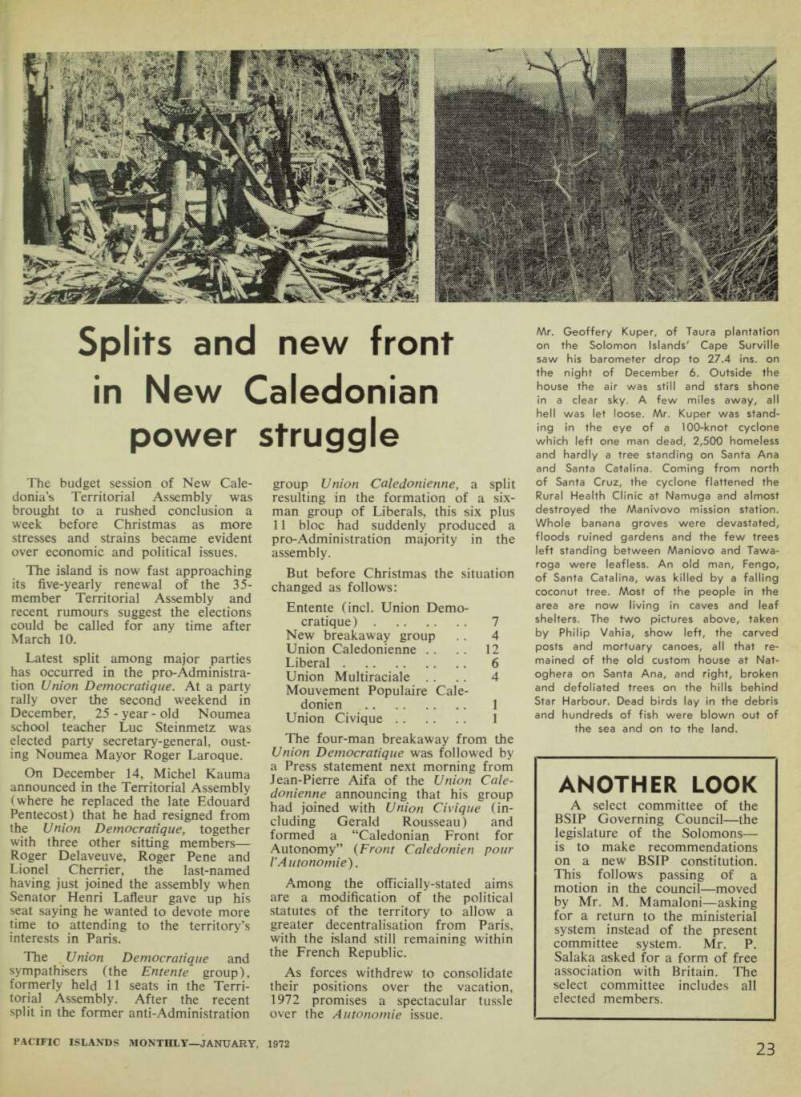
Mr. Geoffery Kuper, of Taura plantation on the Solomon Islands' Cape Surville saw his barometer drop to 27.4 ins. on the night of December 6. Outside the house the air was still and stars shone in a clear sky. A few miles away, all hell was let loose. Mr. Kuper was stand ing in the eye of a 100-knot cyclone which left one man dead, 2,500 homeless and hardly a tree standing on Santa Ana and Santa Catalina. Coming from north of Santa Cruz, the cyclone flattened the Rural Health Clinic at Namuga and almost destroyed the Manivovo mission station.
Whole banana groves were devastated, floods ruined gardens and the few trees left standing between Maniovo and Tawa roga were leafless. An old man, Fengo, of Santa Catalina, was killed by a falling coconut tree. Most of the people in the area are now living in caves and leaf shelters. The two pictures above, taken by Philip Vahia, show left, the carved posts and mortuary canoes, all that re mained of the old custom house at Nat oghera on Santa Ana, and right, broken and defoliated trees on the hills behind Star Harbour. Dead birds lay in the debris and hundreds of fish were blown out of the sea and on to the land.