An elusive
pp. 101-103 · Read in the full issue
Oildorado
reached of a little over a mile is the maximum capacity of the present rig, the only one brought to the island.
Extensive electrical logs were taken and a seismic velocity check shoot carried out before the well was plugged.
Preliminary study of the results had made it clear that drilling at a second prepared site near Fua’amotu Airport, on the south coast of Tonga tapu is not recommended and will not now be carried out. This set back cannot be interpreted too seriously either way at this early stage but it will serve to dampen any over-optimism here and abroad about Tonga’s oil prospects.
Discussions between the Indian State Minister for Petroleum and Chemicals Mr. Sethi, and the King of Tonga were widely reported. Mr.
Sethi offered the King assistance in designing and building an oil refinery in Tonga.
The head of the Indian Oil and Gas Commission undertook to train Tongan technicians at the Institute of Petroleum Exploration at Dehra dum. It was during these discussions at Delhi that the King is reported to have said, “If oil is struck, Tonga will become the Kuwait of the Pacific”. Whereupon the Indian authorities offered to buy crude oil from the kingdom.
Work began in the middle of
From ALF SANFT in Nukualofa.
There had been warnings against over-optimism when the hunt for “Odldorado” started in Tonga with the spudding in of Kumifonua 1 on October 5, but it was still a great disappointment when the well was abandoned on November 2 with the drill head 5,525 ft below. Kumifonua 1, the experts announced, was as dry as a bone. There wasn’t even gas.
The decision by the six-member consortium to abandon the first ex ploration well near Nukualofa was made within days of King Taufa’ahau and his Queen inspecting the drill site for the first time after their return from a state visit to India.
According to the chief geologist, Mr. John van Deldan, the main section, beyond the upper coral for mation and water zone, consisted of a thick layer of hard grey rock of ancient volcanic origin which could be more than two million years old.
The decision to abandon opera tions at this moderate depth came as a mild shock and disappointment to many observers on the shore, especi ally as they now know that the depth
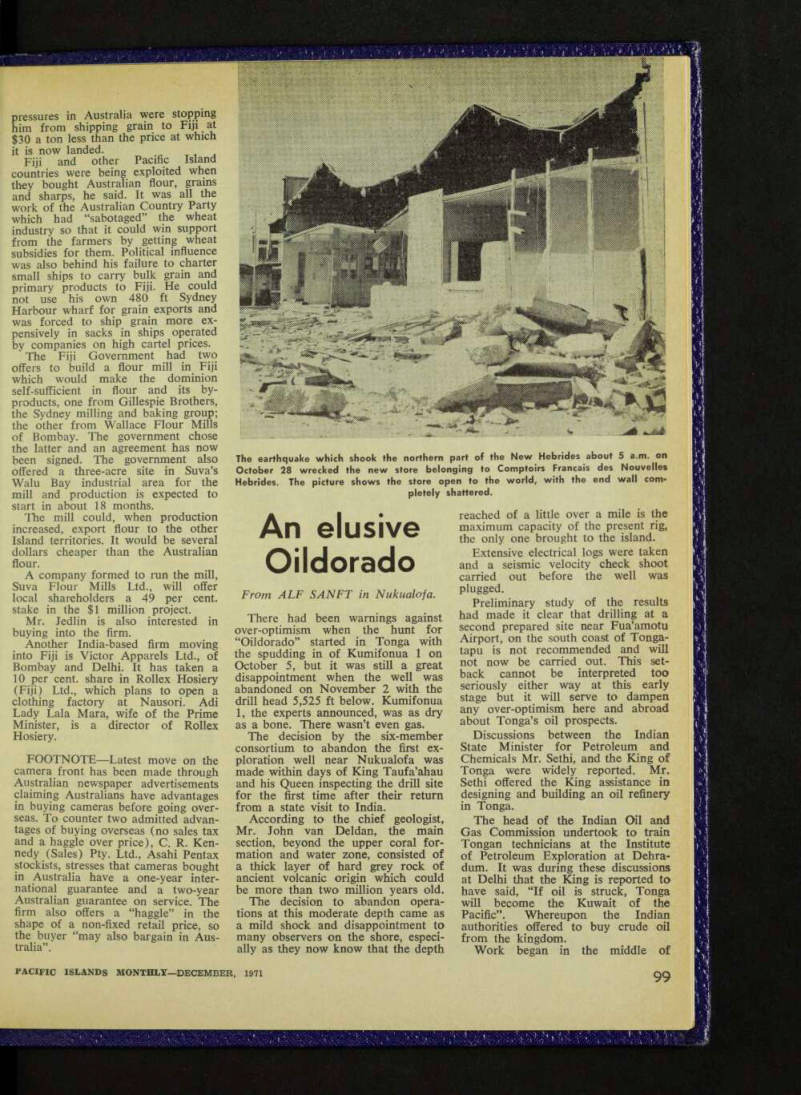
The earthquake which shook the northern part of the New Hebrides about 5 a.m. on October 28 wrecked the new store belonging to Comptoirs Francais des Nouvelles Hebrides. The picture shows the store open to the world, with the end wall com
pletely shattered.
November on a second exploration well three miles from Nukualofa, Meanwhile, if there isn’t exactly oil fever in Fiji a few brows were flushed the day after Tonga’s Kumi fonua 1 was abandoned when it was reported that a substance like oil had been bubbling up from the seabed near Malake village on the island of the same name off Rakiraki on Viti Levu.
Three Fijian women who went for their daily swim found the water bubbling and frothing and turning a deep brown. Geologists were investi gating.
Dairy factory to
open in A. Samoa
Meadow Gold Samoa Ltd., a sub sidiary of the Chicago-based firm of Beatrice Foods Co., plans to open a dairy manufacturing plant in American Samoa.
The new plant, which will be housed in the old General Supply Building, is expected to produce 8,000 gallons of milk and 400 gallons of ice cream a day. Other products will be cream, cottage cheese, sour cream, yogurt and fruit juices.
Samoans will be offered shares in the new company.
Mr. Watson has
plans for Cooks
Cook Islands’ semi-retired Scots born tycoon, Mr. Willie Watson, is back in Cambridge, NZ, after a six months world tour, planning further enterprises for his adopted islands group. With the opening of the air port at Rarotonga late in 1972 he sees a big future for the tourist industry.
Speaking to PIM as he passed through Sydney, Mr. Watson said he owned waterfront land at Avarua, where he proposed to erect a three storey building, to cater for tourists’ needs. On the ground floor there would be shops, a licensed restaurant on the first floor, and on the top a flat for himself and his wife when they leave NZ each year to winter in Rarotonga.
But this project is dependent on a liquor licence for the restaurant.
With tourists passing through the Cooks at an annual rate of 30,000 to 40,000 a year he considers licensed restaurants are a “must”.
Mr. Watson believes there will be a big influx of tourists from New Zealand, because both countries use the same currency. New Zealanders would be able to take money freely to spend in the Cook Islands, but faced restrictions when they planned to go to other countries.
He also considers tourism would
give a fillip to the citrus industry.
There would be an increased demand for oranges, and there would also be a market for mandarins, which now go to waste.
Another industry which could flourish with the opening of the air port would be tropical flowers for export. These could be sold, almost garden fresh, in New Zealand and Hawaii.
Mr. Watson, although now in his 70s, still has a refreshing outlook on life, and obviously is still quick to see commercial oportunities.
A new Bank
of Tonga
Tonga is to have a bank again— the last one having survived for only a short time last century after it was established by the Rev. Shirley Baker, then Tonga’s Prime Minister. The new Bank of Tonga will be more substantial, consisting of a consortium of the Tonga Government, the Bank of Hawaii, Bank of New South Wales and the Bank of New Zealand. Top officials from the three banks met with the Tongan Government in Nukualofa in November to discuss the details.
Tonga had announced as long ago as December, 1968, that it intended to establish a bank—but that an nouncement said the kingdom was “near agreement” with the Bank of Hawaii, and there was no mention of other banks.
In November, Tonga’s Minister of Finance, Mahe ’Uli’uli Tupouniua, said the reason for the inclusion of Australia and New Zealand was Tonga’s long-standing trading rela
tions with them; the United States had been invited in “because of the fast-growing tourist industry with that country”. With three overseas banks participating in both capital and management, Tonga would “have a balanced banking institution to assist in the overall development of the economy”, he said. • The Marianas District became the only district in United States Trust Territory to boast two banks, the Bank of Hawaii and the Bank of America, with the opening on Nov ember 1 of a branch of the Bank of Hawaii on Saipan.
Support for separate
PNG currency
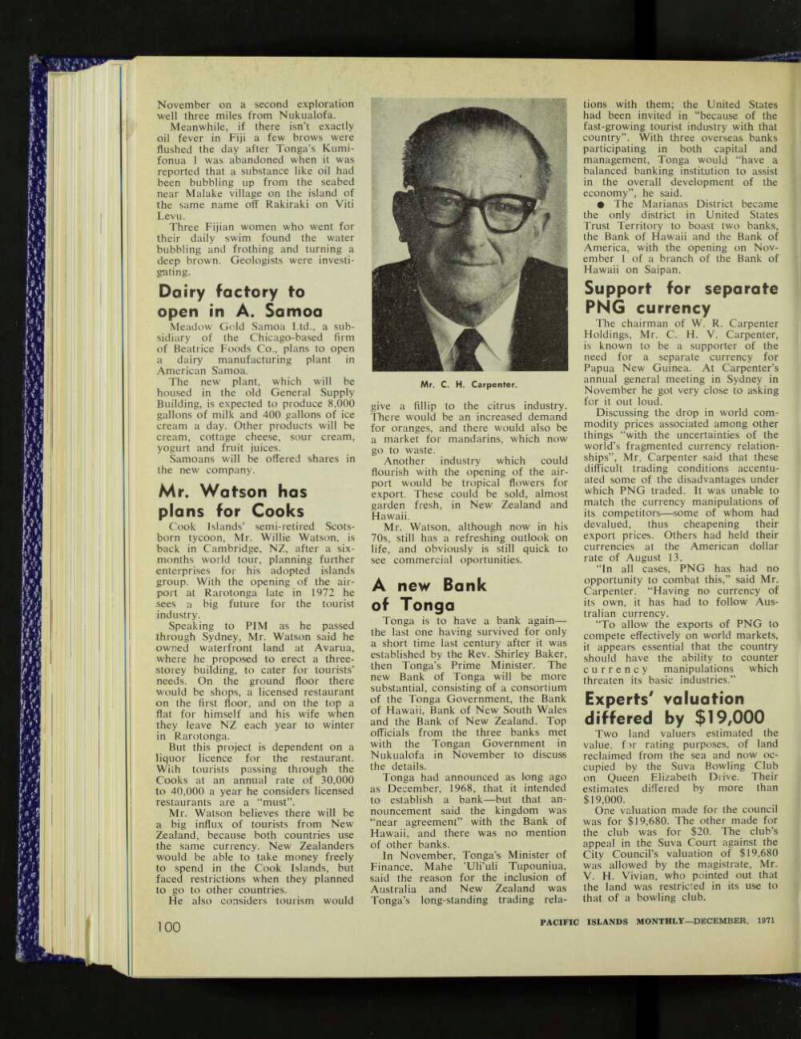
The chairman of W. R. Carpenter Holdings, Mr. C. H. V. Carpenter, is known to be a supporter of the need for a separate currency for Papua New Guinea. At Carpenter’s annual general meeting in Sydney in November he got very close to asking for it out loud.
Discussing the drop in world com modity prices associated among other things “with the uncertainties of the world’s fragmented currency relation ships”, Mr. Carpenter said that these difficult trading conditions accentu ated some of the disadvantages under which PNG traded. It was unable to match the currency manipulations of its competitors—some of whom had devalued, thus cheapening their export prices. Others had held their currencies at the American dollar rate of August 13.
“In all cases, PNG has had no opportunity to combat this,” said Mr.
Carpenter. “Having no currency of its own, it has had to follow Aus tralian currency.
“To allow the exports of PNG to compete effectively on world markets, it appears essential that the country should have the ability to counter currency manipulations which threaten its basic industries.”
Experts' valuation
differed by $19,000
Two land valuers estimated the value, for rating purposes, of land reclaimed from the sea and now oc cupied by the Suva Bowling Club on Queen Elizabeth Drive. Their estimates differed by more than $19,000.
One valuation made for the council was for $19,680. The other made for the club was for $2O. The club’s appeal in the Suva Court against the City Council’s valuation of $19,680 was allowed by the magistrate, Mr.
V. H. Vivian, who pointed out that the land was restricted in its use to that, of a bowling club.
Mr. C. H. Carpenter.
W. Samoa looks
for 'easier' loans
Faced with a constantly deter iorating agricultural exports situation, Western Samoa is now reaching out for membership in various world financial institutions to make borrow ing for development purposes easier.
Over the last 12 months, the gov ernment has been sending represen tatives overseas to negotiate for membership in the International Monetary Fund, the World Bank and its affiliates especially the Inter national Development Association.
And, according to the Minister of Finance, Tofa Siaosi, such member ship is practically a certainty and the only thing now needed is passing of the enabling legislation.
“Membership of the International Monetary Fund will allow Western Samoa immediate drawing rights of foreign exchange in the event of a national catastrophe or an unexpected shortfall in our export receipts,” the minister said.
Membership of the World Bank has little attraction for Western Samoa at the present time as this organisation’s loans are all made on conventional terms, but membership of the World Bank allows member ship of the International Develop ment Association which offers some of the “softest” term loans available anywhere.
Govt, wants to
control airline
The Western Samoa Government has, at last, decided to support Poly nesian Airlines in its efforts to re equip with modern aircraft—but, it has also insisted that it must buy controlling interest in the airline, which is the country’s national flag carrier. It is not known yet what the reaction of other shareholders will be to the government’s proposal for acquiring control.
Fiji hikes its
airport landing fees
Landing fees for aircraft on inter national flights arriving in Fiji will rise by about five per cent, from next January.
This is the first increase since 1969.
The Ministry of Communications, Works and Tourism says it has be come necessary because of up grading costs at Nadi Airport.
The new scale per 1,000 lb of air craft weight for international and domestic flights is: Weight not ex ceeding 30,000 lb, 31c and 28c; from 30,0000 lb to 50,000 lb, 51c and
45c; from 50,000 lb to 100,000 lb, 75c and 65c; exceeding 100,000 lb, 51.50 and 51.30.
The increased charges will mean that it will cost about $25 more to land a Boeing 707 at the airport and about $52 more for a Boeing 747.
The present landing fee for the 707 is $488.48. It costs $1,016.73 to set a Boeing 747 down at Nadi.
Airline officials say that despite the increase, the Nadi fees will still be considerably lower than those charged by airports in Australia.
Clearing way for
Lord Howe airstrip
A start on laying an airstrip on Lord Howe Island will be made in March or April, 1972. Before then five families whose properties are on, or adjoining, the proposed area of the strip will have to be rehoused.
And, of course, the Commonwealth Government still has to “ante up” the funds.
A number of officers from several NSW Government departments flew to the island late in November to speak to the people who are to be resettled, and to try to arrange housing elsewhere for them. A senior officer of the Public Works Depart ment, who will be in charge of work on the airstrip was also in the party.