Book Reviews
pp. 81-82 · Read in the full issue
Disconcerting Problem Of The
Islanders With Two Homes
The people of Ocean Island —the small phosphate isle 160 miles east of Nauru, near the Equator—have lived since 1945 on Rabi Island in the Fiji Group, in an environment radically different from that of their homeland.
Rabi is nine times as large, six times as high and five times as wet as Ocean Island. On Ocean, the people were a special community of landholders and workers on an island thriving with industrial activity. On Rabi they feel they have been reduced to the status of exiled copra cutters and gardeners whose home estates have been nationalised, and they carry a chip on their shoulder.
How the Banabans, as they are called (Rabi is sometimes spelled Rabe, and it is pronounced Rambi) got to this state of affairs, and what they think about it, is described in detail in Martin Silverman’s Discon certing Issue: Meaning and Struggle in a Resettled Pacific Community.
Dr. Silverman is Associate Professor of Anthropology at Princeton Univer sity, and his book is mainly the result of studies he made on Rabi in 1961 and 1964.
On his lengthy 1964 visit I met Dr. Silverman, then doing his PhD.
With my wife and family I had been invited to Rabi by the hospitable Banabans while they put their point of view, and Silverman, the only European besides ourselves on the island, had learned the language and obviously had the confidence of the islanders. His objective book is a valuable study of their background, which will tell them more about themselves than they themselves know.
It’s a unique story of a struggle for identity of people with a “two island culture”, and Dr. Silverman offers no solutions. The struggle con tinues, with the Banabans at this moment still demanding justice from a British Government and a phosphate company which they believe have cheated them of their birthrights.
By coincidence, Disconcerting Issue appears (from Chicago) at the same time as Three Islands, by Maslyn
Williams, has been published in Melbourne by the British Phosphate Commissioners to commemorate the 50th anniversary of the BPC, 1920- 70.
The former is a highly-technical anthropological treatise which examines the profound effect of the BPC operations on the Ocean islanders. Three Islands is a short popular history, in the form of a tribute, of the development and work of the BPC on Ocean Island, Nauru and Christmas Island (in the Indian Ocean).
Maslyn Williams is not unsympathetic to the problems of the Banabans, and his history is not the dull, one-eyed account of a perfectly-
protected business monopoly that probably would have emerged from the pen of a less skilled or less dedicated writer. But naturally the stress is on the BPC view, which results in some contradictions between Williams’ and Silverman’s accounts of events.
Williams, for instance, gives sup port to the company view at the time (the company being the forerunner of the BPC) that an early Resident Commissioner, Quayle Dickson might have been more useful to everybody including the Banabans if he had administered the affairs of the then Protectorate instead of trying to tell the phosphate company its business, Silverman sees Quayle Dickson as
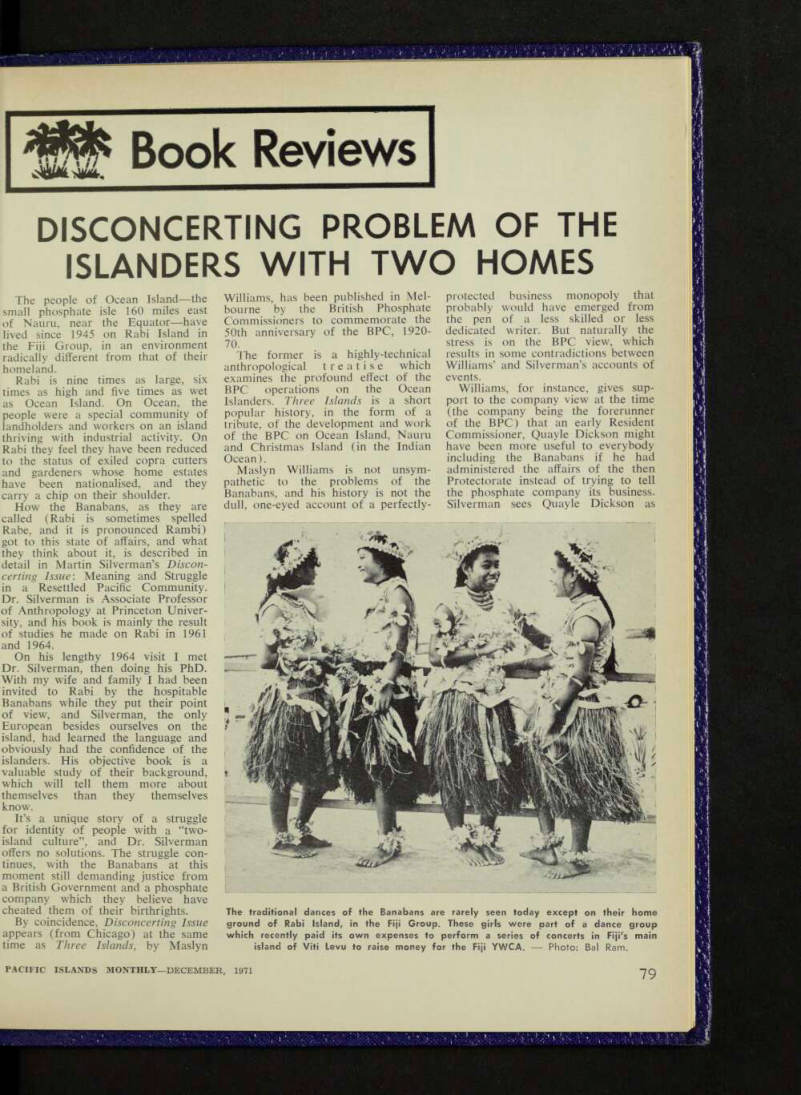
The traditional dances of the Banabans are rarely seen today except on their home ground of Rabi Island, in the Fiji Group. These girls were part of a dance group which recently paid its own expenses to perform a series of concerts in Fiji's main island of Viti Levu to raise money for the Fiji YWCA. -Photo: Bal Ram.
having been forced to interfere with the company’s actions so as to safe guard the Banaban interests from company officials “who were clearly concerned with keeping the mining going efficiently, exporting cheaply and getting more land when needed, all with a minimum of interference from the Banabans and the local government”.
The company considered “the Banabans a nuisance and the govern ment a meddler”. Quayle Dickson was apparently transferred as a result of company pressure, but his replace ment fared no better in a position where he was expected to serve two masters with opposing aims.
Williams refers to an Ocean Island king (the original phosphate deal having been made with him), but Silverman shows there was never a king, and that almost ever since the first “contract” (made with some members of one tribe) the Banabans have vocally been calling for a better deal. Nobody has ever really listened to them, or understood their attitude to land, or accepted the fact that they don’t distinguish between surface and sub-surface land rights (any official arguments attempting to
distinguish between the surface and sub-surface they regard as deception).
Silverman’s book stresses the prob lems and the injustices that arise because of the arrogance of Western ers in believing they know it all.
“Circumstances over which the Banaban people,” writes Silverman, “had little or no control brought about a situation in which they were compelled to make explicit both to themselves and to outsiders what their custom was and what their history was. Outsiders made inter pretations based on this information, their own preconceptions, and their own interests. The interpretations made by outsiders moulded the people’s own conceptions, which were then an input to subsequent inter pretations by outsiders, and so forth in an unending series.”
Today the Banabans are mixed-up, still attempting to deal with the prob lems posed by owning two islands and being involved with three nations, a colonial government and a new dominion.
That kind of trouble doesn’t make it any easier for them to discover who they are. Although they are confused and divided, Silverman feels that, painfully, a Rabi identity seems to be emerging with a measured acceptance for the need of centralised planning.
Stuart Inder.
(Disconcerting Issue. By Martin
G. Silverman. University of Chicago Press.
Susi 3. Three Islands. By Maslyn
Williams. Published by the British Phosphate Commissioners, Melbourne. No price).