Magazine Section
pp. 73-79 · Read in the full issue


When the Norfolk Islanders were 'elegant, petted, indolent'-and had no future
What is the future for Norfolk Island, the Australian territory off the east coast of Australia? Currently the Norfolk Islanders—some of them the descendants of the "Bounty" mutineers—are asking this question of the Australian Parliament, and not for the first time in their long history. They want a greater measure of self-government, of the kind they once had. But, even back in 1884, when they had great authority, there was serious concern about their future, as a confidential report from official sources at the time illustrates.
Captain Cyprian A. G. Bridge was an experienced Royal Navy officer attached to the Australian station in 1884, and in command of HMS Espiegle, one of Her Majesty’s ships responsible for keeping the peace in the Western Pacific at a time when there were no responsible govern ments in most of the island groups.
In May, 1884, he was sent to Samoa and Tonga to report on events there, and en route visited Norfolk Island, where Espiegle anchored off King ston for a day, from May 27 to the 28th. He purchased beef and fresh vegetables and continued on his way.
On May 31, at sea, he wrote the following confidential report on con ditions on Norfolk, which included some comments of his own about his concern for the future of the islanders.
The report was sent to Commodore
James Erskine, commander of the Australian station for the Royal Navy, at Sydney.
Captain Bridge was no stranger to Norfolk Island. Earlier he had spent some time there to compile a report on the possibilities of establishing a port.
Captain Bridge rose to the rank of Rear-Admiral. He wrote the introduc tion to the popular edition, in 1914, of Sir John Barrow’s famous “Mutiny on the Bounty”.
This is what Capt. Bridge said:
Confidential
Norfolk Island
May, 1884
In 1856, people to the number of 194 arrived from Pitcairn’s Island. In 1858 two families went back to the latter island; and in 1863, four more
families went back. The members of these six families amounted to be tween 30 and 40 persons. Not includ ing the clergy, pupils, etc., of the Melanesian Mission, the present popu lation of Norfolk Island is as follows:
The oldest man on the island is Mr.
Buffett (senior), aged 87. He is in full possession of all his faculties and looks about 68. He landed at Pitcairn Island from a merchant ship about 1821. The Revd. Mr. Nobbs, the
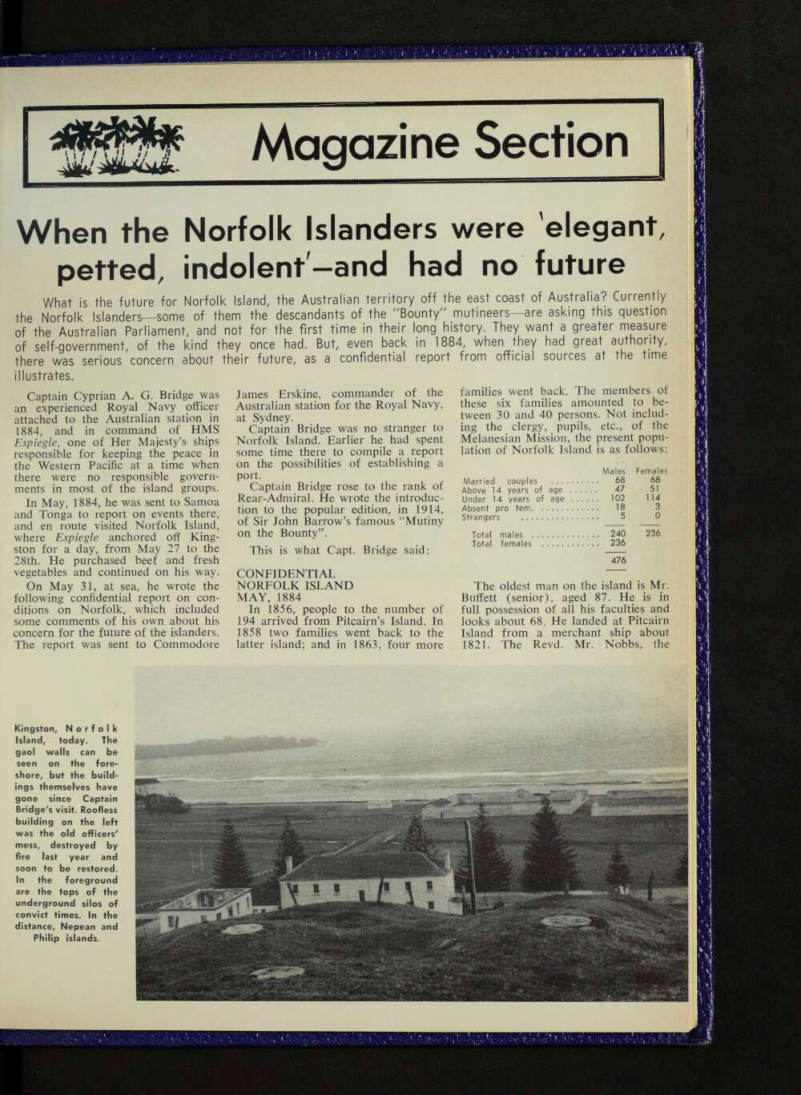
Kingston, Norfolk Island, today. The gaol walls can be seen on the fore shore, but the build ings themselves have gone since Captain Bridge's visit. Roofless building on the left was the old officers' mess, destroyed by fire fast year and soon to be restored.
In the foreground are the tops of the underground silos of convict times. In the distance, Nepean and Philip islands.
Males Females Married couples 68 68 Above 14 years of age . . . 47 51 Under 14 years of age ... . .. 102 114 Absent pro tern. . 18 3 Strangers 5 0 Total males ...
Total females , ... 240 ... 236 476 236
They made their own laws
venerable pastor of the settlement, is now 85, and in very feeble health.
There are at present on Pitcairn’s Island 98 persons. To this number the 30 or 40 who returned to the island 21 and 26 years ago have al ready increased. It therefore appears that in 28 years the population of the two islands has been multiplied by nearly three.
In May, 1884, Mr. Buffett (junior) informed me that only 13 of the original surnames remained, and that there were many new ones. It is, con sequently, likely that some of this increase is due to immigration. But, not to mention, for the present, other facts, the parallel triplication of the inhabitants of Pitcairn’s Island, where only an insignificant immigration can have occurred, shows that it is at least probable that the addition to the population of 1856 is due almost en tirely to natural increase. Judging from the size of the actual families, this will continue at least for some time.
The total effective acreage of Nor folk Island is stated to be 8,600. Not quite 180 acres are under cultivation.
The rest is pasture land—in other words, land exactly in the state in which it was when handed over to its present possessors in 1856.
Kumeras (the Maori sweet potato), yams, maize, and potatoes, besides ordinary kitchen-garden stuff, are
grown. Oranges, bananas, apples, Chinese date-plums, and rose-apples are reared. In May, 1884, a large quantity of fine-looking bananas were being sent to the Bay of Islands by an American whaler.
There are 2,000 sheep, 1,346 horned cattle, and 267 horses on the island.
The sheep are shorn, and the wool exported; it fetches Is. 7d. a lb “in the grease”. Beef is sold to passing vessels for 4d. a lb “put on board”.
Sheep are sold for 14s. each. There are many turkeys, ducks, and other poultry. Turkeys are Bs. a pair, ducks 3s. a pair, and fowls 3s. a pair. Horses are occasionally exported to Noumea.
In the season “black” whales are caught. The season of 1883 is said to have been a bad one. In that of 1882, 18 whales, producing 70 tuns of oil. worth £25 a tun, were caught.
The sale of fresh meat and live stock to vessels probably is consider able. One of the inhabitants stated to an officer of HMS Espiegle that a week rarely passed without a vessel calling. Many of these, however, are whalers cruising; and arrivals of ships direct from any neighbouring colony are rare, and occur irregularly. There are in the island about 40 wheeled vehicles.
Every male over 25 years of age is by right a member of the Popular As sembly, which meets once a quarter, and on other occasions if specially summoned. The Assembly makes laws which, to become valid, require the assent of the Governor of New South Wales, who is also Governor of Nor folk Island.
A magistrate, who is the principal authority on the island, is elected annually on the 26th December, and enters on his office on the Ist Janu ary. He presides in the Assembly, and is invested with limited criminal and civil judicial powers. Should the necessity of trying persons charged with serious offences arise, the Gov ernor of New South Wales is em powered to constitute a tribunal for the purpose.
There is practically no budget of Receipts and Expenditure, and no taxation. A “tax”, or rather subscrip tion of 15s. per family, is raised as an addition to the resident Surgeon’s salary. It amounts to about £5B.
There is an “Island Fund”, derived chiefly from the sale of Government
Only in recent years have the authorities recognised the importance of the old colonial, convict-built dwellings on Norfolk Island. This house in Quality Row is one of a number currently being restored. A book by an Australian architect in charge of the restoration work is reviewed in this issue of PIM.
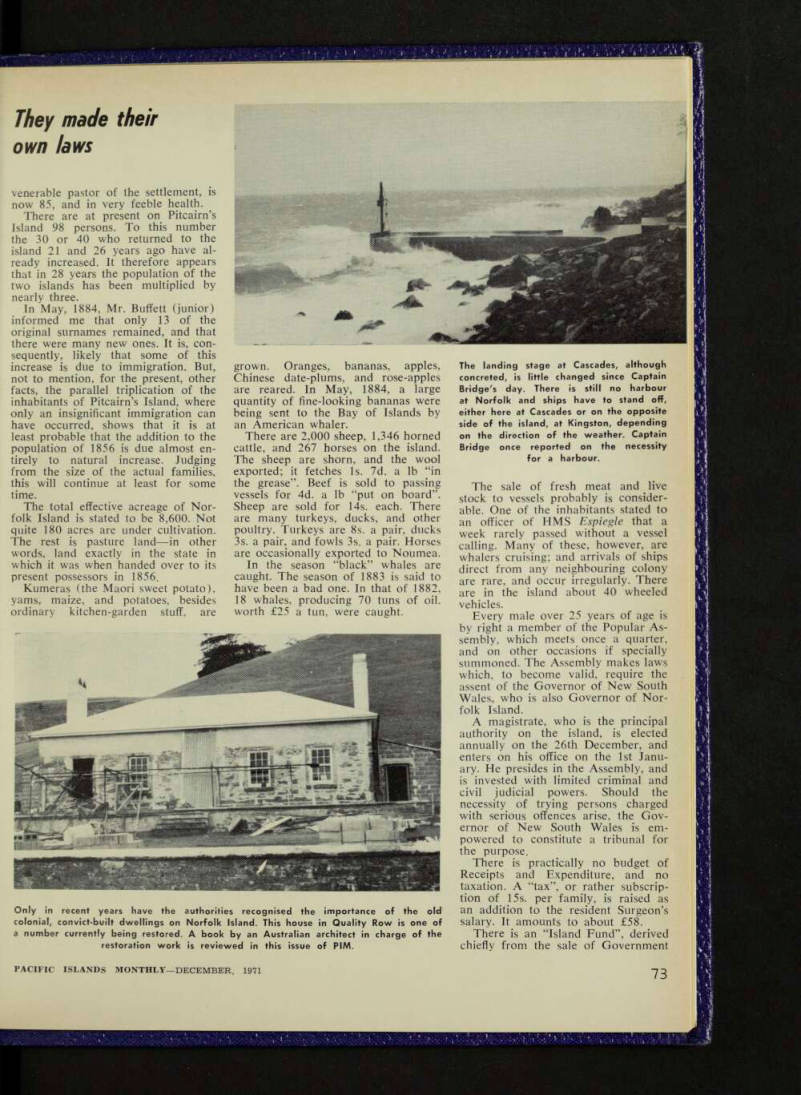
The landing stage at Cascades, although concreted, is little changed since Captain Bridge's day. There is still no harbour at Norfolk and ships have to stand off, either here at Cascades or on the opposite side of the island, at Kingston, depending on the direction of the weather. Captain Bridge once reported on the necessity for a harbour.
Melancholy appearance of settlement
lands to the inhabitants, and of cattle, sheep, etc., to passing vessels. Out of this the salary of the Surgeon (£150) is paid.
Public works are maintained by a system of corvees. Every male resi dent over 18 has to give three and a. half days’ labour a month for six months out of the 12. This labour is principally expended on the roads, which, nevertheless, are badly kept.
Fines are imposed for certain breaches of the law: e.g. ss. for shooting pheasants in the close season.
The Melanesian Mission of the Church of England has its head quarters on the island. Besides the Bishop, there are seven clergymen, one layman, several ladies (wives of the clergy), and about 120 boys and 30 girls from different Melanesian Islands. These numbers vary, as the majority of the clergy are at their stations in Melanesia during great part of the year, and many pupils are sent home at the end of each sum mer.
The Mission clergy have the right of citizenship, but they do not inter fere in island politics. Their help appears to be always at the disposal of the inhabitants; and during the pre sent year, when supplies of certain provisions have run short, they have given of their own stock to those most in need of them.
No vessel has brought supplies to the settlement since December, 1883, upwards of five months ago. As a consequence, there was at the time of our visit a great scarcity of tea, sugar, flour, and stores of that kind. In addi tion to some small presents of these articles made by us individually, I was able to permit, at the request of Mr. Francis Nobbs, the Magistrate, the purchase of about 130 yards of serge and 90 yards of flannel from the ship’s stores, and about 150 lb of flour and 100 lb of sugar from our “ship canteen”.
That the people are in no danger of starvation the enumeration of the live stock and vegetable products of the island given above will be suffi cient to prove. But that, being within four or five days’ sail of Auckland and the same of Noumea, and little more than a week’s sail of Sydney, they should permit themselves to be in want of articles that have become as necessary to their comfort as they are to our own, is a symptom of their condition which, I submit, is worthy of consideration.
In the midst of an abundance of
certain necessaries, there is an ap proach to starvation of a certain kind.
A little flour and some tea were begged of me, in order to keep an aged and respected resident alive.
Some of the more enlightened in habitants do not conceal their con viction that the race is physically de teriorating. The superior physique of the elder men is apparent to the least discriminating observer. Two or three cases of idiotcy have lately appeared.
An infusion of new blood by care fully-guarded immigration is advo cated by some who perceive the grow ing evil of the present system of inter marriage, I was told by a person qualified to form an opinion that the cattle and sheep of the island were falling off in quality, owing to neglect of the ordinary methods of the stock breeder.
The appearance of the settlement is melancholy. Fine buildings are falling into ruin; not only those which are too large—such as the old convict prisons—for the use of the present inhabitants, but also smaller buildings which would make admirable dwell ings.
Several families, I was informed, huddle together in one or other of the cottages, which are built in rows, and which probably formerly housed prison-warders and subordinate offi cials. The roads, notwithstanding the labour expended on them, are not in as good order as might be expected.
The whole place has an air of ex treme slovenliness. An excellent de scription of orange is grown; from want of proper attention, though re taining its size and juiciness, it is now nearly without flavour.
The foregoing statements—every one of which is made on what would be admitted to be high authority— will have conveyed some idea of the material condition of the community.
Its moral condition seems also to have deteriorated.
Observers worthy of credit are of opinion that the high reputation for moral purity of all kinds enjoyed by the Pitcairn Islanders was never quite deserved. Making full allowance for all possible exaggeration, there is good reason to believe that they were con siderably superior in this respect to their Norfolk Island descendants.
There is something so attractive in the history of these people and in their external manners that a visitor is predisposed to attribute to them qualities which they, probably, but seldom possess.
The stranger arriving from Austra lia is at once struck by the absence of any accent in their English, which —except for a slight drawl, apparently an inevitable result of the mixture of our section of the Teutonic family with a coloured race —they pronounce perfectly. The accuracy of their dic tion is complete.
They have inherited from their an cestresses in full perfection the well bred elegance of manner of the Poly nesians, A bare-footed man, with nothing on but a shabby shirt and pair of trousers, sitting at a mess table, manipulating his knife and fork with unimpeachable propriety, ex pressing himself in English with ac curacy and even elegance, and behav ing with a graceful dignity in which the best-born Englishman could not surpass him, is a spectacle that is both unexpected and nearly sure to pre judice the visitor in favour of a com munity able to produce such a being.
Nevertheless, with the graceful de meanour of the Polynesian they have inherited his indolence and procrasti nating habits. The act which led to the first settlement of Pitcairn’s Island [the mutiny on the Bounty ] was of a character to completely vindicate its original founders of the male sex from any suspicion of want of energy.
"Kinder to let them die out"
But they were not the ancestors of all the present inhabitants.
Early in this century strangers from merchant vessels were admitted into the young community. A knowledge of the more remote Pacific Islands will have convinced anyone who pos sesses it that even the best behaved white men who voluntarily settle in them are generally amongst the least energetic of their kind. So that on both sides many of the islanders have descended from an exceptionally in dolent ancestry.
The condition of the island is, therefore, hardly matter for surprise.
I learnt that the failure of the last whaling season was not caused by scarcity of whales, but by want of efficient guidance and supervision.
By their own free admission, many of the islanders abstain from strong drink only because they cannot get it.
The virtue, the possession of which was supposed to be the peculiar merit of Pitcairn’s Island amongst the islands of Polynesia, is now by no means universal amongst the people, and is probably much less common than formerly. It was mentioned that —to use my informant’s phrase—“un necessary immorality” was far from infrequent.
Where there is nothing to prevent those who have not the gift of con tinency from marrying almost just when they please, it is no very un usual sight to see a bride already pregnant at the altar.
The good qualities of the islanders, their gentleness, orderly conduct, sub missiveness, prevent the self-regarding virtues, temperance and charity, from flourishing rather than encourage them. They seem to be deficient in moral robustness, which is so often wanting in Polynesia. On this account it is to be feared that good advice, however freely given, would have but little effect.
For several years they have enjoyed the unusual advantage of close neigh bourhood to a society of well-born, refined, high-principled Englishmen and women, leading a life of singular devotion and self-sacrifice. Yet, unless it has diminished the speed of their moral decline, they appear to have derived no great benefit from it; ex cept, indeed, it be in a material direc tion, as it has probably led to more frequent opportunities of sending abroad for supplies.
I trust that it will not be thought improper if attention be invited to our responsibilities to these people.
To the British Navy they owe their origin. Though that origin was the result of the most serious offence against our discipline possible, the offence has long since been more than condoned.
For 60 years the islanders have been treated by us like petted, if not spoiled children. Gifts have been lav ished on them in great profusion, and then they have been left pretty nearly to their own devices for long periods.
It can hardly be matter for surprise if, in spite of the surrounding abund ance, they are likely to become mere polite claimants of the bounty of visitors.
In consequence of his great age and infirmity, the islanders have already lost the wise guidance of the venerable Mr. Nobbs (senior). It is really pain ful to contemplate their future if they are not fortunate enough to find a suitable successor to him.
The qualifications for the post would be such as fortunately have not been unfrequently combined in the persons of officers in Her Majesty’s Navy, viz., purity of life, energy of character, tact, experience in the man agement of bodies of men, and a practical acquaintance with the hand ling of ships and boats. To be the hus band of a sensible wife would also be a very desirable qualification.
The difficulty would lie less in find ing the man than in finding the means of supporting him. A capable and in dustrious man of high principles and aims going amongst them might pre serve this interesting community in its former purity, might supervise a system of immigration that would in troduce new blood into it, and might so develop the resources of the island as to secure its inhabitants against the want of any reasonable comfort, and raise sufficient funds to support a pro per establishment for their govern ment and instruction.
On this very Norfolk Island there is a company of disinterested gentlemen and ladies who have resigned every
worldly advantage in order to spend their lives in endeavours to christian ise the cannibal inhabitants of certain islands with which England, after all, has but little concern.
To further the efforts of these noble-minded persons, our country men in England and in the Colonies subscribe some £5,000 a year. A few months since the highest lady in New South Wales laboured earnestly and successfully to establish a bazaar, the proceeds of which were added to the funds of this Mission; and of honour able women, not a few cheerfully underwent the fatiguing work of act ing as shop-girls day after day that money might be sent to evangelise the savages of Melanesia.
Probably if their case could be in quired into and its state made known, equal interest would be taken in the cause of preventing the deterioration of a people whose souls are presum ably as precious as those of cannibals, and for whose existence and subse quent petting, not to say spoiling, we are responsible.
If nothing can be done to help the Islanders to stop the moral and physi cal deterioration threatening them, it would be kind to allow them to die out. That they will do so before very long is more probable than their late rapid increase may seem to imply.
That they are still prolific is evi dent enough; but a curious check is likely to be put upon their reproduc tion. More than one-fifth of the popu lation is composed of individuals of the age of puberty who are still un married.
One of the elders stated to an offi cer of HMS Espiegle that the girls were beginning to refuse to marry the young men. If this be the case—and the statistics show that it is not im probable—the cause may be found in an instinctive repugnance on the part of the members of the more perceptive sex to ally themselves with men with whom they are already intimately con nected in blood.