The Editor's Mailbag
pp. 37-38 · Read in the full issue
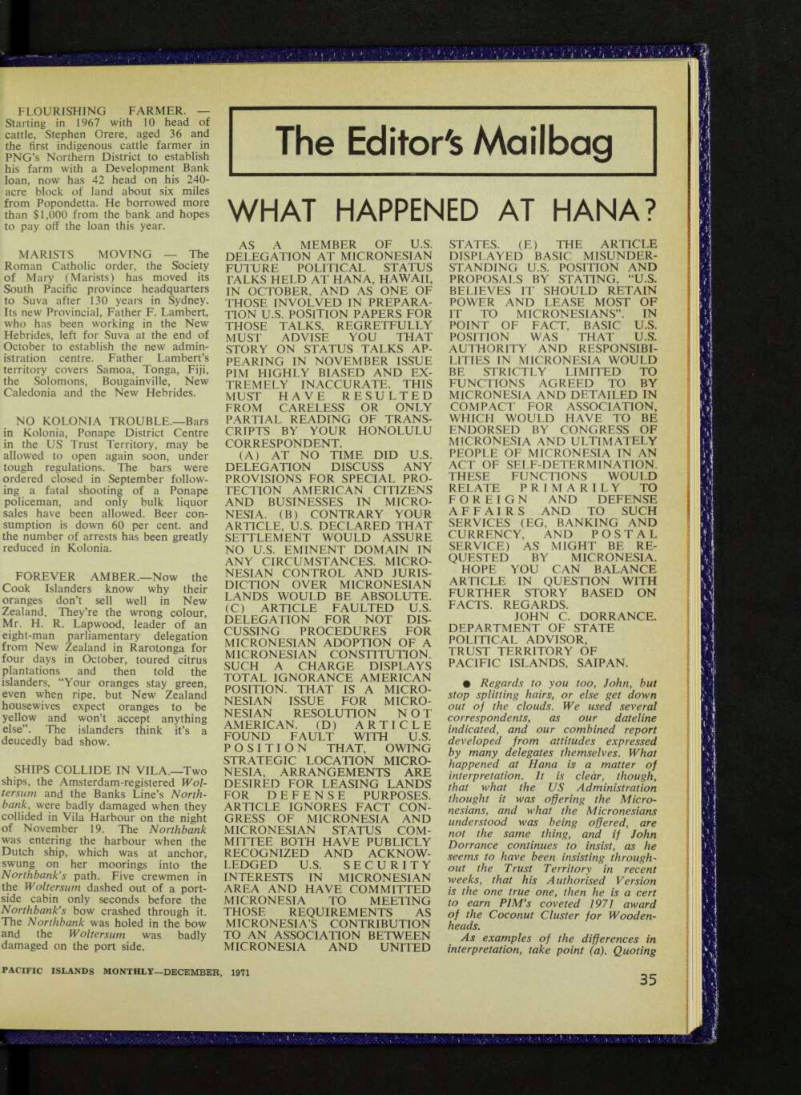
What Happened At Hana?
As A Member Of U.S.
Delegation At Micronesian
Future Political Status
Talks Held At Hana, Hawaii,
In October, And As One Of
Those Involved In Prepara
Tion U.S. Position Papers For
Those Talks, Regretfully
Must Advise You That
Story On Status Talks Ap
Pearing In November Issue
Pim Highly Biased And Ex
Tremely Inaccurate. This
Must Have Resulted
From Careless Or Only
Partial Reading Of Trans
Cripts By Your Honolulu
Correspondent.
(A) At No Time Did U.S.
Delegation Discuss Any
Provisions For Special Pro
Tection American Citizens
And Businesses In Micro
Nesia. (B) Contrary Your
Article, U.S. Declared That
Settlement Would Assure
No U.S. Eminent Domain In
Any Circumstances. Micro
Nesian Control And Juris
Diction Over Micronesian
Lands Would Be Absolute.
(C) Article Faulted U.S.
Delegation For Not Dis
Cussing Procedures For
Micronesian Adoption Of A
Micronesian Constitution.
Such A Charge Displays
Total Ignorance American
Position. That Is A Micro
Nesian Issue For Micro
Nesian Resolution Not
American. (D) Article
Found Fault With U.S.
Position That, Owing
Strategic Location Micro
Nesia, Arrangements Are
Desired For Leasing Lands
For Defense Purposes.
Article Ignores Fact Con
Gress Of Micronesia And
Micronesian Status Com
Mittee Both Have Publicly
Recognized And Acknow
Ledged U.S. Security
Interests In Micronesian
Area And Have Committed
Micronesia To Meeting
Those Requirements As
Micronesia’S Contribution
To An Association Between
Micronesia And United
States. (E) The Article
Displayed Basic Misunder
Standing U.S. Position And
Proposals By Stating, “U.S.
Believes It Should Retain
Power And Lease Most Of
It To Micronesians”. In
Point Of Fact. Basic U.S.
Position Was That U.S.
Authority And Responsibi
Lities In Micronesia Would
Be Strictly Limited To
Functions Agreed To By
Micronesia And Detailed In
Compact For Association,
Which Would Have To Be
Endorsed By Congress Of
Micronesia And Ultimately
People Of Micronesia In An
Act Of Self-Determination.
These Functions Would
Relate Primarily To
Foreign And Defense
Affairs And To Such
Services (Eg, Banking And
Currency, And Postal
Service) As Might Be Re
Quested By Micronesia.
Hope You Can Balance
Article In Question With
Further Story Based On
Facts. Regards.
John C. Dorrance.
Department Of State
Political Advisor,
Trust Territory Of
Pacific Islands, Saipan.
• Regards to you too, John, but stop splitting hairs, or else get down out of the clouds. We used several correspondents, as our dateline indicated, and our combined report developed from attitudes expressed by many delegates themselves. What happened at Hana is a matter of interpretation. It is clear, though, that what the US Administration thought it was offering the Micro nesians, and what the Micronesians understood was being offered, are not the same thing, and if John Dorrance continues to insist, as he seems to have been insisting through out the Trust Territory in recent weeks, that his Authorised Version is the one true one, then he is a cert to earn PlM’s coveted 1971 award of the Coconut Cluster for Wooden heads.
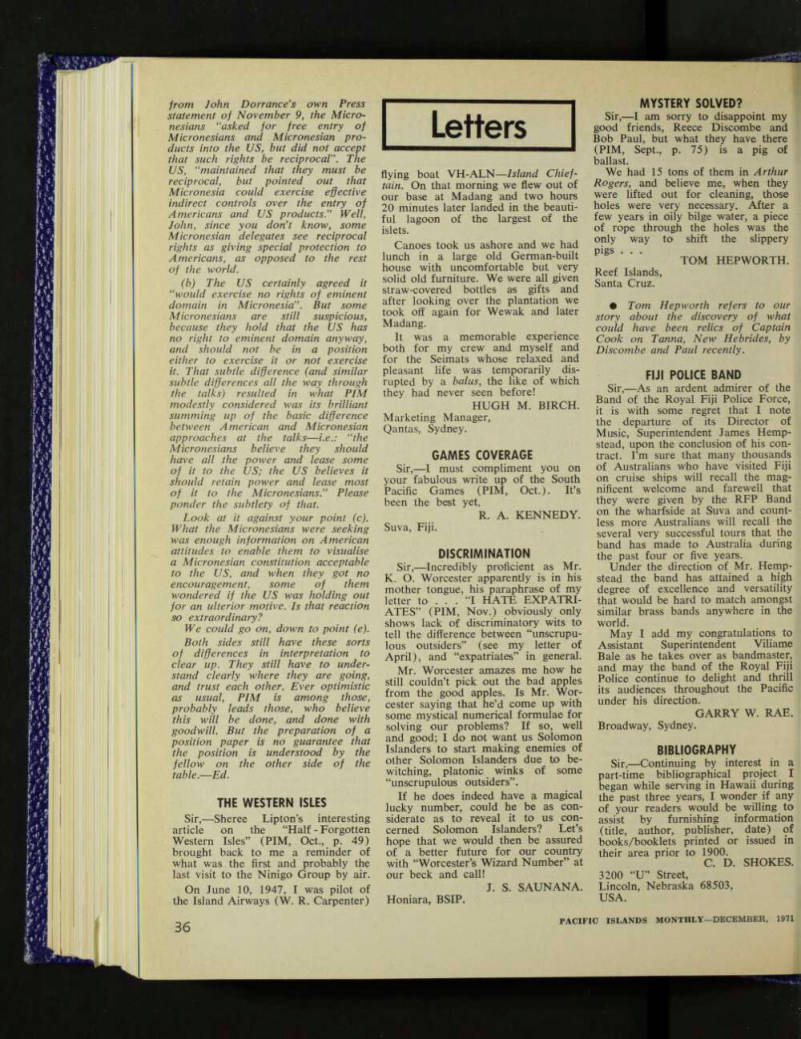
As examples of the differences in interpretation, take point (a). Quoting
from John Dorrance’s own Press statement of November 9. the Micro nesians “asked for free entry of Micronesians and Micronesian pro ducts into the US, but did not accept that such rights be reciprocal”. The US, “maintained that they must be reciprocal, but pointed out that Micronesia could exercise effective indirect controls over the entry of Americans and US products.” Well, John, since you don’t know, some Micronesian delegates see reciprocal rights as giving special protection to Americans, as opposed to the rest of the world. (b) The US certainly agreed it “would exercise no rights of eminent domain in Micronesia”. But some Micronesians are still suspicious, because they hold that the US has no right to eminent domain anyway, and should not be in a position either to exercise it or not exercise it. That subtle difference (and similar subtle differences all the way through the talks) resulted in what PIM modestly considered was its brilliant summing up of the basic difference between American and Micronesian approaches at the talks — i.e.: “the Micronesians believe they should have all the power and lease some of it to the US; the US believes it should retain power and lease most of it to the Micronesians.” Please ponder the subtlety of that.
Look at it against your point (c).
What the Micronesians were seeking was enough information on American attitudes to enable them to visualise a Micronesian constitution acceptable to the US, and when they got no encouragement, some of them wondered if the US was holding out for an ulterior motive. Is that reaction so extraordinary?
We could go on, down to point (e).
Both sides still have these sorts of differences in interpretation to clear up. They still have to under stand clearly where they are going, and trust each other. Ever optimistic as usual, PIM is among those, probably leads those, who believe this will be done, and done with goodwill. But the preparation of a position paper is no guarantee that the position is understood by the fellow on the other side of the table. — Ed.