the Solomons
pp. 25-26 · Read in the full issue
Tax blow for the Solomons
.From a Honiara correspondent On the evening of November 11, in places where Solomons workers gathered for a drink, a smoke and a talk after the day’s toil, easily the most popular unpopular subject of the conversation would be Financial Secretary John Smith and his budget.
Earlier in the day he’d taken the lid off his tax proposals and made it pretty clear that if the islanders want progress and all that goes with it then they’ll have to pay for it by paying more, in the first place, for their luxuries.
And he drove his point home with what smokers and drinkers would call a “brutal hand”. He slapped a $6 a gallon tax increase on spirits (i.e., $1 a bottle); 20c a gallon on beer; 10c a pound on twist tobacco and $1.05 a pound on cigarettes, but drinks and smokes are still cheaper than in most places.
He also added 1c a pound to the sugar tariff, 5 per cent, ad valorem to imported meat and for the first time ever squeezed the ice cream lickers with a 20 per cent, ad valorem duty.
His justification “No absolute necessities” had been taxed; he had to ensure all sections shared in revenue raising and, anyway, the extra duty on meat and sugar meant only an increase of $1.54 for each
of the 31,000 households. He was hoping also that dearer foreign meat would help the local meat cattle in dustry.
There was a little cheer for the copra planters—removal of the $7 a ton export duty though the 10 per cent, ad valorem levy remains. Mr.
Smith wanted a total of $13,351,400 with $6,031,010 to be raised locally and the rest coming from UK grants.
The Secretary of State, however, put a brake on recurrent spending by lopping $186,240 from the $1,900,000 grant-in-aid and refused to allow Mr.
Smith to budget for a $145,680 deficit. The capital budget is a record at $5,853,125.
Although he warned that “1972 will need all our determination and enthusiasm to see our budget pro posals implemented”, Mr. Smith was optimistic about all sorts of things.
TTie Development Plan was going well with 58 of the 286 projects already approved for aid and 32 more waiting, most of them in agriculture.
The oil palm project on Guadalcanal Plains was under way with the first 1,000 acres due for planting by mid -1972 and 250 islanders working on it by the year-end.
Other projects looking up were, rice cultivation on Guadalcanal Plains, meat production, timber— expected to reach 9 million cu. ft by the year-end—the skipjack fishing in dustry survey by the Japanese Taiyo Fishery, tourist industry expansion, exports, which should top $8 million at December’s end, nearly $1 million more than last year, and shipping, which showed a big increase of arrivals over last year’s figure—l3o in the nine months to September against 107 last year.
Then, doing some crystal gazing, Mr.
Smith described economic prospects as excellent with bauxite mining scheduled to begin on Rennell Island in 1975, the proving of a second major bauxite deposit of 30 million tons on Vaghena Island and a feasi bility study of nickel resources on Isabel.
He was cautious about bauxite mining, however. There was a sur plus of aluminium in the world and, therefore, less demand for bauxite and—what was more ominous news —in recent months technological advances have resulted in the produc tion of aluminium without the use of bauxite. There might, he warned, be some delay in the plans regarding Rennell.
But John Smith was nothing if not optimistic. They looked like having so much bauxite there was a chance they could do their own processing and, whatever happened, it looked as
if fishing would be so good their present trade deficit could be turned into a surplus by 1974.
Inflation! That was another danger which he suggested the Solomons could counter by becoming “increas ingly self-sufficient in basic foodstuffs —the most powerful weapon in our armoury against externally - imposed inflation”.
The Secretary of State’s cut in the grants and his refusal to allow a budget deficit a decision which reached Honiara only two days be fore Budget Day—brought a storm of protests from members. Forced to make cuts in agriculture, educa tion, and medical spending, Mr.
Smith faced some angry speakers.
One called the Secretary of State’s handling of the matter “irresponsible” and, at first, no one would accept any cuts.
They had to be realistic, however, and by the debate’s end they had agreed to cuts of $230,000 but were adamant over other items totalling $102,000. They insisted that it was now up to London.
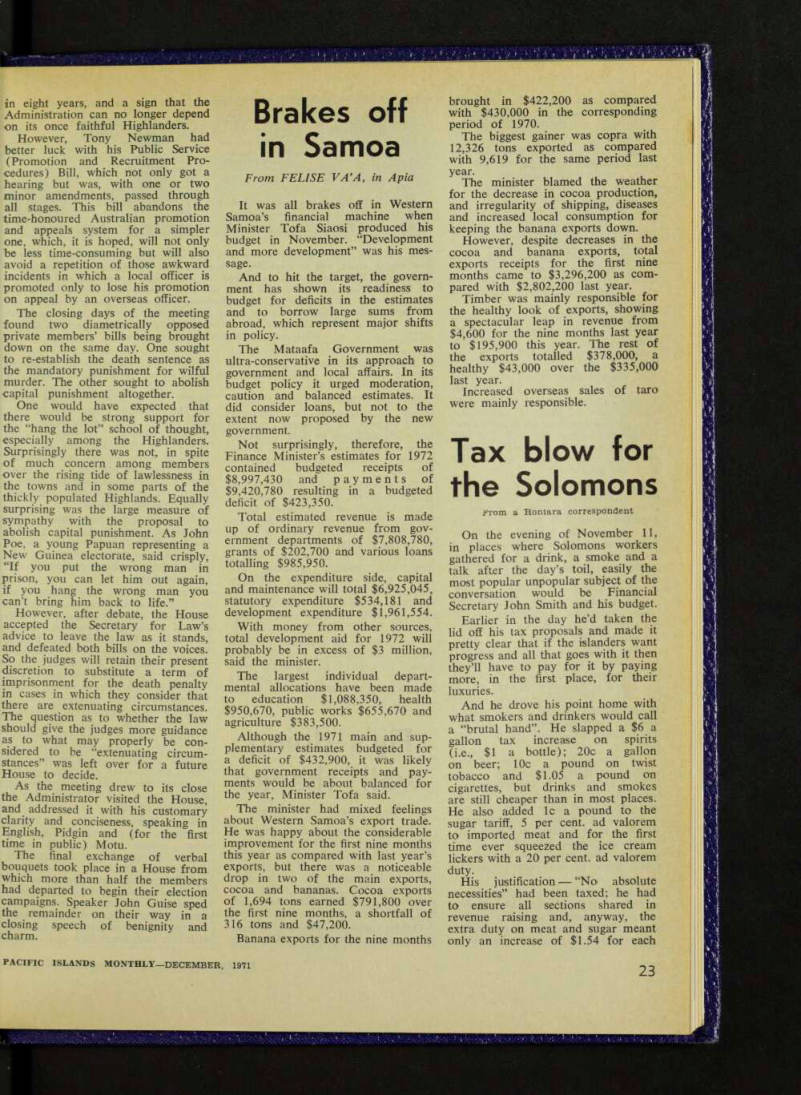
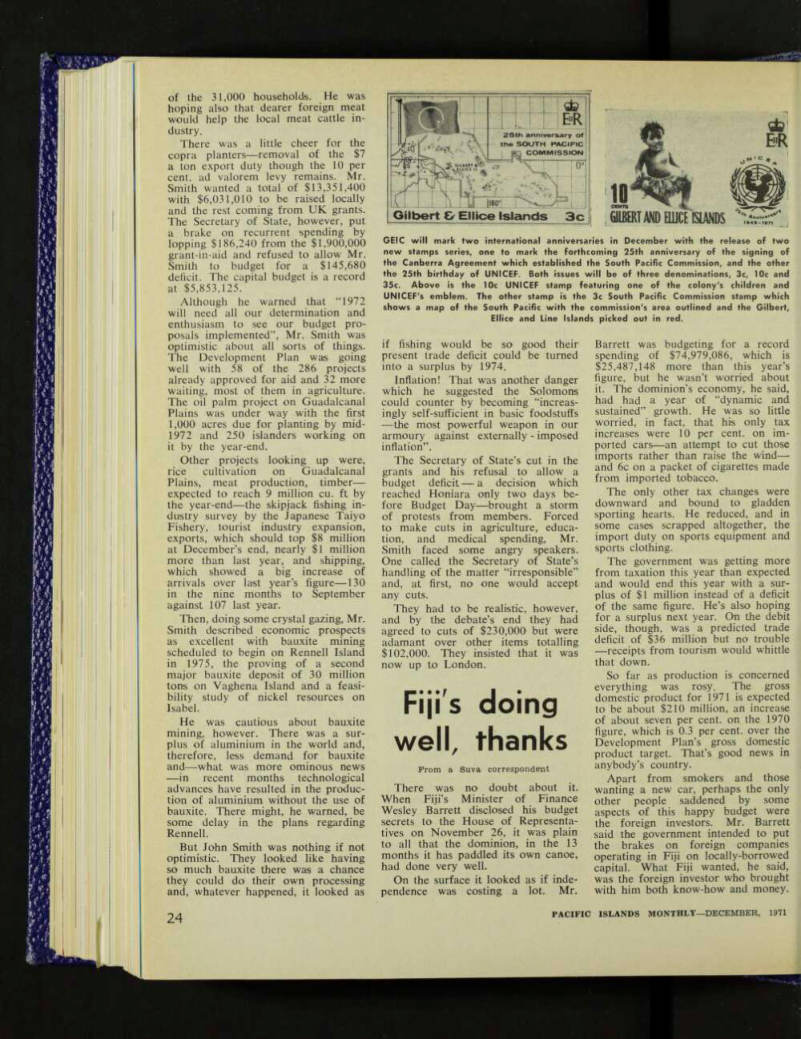
GEIC will mark two international anniversaries in December with the release of two new stamps series, one to mark the forthcoming 25th anniversary of the signing of the Canberra Agreement which established the South Pacific Commission, and the other the 25th birthday of UNICEF. Both issues will be of three denominations, 3c, 10c and 35c. Above is the 10c UNICEF stamp featuring one of the colony's children and UNICEF's emblem. The other stamp is the 3c South Pacific Commission stamp which shows a map of the South Pacific with the commission's area outlined and the Gilbert, Ellice and Line Islands picked out in red.