Pacific Islands Monthly
pp. 24-25 · Read in the full issue
End Of Session Blues (And Higher
Taxes) For Some Islands People
From a Port Moresby correspondent
For the greater part of the four year life of the Second House of Assembly, “party” has been a dirty word. During the last twelve months, however, the pendulum has swung with a vengeance, and one Euro pean MHA has expressed a fear that party politics is in danger of be coming a cult.
It was perhaps to be expected that our young parties currently flexing their muscles would engage in a bit of skirmishing during the last meeting of the Second House in preparation for the elections which will produce the Third House. But the violence of the emotions evoked by these skirmishes was unexpected and dis turbing.
It began on the first day of the meeting when Tim Ward, a member of the United Party, produced a document containing cargo cult type promises allegedly made by the Pangu Party, and insisted on debating it as a matter of public importance.
The debate generated a lot of heat and noise, but from the point of view of United Party campaigning was rather a damp squib. A Pangu Party spokesman was able to point out that the local government council president over whose name the promises appeared was not a mem ber of Pangu, but was in fact reputed to be, if not a member of, at least a sympathiser with the United Party.
It was bound to be only a question of time before an opportunity for “pay-back” cropped up; and a week later Pangu Party leader Michael Somare produced a letter over what was, or purported to be, the signature of none other than the United Party’s secretary, Anton Parau a letter which, it was alleged, had been circulated among Highlands students, and which was couched in terms well calculated to increase existing tensions between Highlands and Coast. This document, too, was debated as a matter of public importance.
This debate, like the earlier one, produced emotional outbursts un equalled before in this young parliament. Interjections were almost
continuous, the din sometimes be coming so great that Mr. Speaker’s calls for order could not be heard.
At one point the Speaker threatened to suspend the sitting.
The only speech listened to with out interruption during this debate was one by prominent Papuan politician Gala Oala-Rarua, in the course of which he remarked acidly that he was not a separatist and was still hoping for national unity in Papua New Guinea, but that if the New Guineans were going to quarrel among themselves with such ferocity, Papuans might do well to consider whether they would not do better going it alone.
It was Gala Oala-Rarua who secured the addition of a rider to the motion “taking note” of the revised Five Year Plan, calling on the government to promote balanced development of all areas rather than
maximised development of those areas which promise maximum returns.
Another exercise which had a strong smell of electioneering about it was a United Party instigated and supported move to raise the deposit demanded of candidates in House of Assembly elections from $5O to $lOO.
This proposal was opposed by Pangu Party, several independent members and a solitary United Party member, Fr. Nilles.
These objectors pointed out that the increase would favour firstly sitting members, whose salaries and allowances continue through the campaign period, and secondly affluent candidates and affluent parties. Pangu’s enfant terrible, Pita Lus, made no bones about accusing the United Party, reputedly the most affluent of the three parties repre sented in the House, of using this ploy to entrench its own position by reducing possible opposition to its candidates.
The proposal was nevertheless im plemented by a substantial majority.
Confrontation between parties was succeeded by confrontation between official and elected members. A gov ernment white paper on the future security of permanent overseas officers in the Public Service had been debated, and the usual motion to “take note of the paper” had been amended in terms which in effect amounted to a rejection of the pro posals contained in the paper.
This put the government in a quandary, as it had prepared a series of bills framed to give effect to the white paper’s recommendations.
Senior Official Member Tony New man, unwisely as it turned out, decided to bring down the bills regardless.
The amour propre of the House was affronted; those arch-enemies, the United Party and Pangu, joined hands, and with the Peoples’ Progress Party rallying to their support the government was forced to its knees and obliged ignominiously to with draw the whole group of bills. It was Konedobu’s most resounding defeat
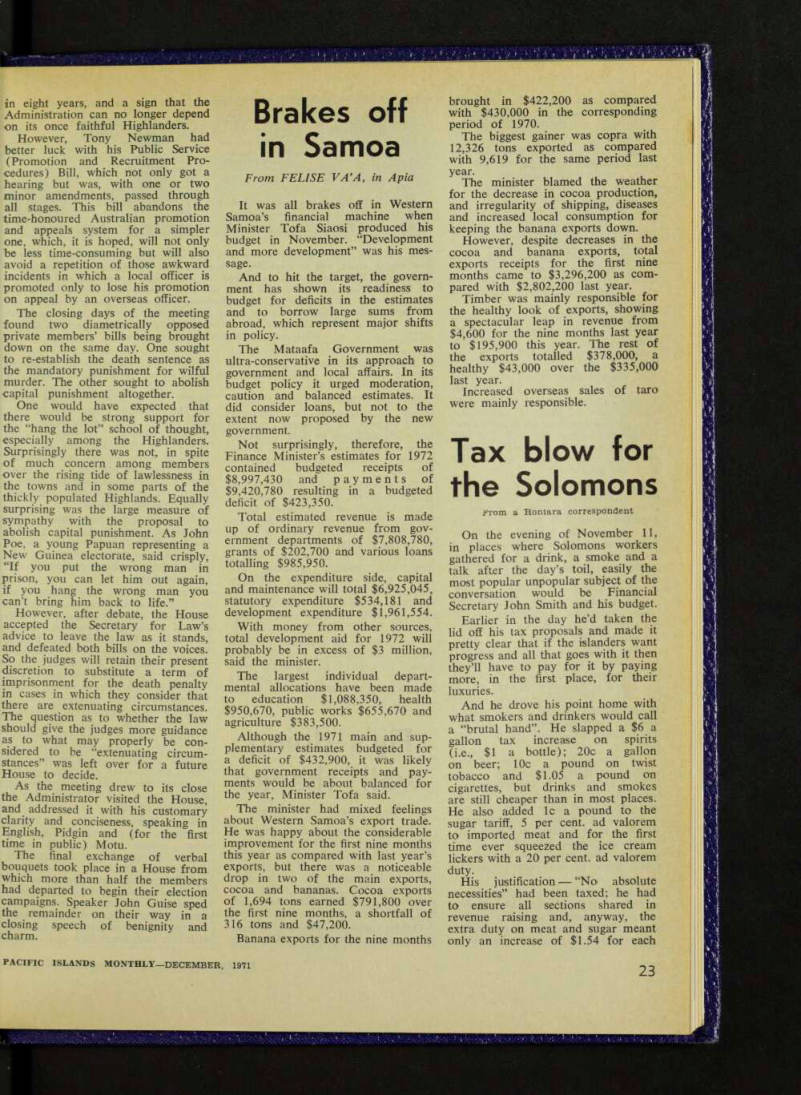
Warm tributes were paid by members of the PNG House of Assembly in November to the work of Mr. Percy Chatterton, MHA, 73, retired missionary and long time parliamentarian and resident of Papua, who will not contest his seat in the House next year. He says he wants to relax—which nobody believes.
in eight years, and a sign that the Administration can no longer depend on its once faithful Highlanders.
However, Tony Newman had better luck with his Public Service (Promotion and Recruitment Pro cedures) Bill, which not only got a hearing but was, with one or two minor amendments, passed through all stages. This bill abandons the time-honoured Australian promotion and appeals system for a simpler one, which, it is hoped, will not only be less time-consuming but will also avoid a repetition of those awkward incidents in which a local officer is promoted only to lose his promotion on appeal by an overseas officer.
The closing days of the meeting found two diametrically opposed private members’ bills being brought down on the same day. One sought to re-establish the death sentence as the mandatory punishment for wilful murder. The other sought to abolish capital punishment altogether.
One would have expected that there would be strong support for the “hang the lot” school of thought, especially among the Highlanders.
Surprisingly there was not, in spite of much concern among members over the rising tide of lawlessness in the towns and in some parts of the thickly populated Highlands. Equally surprising was the large measure of sympathy with the proposal to abolish capital punishment. As John Poe, a young Papuan representing a New Guinea electorate, said crisply, “If you put the wrong man in prison, you can let him out again, if you hang the wrong man you can’t bring him back to life.”
However, after debate, the House accepted the Secretary for Law’s advice to leave the law as it stands, and defeated both bills on the voices.
So the judges will retain their present discretion to substitute a term of imprisonment for the death penalty in cases in which they consider that there are extenuating circumstances.
The question as to whether the law should give the judges more guidance as to what may properly be con sidered to be “extenuating circum stances” was left over for a future House to decide.
As the meeting drew to its close the Administrator visited the House, and addressed it with his customary clarity and conciseness, speaking in English, Pidgin and (for the first time in public) Motu.
The final exchange of verbal bouquets took place in a House from which more than half the members had departed to begin their election campaigns. Speaker John Guise sped the remainder on their way in a closing speech of benignity and charm.