Business and Development
pp. 98-102 · Read in the full issue

Things are
tough in the
Cook Islands
The Cook Islands Government is in hock to Rarotonga firms to the tune of $350,000. Or so the story goes in Rarotonga where there is confirmation offered in the shape of a refusal by some of the firms to supply any more goods on credit to government stores.
Other stores still accept orders but are charging 1 per cent, per month on overdue accounts. Govern ment penury is also reflected in private sectors which have been affected by a severe curtailment in government spending.
This has also reduced citrus pro duction. Island Foods Ltd.’s factory has reported a drop of more than 40,000 cases of fruit for processing this year, which represents a loss to growers of about $62,000. The future of the citrus industry looks glum with grower interests declining and many orchards showing neglect.
Shippers report a general slowing down of cargo between the islands in the group but this time of the year usually sees a drop in freight move ments with the citrus season at an end and pineapple production not due to start until late November.
Large numbers of government workers have been laid off, almost 100 in Rarotonga alone, and trading firms report big reductions in cash sales with consequent increases in applications for credit.
One major sales and service firm complained that business was all “to hell and gone” over the past two months with sales in August and September down to less than half the June volume.
The islanders were hoping that New Zealand would come to the rescue at the behest of Premier Albert Henry who went there look ing for an extra $1.2 million to tide his country over the crisis, but hopes were somewhat dashed when Mr.
Henry, on the eve of returning home
on October 20, wailed that he had asked for a loaf of bread and got only half a loaf.
But that half loaf is worth $500,000, which the NZ Government had fixed as the most it would hand out on this occasion. Mr. Henry was downcast. He doesn’t expect that even his persuasive pleading will be able to loosen New Zealand’s purse-strings further.
The NZ Government’s financial re view team headed by Mr. B. D. A.
Crieg, recently retired comptroller and auditor-general of the NZ Gov ernment, has been in the Cooks assessing the situation.
The team was expected to follow up rumours of serious overspending by some government departments with suspected inefficient administra tive machinery. It’s not clear what the team found but, if the amount the NZ Government has agreed to hand out is any criterion, the team has found that things are only about half as bad as has been reported.
This won’t cheer the Premier how ever. He was decidedly despondent when he left for home.
“I am an unhappy man returning to the islands not knowing what will happen,” he said.
Tonga digs the
modern dream
From BETTY SANFT in Nukualofa King Taufa’ahau of Tonga calls his first exploratory oil well now being drilled at Maafanga, two miles out of Nukualofa, Kumifonua, which means exploring or prospecting. But Fonua, often used in Tongan poetry, means a place of rest, where dreams can come true, which is probably what his Majesty had in mind when he named it.
He was on his state visit to India with his Queen Mata’aho when the well was spudded in on October 5 with Prime Minister Prince Tuipele hake setting off the drill rig which could make dreams come true of a Kuwait in the South Pacific.
The king’s brother didn’t mention dreams. He was down to earth with a warning that “if there is no oil in Tonga then no amount of drilling will produce it”, and then on a much higher plane with, “But, if God is with us in this project, then we shall strike oil”.
A crowd of several hundreds flocked to the site, a flat, open acre
where a 106 ft drill rig, two huge mud tanks and pumps, a large diesel oil tank to feed the generators and all the wheels, dials, bits and pieces needed for the operation had taken the place of coconut trees and bush.
There were 30 operators there, all mining engineers from the Hague, and 27 highly-skilled technicians from Australia, representing four sub contracting firms.
The events of early October were the culmination of three years of exciting activity following the dis covery of the first oil slick off the island of ’Eua in August, 1968 (PIM, Oct., 1968, p. 27). This brought a flow of geologists and oil company executives from major cor porations. Some took the rough boat
trip to ’Eua, all wanted to interview the king. fhen, suddenly, there was oil everywhere, with seepages showing up on the main island of Tongatapu in backyards, gardens or up country where villagers were digging their yam pits or a posthole or a waterwell. Even the turn of a fork in the soil brought oil.
There were those who recalled that over the years a black, noxiouslooking stuff had thwarted many an attempt to sink a waterwell. There were wild stories and hopes of Tonga floating on oil and wishful thinking in next-door Fiji that perhaps they
could have a little oil with their sugar.
As the experts came and went with renewed_ interest, there were rumours of . f f b “J. ous . 9 ffers help including w !* at the ,~ wld ca i, s^if, l T es j ? u i s Government r, J htly d “ lded to resist all individual ? ffe , r k s . and takeovers and take time to i? in * 4 , .
There were two very good reasons for this go slow policy—the Minerals Act was found to be woefully anti quated; and there was no impartial consultant in the kingdom to give technical advice, In both these aspects, the United Kingdom, as Tonga’s treaty partner,
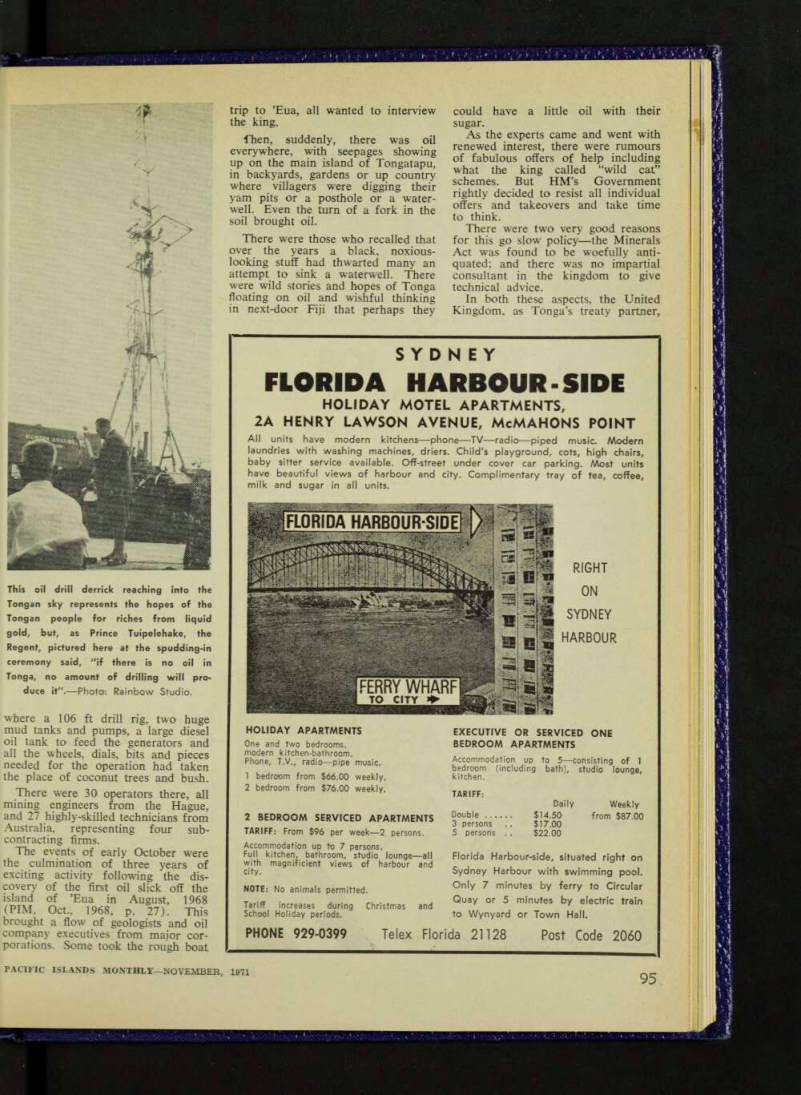
This oil drill derrick reaching into the Tongan sky represents the hopes of the Tongan people for riches from liquid gold, but, as Prince Tuipelehake, the Regent, pictured here at the spudding-in ceremony said, "if there is no oil in Tonga, no amount of drilling will pro duce it".— Photo: Rainbow Studio.
came to her aid with the provision of an oil expert for close consultation. „„ . , , , , When the act was upgraded and government moved with more confidence, oil talks were held m London between the British, the Tongan Government and major oil companies, The outcome was a six-member consortium signed up to carry out invest!gallons over an area that takes in the mam island groups and much of the ocean floor m between, A subsidiary of the Shell Group, the first in Tonga as suppliers of
fuel oil, was set up to head the search. Tonga Shell NV established headquarters in Nukualofa in mid -1970 and moved reasonably fast s i nce then with geological and mag netometer surveys on land and off .
They have now reached the significant point of drilling the first exploration well. the time of writ ing, Kumifonua No j has reached a depth of 1?800 working around the clock, seven days a wee bringing a touch of drama and a sense of anticipation to the lives of the people of this quiet corner of the Pacific.
Suva land
values soar
A revaluation of land within the boundaries of Fiji’s capital, Suva, has ballooned the total value to $51,725,270 compared with the original figure of $13,512,407 set six years ago.
The increase means a much bigger rate bill for Suva landowners al though the City Council is expected to cut its present rate of 5c in the dollar to something like 1.13 c.
Shopkeepers and people living in the recently-developed areas will feel the draught more than dwellers in the older parts of the city. Muanikau ward, one of the more “exclusive” areas, has had its land values raised from $1,915,000 to $7,558,000. Suva ward’s figure is $29,999,000 compared with $7,776,000 and Samabula’s rises from $3,829,000 to $14,167,000.
Among the shopowners, Morris Hedstrom Ltd. have had their site, which covers more than an acre, in creased from $159,488 to $657,800, while Gumming Street shop sites most occupied by Gujerati shop keepers, have jumped from around $B,OOO to more than $50,000.
The increases, according to Lands Department senior valuer, reflect the heavy demand for sites which have sent land prices zooming since 1969.
Ratepayers have until the year-end to appeal against the new valuations, which could create an interesting situ ation if some of the valuations were upset. The City Council will fix its 1972 rate in November, using the new valuation figures. Should these be greatly reduced on appeal, the council would find itself a long way from balancing its 1972 budget.
Work starts on
the new Casino
Although the Western Samoa parliament had already approved the removal of the old German Casino Hotel on the Apia waterfront, nothing can hide the fact that the decision is controversial.
Built during the German colonial era (1900-1914) as a kind of rest centre for aged and sick servants of the Kaiser, the Casino—-until the emergence of Aggie Grey’s hotel— had always enjoyed eminence as Western Samoa’s leading hotel.
It had become an historic land mark in the capital of the first inde pendent Polynesian nation and a
remembrance of the good old German days. Many of Western Samoa’s leading citizens are de scended from early German settlers and still have many relatives in Germany.
Now, the Western Samoa Hotel Co. Ltd. has announced that work has already started on the new Casino Hotel, to be built just behind the old one. The new 100-room Casino will be owned by the Western Samoa Hotel Co. Ltd. with 300,000 $1 shares, and Naviti Investments of Fiji with 100,000 shares. The first 50 rooms are expected to be ready by the end of next year.
Nothing came of the Travelodge proposal for the development of the Casino because the government dis liked the idea of diverting the present road in front of the Casino. Ap parently, according to the govern ment’s way of thinking, this was more of a landmark than the old German building.
The beloved road past the old Casino Hotel in Apia (right). The hotel is fated to disappear before the march of progress and be replaced by a new 100-room Casino, further back on the site. Sentimental ties with the past era cannot compete with the demand for economic development, it seems.
Share gift offer
boomerangs on BP
The Fiji Government has rejected an offer by Burns Philp (South Sea) Co. Ltd. of 200,000 shares at an “advantageous price” as an indepen dence gift.
The shares, which were offered at $2.50, 50c above par, are around $3.15 on the Sydney Stock Exchange.
If the government had accepted the offer, it would have received about the middle of October a final divi dend of 5 per cent, plus a special dividend of 2i per cent., a total of $30,000 on the 200,000 shares.
In a written address delivered at the annual meeting in Suva on October 16, which he was unable to attend having broken a rib in a fall, chairman Sir Maurice Scott said the share offer was in recognition of the government’s wish to take an in terest in local enterprise.
The government’s reaction was to suggest that the shares be sold to Fiji citizens at the same price, but Burns Philp is not expected to agree to this as it would leave the situation wide open to speculators. Burns Philp (SS) is now on the horns of a dilemma The company’s net profit for the year was $683,894.
Carpenter profit
a record
The Fiji dock strike in April and May caused some loss of profit to the Carpenter companies there, but the amount was impossible to assess.
This was stated in the preliminary re port to June 30, 1971, of Carpenter Holdings Ltd., released in October.
There were also substantial losses in earnings in the group’s stevedoring division because of the strike. Island Transport Ltd., the Carpenter local shipping operator, had a net loss of $51,007 in the latest financial year, as its three ships were tied up for the duration of the strike.
In spite of all that overall turn over and profits of the group in Fiji were at record levels. Total mer chandise sales increased by 11.5 per cent, over the previous year. The industrial activities of Millers Ltd. maintained a high level of output, while building construction also made an important contribution to profits.
The Carpenter group in Papua New Guinea lifted total merchandise sales by 10.7 per cent., but sub stantial cost increases cut profits to be low last year’s level.
The group’s automotive division, following management changes and an internal reorganisation, returned to a satisfactory level of profitability.
Progress in the tea industry continued to be good, with production up; coffee production was up, so was copra and cocoa (but prices dropped).
The company’s net profit was a record $6,747,896, compared with $6,035,809 in 1969-70. The net earning rate on the issued capital was 37.5 per cent. The final dividend is 10 per cent., making a steady 20 per cent, payout for the year. • ANG Holdings Ltd., investment and development company, has de clared its first dividend—s per cent, on a net profit of $380,537 for the year ended June 30. In 1969-70, the company’s net profit was $149,706, while in 1968-69 it was $6,000. • Reports of a plan to build a cable car to Robert Louis Steven son’s tomb atop Mt. Vaea, above Apia in Western Samoa, and also of a Canadian Government offer to build a hotel on Mt. Vaea, have been termed “rumours” by the Western Samoa Department of Economic De velopment. • Potlatch timber operations in Asau, Western Samoa, are reportedly in full swing, although there is still some trouble with the Asau wharf for larger ships.