Pacific Shipping
pp. 89-93 · Read in the full issue
Plan to cure rank trouble
Australian shipping interests are jetting their heads together in an ittempt to streamline loading pro cedures and eliminate money-wasting ‘rank trouble” which delays Islands’ cargo getting on to the wharves.
Co-operating in the task are the \ustralian Stevedoring Industry Authority, the NSW Maritime Ser vices Board, shipping companies, hippers and road transport operators.
The present expensive system has ;one on for years, and although nost of those interested have been iware of the problem, little has »een done to overcome it, and indi idual efforts have failed. A few nonths ago the parties concerned ;ot together and formed a working roup to look at the problem from 11 angles.
After several meetings it was greed that one of the biggest ship jng companies in the Islands trade, karlander, should conduct an exped ient to develop a method to over ome the delays. This method J similar to one operated by the lersey Docks and Labour Board, ut the decision to use it was arrived
t independently.
At present, apart from the Kar mder experiment, expensive delays re occurring, the cost of which is ventually passed on to the purchaser i the Islands. To the casual observer appears that a little streamlining r rationalisation would cut costs, he problem is one peculiar to the dands trade as far as the Sydney harves are concerned.
When ships are loading for the dands, it is usual to see long queues f vehicles along the main streets cading to the wharves. Sometimes vehicle may wait all day, and then ie driver will be told to come back
the next day. But what must be so painfully expensive is the cost of a driver of a three-ton lorry, carrying two or three packages—at least $36 a day in waiting time.
Perhaps an amount like that could conceivably be spread over a 10-ton load without greatly affecting the price of the goods, but the imagina tion boggles at the thought of what it could do to a few outers of corn flakes on a three-tonner.
Last year, Australia shipped 640,000 tons of goods to the Pacific Islands from Sydney, which means big savings with an efficient delivery and receiving system, followed by efficient handling on the wharf. For one reason or another, cargo for the Pacific Islands does not get across the wharves as efficiently as cargo for other world markets. Possibly this is because of the nature of the cargo—almost anything from a packet of pins to a tractor, requiring
more detailed attention, compared with bulk cargoes of frozen meat, wheat, wool, and other products destined for populous markets.
It doesn’t suit road transport opera tors to have their vehicles tied up in queues on the way to the wharf; nor does it suit the shipping com panies, who want to cut down their time on the wharves. The Maritime Services Board would prefer to have ships turn round quickly. No shipper is happy to deal with com plaints from his clients in the Islands, suffering from inflation as well, at having to pay more and more for their goods.
The experiment carried out by Karlander was in loading the Golden Swan for Honiara, Kieta and Rabaul.
In the experiment, the shipper makes his cargo booking in the normal way.
When Karlander has a ship arriving and has been allocated a berth, the shipper is advised and also told how long the ship will be at the wharf to receive cargo.
He is also given a telephone num ber to call at the wharf to receive a time slot for delivery of cargo.
It is then up to the shipper to play his part.
Karlander worked the Golden Swan on what they called a “time bracket”, aimed at handling a certain number of vehicles an hour. While there were a few initial “bugs” with the Golden Swan, they were amazed how quickly the vehicles went through without any sign of a queue in the road leading to the wharf. The longest time it took to handle any one vehicle was only 36 minutes.
One of the bugs was failure of some suppliers to appreciate sufficiently what was going on. They sent their vehicles along up to four hours be fore their allotted time slot.
But Karlander is confident they can iron that one out, so confident that they will soon change their whole fleet over to this new system. While Islanders may not find the prices of their imports falling, at least they should find they are being contained.
Conpac (Burns Philp and AWP) rarely suffer “rank” trouble because their ships in the Australia-Papua New Guinea trade operate from new wharves which can handle several vehicles at a time.
Swire and Gilchrist, a major ship ping company in the Islands trade,
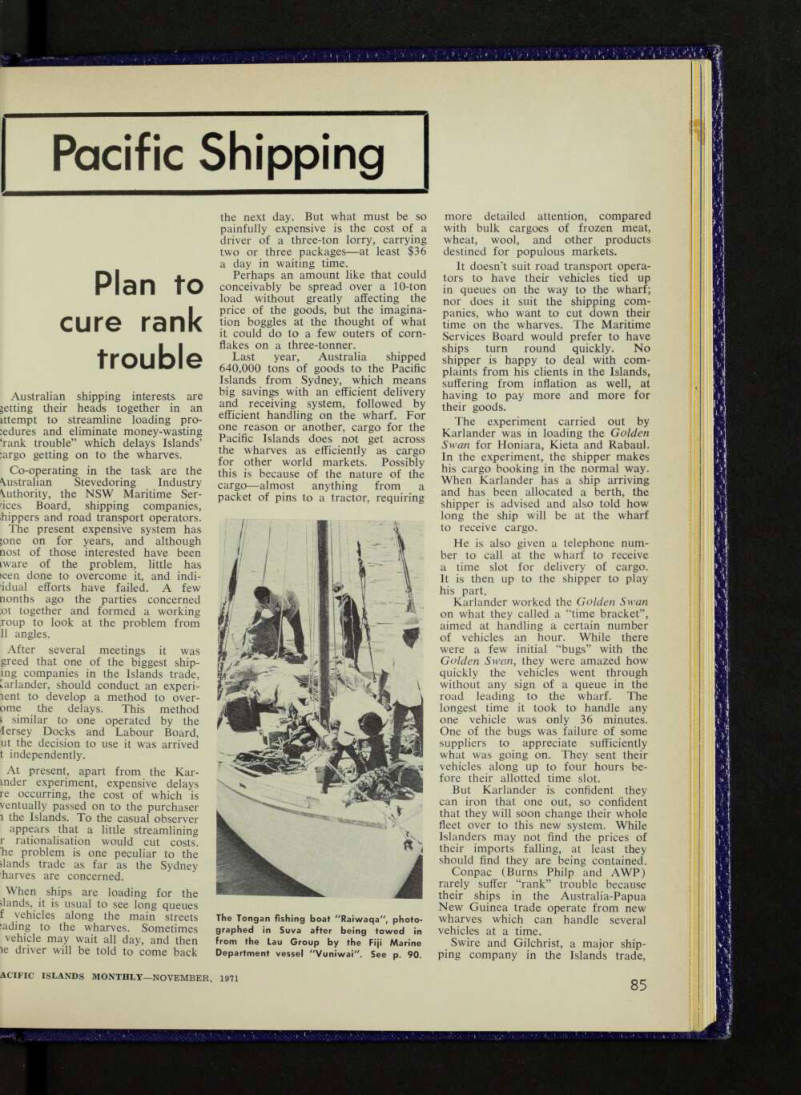
The Tongan fishing boat "Raiwaqa", photo graphed in Suva after being towed in from the Lau Group by the Fiji Marine Department vessel "Vuniwai". See p. 90.
have also introduced a system aimed at eliminating the “rank”. They ask shippers to watch their daily adver tisements in a shipping newspaper.
This advertisement gives full instruc tions about delivery of cargo. Ship pers are asked to advise the shipping clerk at the wharf the day they pre fer to deliver cargo, allowing steve dores to regulate delivery and to estimate the labour force required.
Png Shippers To
Fight Rising Rates
A shippers’ council is being formed in Papua New Guinea to try to com bat rapidly-rising freight rates be tween Australia and the Territory.
According to a Port Moresby report, a similar move is being made by Sydney exporters.
However, PIM inquiries among major exporters failed to reveal any such move in Sydney, although one shipper said, “It is high time shippers got together to form such an asso ciation”.
Freight rates between Australia and PNG have risen twice in 1971 by 15 per cent, in March and a further 9 per cent, in June. These have added to the already high cost of most consumer goods in PNG.
They have also added to the prob lems of producers of the Territory’s main export crops which are already in difficulties because of depressed world markets. For example, the price of shipping copra from Port Moresby to Australia has risen from 117 a ton in January, 1970, to $27.60 in July, 1971.
Both the Territory Administration and the Australian Government have oeen worried that increases would affect massive trade between the two countries.
In the year ended June 30, 1970, Papua New Guinea’s import bill was &211.7 million—sll2.6 million of which went to Australia.
In the same period the Territory >old $41.3 million worth of goods, 14 per cent, of its total exports, to Australia.
Decision to set up the council was nade at a meeting of Government ind businessmen in Lae in October.
Nauru Line
Puts Up Rates
Nauru Pacific Shipping Line, from November 15, will increase freight rates from Australia to the Pacific [slands by amounts ranging from 10 per cent, to 22.5 per cent, to meet ises caused by a “world-wide in lationary trend, further aggravated )y a rise in local costs of labour md materials”. Ports in New 3uinea, Guam and Fiji had all be come more expensive to work over
the last six months, said the company. The Nauru company left most of its rates unchanged when other lines raised theirs in July and August but the latest increase on rates to Fiji is the second since August.
The new rates are: Melbourne- Guam, up 10 to 15 per cent, on present JUS3B.BO; Melboume-Port Moresby, up to 124 per cent, on SA3O, ($33.75); Melbourne-Lae, Madang, Rabaul, up 124 per cent. on $31.20 (about $35.10); Melbourne-Kieta, up 12i per cent. on $36 (about $40,50); Melbourne- Fiji, up 22i per cent, on $29.30 (about $35.90); Sydney-Fiji, up 15 per cent, on $29.30 (about $33.69).
Trouble Looms Over
New Nz-Tahiti Service
, ... ... , , H v , u ?* ave a , shl PP ln ?, P el 7 lce t . wl * N « w Zealand, provided by the French °*ned S ° £rana Lme - Hol “ sh 'PP>»g c °- runs a charter vessel ° n th ® r °T Auckland and Pap f ete A the German-owned Luhe “nd- Holm had some doubts about continuing its service unless the NZ Government backed it against loss.
Not that the Luhesand operated at a loss. Captain J. F. Holm, managing director of the Holm Ship ping Co., said the Luhesand had been making a profit lately. Although it
was unlikely it would need any gov ernment money, a safeguard up to a ceiling of SNZSO,OOO over nine monies would be needed to keep the service running.
However, it appears that Holm has no intention of abandoning the ser vice. Holm is negotiating with the German owners for a renewal of the charter.
But New Zealand seamen are threatening trouble. They feared that the Luhesand might be taken off if Sofrana moved in with New Cale donian seamen, who would be paid at lower rates. They threatened to picket any Sofrana ship which started to service the route, and asked the government to take action.
Sofrana plans to start the service in November, using the Capitaine Cook.
A Whale Of A Tale
Two men trolling off Rarotonga recently in their 14 ft launch accidentally hooked a whale and almost got towed under the surface.
Dick kuddell and a friend were fishing off the north-west coast at Nikao when they sighted two whales splashing in the ocean a short dis tance away. Then their fishing reel screamed and something began to tow the launch astern.
Dick cut the line and cleared the propeller of tangled line. They lost 100 yards of line and two lures and one of their big hooks was straightened by the mammal.
“It must have been another whale,” he said later. “If I hadn’t managed to cut the line when I did it would’ve dragged us under.”
Three Of The
Best From The Captain
The Suva waterfront has never seen anything like it—a mass spank ing for a crew by the captain.
Going on board his Korean fishing ship Nam Hae 256 one morning in September, the captain found his 22man crew fast asleep after an ex hausting night ashore. Rousing them, he made them all lie, face down, on the deck.
Then, with a piece of six by two, he went down the line and gave each man three belts on the backside.
One man laughed and got a bonus of three more strokes.
Strike Echoes
The Fiji dockworkers’ strike in May is still creating echoes in the GEIC. The colony is suffering from a shortage of paper and building materials, cargoes of which have been strike-bound in Suva or have been off-loaded at other ports and have not yet found their way to the colony. One cargo, which was over carried, finished up in the Queensland city of Townsville.