Yesterday
p. 77 · Read in the full issue
Whatever happened to Chou-Chou?
Who's Chou-Chou? Well, according to the front cover of PIM for November, 1951, Chou-Chou is, or was, Chou-Chou Kerimarec, a Papeete beauty, bare-topped except for a leis, who was photographed with "well-known American producer of striking pictures for magazine covers, Roy Armstrong" who'd done a painting of her for a United States magazine. (No, not that one! It wasn't going then!) This preoccupation with Chou-Chou was prompted by the fact that there was very little else to get enthusiastic about around the Islands 20 years ago this November. It was a sort of silly season. Plenty of small happenings, some important, like the first news of a battalion of Fijian troops going to Malaya to fight the terrorists; some a carry over from the previous month, like the slump in copra prices; but nothing world, or even South Pacific shaking.
Take the news about the Fijian battalion.
It caused quite a stir in Fiji, but only because some people thought Fiji needed her fine young men at home rather than have them fighting terrorists in the Malayan jungles. PIM calculated that on a population basis Fiji would be contributing more fighting men than any other country. To do as well as Fiji, Australia would have to send 40,000 men.
The Fijians volunteered in their thousands.
A battalion went to Malaya and covered itself with glory. A book on the campaign written by a commander of a Welsh battalion, "Shoot to Kill", was loud in its praises of the Fijians. Not only were they top of the league in the number of terrorists accounted for, wrote the colonel, they even beat everybody else at cricket!
But the copra planters weren't thinking about Fijian soldiers, or about Chou- Chou. They were still worrying during that quiet month about copra prices.
A headline said they feared "another blitz" and an article by J. Bryan blasted the BSIP Copra Board over its dealings with the visiting British Minister for Colonial Affairs, Mr. John Dugdale. Mr, Bryan complained that the case for the planters should have been put by the planters themselves and not by a government-created body.
"The Pacific Islands are not free from the blight of our civilisation under
which officialdom becomes a hide bound bureaucracy," he wrote.
Mr. Dugdale had also upset people in Fiji. During his tour he pointed to some land in Nadroga which appeared to be going to waste. He was very critical of it, but nobody told him that it wasn't Fijian land lying neglected but European-owned land which was waiting for roadmakers to go through. The observation was made that "if the British Government had presented the Fijians with a fraction of the millions squandered on groundnuts and poultry schemes in Africa, Fiji would now be an exporter of rice."
By the way, at that time New Guinea copra was fetching £76 a ton for plantation hot-air dried, £75 for FMS and £74/7/6 for smoke-dried. Today, the planters face crisis again (PIM, Oct., p. 119) and prices quoted last month for New Guinea copra were $lll a ton for hot-air dried, $lOB for FMS and $lO6 for smoke-dried—a little more than half the price 20 years ago.
With money losing its value so fast, the present position of planters is
obviously difficult.
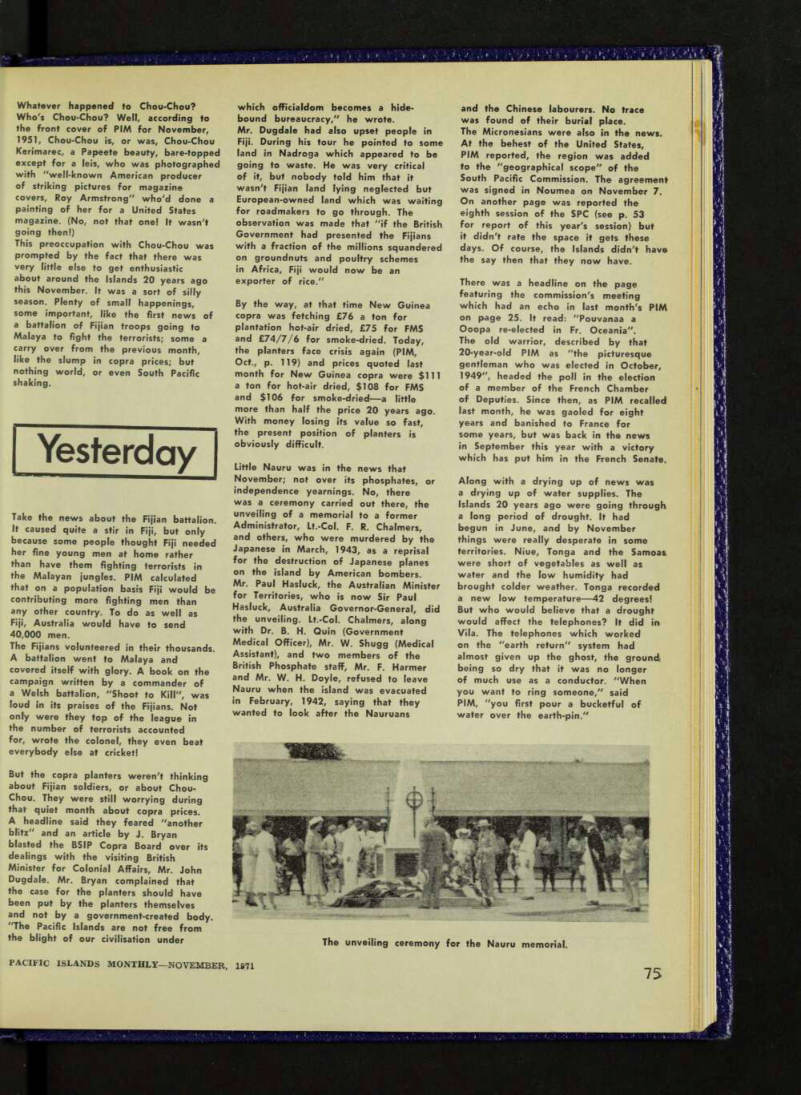
Little Nauru was in the news that November; not over its phosphates, or independence yearnings. No, there was a ceremony carried out there, the unveiling of a memorial to a former Administrator, Lt.-Col. F. R. Chalmers, and others, who were murdered by the Japanese in March, 1943, as a reprisal for the destruction of Japanese planes on the island by American bombers.
Mr. Paul Hasluck, the Australian Minister for Territories, who is now Sir Paul Hasluck, Australia Governor-General, did the unveiling. Lt.-Col. Chalmers, along with Dr. B. H. Quin (Government Medical Officer), Mr. W. Shugg (Medical Assistant), and two members of the British Phosphate staff, Mr. F. Harmer and Mr, W. H. Doyle, refused to leave Nauru when the island was evacuated in February, 1942, saying that they wanted to look after the Nauruans
and the Chinese labourers. No trace was found of their burial place.
The Micronesians were also in the news.
At the behest of the United States, PIM reported, the region was added to the "geographical scope" of the South Pacific Commission. The agreement was signed in Noumea on November 7.
On another page was reported the eighth session of the SPC (see p. 53 for report of this year's session) but it didn't rate the space it gets these days. Of course, the Islands didn't have the say then that they now have.
There was a headline on the page featuring the commission's meeting which had an echo in last month's PIM on page 25. It read: "Pouvanaa a Ooopa re-elected in Fr. Oceania".
The old warrior, described by that 20-year-old PIM as "the picturesque gentleman who was elected in October, 1949", headed the poll in the election of a member of the French Chamber of Deputies. Since then, as PIM recalled last month, he was gaoled for eight years and banished to France for some years, but was back in the news in September this year with a victory which has put him in the French Senate.
Along with a drying up of news was a drying up of water supplies. The Islands 20 years ago were going through a long period of drought. It had begun in June, and by November things were really desperate in some territories. Niue, Tonga and the Samoa* were short of vegetables as well as water and the low humidity had brought colder weather. Tonga recorded a new low temperature—42 degrees!
But who would believe that a drought would affect the telephones? It did in Vila. The telephones which worked on the "earth return" system had almost given up the ghost, the ground being so dry that it was no longer of much use as a conductor. "When you want to ring someone," said PIM, "you first pour a bucketful of water over the earth-pin."
The unveiling ceremony for the Nauru memorial.