Magazine Section
pp. 71-75 · Read in the full issue

When gun-running traders turned Nauru into "a blood-stained little island”
From May to September, 1884, HMS Dart, under the command of Lieutenant W. U. Moore, was on patrol among the islands of the West ern Pacific to help keep the peace.
Her job was to investigate any com plaints by white men against natives and by natives against white men, and issue punishment where her com mander thought this necessary. To make his position stronger, Lieut.
Moore had been commissioned to act as a Deputy British Commissioner for the Western Pacific.
While the Dart was on station the High Commissioner issued regulations forbidding the sale of arms to the natives by British subjects, and one of the Dart's jobs was to see that this regulation became known around the islands. Lieut. Moore issued a general proclamation in August (see box) while his ship was at Arno atoll, east of Majuro, in the Marshall Islands of Micronesia, and later the same month the Dart visited Nauru Island (then called Pleasant Island) to spread the news.
What life was like on Nauru in August, 1884, is given in the follow ing report, quoted verbatim, which Lieut. Moore made to the officer commanding the Australian station, Commodore James Erskine, in Syd ney.
Here is Lieut. Moore’s official report: Arrived at Pleasant Island at 8.30 a.m., August 20, and at once landed for observations and to see the British subjects. This island contrasts un favourably with Ebon [in the Marshall Islands]. It is inhabited by about 1,200 people, none of whom have any re ligion, who for the most part drink to excess of sour palm toddy, who are well armed, and who are ever fight ing amongst each other, being freely supplied as occasion requires with firearms and ammunition by the eight white men on the island, five of whom are agents, for Mr. Hemsheim, the Imperial German Consul, one for
Messrs. Henderson & Macfarlane, and two for Mr. Pfeffer (Jaluit agency).
Their names are as follows:
For Consul Hernsheim:
William Harris, Thomas Jack (British subjects); Thomas Hensen, Albert Thomas (Norwegian); Van Vein (Dutch).
For The Jaluit Agency
(Mr Pfeffer): John Smith (British subject); Robert Rash (German).
For Messrs. Henderson &
MACFARLANE: Samuel Holstead (born on Sunday Island).
William Harris has been 42 years on the island without leaving it for more than a fortnight. He is prob ably one of those earlier residents spoken of in Findlay’s South Pacific Directory.
He and John Smith expressed satis faction at the communication I had to make to them on the part of the
High Commissioner respecting the sale of firearms, etc., but Thomas Jack, who seems to have a large stock of ammunition on hand, was hurt, and asked “how a fellow was to get a living now?”
I explained to the traders that the High Commissioner did not prohibit the sale of those rifles already given to the natives on credit; but I de clined to authorise Mr. Jack to issue his ammunition.
I have stated that the natives are ever fighting; by this I mean that the members of one small tribe, of which there are 11 on the island, are every now and then laying in wait for mem bers of another tribe and shooting them from behind an ambush. It is a vendetta warfare on a large scale.
In this way about 250 men, women, and children, that is about one-fifth of the population, have been killed
or wounded in the last four years— among the killed the son of William Harris, whose body was found with six bullets in it, he being at the time of his death on the warpath, intend ing to shoot somebody else.
On the 29th October, 1881, a native of Cornwall, named James Mitchell, was shot in a drunken quarrel with the natives. His partner, Thomas Hensen, some few months ago killed a native who threatened him with a rifle. Mr. Albert Thomas, who kindly allowed us to make use of his house, sent for this man, who readily came, and complained that the natives of his district (Enibuck) now wanted to seize the corpse of Mitchell, which was in terred in his (Hensen’s) house, and asked me to speak to the chief (Gahea), which I did, warning him that if the body of the Englishman was disturbed the next man-of-war which visited the island would hold him responsible. He promised to re strain his people, and I think he will do so.
I also spoke to Gahea, to a chief called Hommey, and another named Eginopin, who is the chief of the head tribe in the island, about the prohibition of the sale of firearms,
the functions of men-of-war, and the interest taken in the welfare of the natives by Her Majesty and Her Gov ernment.
Speaking to the chiefs about drink is of little use. I hear Dr. Stubel ex horted them to stop it when he was here in January. They promised every thing he desired, and after the de-
parture of the Hayaene commenced drinking harder than ever.
There has however, not been much fighting since, only 20 people having been shot in the last six or seven months. The natives will drink gin after the arrival of a ship (as you are aware, sir, this is a common im port with English ships; the firm of On Chong, in Sydney, imports quanti ties of gin by the George Noble into the Line Islands); but their chief liquor is the juice of the palm on the third day of fermentation, which is said to be most intoxicating.
The medical officer, on his rambles, entered a hut in the interior about 11 o’clock in the forenoon, where he found a man, two or three women, and some children, all in a state of intoxication. His guide, Mr. Holstead said there was nothing unusual in this; and I was told that the beach natives, some 150 of whom were crowding round us, watching the sextant ob servations, were only sober because of the curiosity excited by our arrival.
I made several inquiries in the death of Mitchell, but could get no satisfactory replies. His friend Hensen said, “I saw little of it; they were all drunk together, he and the natives shooting at one another”.
It was evidently a case which would not bear much investigation, and cer tainly did not demand any punish ment of the natives. It is the general opinion among the whites that Hen
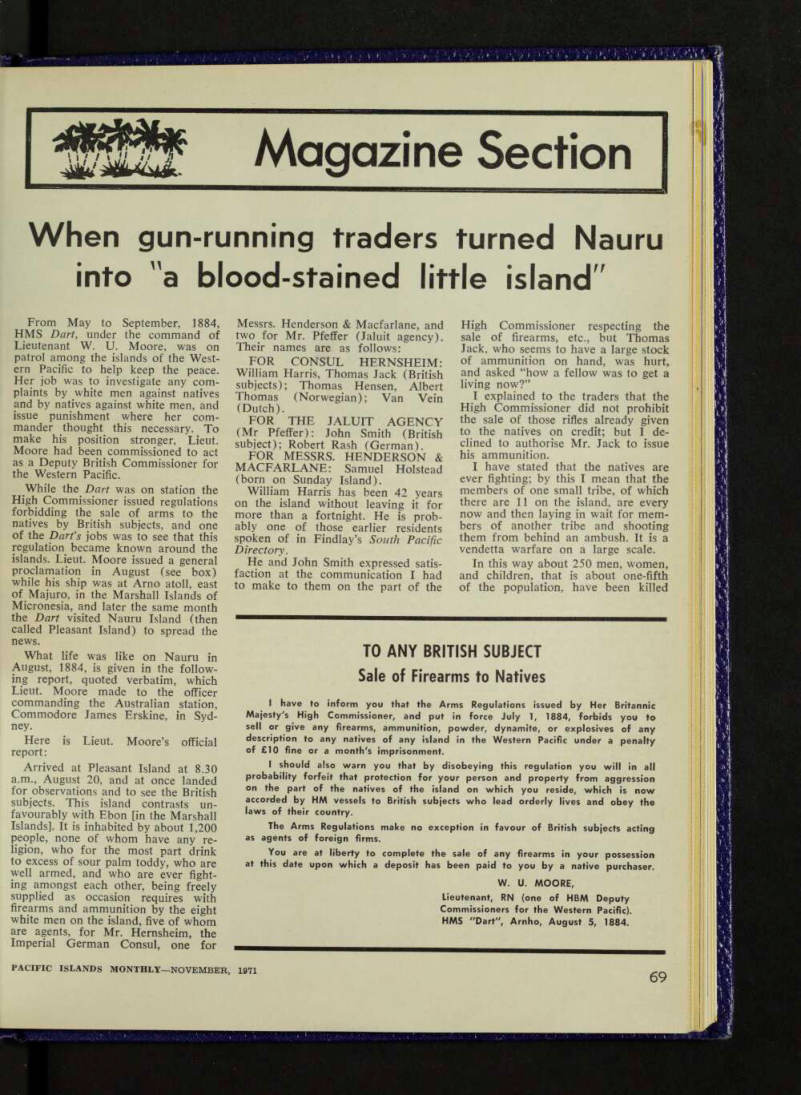
Nauru Island, smallest republic in the world, and the richest island in the South Pacific, the home of a Christian community, proud but gentle and showing none of the traits which prompted the despatches from the "Dart". Twelve miles long with its 5,263 acres in a hat-shaped area, Nauru is 26 miles south of the equator. Its nearest neighbour is another island of phosphates, Ocean Island, 190 miles to the east. First European to see the Nauruans was Captain John Fearn of the whaling ship "Hunter" in November, 1798. It was he who first called it Pleasant Island. The republic was born on January 31, 1968, 22 years to the day after the return from Truk of the remnants of a whole community exiled by the Japanese.
The Nauruans catch and tame frigate birds which once had religious significance and are still inherited by a man's sons.
// distinct tribes
sen’s life is in danger. I understood that Dr. Stubel had made inquiries into his shooting case.
We found that no one had landed at Pleasant Island from a man-of-war since 1880, when HMS Sappho, Cap tain Digby, called. The Flying Squad ron under the Earl of Clanwilliam hove to for a short time off the island on the 21st September, 1881, and the Inconstant was boarded by one of the English residents.
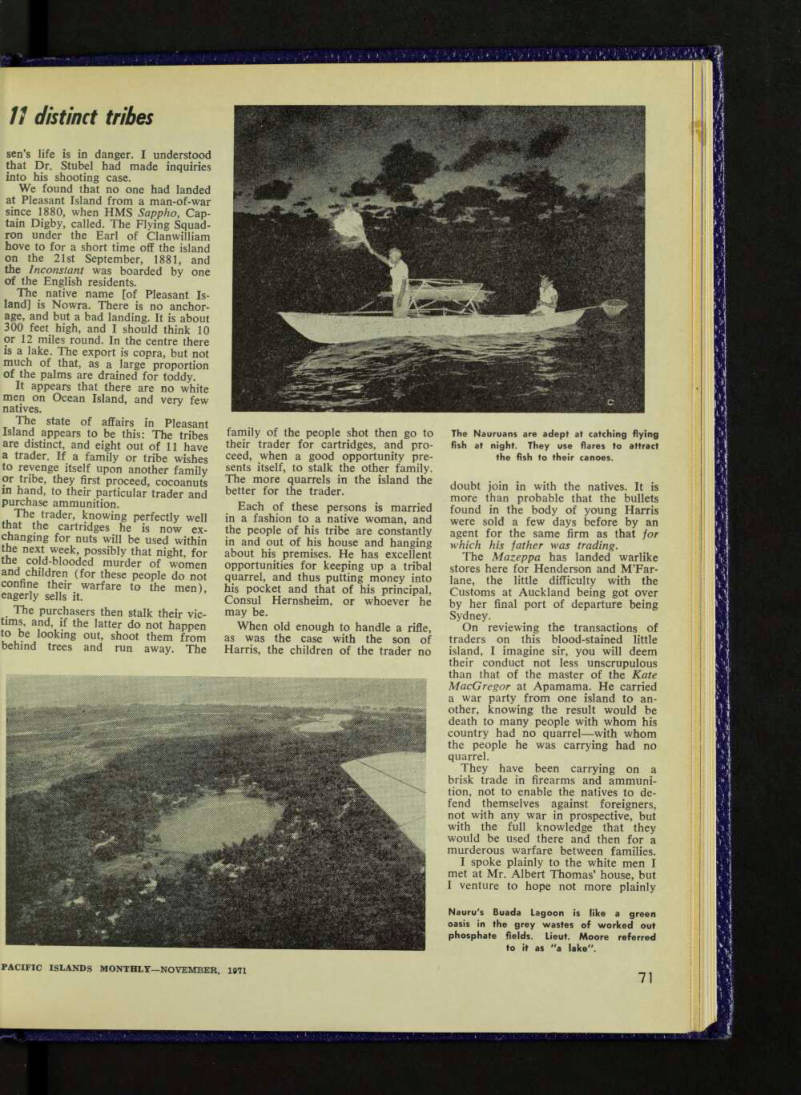
The native name [of Pleasant Is land] is Nowra. There is no anchor age, and but a bad landing. It is about 300 feet high, and I should think 10 or 12 miles round. In the centre there is a lake. The export is copra, but not much of that, as a large proportion of the palms are drained for toddy.
It appears that there are no white men on Ocean Island, and very few natives.
The state of affairs in Pleasant Island appears to be this; The tribes are distinct, and eight out of 11 have a trader. If a family or tribe wishes to revenge itself upon another family or tribe, they first proceed, cocoanuts in hand, to their particular trader and purchase ammunition. .The trader, knowing perfectly well that the cartridges he is now ex changing for nuts will be used within the next week, possibly that night, for the cold-blooded murder of women and children (for these people do not confine their warfare to the men) eagerly sells it.
The purchasers then stalk their vic tims, and, if the latter do not happen to be looking out, shoot them from behind trees and run away. The
family of the people shot then go to their trader for cartridges, and pro ceed, when a good opportunity pre sents itself, to stalk the other family.
The more quarrels in the island the better for the trader.
Each of these persons is married in a fashion to a native woman, and the people of his tribe are constantly in and out of his house and hanging about his premises. He has excellent opportunities for keeping up a tribal quarrel, and thus putting money into his pocket and that of his principal, Consul Hernsheim, or whoever he may be.
When old enough to handle a rifle, as was the case with the son of Harris, the children of the trader no
doubt join in with the natives. It is more than probable that the bullets found in the body of young Harris were sold a few days before by an agent for the same firm as that for which his father was trading.
The Mazeppa has landed warlike stores here for Henderson and M’Far lane, the little difficulty with the Customs at Auckland being got over by her final port of departure being Sydney.
On reviewing the transactions of traders on this blood-stained little island, I imagine sir, you will deem their conduct not less unscrupulous than that of the master of the Kate MacGregor at Apamama. He carried a war party from one island to an other, knowing the result would be death to many people with whom his country had no quarrel—with whom the people he was carrying had no quarrel.
They have been carrying on a brisk trade in firearms and ammuni tion, not to enable the natives to de fend themselves against foreigners, not with any war in prospective, but with the full knowledge that they would be used there and then for a murderous warfare between families.
I spoke plainly to the white men I met at Mr. Albert Thomas’ house, but I venture to hope not more plainly
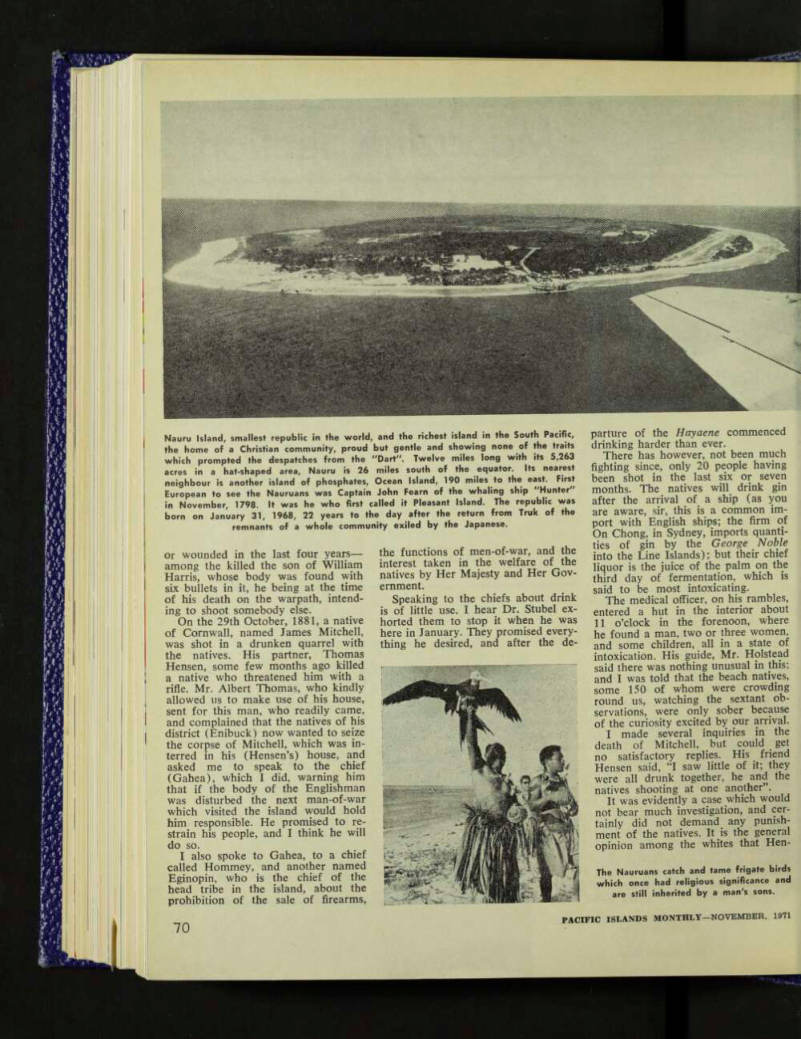
The Nauruans are adept at catching flying fish at night. They use flares to attract the fish to their canoes.
Nauru's Buada Lagoon is like a green oasis in the grey wastes of worked out phosphate fields. Lieut. Moore referred to it as "a lake".
Children with pistols
than you will consider it my duty to have done. I said, “By forfeiting pro tection I mean this: If next year an English man-of-war comes to this island and finds your children shot, your house burnt, or your property destroyed and the Captain of her discovers that you have, in disobedi ence to the High Commissioner’s Arms Regulation of which I now in form you, given or sold either your own stores of firearms and ammuni tion, or another person’s firearms and ammunition, to the natives, I be lieve he will do nothing for you. If your own life is taken I believe he will adopt no steps to punish the people who shot you”.
It appears that some of the white men—Thomas Jack, the Scotchman, notably—have many rifles sold on credit, and are afraid, now that the views of HM Government are made known, that the natives will not pay.
To this grievance I did not attempt to offer any consolation.
Every adult I believe has a weapon of some sort, and many of the chil dren can be seen going about with pistols.
Altogether the natives have a wild and disorderly appearance. None of them wear clothes. With eight white men distributed over the island, allow ing them to purchase the means wherewithal to kill each other, and thus stimulating their savage natures, it would be surprising if they were other than what they are, naked, ig norant and quarrelsome.
William Harris, who ought to know, stated that when he first came to Pleasant Island the natives did not know the art of extracting spirit from the juice of the palm, and that it was introduced by a white man.
Equal altitude observations by Lieut. Messum and myself place Pleasant Island 12 miles west of the position it occupies in chart 780, xi 81. We left at 4 pm, 20th August, and after an uneventful passage an chored at Matupi [New Britain] at 11 am, 28th August. [Three years after Lieut. Moore’s visit, Nauru was visited by a member of New Zealand’s parliament, Fre derick J. Moss, and his account of what he saw there (in his book, Through Atolls and Islands in the Great South Seas, London, 1889) showed there had been little change in conditions over the three years.
The British trader William Harris, whom Lieut. Moore mentions as hav ing had his son killed in a feud, had lost another son—shot dead in at tempting to revenge his brother. See PIM June, 1970 (p. 87).]