Cabbage
pp. 36-37 · Read in the full issue
and French cooking
New Caledonia Diary
with
Helen Rousseau
in Noumea
Pacific Islanders would no doubt be surprised at an offer of “millionaire’s cabbage” at $lO a tin, surprised at least when they learn that “millionaire’s cabbage” is none other than the heart of coconut palm, used for salad making. The offer to supply this food was apparently made recently to Sydney restaurateurs, in a bid to treat gourmets to something really special.
Here in Noumea, where several restaurants already offer this delicacy, one is tempted to wonder whether Anglo - Saxon visitors would recognise this dish when they see it on the French menu as “salad de coeur de cocotier”.
Served with French dressing, it is offered at one-fifth the proposed Australian price.
And then, one wonders how many other treats visitors here miss out on, simply because they don’t know that “croissants” and “cafe au lait” can be so much more fun for breakfast than tea and toast, or that if you really do want a simple dish like ham and cheese jaffle, you have to ask for “un croq M’sieur”, in a small snack bar.
Noumea restaurants are worth exploring, provided you check which is their “closed” day and that you arrive at suitable hours —preferably no later than midday for lunch and best after seven at night. If you are tempted by some of the ready-prepared French or
Indonesian food in downtown supermarkets, Georges Lavoix in his new Isle de France Hotel has at last provided what visitors have been waiting for—tea-making facilities and a fridge in each room, to cater for light snacks.
Noumea offers plenty of feast ing material, and not only for the palate, but for the eye also.
The beginning of October saw the streets of Noumea flooded with carnival - atmosphere crowds for a day, as local stores offered supposedly bargain wares on the pavements, in the now-annual “Braderie”. The city’s shopping area has considerably expanded over the past year to cater for the 6,000 settlers who came to the island last year alone. Gone are the days when you needed to find a craftsman, even to build a couple of kitchen cupboards.
Modern furniture stores have appeared and established a good trade with the new arrivals. In addition there has been a pro liferation of smart fashion shops, with luxury evening bags, shoes and frocks all flown in from Paris.
Most stores had something to offer for the “Braderie”, from suede pantsuits to garden spades, with all manner of refreshments to sustain folks’ shopping appetite, along the way. The “Braderie” has come to be an extension of the island’s main festival day, which is September 24, the anni versary of French taking-of possession.
You need to be a scrutinising shopper when you’re hunting for bargains. If you don’t know your size in French clothes, be wary, since the moment of frenzied jostling on the pavement will not
be the time for you to find out that it’s 40 inches to the metre and that Australian women’s size 12 is French size 40, for example.
Of course, it’s an open day for photographers, who can study faces from all around the French Pacific, from French Africa and the Caribbean, from Indonesia and Vietnam or fresh faces, newly disembarked from Paris.
Special visitors from France re cently included two young cyclists who flew out to join the fifth annual Tour de Caledonie bicycle race around the island. They joined two Australians, a Tahitian, a New Zealander and 17 Cale donians to make a field of 23 competitors in the 600-mile trial.
The cyclists seemed to have more courage than many a subur ban motorist as they laboured in heat and sweat along stony, dusty roads to link up the main centres of the island. With vivid daily coverage by Press, radio and tele vision, they brought the inhabi tants of the whole island together for 10 days of awe and suspense.
Veteran organisers following the tour were Jean-Louis Bonnard and Maurice Ducoin, accompanied by a whole caravan of supporters and tyre-changers, not forgetting the gendarme escort on motor cycles.
Second major sporting event of the month was the soccer match between New Caledonia and a visiting team from Western Suburbs, Sydney: the locals won 1-0. The match was seen as a gesture to cover up the blunder which occurred over the first Oceania Soccer tournament sched uled for Noumea late October, between Australia, New Caledonia, New Zealand, Fiji, New Hebrides and Tahiti.
The contest was called off by New Caledonia after a cable was received late September from the Australians saying they could not compete unless their team’s air fares were paid. Caledonian Soccer League President Guy Fouques said such terms had never been included in the original arrangements. This unsporting gesture provoked the cancellation of the tournament.
The Oceania Cup was not the only cancellation registered in
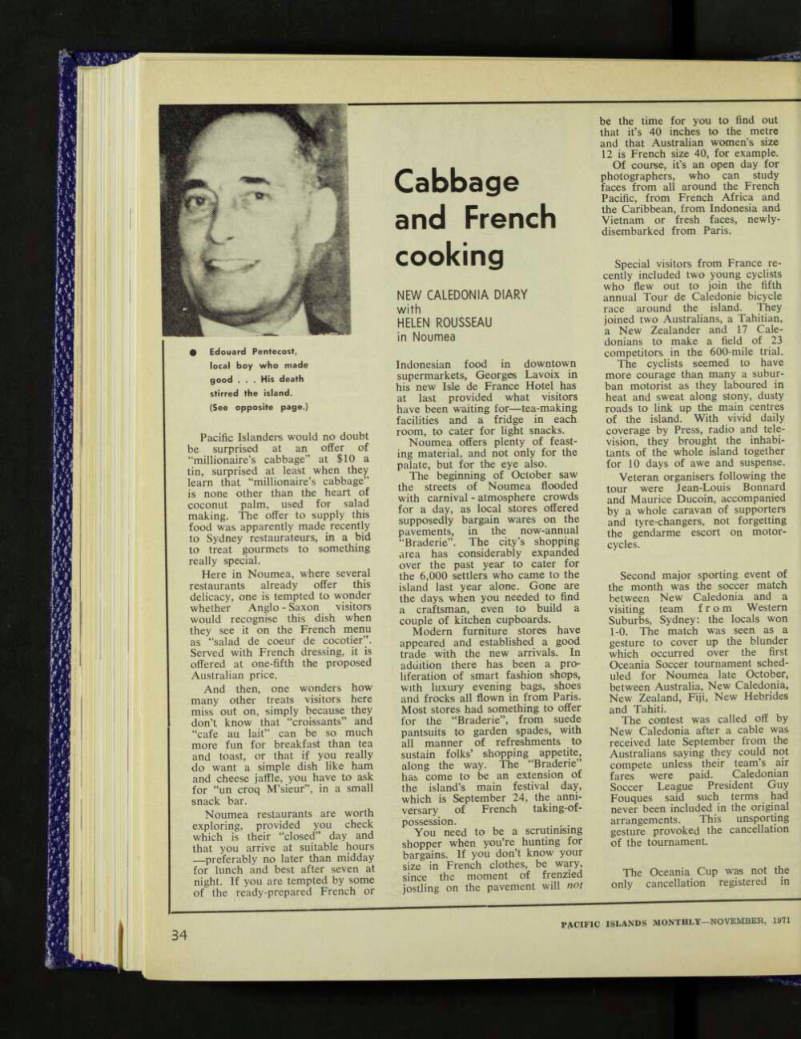
Edouard Pentecost, local boy who made
good . . . His death
stirred the island. (See opposite page.)
Noumea recently. Much more alarming was the news from Japanese nickel buyers here that they were slowing down, almost stopping, their ore shipments from New Caledonia, The quota system piaced a 4.3 million ton limit on Caledonian exports in the Japanese financial year ending March 31, 1971. It is now feared that this year ore exports may not exceed much more than 3 million tons.
As panic spread among the “petits mmeurs” independent mine operators, various Caledonians flew off to Tokyo in a bid to remedy the situation. At the same time, as trucking contractors lost their jobs on inland mines, concern mounted over their ability to pay back truck loan payments, which can amount to $l,OOO per month.
There are now about 25 Cale donian mine operating groups. As they began closing down their mines, dipnissing workers and put ting millions of dollars of heavy earth - moving equipment into “mothballs”, the government was faced with a serious problem.
The miners’ first reaction was to blame not only the current re cession on the world nickel market, but the fact that Japan is now seeking to buy her ore more from other sources, since the Paris government placed snap quotas on the Caledonian ex porters in May, 1970.
The quotas were imposed to help big French companies to establish smelters here, but to date none of the promised three new companies has been able to get off the planning table and begin construction of their factories.
In the face of rising local un easiness, the authorities suddenly produced a series of TV inter views and an on-location movie showing a new prospecting ven ture involving Swedish and Cale donian interests, on the East Coast, between Thio and Yate.
As helicopters whirled overhead transporting mobile drilling equip ment over a dramatic mountainous terrain, Caledonians were told that the new exploration venture has embarked on a two-year research programme to try to prove the existence of 25 million tons of garnieritic ore at 2 per cent, nickel content. The exploration involves Granges of Sweden and Rene de Rouvray of Noumea, forming the
Societe Mini e r e Caledonienne
(Sominec).
Caledonian mining circles were wondering why Swedish pros pectors were admitted to the territory when certain American, Australian and Japanese interests have not been accepted. It was whispered that the French com pany Pechiney could eventually be involved in the project. In the meantime, the Caledonians pointed out that much further-advanced projects such as Canadian INCO, SOMECAL and PEN AM AX were still awaiting either French finance or government approval to pro ceed.
Amid the local deception and uneasiness, it was expected that the Territorial Assembly, resuming late October to debate next year’s lABO million budget, would be having an exceptionally “hot” summer session, especially in view of the general elections looming up next year. The Assembly met only a couple of weeks after the death of one of its most esteemed members, Vice-President Edouard Pentecost (see next column).
Meanwhile, somewhat on the periphery of all this local debate, the South Pacific Commission was expecting Mr, Fred Betham to take up his post as Secretary- General from November 1.
In other parts of town, on the business and political plane, a New Zealand parliamentary dele gation succeeded a business mission from the Wellington Manufacturers’ Association. On the artistic scene, French painter Frank Fay, from Tahiti, held an exhibition at the Chateau Royal Hotel, offering canvases from $lBO to $5BO, which raised some interesting comment as to how comfortably an artist should ex pect to live.
Finally, among the social activi ties during October, Richard Johnston, only son of Louis and Verna Johnston, married Mademoiselle Maryline Boyer, in a ceremony which brought to gether numerous members of two old Noumea trading families, the Johnstons and Hagens.
In ail there is plenty of activity in Noumea these days, and the Caledonians have a busy time sandwiching it all in, between the coconut palm salad and the “croq M’sieur”.