Papuans want more
pp. 27-111 · Read in the full issue
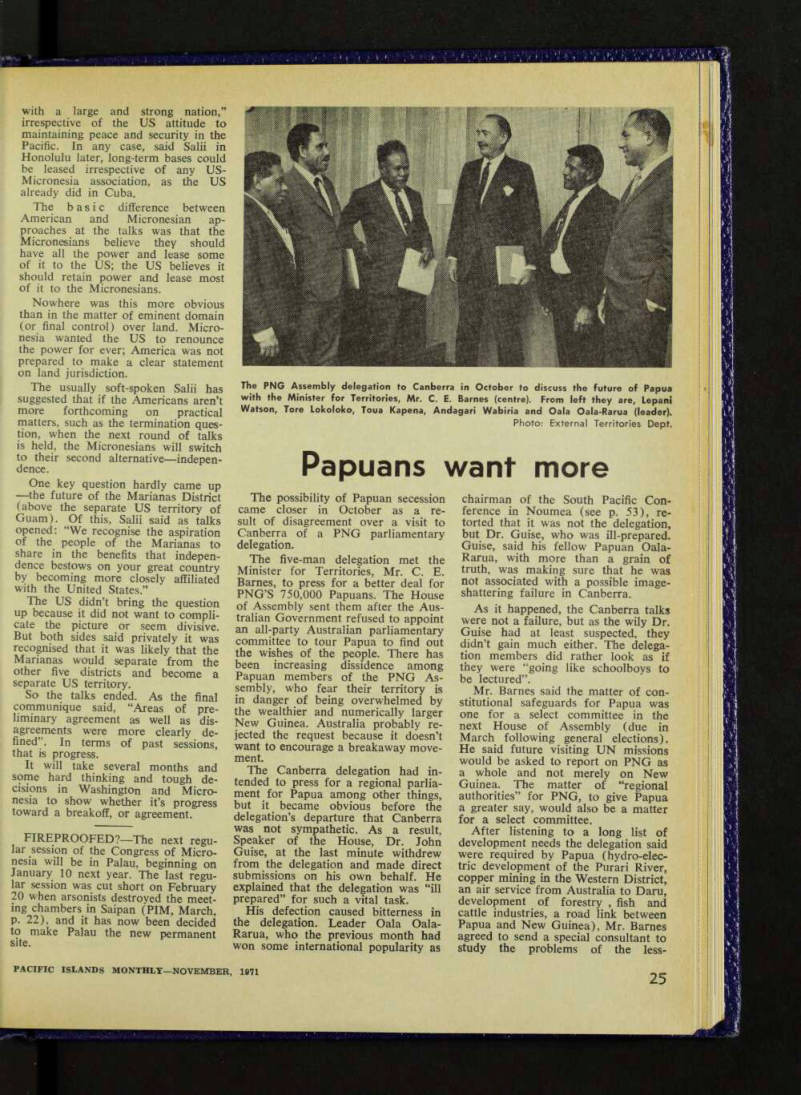
The possibility of Papuan secession came closer in October as a re sult of disagreement over a visit to Canberra of a PNG parliamentary delegation.
The five-man delegation met the Minister for Territories, Mr. C. E.
Barnes, to press for a better deal for PNG’S 750,000 Papuans. The House of Assembly sent them after the Aus tralian Government refused to appoint an all-party Australian parliamentary committee to tour Papua to find out the wishes of the people. There has been increasing dissidence among Papuan members of the PNG As sembly, who fear their territory is in danger of being overwhelmed by the wealthier and numerically larger New Guinea. Australia probably re jected the request because it doesn’t want to encourage a breakaway move ment.
The Canberra delegation had in tended to press for a regional parlia ment for Papua among other things, but it became obvious before the delegation’s departure that Canberra was not sympathetic. As a result, Speaker of the House, Dr. John Guise, at the last minute withdrew from the delegation and made direct submissions on his own behalf. He explained that the delegation was “ill prepared” for such a vital task.
His defection caused bitterness in the delegation. Leader Gala Oala- Rarua, who the previous month had won some international popularity as
chairman of the South Pacific Con ference in Noumea (see p. 53), re torted that it was not the delegation, but Dr. Guise, who was ill-prepared.
Guise, said his fellow Papuan Oala- Rarua, with more than a grain of truth, was making sure that he was not associated with a possible image shattering failure in Canberra.
As it happened, the Canberra talks were not a failure, but as the wily Dr.
Guise had at least suspected, they didn’t gain much either. The delega tion members did rather look as if they were “going like schoolboys to be lectured”.
Mr. Barnes said the matter of con stitutional safeguards for Papua was one for a select committee in the next House of Assembly (due in March following general elections).
He said future visiting UN missions would be asked to report on PNG as a whole and not merely on New Guinea. The matter of “regional authorities” for PNG, to give Papua a greater say, would also be a matter for a select committee.
After listening to a long list of development needs the delegation said were required by Papua (hydro-elec tric development of the Purari River, copper mining in the Western District, an air service from Australia to Daru, development of forestry , fish and cattle industries, a road link between Papua and New Guinea), Mr. Barnes agreed to send a special consultant to study the problems of the less-
A gentle smile
developed areas of Papua New Guinea (not merely Papua).
In his own submission, sent with more fanfare and less personal effort, Dr. Guise said he believed in unity for PNG, but the Papuan people were “sad and dismayed” that most social, economic and political development had gone to New Guinea. Money had been spent in areas where the government believed it would get the best return, which was “good economics but dangerous politics”.
He said, “If Australia wishes to disengage honourably, she dare not leave an economically crippled Papua and expect the Papuans to be happy with the arrangement”. He said a regional or provincial system of gov ernment should be set up early in the life of the new House to “resist the pressures of a central govern ment”.
Meanwhile, back in Port Moresby, political life had been continuing, with millions more words spoken in the budget session of the House of Assembly.
Papua New Guinea’s House of Assembly is notoriously unpredic table. As expected, the second read ing debate on the 1971 budget was undistinguished and there was little enthusiasm for it.
But when the committee stage was reached and the appropriations to in dividual departments had to be ap proved, the members really let their hair down in a marathon debate which started shortly after lunch and, with a break for dinner, went on till two o’clock the next morning.
A substantial slice of this time was taken up with divisions on the ap plication of the gag. Debate gagging is not a popular device in this par liament, and the usual line-up in such divisions is that those members who have already spoken are for the gag while those who still want to speak are against it—a fairly human re action.
On this occasion the series of divi sions produced two ties, with Chair man of Committees Wally Lussick casting his vote against the gag—a rather noble gesture in the circum stances.
In the Mother of Parliaments the reduction of an appropriation by a symbolic £1 brings the government of the day crashing down. Not so in Papua New Guinea. In 1966, the brash young First House showed its displeasure with the current budget by lopping $50,000 off one of the appropriations. All that happened was that the official members smiled
gently and the Australian Govern ment saved $50,000 of grant money.
This year, as the life of the Second House draws to a close, the same ploy was tried again, this time unsuccess fully. East Sepik Regional’s Michael Somare sought to lop $BO,OOO from the Department of Labour’s alloca tion, this being the cost of operating the Highlands labour scheme —a gov ernment run plantation labour place ment service; while Angoram Open’s Peter Johnson wanted to cut the allocation to the Department of Agriculture, Stock and Fisheries by
$Lo,Ooo.
In both cases the move was in the nature of a protest; in Michael Somare’s case against what he re gards as the sub-human treatment of plantation labourers, and, in the case of Peter Johnson, against the neglect of the crocodile skin industry.
Protests against other appropria tions were entered in less spectacular manner; and there was a good deal of waffling of a kind more suited to the second reading debate than to the committee stage.
The Appropriations Bill having been given its third reading at ap proximately 2 a.m., four subsidiary bills were passed through all stages at the rate of about two minutes per bill.
Land, pigs and women are the principal causes of strife among Papuans and New Guineans. Since 1963, the Land Titles Commission has been trying to sort out Papua New Guinea’s numerous land dis putes, which hold up the country’s
development as well as providing flashpoints for inter-clan violence. It has found it hard to keep abreast of the demand for its services, and in the House complaints about the de lays which occur in bringing cases before the commission have been fre quent The Land Titles Commission (Con stitution, etc.) Bill 1971 is the latest of a series of bills amending the original ordinance, ostensibly for the purpose of speeding up its work.
Some members, however, have sus pected that they were also designed to diminish the commission’s inde pendence and make it more sensitive to the wishes of, and less likely to hand down decisions embarrassing to, the government.
A provision in the current bill that commissioners should be appointed for a seven-year period instead of, as formerly, for life consequently came under attack during the second reading debate. So much so that at the committee stage the government extended an olive branch by propos ing that future indigenous commis sioners should be appointed for life (that is, till retirement at 60), while expatriate ones would, in the sacred name of localisation, be appointed for periods of seven years or less.
This compromise was accepted by the House.
A remarkable feature of the bill’s committee stage was the government’s unaccustomed willingness to accept or meet half-way amendments pro posed by back-benchers. Cynical ob servers were left wondering whether it was a case of change of heart or of guilty conscience.
Localisation was very much in the air at this meeting. In relation to the public sector there was the govern ment’s White Paper on accelerated localisation, and an announcement that powers already possessed by the Public Service Board to give pre ference to local officers would be brought into operation. Then the House itself gave firm notice to the private sector that it is prepared to force the pace.
There was the adoption of a motion by Fr. Nilles, asking government and local government councils “to grant commercial land and business licences in rural areas to outsiders only on the condition that local natives are taken into partnership in developing these blocks and in partici pating in business activities”.
More importantly, there was the passage of the Employment (Train ing and Regulation) Bill 1971, which, among other things, will give Papuans and New Guineans in certain occupa tions (to be declared from time to
Continued on p. 107
time) a measure of protection from expatriate competition.
Expatriates already in Papua New Guinea and engaged in their declared occupation will be allowed to con tinue in it, but no new immigrants will be allowed into the country to add their competition to that already existing. The House has travelled a long way since 1968, when a tenta tive suggestion for something of this kind got very rough treatment, being denounced by white and brown mem bers alike.
One step forward taken at this meeting may turn out to be the most important of all. This was a bill to create a Local Government Service— a kind of mini-Public Service to pro vide an administrative arm for local government. More and more people are coming round to the view that decentralisation is an important part of the answer to the problem of
creating unity out of diversity. The Local Government Service, by secur ing effective implementation of de cisions taken at local levels, may play a key part in the task of nation building.
Other bills passed included one providing for the tabling in parlia ment of the reports of commissions of inquiry, and a long overdue one which will enable the victim of an accident caused by an unregistered and uninsured vehicle or a hit-and run driver to sue a “nominal defen dant” for compensation.
In motions approved by the House the member for Rigo-Abau Open, Scotty Uroe, put in a strong plea for the advancement of women in public life, while the member for Moresby Open, Percy Chatterton, asked for consideration to be given to the creation of a National Capital District on the lines of Australia’s Capital Territory.
Finally, in one of those not-too frequent gestures in which PNG’s parliament turns its attention from internal problems to those of the outside world, unanimous support was given to a motion sponsored by Fr.
Nilles (Chimbu Regional) which declared that the House “is disturbed by reports of the French Govern ment’s insistence on carrying out atomic bomb tests in the Pacific area and calls upon the government to re quest other governments likely to be affected by these activities to join with us in making a strong protest to the French Government with a view to having these tests stopped permanently”.