Progress Or Impasse? Micronesia's
pp. 26-27 · Read in the full issue
Future Still In The Balance
From PIM correspondents in Honolulu
Depending on how you view it, the latest round in the two-year-old negotiations between the US and Micronesia on Micronesia’s political future ended in October with hopes for more progress—or just another impasse over basic points.
Nobody could call it a successful meeting. Both sides will have to alter their positions before talks are re sumed—and the meeting broke up without anybody fixing a date.
It was a complex session, held over eight days at the rambling Hotel Hana Maui, in one of Hawaii’s most remote and undeveloped areas. The resort is one of the most expensive in the Hawaiian islands, and the Americans paid.
The American delegation was headed by Ambassador Franklin Haydn Williams, and the Micro nesians by Senator Lazarus Salii, and it’s probably true to say that both sides stopped talking when it was obvious there was going to be no further unanimity. But the Micro nesians invited the American Gov ernment to another round, in Micro nesia, before the January session of the Micronesian Congress.
Neither side negotiated effectively; both were aware that they could have done better.
The US made what appeared to be some major concessions. The Micro nesians will be able to vote to choose their own political future (which is required by the UN anyway); they will write their own constitution and laws (so long as rights of American citizens and businesses are protected); they will control their own land (al though questions remain on leases for military bases required by the US in the Marshalls, the Marianas and Palau, and it was not stated whether the US would need further land, and whether it would be entitled to store nuclear weapons in Micronesia).
This all added up to an offer of a Micronesian association with the US having many of the characteristics of the “free association” the Micro nesians asked for. Commonwealth status is dead, but this new relation ship would have an important draw back. Micronesians asked that free association be terminated at any time should either side want it that way. The US insisted that termina tion should only be by mutual con sent—which would give the US
power of veto, and the free association would not be free at all.
As Senator Tosiwo Nakayama, one of the three members of the Micronesian Independence Coalition in the Micronesian delegation, saw it; “Mutual consent is a kiss of death!”
Thus the big question is just how much either side is disposed to compromise on this vital point.
The US argument was that even in offering termination on a mutual basis the US was making a significant concession on its past stand; that in any case it was doubtful if the US Congress would want to pour money into Micronesia for development programmes and American bases if the Micronesians could pull out at any point. Certainly the US tended to moderate its security interests during the discussions. In doing this it was showing a clearer perception of Micronesian attitudes (as it did in many other ways during the talks).
But stripped down to essentials, the US position was that it still believed in its right to use Micronesia for defence, and it still hoped to retain US sovereignty in Micronesia.
Not at any time during the talks did the Americans say the Micronesians could have sovereignty; what
the US was really offering was terri torial status dressed in a fine new set of clothes, Its delegation avoided answering probing questions, and it talked around crucial points.
An example was when the Micro nesians attempted to find just what the procedure would be when they had to write their own constitution.
The US didn’t have the details, or if it did, wouldn’t come clean. A sample of American gobbledegook, from Ambassador Williams: “Precipitate change or termination against the will of the United States would have to be weighed against the continuing need for political stability in the Pacific Ocean area. Termina tion could adversely affect our ability to fulfil our responsibilities to our selves, to Micronesia, and to the world community for the mainten ance of international peace and security, and could diminish your capacity to fulfil your own future role in this regard.”
Salii pointed out that the ability of Micronesia to unilaterally termi nate its relationship with the US was “an essential protection for a small nation that wishes to maintain its identity while in a relationship
with a large and strong nation,” irrespective of the US attitude to maintaining peace and security in the Pacific. In any case, said Salii in Honolulu later, long-term bases could be leased irrespective of any US- Micronesia association, as the US already did in Cuba.
The basic difference between American and Micronesian ap proaches at the talks was that the Micronesians believe they should have all the power and lease some of it to the US; the US believes it should retain power and lease most of it to the Micronesians.
Nowhere was this more obvious than in the matter of eminent domain (or final control) over land. Micro nesia wanted the US to renounce the power for ever; America was not prepared to make a clear statement on land jurisdiction.
The usually soft-spoken Salii has suggested that if the Americans aren’t more forthcoming on practical matters, such as the termination ques tion, when the next round of talks is held, the Micronesians will switch to their second alternative—indepen dence.
One key question hardly came up —the future of the Marianas District (above the separate US territory of Guam). Of this, Salii said as talks opened: “We recognise the aspiration of the people of the Marianas to share in the benefits that indepen dence bestows on your great country by becoming more closely affiliated with the United States.”
The US didn’t bring the question up because it did not want to compli cate the picture or seem divisive.
But both sides said privately it was recognised that it was likely that the Marianas would separate from the other five districts and become a separate US territory.
So the talks ended. As the final communique said, “Areas of pre liminary agreement as well as dis agreements were more clearly de fined”. In terms of past sessions, that is progress.
It will take several months and some hard thinking and tough de cisions in Washington and Micro nesia to show whether it’s progress toward a breakoff, or agreement.
FIREPROOFED?—The next regu lar session of the Congress of Micro nesia will be in Palau, beginning on January 10 next year. The last regu lar session was cut short on February 20 when arsonists destroyed the meet ing chambers in Saipan (PIM, March, p. 22), and it has now been decided to make Palau the new permanent site.
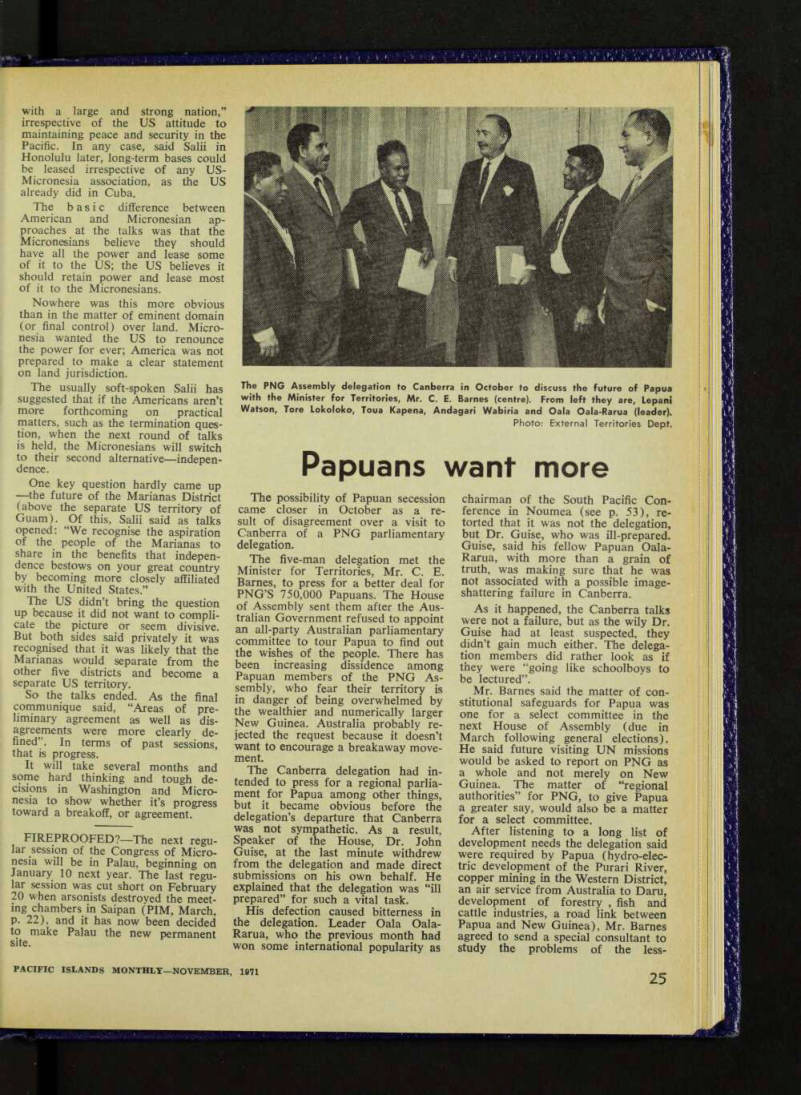
The PNG Assembly delegation to Canberra in October to discuss the future of Papua with the Minister for Territories, Mr. C. E. Barnes (centre). From left they are, Lepani Watson, Tore Lokoloko, Toua Kapena, Andagari Wabiria and Oala Oala-Rarua (leader).
Photo: External Territories Dept.