Pacific Islands Monthly
pp. 24-25 · Read in the full issue
Booming Vila (where the action is) won't back down on land speculation
The problems caused by Vila’s boom growth rate and the future of the cattle and beef industry were the main concern of members of the New Hebrides Advisory Council when they met in Vila in October. But high light of the session was a debate on a petition to the UN prepared by the Fiji law firm of Ramrakhas on behalf of the Na-Griamel land move ment, which was roundly condemned.
The 24-man council (the Resident Commissioners, as joint presidents, and four ex-officio members who also attend, have no vote) was able to meet at all thanks only to a reprieve which extended its life for another year. Indeed, for a short time it ceased to exist because its two-year life ended on September 3 and the decision extending its life was not published until September 23.
The British and French Resident Commissioners gave the reason for the extension of life in their opening speech. Apparently the London and Paris governments are currently put ting their heads together to sort out a number of issues obstructing pro gress in the group.
One issue is the constitution of the Advisory Council itself and it seems likely that elections will be taking place next year for a new kind of council, perhaps with an enlarged franchise for both New Hebridean and European members. And per haps with more than simple advisory powers.
Thanks largely to the discovery of the New Hebrides as a tax haven, and the consequent inrush of solici tors, auditors, banks (Barclays, CBC and the Bank of NSW all declared within 10 days of each other in late September their intention to open branches) and even, in a few cases, the arrival of real businessmen, the demand for office space and housing in Vila is causing a major building boom.
On every side bulldozers are rip ping platforms out of the limestone and local builders are so busy trying to complete fat contracts as fast as
possible to make room for the next, that minor contracts are going un bidden for.
The result of this growth is a real problem in town management.
Council members were particularly concerned with the impossible de mand made on the police and on Vila’s narrow, bumpy streets by enormously increased traffic. They called on the Resident Commissioners to review completely current traffic regulations and increase the penalties for traffic offences, to establish a specialist joint traffic police unit, to review the insurance situation (at present the minimum required is only third party with $B,OOO cover) and to raise by a year the minimum ages for driving licences to cut down on skid-kid accidents.
The council also gave a sympa thetic hearing to Mr. d’Hautesserre, a young VAT (Volontaire Aide
New added value tax legislation was issued in Vila on October 8 to replace the controversial Joint Regulation No. 16 issued on August 2 (PIM, Sept., p. 25). Joint Regulation No. 22 of 1971 is a completely new text, re-written to include amendments suggested by the Advisory Council Standing Committee when it met in late August. Land speculators will find it no more pleasant than the original. The amendments are aimed primarily at softening the blow for local, long-term, landowners.
A rebate of tax, starting at 15 per cent, for over five years of ownership up to a maximum of 80 per cent, for over 50 years of ownership by the vendor, is allowed. In addition, although the tax applies on the sale of every plot of land subdivided after January 1, 1967, on hire purchase sales already in progress on August 2, it will only apply to instalments paid since then.
Payments made previous to August 2 escape.
Other amendments differentiate between the tax applicable on rural subdivisions (50 per cent, of added value maximum) and urban subdivisions (25 per cent.) and provide for appeal to “the appropriate court” in the event of dispute over the added value assessment.
Despite the changes, the legislation maintains rigidly the original intention to stop speculative land subdivision, and to encourage such subdivisions as do take place to be carried out properly. The original legislation has already brought a halt to New Hebrides land sales in Hawaii, while its implications are studied by authorities there.
It is difficult to see how any buyer of a subdivision can now hope for any return on his investment for many years to come. With the New Hebrides joint administration also imposing a virtual ban on all but the most necessary immigration, the price of land outside the town areas, already artificially high, is not likely to rise.
Most of the speculative subdivision operations are well away from the towns, some so remote as to be virtually inaccessible.
Technique) architect who had drawn up a plan for the use of the large area now being reclaimed from the sea along Vila’s waterfront. Included in the plan were six-storey office blocks (the highest in Vila at present is three storeys) and a four-lane boulevarde taking north-south traffic along the new seafront instead of congested Rue Higginson.
However, some members had reser vations, particularly about the large office blocks on the reclaimed land which it was originally intended should be maintained as a green area.
Mr. Chauveau raised the question of compensation for the Rue Higgin son businesses that had their view of Vila Bay—one of the loveliest in the Pacific—cut off by the new buildings but Mr. d’Hautesserre thrust this aside as a problem for the legal ex perts, as architects tend to do. How ever, the British Resident Commis
sioner, Mr. Allan, agreed that com pensation had to be considered.
The alarm caused among farmers by the discovery of brucellosis near Vila earlier this year showed itself in the serious concern expressed by the council for the protection of the beef and cattle industry. Beef is one of the main economic hopes for the future of the New Hebrides and so far, unlike most other Pacific territories, the group has taken few measures to protect itself properly against imported diseases. Strict quarantine and complex laboratory testing of all imported animals were called for, it was agreed.
The Resident Commissioners were asked to correct what was attacked as being false information supplied to the UN in a petition from the Na- Griamel movement. The petition had been prepared by Suva lawyers Messrs. Ramrakhas.
Quotations from the petition cited by the originator of the motion, Archdeacon D. A, Rawcliffe, in cluded these: “Natives are being im prisoned and in many cases they have been terrorised off the land. The Administrations have proved ex tremely callous and indifferent to the cries of the indigenous people and new and sophisticated methods of clearing us off our land have been devised, and the methods of using police dogs have struck a new terror in the hearts of the indigenous people.”
Talking of marriage, the petition said “customary marriage laws are not being recognised . . . the non recognition of the marriage laws is an attempt to break down the social and the moral order which prevails in the New Hebrides . .
Also, “No real attempt has been made to educate the indigenous people”.
To people in the New Hebrides such statements are so far from the truth as to be ludicrous.
Archdeacon Rawcliffe cited many more examples and proceeded to pour well-deserved scorn on most of them.
About the police dogs “striking new terror”, he commented that whoever wrote that must have “seen the Superintendent of Police walking his pet dog around Vila”.
Archdeacon Rawcliffe quoted other inaccuracies made by speakers in the UN when the petition was dis cussed, and said his complaint was that the Special Committee on Colonialism apparently believed the stuff. The New Hebrides was surely entitled to have the facts put cor rectly in the UN.
Mr. George Kalkoa said the council should take action against the UN committee “for giving false
impressions of the Government of the New Hebrides”.
Father Verlingue and Mr. Bob Paul took the view that the committee’s “ravings” didn’t require the honour of reply, and Father Verlingue added: “What we could perhaps do is see if this Mr. Ramrakha could be . . . if some action could be taken against him for slander, for defamation of character. If there is any way of getting at him by taking him to court then I think we would perhaps change these people’s attitude; make them a little more responsible and serious with their writing things, and if he cannot be brought before the court he may be marked down as an un desirable alien in the New Hebrides.
I don’t know if this is possible from the legal point of view, but it is my proposal.”
Father Leymang said he was in favour of taking “fairly strict measures” against the Na-Griamel movement, which was “sowing more and more disorder”. He said Na- Griamel seemed to have had some good ideas in the very beginning, but it was now “going down, down, more and more”.
Mr. Paul asked Mr. Allan whether he had had “any complaints from American land developers of Jimmy Stevens [of Na-Griamel] extracting money from them in exchange for no opposition to their land claim?”
The Resident Commissioner said he personally had not.
Archdeacon Rawcliffe’s motion (that the Resident Commissioners “urge the two metropolitan govern ments to take steps to correct the false information regarding the New
Hebrides which has been supplied to the UN General Assembly on behalf of Na-Griamel”) was passed over whelmingly.
While the council was considering the text of the re-drafted, contro versial added-value tax legislation— main changes were the easing of the tax for long-term landowners and the elimination of retroactivity (see p. 22) —Mr. George Kalkoa elected to make a speech giving the undiluted views of New Hebrideans on the land issue. Essentially his theme was, “We wuz robbed”, and that New Hebrideans would not be satisfied until the roots of the land issue had been dug out.
“Judgments have been proclaimed, but was justice done?” he said of Joint Court rulings on land claims.
“We have been made fools and stooges of—perhaps that was the treatment my Grandpa had; as for me, I want justice.”
Fellow member Bob Paul described the speech as “bitter” and said it seemed to him that the recent land legislation had caused a split be tween Europeans and New Hebri deans, even in the Advisory Council.
For the first time, during the current session, said Mr. Paul, Adco mem bers had tended to form separate groupings during their off-session hours, “New Hebrideans at one end of the verandah, Europeans at the other”.
He seemed as surprised as many other people that younger New Hebrideans are finding a mind and a will of their own. They are no longer content to follow blindly the lead provided by Europeans, no matter how well-intentioned the latter might be.
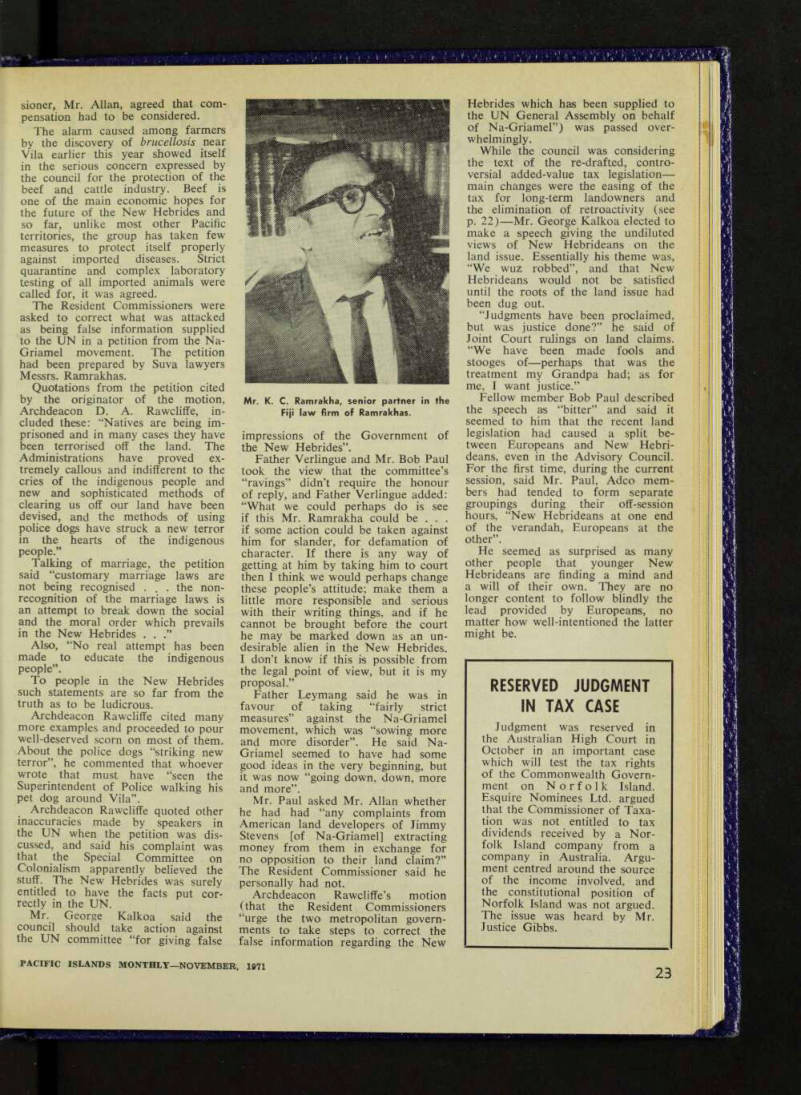
Mr. K. C. Ramrakha, senior partner in the Fiji law firm of Ramrakhas.