Business and Development
pp. 120-121 · Read in the full issue
More wages or tea, but not both
The New Guinea tea industry be lieves it has acted in time to prevent increases in the country’s minimum rural wage which could have crippled the young Highlands industry before it reached maturity in the mid-1970s The Papua New Guinea Tea Society, formed this year, has “pro tested pretty strongly” to the Adminis tration in Port Moresby over increases it understands were planned, in re sponse to the Cochrane Report on rural wages made public late in 1970.
A board of inquiry headed by Aus tralian Professor Donald Cochrane re commended that the $4.83 minimum rural wage paid to about 77,000 workers be increased over a period of two years by 32.4 per cent, to 56.40 a week.
The recommendation stunned mar ginal producers (rubber especially), and the tea industry, with its labour intensive methods, was immediately concerned.
The Administration, under political pressure from Members of the House of Assembly, immediately legislated to give a 50c a week increase (10.3 per cent.) as an interim measure, which became effective in January this year.
The tea industry, and other agri cultural industries, are certain there will be a further increase, but they are concerned to keep it within what thev see as their capacity to pay.
The Tea Society’s submissions to the Administrator and to the Ministerial Member for Agriculture, Mr. Tei Abal (himself a Highlander), have been: • The Cochrane Report empha sised too much idealistic solutions to the low wages of rural workers, and too little the effects its recommenda tions could have on New Guinea agriculture; • In the tea industry, labour costs were already 50 to 100 per cent, higher than in other tea producing countries, with labour approximately 45 per cent, of the ex-factory cost of tea;
• The Cochrane Report took a short-sighted view which could place the tea industry at a disadvantage and cause serious problems for a future independent New Guinea trying to make its way on world markets; • As a result, the rural workers would be worse off in the long term.
One tea producer said the industry believed that the Department of Labour had gone too far in public in appearing to fall in with the Cochrane Report recommendations, and now was embarrassed by the obvious effects of implementing the wage re commendations in full.
A spokesman for the Tea Society said he felt the Administration was sympathetic to the industry’s claims that the Cochrane Report basically was unrealistic and biased towards the workers’ needs and against the industry’s needs as a whole.
The industry realised the wage re commended was for workers in all crops, but tea had the potential to become the fourth biggest rural ex porting industry within this decade, and considerations for it should be strong.
Coincidentally, the fourth big tea producer in New Guinea, ANG Corp., opened a $500,000 factory at Banz
on its Bunum-Wo plantation to cater for its 1.000 acres of tea worth an investment of $1,250,000. ANG chair man, Mr. Steven Rich, said in Sydney that the present high prices for tea around the world would probably be temporary.
“Prices seem to move in cycles,” he said. “We are prepared for prices to go lower in the future, but not if costs rise steeply, as they would with the wage increases recommended in the Cochrane Report. We have appealed in the past to the Labour Department to be reasonable in its approach, but in the end the industry as a whole had to make an approach.
“We are not against wage increases that leaven the Cochrane Report with reality. Talking globally, I have known no black country which has legislated itself off a market. I can’t see the Administration doing anything silly in this case, despite some of the pres sures on it.”
Mr. Rich estimated that there was $l5 million invested in tea in the Highlands already, with the early plantings not due to be mature until 1973-75, when accurate production cost figures could be worked out for the first time in New Guinea.
A spokesman for Pioneer Concrete Services (Kurumul Plantation) said implementation of the $6.40 wage could be the “death knell” for tea in dustry growth.
He said there was ample labour in the Wahgi Valley, where most tea was being grown, and the industry so far could not absorb the labour avail able. About 4,000 worked in tea. It seemed a denial of normal economics
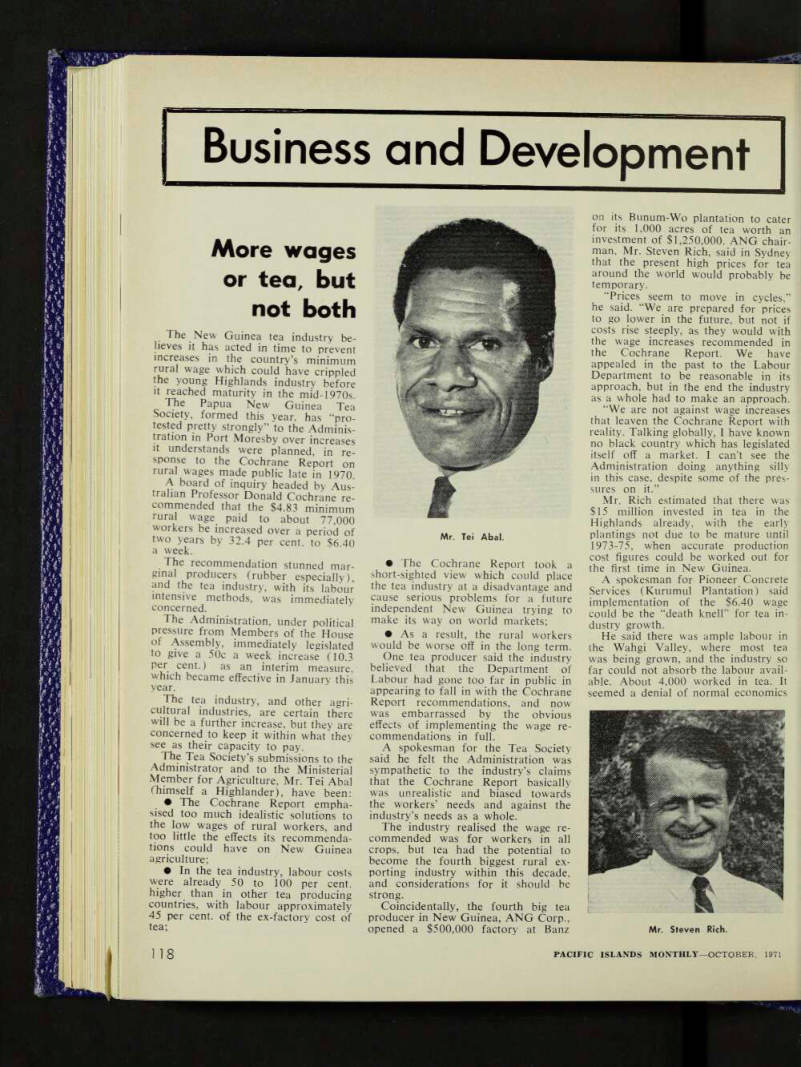
Mr. Tei Abal.
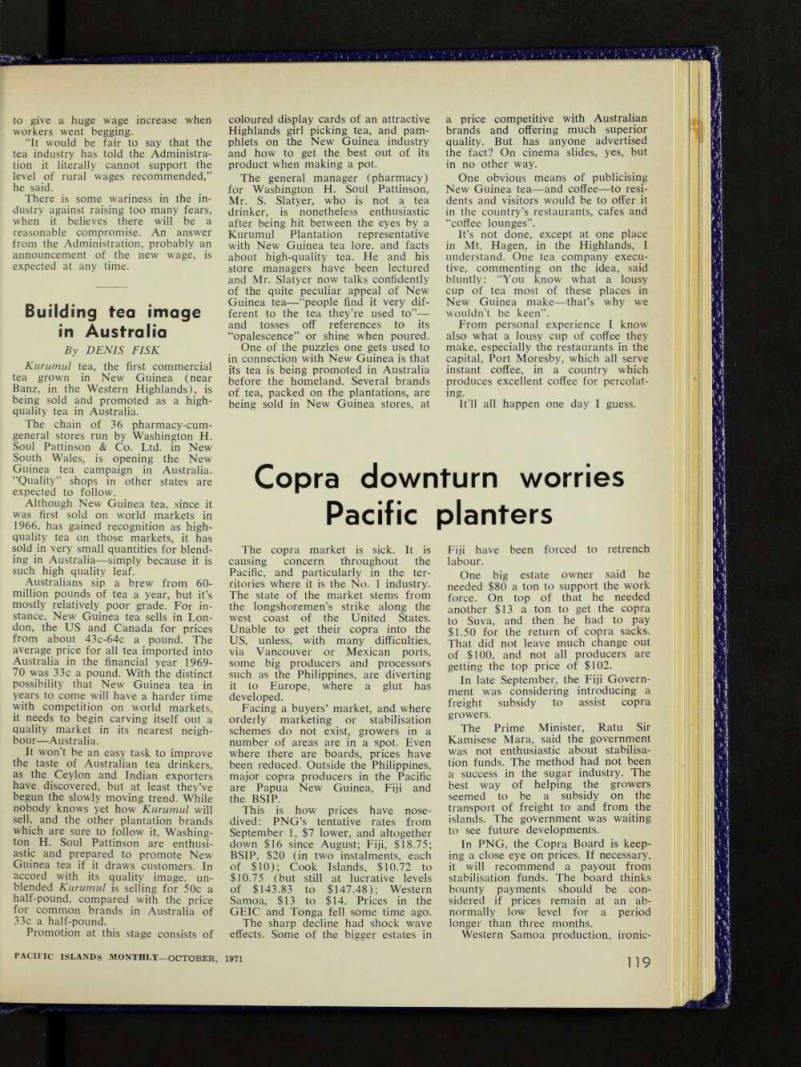
Mr. Steven Rich.
to give a huge wage increase when workers went begging.
“It would be fair to say that the tea industry has told the Administra tion it literally cannot support the level of rural wages recommended,” he said.
There is some wariness in the in dustry against raising too many fears, when it believes there will be a reasonable compromise. An answer from the Administration, probably an announcement of the new wage, is expected at any time.