Pacific Shipping
pp. 103-113 · Read in the full issue
Tnt Says
It Wants
To Extend
Tofua (also passengers), Taveuni and Waimea, and the Holm Shipping Co. services, as Holm is largely owned by the USS Co.
Although it is early days yet and details of the takeover are not com plete, TNT says categorically that ser vices to the Pacific Islands will not be curtailed. It will provide the ser vices needed by USS Co. customers.
“The intention, if anything, is to provide improved services, not curtail them,” a TNT spokesman said to PIM. “We are builders of business not liquidators”. He qualified that statement by adding that shipping ser vices must provide an adequate re turn on capital.
But whether the type of service offered to the Pacific Islands from NZ continues much longer depends on a survey of needs. This survey will take many months. It could result in a decision to place different types of ships on those services.
With the takeover, the USS Co. is almost certain to lose its agency for P and O Lines to another P and O subsidiary, the New Zealand Shipping Co. The NZ Shipping Co. has already acquired the agency for the British India Steam Navigation Co, from the USS Co. Presumably Burns Philp (SS) Co., Fiji agents for the NZ Ship ping Co. will take over handling of P and O liners in Suva from the USS
TNT’s policy is to build, not to liquidate. So Fiji, Tonga, Niue and both Samoas may expect, in time, a shipping service from New Zealand, better than the service they now enjoy. TNT (Thomas Nationwide Transport, a big Australian-owned land and sea transport complex), by the end of 1971, will be half-owner of the Union Steam Ship Co. of NZ Ltd., which services those islands.
Although the other half of the com pany will be owned by about 20 NZ companies, it will be TNT which will provide the drive behind the USS Co. from 1972 on. The companies which will own the USS Co. are TNT Ship ping (NZ) Ltd. and NZ Maritime Holdings Ltd.
The USS Co. will cost the new owners $24 million, give or take a few hundred thousand dollars, depend ing on final audit.
The announcement in September that TNT and NZ interests would take over the USS Co. came after about a year of negotiations, and nearly two years after TNT put out the first feelers to the USS Co. parent, the P and O Company.
NZ’s Transport Minister, Mr. John Gordon, announcing that agreement had been reached on the takeover, said, “I am confident that the ability and expertise, coupled with the en thusiasm and commercial knowledge of the NZ partners, will ensure the success of this venture.”
The USS Co. shipping operations fall roughly into three categories: Coastal (both NZ and Australia), trans-Tasman and Pacific Islands.
Naturally it is the South Pacific which is interested in what will happen to the cargo services provided with the
Co. Thus, Jack Gosling, shipping manager of BP’s, will meet and fare well P and O liners at Suva, instead of Jack St. Julian, Fiji manager of the USS Co.
The USS Co. will continue to act as agent for the NZ Government Moana Roa at Auckland and Raro tonga, although this ship is now man aged by the Department of Maori and Island Affairs.
For the record, the takeover in volves about 40 ships, including two harbour tugs, with an average age of 13 years. There are two trans-Tasman roll on-roll off ships (roros) and two coastal roros, and one ferry, the
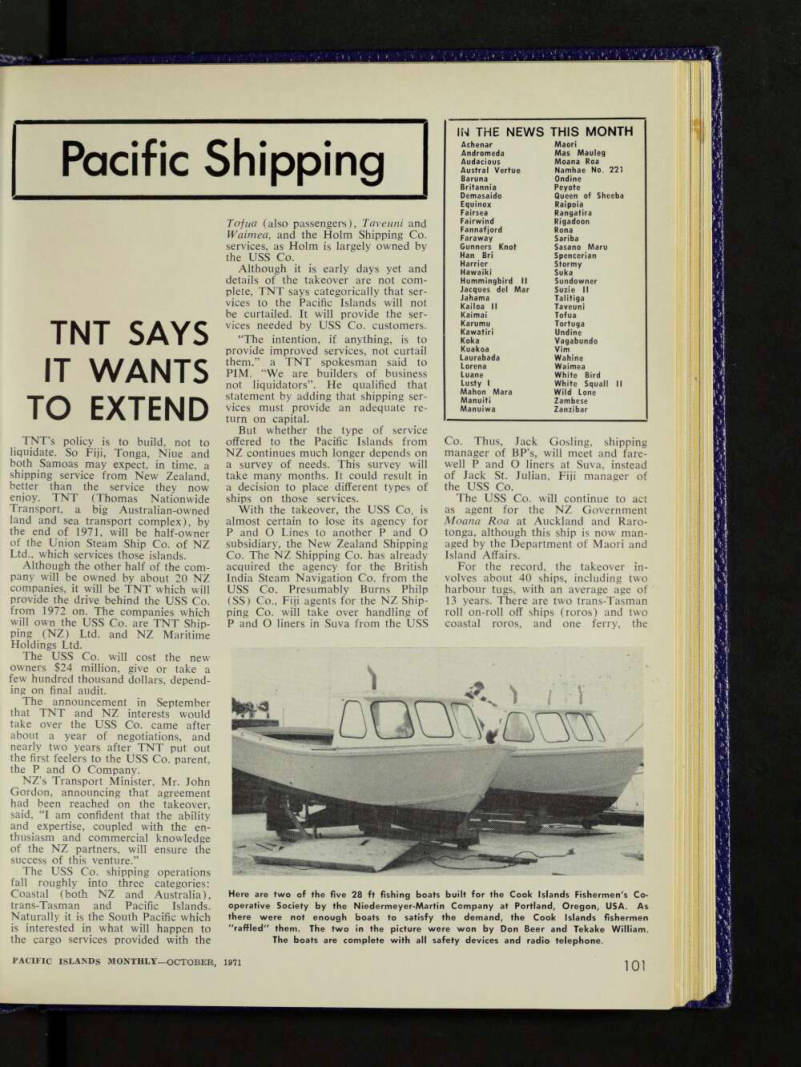
Here are two of the five 28 ft fishing boats built for the Cook Islands Fishermen's Co operative Society by the Niedermeyer-Martin Company at Portland, Oregon, USA. As there were not enough boats to satisfy the demand, the Cook Islands fishermen "raffled" them. The two in the picture were won by Don Beer and Tekake William.
The boats are complete with all safety devices and radio telephone.
Maori, which operates between Lyttel ton and Wellington.
Another ferry, Rangatira, is being built to replace the Wahine, which overturned and sank outside Welling ton in a gale in 1968. Three ships are tied up at Auckland —the Kaimai, Karwnu and Kawatiri.
Container Ships
For The Islands
Moves are afoot in New Zealand to launch a new service to the Pacific Islands with container ships. A com pany, Interocean NZ Ltd., has been formed. This company has an option on a container ship under construction in Holland.
The general manager of Interocean NZ, Mr. T. Hallrakar, recently visited Samoa, Fiji and Tonga to talk about the service. However, ports of call and schedules are still not decided.
The company’s intention was to use its ship on a main route from NZ, with smaller ships to maintain feeder services.
The new ship will be of standard design and capable of loading up to 111 international containers. But she does not need a special wharf to handle her container cargoes. She will be able to load 12 cars and use most small ports in NZ and the Pacific Islands. The ship is expected to be ready for service about April, 1972.
Interocean NZ Ltd. is closely asso ciated with Interocean Steamship Cor poration, of San Francisco. It has other Pacific Islands shipping and trading interests.
Interocean may run into several difficulties, chief among which is that they will not be supported by Pacific Islands governments. The governments concerned consider the plan is in con flict with their own schemes for a regional shipping line.
A final blow could come from stevedores. The Fiji Seamen’s and Dockworkers’ Union has warned it will oppose the introduction of con tainers because they might put some dockworkers out of work. And is that not one of the matters which has led to the industrial upheaval along the waterfront of the US west coast?
Fiji Loses 'Rona'
Cargo Link
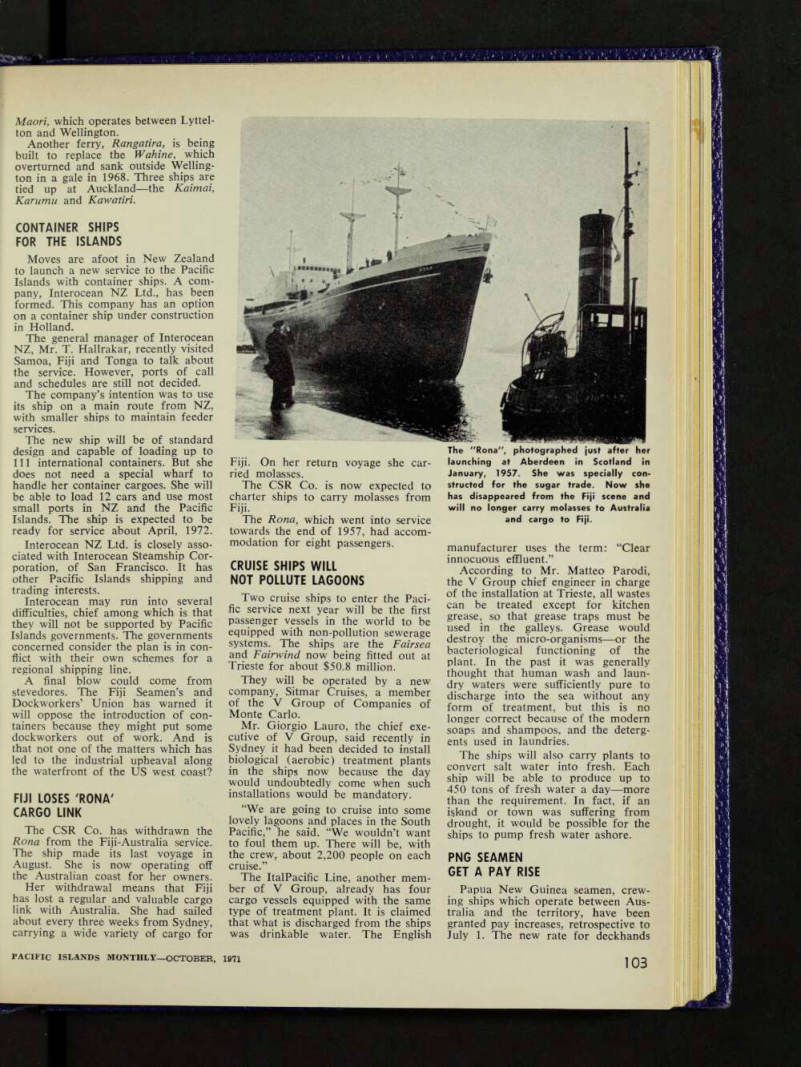
The CSR Co. has withdrawn the Rona from the Fiji-Australia service.
The ship made its last voyage in August. She is now operating off the Australian coast for her owners.
Her withdrawal means that Fiji has lost a regular and valuable cargo link with Australia. She had sailed about every three weeks from Sydney, carrying a wide variety of cargo for
Fiji. On her return voyage she car ried molasses.
The CSR Co. is now expected to charter ships to carry molasses from Fiji.
The Rona, which went into service towards the end of 1957, had accom modation for eight passengers.
Cruise Ships Will
Not Pollute Lagoons
Two cruise ships to enter the Paci fic service next year will be the first passenger vessels in the world to be equipped with non-pollution sewerage systems. The ships are the Fairsea and Fairwind now being fitted out at Trieste for about $50.8 million.
They will be operated by a new company, Sitmar Cruises, a member of the V Group of Companies of Monte Carlo.
Mr. Giorgio Lauro, the chief exe cutive of V Group, said recently in Sydney it had been decided to install biological (aerobic) treatment plants in the ships now because the day would undoubtedly come when such installations would be mandatory.
“We are going to cruise into some lovely lagoons and places in the South Pacific,” he said. “We wouldn’t want to foul them up. There will be, with the crew, about 2,200 people on each cruise.”
The Ital Pacific Line, another mem ber of V Group, already has four cargo vessels equipped with the same type of treatment plant. It is claimed that what is discharged from the ships was drinkable water. The English
manufacturer uses the term: “Clear innocuous effluent.”
According to Mr. Matteo Parodi, the V Group chief engineer in charge of the installation at Trieste, all wastes can be treated except for kitchen grease, so that grease traps must be used in the galleys. Grease would destroy the micro-organisms—or the bacteriological functioning of the plant. In the past it was generally thought that human wash and laun dry waters were sufficiently pure to discharge into the sea without any form of treatment, but this is no longer correct because of the modern soaps and shampoos, and the deterg ents used in laundries.
The ships will also carry plants to convert salt water into fresh. Each ship will be able to produce up to 450 tons of fresh water a day—more than the requirement. In fact, if an island or town was suffering from drought, it would be possible for the ships to pump fresh water ashore.
Png Seamen
Get A Pay Rise
Papua New Guinea seamen, crew ing ships which operate between Aus tralia and the territory, have been granted pay increases, retrospective to July 1. The new rate for deckhands
The "Rona", photographed just after her launching at Aberdeen in Scotland in January, 1957. She was specially con structed for the sugar trade. Now she has disappeared from the Fiji scene and will no longer carry molasses to Australia and cargo to Fiji.
is $32 a month —previously $26.
There are proportionate increases for bosuns and quartermasters.
The shipping lines chiefly affected are Karlander, China Navigation and Conpac. Seamen were not represented at negotiations, which were conducted by the Department of Labour. The department guided shipowners on what would be appropriate rates, A feature of the negotiations was a request by shipowners to the depart ment that it encourage seamen to form a union so that they would have someone with whom to negotiate.
The new pay rates for seamen fol low recent increases secured by steve dores. There will inevitably be a flow on to seamen who man the PNG coastal fleet.
Trix Chased The
"Gunners Knot"
A typhoon scare delayed re-entry of MILFs Gunners Knot into service after emergency repairs to bearings and the propeller shaft. She went out on sea trials after the repairs had been carried out in Onomichi shipyard in Japan.
The trials indicated she was ready to return to service, but just after her departure was announced Typhoon Trix caused her to make a quick run to Kobe anchorage for temporary
shelter. The schedule for Gunners Knot covers Guam, Truk, Ponape, Kusaie, Majuro, Ebeye and Japan.
Mill WANTS
Port Dredging
Failure to dredge the harbour at Yap in the US Trust Territory has made handling of some ships ineffici ent and time-consuming. When the MILI ship Mas Mauleg went aground in August, while trying to get along side the barge which serves the port as a pier, an immediate request was made to dredge the area to a mini mum depth of 20 ft.
The harbour was not dredged. To accommodate the Fannafjord on Sep tember 6 it was necessary to move the barge into deeper water so that the ship could tie up safely and discharge her cargo.
Us Waterfront Strike
Worries Micronesians
The US Trust Territory is becoming alarmed at the prolonged strike by longshoremen at ports on the US west coast. It is to these ports that the territory exports much of her meagre primary produce, and it is from the same area that she imports many of her requirements.
The strike started on July 1 and
late in September there seemed to be little prospect of its ending.
MILFs Hoi Kung finally sailed from Vancouver on September 10 with cargoes for all TT ports and Guam—and was expected in late September to be the first commercial vessel to reach the TT from the US West Coast since the shutdown.
Is "Moana Roa's"
End In Sight?
Airport development at Rarotonga and entry of a new ship, the Lorena, into the Cook Islands trade, may spell “finis” for the NZ Government’s Moana Roa. The Moana Roa has maintained a New Zealand-Cook Islands passenger cargo service for a number of years.
On top of the competition, the Moana Roa lost $346,527 in the last financial year. Of that amount, about $21,000 went to meet claims for pilfered, broken or short-landed goods.
The Moana Roa will be unable to meet competition from airlines when the Rarotonga Airport is opened. Al though the new airport is likely to increase demands for cargo to meet a tourist influx, local opinion is that the Cook Island Shipping Co.’s new ship, the Lorena, will get the bulk of cargo offering. The Lorena, with a shallow
draught, was built specially for Is lands trade. She will have no trouble entering Avatiu Harbour.
Another Victim
For Fiji's Reefs
Yet another Japanese fishing ship, aground on a reef in the South Paci fic, has been abandoned. The latest victim is the Sasano Maru, 200-ton wooden tuna fishing ship, which stranded on Nacula Island reef in the Yasawas in Fiji on August 19.
Loss of the Sasano Maru was a blow to a feasibility survey into a possible skipjack tuna fishing industry in Fiji. The survey was commissioned by United Nations and the Fiji Gov ernment. There are hopes that another ship will arrive from Japan before the tuna begin running in October and November.
The Sasano Maru covered herself with glory before running on the reef, catching 4,000 lb of tuna and helping the feasibility study along.
Support For
Fiji's Sea Claims
The justice of Fiji’s claims over territorial waters as a small developing oceanic country was recognised at a recent meeting of the United Nations Seabed Committee in Geneva.
Fiji was represented by the Solici tor-General, former Perth solicitor, Don McLoughlin. He reported on his return to Fiji that countries with im portant maritime interests had sup ported Fiji’s claims to territorial waters and exclusive fishing rights.
Fiji, as an oceanic archipelago, claimed territorial waters extending three miles from a line drawn round the outer limits of the group, and fish ing rights exclusively for 12 miles out from the same line.
Countries with important maritime interests supported Fiji’s claims. A full international conference about the law of the sea will be held in 1973, and the preparations for it will be followed closely by the Fiji mission to the UN.
New Arrival
For Karlander
Karlander is now one of the big gest, if not the biggest shipping line, operating from Sydney to Pacific Is lands ports. The latest addition to her fleet is the Sariba, 7,000 tons carry ing capacity, which has opened up a new Sydney-Brisbane-Port Moresby service.
The Sariba was scheduled to sail from Sydney on the first service on September 22. On her return voyage to Sydney she is scheduled to call at Gove in the Northern Territory.
The Sariba has two large sideport
doors and her derricks are capable of lifts of 58 tons.
There are now 11 flying the Kar lander flag out of Sydney to Pacific Island ports. These ships call at 30 ports altogether, including 16 in the Pacific. The three sideport loaders which operate from Sydney to the US west coast, via Fiji, have been using Canadian and Mexican ports since the strike of the longshoremen.
On October 1, Karlander took over the agency of the Jacques del Mar, which operates from Sydney to New Caledonia, via Norfolk Island.
A. Samoa Gets
A New Tug
American Samoa’s new tug, the Talitiga, due in Pago on October 1, was named after a contest. One stipu lation in the contest was that those who submitted entries should give the tug a Samoan name, starting with “T”. The winner was awarded a $25 savings bond.
The Talitiga , 134 tons, was for merly the Koka. It has been added to the government fleet. The Koka was based in San Diego, and has been valued at about $lOO,OOO by Captain John Calver, deputy port director in Pago Pago. She will be used primarily for charter work, and is expected to increase the Department of Port Ad ministration’s income by about $lOO,OOO a year.
Nz Company Opens
New Service
A new shipping service from Napier, on the east coast of the NZ North Island, will soon be opened to the New Hebrides, New Caledonia, the BSIP and Papua New Guinea.
Ships will be provided by a NZ com pany, Concorde Export and Agency, and Maritime Pacific Merchants.
Sailings are planned every six to eight weeks with ships in the 2,000 to 2,500 tons range.
This new service, expected to start before Christmas, comes hard on the heels of the suspension of the New Zealand Export Line’s Auckland-Port Moresby-Brisbane service, via Honi ara and Kieta (PIM, Aug. p. 91),
Z Ships To
Replace V Ships
Messageries Maritimes will replace their general cargo V ships which ser vice New Zealand, via some Pacific Islands’ ports, with bigger Z ships (13,200 tons), which have much more reefer space.
The first of the new ships, the Zam hese, will sail from northern Euro pean ports for New Zealand, via New Caledonia, in October. The second Z ship, the Zanzibar, will come into ser
vice in April, and the third, the Zee hruge, in May. The Z ships have 3,000 cubic metres reefer space, com pared with 250 cubic metres in the V ships.
Blue-Print For
An All-Service Ship
The US Trust Territory has re ceived a conceptual blue-print for a new inter-island field trip vessel. The Trust Territory requires a ship to serve the varied transport needs of Micronesia, preferably a type of ship which could eventually replace the older fleet of 14 vessels which pro vide present field trip services to the islands. The design, by a San Fran cisco naval architectural company,
Thomas Lundy Inc., will be circulated among government officials for com ment.
Mr. Wayne Thiessen, head of Trust Territory transport, reported the new design would provide for a ship with three major assets: • Flexibility, with the ability to carry a wide variety of cargo and varying numbers of passengers, and able to service all types of ports from modern developed harbours to small atolls with no docking facilities; • The ship would be able to ope rate with a relatively small number of crew, and would not require sophisticated, on-board repairs; • It would be fast and able to maintain frequent shipping schedules.
Mr. Thiessen said it was hoped to
have the final design, incorporating any revisions which may be necessary, ready by the end of 1971. It would then be possible to construct the first ship by the end of 1972. Till the final design was completed it would be difficult to estimate the cost of the vessel, but he felt it would be pos sible to build it at a reasonable cost.
Crash Programme
For Samoa
A one-year crash programme cost ing $U576,000 has been organised by the United States Office of Economic Opportunity to improve American Samoa’s off-shore fishing industry.
Under the scheme, a boat builder, hydraulics mechanic, a fishing instruc tor and a co-ordinator were due in the territory in late September to super vise construction of five 22 ft fishing dories, each with a capacity of more than a ton of fish. Boat builders, fishermen and marketing officers will also be trained under the scheme.
New Fishing Fleet
For Micronesia
A newly-formed fishing company plans to operate 12 fishing ships in Micronesian waters. The company, Spicewind, will start fishing in Yap District and the Marshalls later this year with the first two ships in the fleet, the Polaris and the St. Vincent.
Each ship costs about $2 million and is fully equipped with the latest devices for locating schools of yellow fin tuna. Each is 165 ft long with storage capacity of 650 tons and will carry a Micronesian crew of between 14 and 18.
A United States fisheries survey ship which carried out a three-month cruise in the Mariana, Caroline and Marshall islands returned to Honolulu recently with a report that the islands’ nearshore fish resources were poor.
The ship, the Townsend Cromwell fished around 26 island and atolls and found that “trawlable grounds were almost non-existent” and “troll catches were negligible”.
The ship also looked for surface skipjack schools suitable for high seas purse seining operations and found that “in general, the size and type of schools seen did not look very promising for purse seining”.
Geic Fisheries
15 Expanding
The GEIC’s Fisheries Department has placed an order in Fiji for a bait survey vessel which will operate from Christmas Island and will be similar to the department’s ship Eileen which is based on Funafuti. Two fisheries
development officers have been re cruited in the United Kingdom, one for the Christmas Island station and the other for Funafuti. A third will be recruited for fisheries headquarters at Betio.
A 300-ton mother ship and two catchers are due in the colony in August to carry out a fisheries survey for the Van Camp Sea Food Co. of California.
Niue To Get A
Container Barge
Niue’s Public Works Department was due to start in August on build ing a new barge for handling con tainers. The craft will carry up to 12 tons and be 34 ft in length, with an 11 ft beam.
The PWD handles the island’s efficient lighter service on behalf of the Government and has nine craft— five of steel and three of the old wooden type that is gradually being phased out.
“We hope in two years to have six steel lighters and two steel barges,” says PWD director Mr. Jack Roughan, “I think we do pretty well here. We can unload an average of 45 tons an hour and that’s fairly good going.”
A New Zealand - owned coastal trader, the Hokianga, 168 tons, sprang a leak and sunk in the Gulf of Papua early in September, while midway between Daru and Port Moresby. The eight men on board were picked up from a life raft. The Hokianga was owned by Captain J.
C. McCormick.
Korean Vessel
Wrecked On Penryhn
Namhbae No. 221, a Korean fishing vessel, was wrecked on the southern tip of Penrhyn’s reef during the early hours of September 15. With the help of the Penrhyn people, all on board got safely ashore, but the vessel, badly holed, was considered a total loss.
The following day another Korean fishing vessel arrived at Penrhyn (in the northern Cooks) and took the stranded men off. It is believed that both vessels are based at Pago Pago, American Samoa.
YANKEE, world-famous brigan tine, stranded on the reef at Raro tonga since she was wrecked seven years ago, has been bought by an American syndicate. Her new owners hope to salvage her and transform her into a floating Polynesian mus eum in Los Angeles harbour. She has changed hands twice in the last two months. Island Merchants Ltd. bought her from Cook Islands Mar ine Board, intending to convert her into a restaurant, but found costs too high and sold her to the Ameri can syndicate. A salvage team hopes to refloat Yankee and tow her to Fiji for refitting. • A new small ship has been added to Burns Philp’s coastal fleet in Papua. It is the Riga, 68 ft, built at Ballina slipway. The Riga will operate mainly between Port Moresby and Daru. She is powered by two Cater pillar diesel engines and is capable of lifting about 70 tons of cargo.