Yesterday
p. 95 · Read in the full issue
October, 1951, was a fiddling sort of a month— in the sense that PIM, in its faithful reflections of life in the South Pacific, had no big stories of world-shaking events, but lots of small stories of small happenings which, of course, make up the very weft of life.
In recording that let's, at the very outset, apologise to the Prime Minister of Fiji, Ratu Sir Kamisese Mara, and assure him that not for one moment would we describe one happening recorded in PIM that month as a small happening.
It was one of the biggest in his life—his wedding, on September 22 at the Sacred Heart Cathedral in Suva, to Adi Lalabalavu, daughter of Ratu George C. Tuisawau, Roko Tui Dreketi. The marriage, PIM said, linked two of the greatest chiefly families of Fiji. It being the season of spring, there were quite a few weddings reported by PIM that month, including that of Mr. Ken Bain, now Fiji's number 2 man in London, to Miss Margaret Emberson, member of a well-known Fiji family; Mr. Jack Patrick Ryan, of Lalovaea, Western Samoa, to Miss Isabella Louise Stehlin, of Apia; Mr. Maurice Binnvenu, ex-French Navy, to Miss Irene de Laplane, of Vila, and Mr. Bill Kilroy, of Suva, to Miss Dorothy Kimsim.
There were other happenings of course and one was very important although there didn't seem to be a big song and dance about it. That was the setting up of a new Legislative Council in Papua New Guinea, an occurrence which PIM said had come "after a remarkable and unexplained delay of about two years". It gave the hoi polloi a voice which, up to then, they had lacked although the new council had no legislative power. Its composition was the Administrator, 16 departmental heads and officials, three nominated Europeans, three nominated missionaries, three nominated natives and three elected Europeans.
The election for the three Europeans was scheduled for November 10. Come to think of it, of course, if the council had no legislative power, there wasn't a lot to sing and dance about.
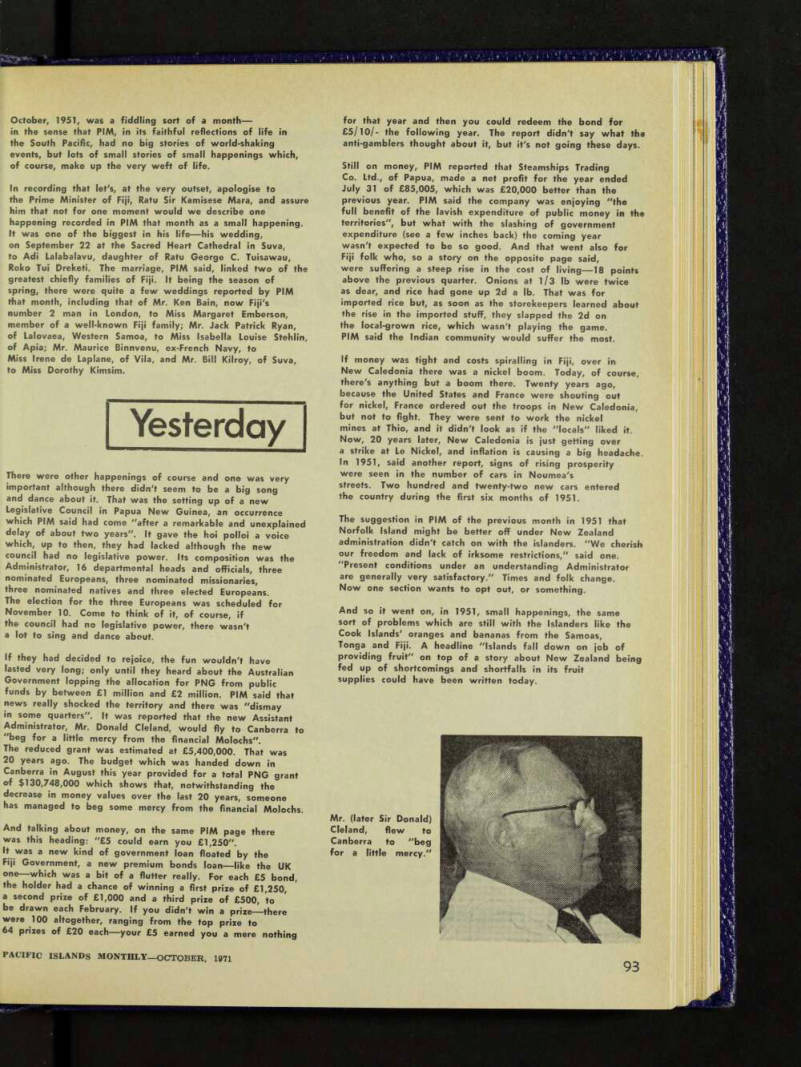
If they had decided to rejoice, the fun wouldn't have lasted very long; only until they heard about the Australian Government lopping the allocation for PNG from public funds by between £1 million and £2 million. PIM said that news really shocked the territory and there was "dismay in some quarters". It was reported that the new Assistant Administrator, Mr. Donald Cleland, would fly to Canberra to "beg for a little mercy from the financial Molochs".
The reduced grant was estimated at £5,400,000. That was 20 years ago. The budget which was handed down in Canberra in August this year provided for a total PNG grant of $130,748,000 which shows that, notwithstanding the decrease in money values over the last 20 years, someone has managed to beg some mercy from the financial Molochs.
And talking about money, on the same PIM page there was this heading: "£5 could earn you £1,250".
It was a new kind of government loan floated by the Fiji Government, a new premium bonds loan—like the UK one—which was a bit of a flutter really. For each £5 bond, the holder had a chance of winning a first prize of £1,250, a second prize of £l,OOO and a third prize of £5OO, to be drawn each February. If you didn't win a prize—there were 100 altogether, ranging from the top prize to 64 prizes of £2O each—your £5 earned you a mere nothing
for that year and then you could redeem the bond for £5/10/- the following year. The report didn't say what the anti-gamblers thought about it, but it's not going these days.
Still on money, PIM reported that Steamships Trading Co. Ltd., of Papua, made a net profit for the year ended July 31 of £85,005, which was £20,000 better than the previous year. PIM said the company was enjoying "the full benefit of the lavish expenditure of public money in the territories", but what with the slashing of government expenditure (see a few inches back) the coming year wasn't expected to be so good. And that went also for Fiji folk who, so a story on the opposite page said, were suffering a steep rise in the cost of living—lB points above the previous quarter. Onions at l/3 lb were twice as dear, and rice had gone up 2d a lb. That was for imported rice but, as soon as the storekeepers learned about the rise in the imported stuff, they slapped the 2d on the local-grown rice, which wasn't playing the game.
PIM said the Indian community would suffer the most.
If money was tight and costs spiralling in Fiji, over in New Caledonia there was a nickel boom. Today, of course, there's anything but a boom there. Twenty years ago, because the United States and France were shouting out for nickel, France ordered out the troops in New Caledonia, but not to fight. They were sent to work the nickel mines at Thio, and it didn't look as if the "locals" liked it.
Now, 20 years later, New Caledonia is just getting over a strike at Le Nickel, and inflation is causing a big headache.
In 1951, said another report, signs of rising prosperity were seen in the number of cars in Noumea's streets. Two hundred and twenty-two new cars entered the country during the first six months of 1951.
The suggestion in PIM of the previous month in 1951 that Norfolk Island might be better off under New Zealand administration didn't catch on with the islanders. "We cherish our freedom and lack of irksome restrictions," said one.
"Present conditions under an understanding Administrator are generally very satisfactory." Times and folk change.
Now one section wants to opt out, or something.
And so it went on, in 1951, small happenings, the same sort of problems which are still with the Islanders like the Cook Islands' oranges and bananas from the Samoas, Tonga and Fiji. A headline "Islands fall down on job of providing fruit" on top of a story about New Zealand being fed up of shortcomings and shortfalls in its fruit supplies could have been written today.
Mr. (later Sir Donald) Cleland, flew to Canberra to "beg for a little mercy."