tor record
pp. 66-67 · Read in the full issue
No medal tor record breakers
New Caledonia Diary
with
Helen Rousseau
in Noumea
Before the Caledonians even departed for the Tahiti Games in September, they had created a local record which will not be readily broken in the South Pacific.
But for that performance there were no medals or proud playing of the Marseillaise. The record nevertheless kept many cable wires hot to Paris, provoked grave concern in the French Adminis tration and coincided with the launching of no less than three newspapers in Noumea, The record, of course, was the two-month strike by almost 4,000 employees of the Paris-based nickel company, Societe Le Nickel (SLN). While some outside ob servers saw the strike as the first signs of a Caledonian “revolt” against the Rothschild-SLN domi nation of the territory’s economy, others saw the conflict as a general anti-zozo movement. The zozo, for those who have not yet met this Pacific island personality, is the unflattering Caledonian de scription of the Metropolitan French (particularly short-term settlers) otherwise known as Metros. The Metros’ term for Caledonians is not generally used in print. However, it is intended to refer to the convict (political prisoner) antecedents of present Caledonian society.
As for the Caledonians them selves, black and white, as they
slowly react to the strong insurge of nickel-conscious Metros , they are suddenly becoming more aware of their “island” identity, and the local term Caldoch is being fondly revived. It takes a long time for the Caldoch to be stirred, but the recent strike has shown he is able to resist, even at the loss of a few thousand francs in his pocket.
Actually, lost wages during the strike were officially estimated at the equivalent of more than SUS 3 million. Supplementary income, including working wives, and the ability to “pull in their belt” were used to explain the Caledonians’ staying power.
Every effort was made to break the power of the SOENC Union.
After six weeks conflict, a new movement was started to collect signatures from the “silent majority” which some people claimed were willing to return to work. About 1,100 signatures were collected, including over 700 in Noumea. But when the SLN then lifted its “lock-out” and in vited its workers back to the Noumea smelters and inland mining centres, apart from the security teams, only about 100 men reported for duty after the 3 a.m. factory shift in Noumea.
The SOENC in the meantime, on the strength of the claimed “700 willing workers”, announced it no longer saw the necessity to
maintain security operations, supervising the huge smelters as they smouldered at minimal safety level. In a surprising display of solidarity, Tahitian, Wallisian, Melanesian and European workers stood by the union decision.
Governor Louis Verger called a Press conference to explain the gravity of the situation. Eventu ally, he made a simultaneous radio and TV appeal to the workers to go back to the smelters, for the sake of the territory’s economy.
Finally, the workers accepted the SLN terms of paying a “loyalty bonus” and the granting of workers’ holiday trips to France, thus ending the conflict on August 30.
The SLN had originally an nounced plans to produce 65,000 tons of nickel metal this year.
SLN president, the Baron Guy de Rothschild himself, on May 10, had attended the inauguration of the smelter extensions, providing this increased production capacity.
Yet, on June 28 the SLN claimed problems in selling its nickel; stated it did not expect to market more than about 43,000 tons this year; announced plans to cut back production to about 55,000 tons and rejected the June 21 Arbitra tion Commission recommenda tions. The resulting two-month strike was expected to reduce this year’s production to less than 48,000 tons.
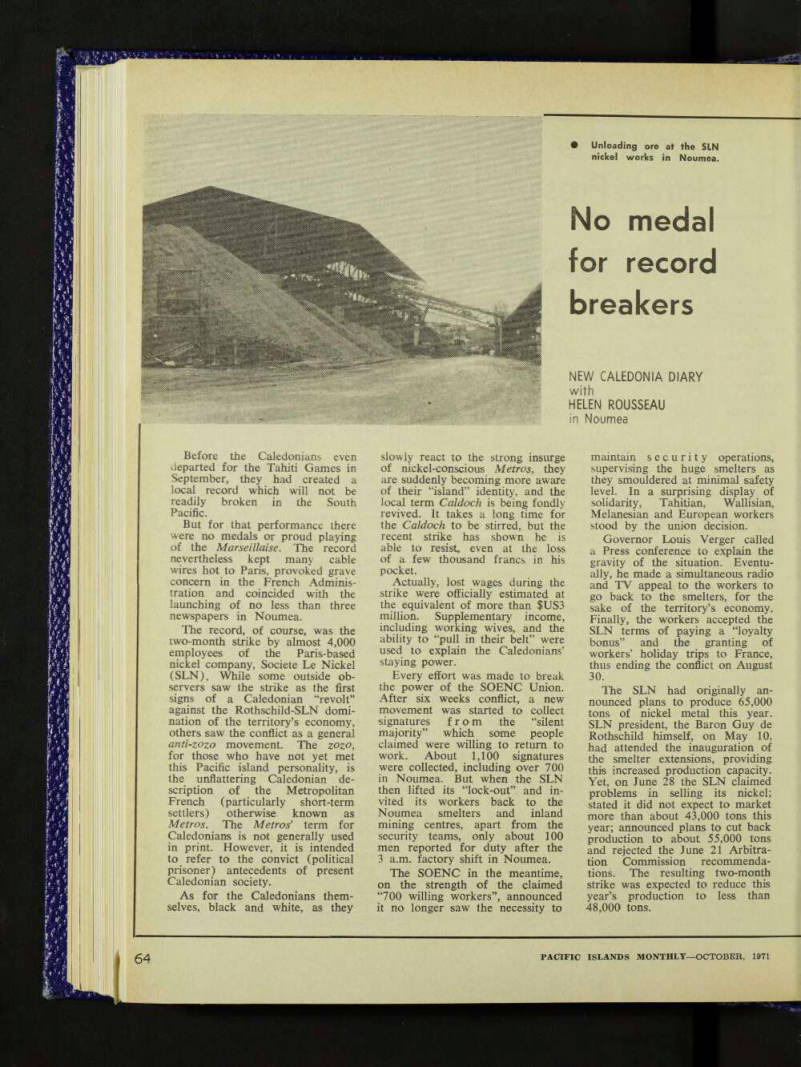
Unloading ore at the SLN nickel works in Noumea.
At the same time, no prospects were in sight for the much publicised Paris promises over the installation of a second, foreign involved nickel company, includ ing Canadian INCO. Nor were there any prospects for the im mediate realisation of the SOME CAL or PENAMAX projects, both SLN-dominated.
Meanwhile, as the huge fur naces smouldered at “minimal safety level”, the printing presses ran hot in Noumea. If the workers were challenging a Paris based mining company in its power over the territory’s destiny, some journalists also took the op portunity to challenge the nickel company’s dominance of the local Press. The conflict provided plenty of copy for Les Nouvelles, a new daily which had just appeared to compete with the SLN-controlled La France Australe.
In a territory where the radio and TV are both State-operated, newspapers have been launched in rapid succession, particularly over the past three years. Due to
political—including autonomist—
pressures during the strike, three more papers appeared during and after that conflict. This means there are no less than 17 news papers and political newssheets now being published in Noumea.
Their titles include: Canaque Awakening, The Caledonian In land, Le Caldoch. Does this fore shadow a more vehement battle for New Caledonia’s rich heritage?
How far will words be followed by action? Is there a leader who can determine what the Cale donians really want?
Amid what a Paris banking official described as the “wind of uncertainty which prevails here, the deceptions, the lack of confi dence”, the territory’s fourth bank announced plans to open its doors at the beginning of December.
M. Claude de Kemoularia, financial consultant for the Paribas Bank in France, had flown out to introduce the new manager of Paribas Nouvelle-Caledonie, M. Christian de Bernede, from the French Riviera. The new bank was formally constituted at the beginning of this year (PIM, March, ’7l, p. 109). It is the
only bank in the territory with Caledonian shareholders (includ ing M. Edouard Pentecost). Com posed of 70 per cent. French and Caledonian interests, Paribas NC also has a 30 per cent, share held by the Bank of America, which thereby becomes the first foreign bank to enter the territory. The bank is being built on the main street, Rue de I’Alma, at the Rue Georges Clemenceau intersection.
Underlining the bank’s business and investment activities, M.
Kemoularia explained that Paribas has an interest in the nickel mining project concerning INCO and also Chateau Royal hotel extensions, as well as in Fougerolle construc tions and OTH engineering con sultants, both recently installed in the territory. He emphasised that all these investments indicate the confidence this private French bank holds in the prosperous future of New Caledonia.
Other visitors to Noumea in September included three mine sweepers from the Royal Aus tralian Navy. They reported no difficulty in detecting mines on the seabed around Pacific islands on their tour. Risking these perils, however, they shipped in a pro hibited import for the Caledonians, an item which was particularly appreciated by the locals who were thus able to taste Pernod on board. This drink with an absinthe base, is banned from New Caledonia because the French fear its possible effects on the local population.
Almost every other variety of French wine, liqueur or cham pagne was offered by Noumea’s newest supermarket, at Prisunic, when they opened their upper floor in the centre of town.
Prisunic now becomes the first Noumea building to have escala tors both up and down. One other store has an escalator up, but you come down under your own propulsion.
Prisunic still maintains an adjacent staircase for those Noumea housewives who have greater confidence in their own legs. The new supermarket has
become quite a bustling rendez vous, especially after 5 p.m. when young working couples can choose from an immense selection of cheeses flown in from France, fruit and vegetables air-freighted from Australia and pot plants im ported from New Zealand.
Meanwhile, the spiral of infla tion maintains its grip on Noumea shop shelves. Prices are perpetu ally leaping 15 per cent, overnight, with no upper limit in view. The Administration follows spot checks on stores made by police, gendarmes and price - control officers, but no Noumea house wife has yet reported any reduc tion in her weekly grocery bills.
Latest item under enquiiy was butter, the Australian imports having just risen 50 per cent, in retail price, with NZ butter rising about half this much.
Meanwhile, in a bid to create local enthusiasm over the much neglected tourist industry, the Noumea TV network organised some debates on this subject re cently. The main objective seems to be to encourage Caledonians to show a “friendly attitude” to foreign visitors. The growing population in Noumea is itself prompting the organisation of many more distractions and leisure activities, from club and restau rant life to art and sport gather ings. The problem remains, how ever, that many of these interests are calculated to suit nickel-lined pockets, rather than those of bargain-hunting tourists. But visi tors with some imagination and curiosity can still have lots of adventures in Noumea, even if this might include brushing one’s teeth in whisky and ice, during a water cut.
Amid the many construction works progressing around Noumea, a new hotel has recently opened its doors. It is the Isle de France, operated by M. Georges Lavoix at Anse Vata beach. The 64room hotel, between the South Pacific Commission and the race course, was finished by Fijian labour brought in by Hines, of Suva. Rooms are offered at SAI7 per single and $2O per double. A welcome addition is the emergency water supply provided for water cut periods.