Stormy Weather Blows Optimism
pp. 59-61 · Read in the full issue

Away In Solomons Council
By a Honiara Correspondent
The final day of the Solomon Islands Governing Council session— August 26—was an historic one, when Mr. Silas Sitai, nominated by the High Commissioner to be the first Solomon Islander chairman, tried his hand out, first at presiding over Private Members’ Day, His appointment had been widely acclaimed by elected and public service members alike, and he was given a warm and sympathetic wel come on his first morning.
Six months ago, Governing Council rose on a note of sober optimism with the Sixth Development Plan agreed in principle, and members seeming prepared to stick to the Plan and to try to make sure their constituents accepted some of the more unpopular economic measures which would see the Solomons along the road to economic independence.
Sober optimism this session seemed to have gone in favour of a deter mined push towards self-determina tion, Plan or no Plan, and the pro ceedings were stormy, with members often bitterly critical both of their year-old constitution and the Civil Service.
One thing all elected members agreed on was the need for radical constitutional change, but despite the efforts of Peter Thompson and one or two other more responsible mem bers to persuade the House to get down to some constructive debate on this vital subject, a great deal of the council’s time was taken up with wrangling about the Taiyo Fishing Company agreement, castigating the Wages Advisory Board—set up on their recommendation at a previous session—and, despite the Plan, demanding more development for no extra effort.
Nearly every elected member spoke with some heat about the Japanese Taiyo Fishing Company agreement, now in its second month, but the impression was that they were arguing, not so much about any pos sible harm the Japanese might do during the 18-month survey for a potential fishing industry—though some very extravagant suggestions were made —as the splitting of con stitutional hairs. What bothered them was that the High Commissioner had used his reserve powers over the agreement and that the prospect of the survey had never been discussed
by the whole House. The Natural Resources Committee had been in the know, and an information paper had been circulated. But it seems likely that some members had not done their homework, as many said their first knowledge of any agree ment was when the fishing boats actually arrived.
And what seems even more im portant —neither had their con stituents. Members had clearly been embarrassed by the strong reaction of the people to the Japanese, ap pearing apparently at the behest of those who purported to represent them in Governing Council, and who now seemed to have sold them out to the Japanese.
From the tone of the debate, many members thought they had lost not only face but also any faith which their constituents had previously placed in them, and the Financial Secretary and the Chairman of the Natural Resources Committee, both of whom had signed the agreement in Tokyo in May, came in for severe criticism.
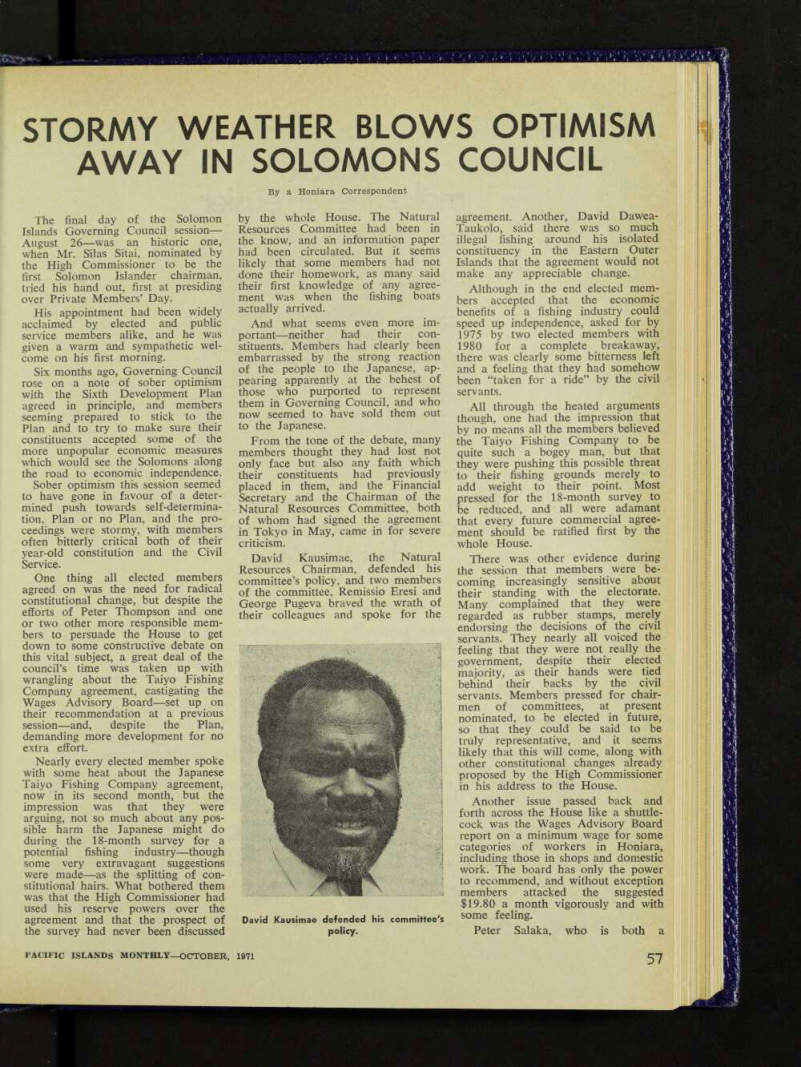
David Kausimae, the Natural Resources Chairman, defended his committee’s policy, and two members of the committee, Remissio Eresi and George Pugeva braved the wrath of their colleagues and spoke for the
agreement. Another, David Dawea- Taukolo, said there was so much illegal fishing around his isolated constituency in the Eastern Outer Islands that the agreement would not make any appreciable change.
Although in the end elected mem bers accepted that the economic benefits of a fishing industry could speed up independence, asked for by 1975 by two elected members with 1980 for a complete breakaway, there was clearly some bitterness left and a feeling that they had somehow been “taken for a ride” by the civil servants.
All through the heated arguments though, one had the impression that by no means all the members believed the Taiyo Fishing Company to be quite such a bogey man, but that they were pushing this possible threat to their fishing grounds merely to add weight to their point. Most pressed for the 18-month survey to be reduced, and all were adamant that every future commercial agree ment should be ratified first by the whole House.
There was other evidence during the session that members were be coming increasingly sensitive about their standing with the electorate.
Many complained that they were regarded as rubber stamps, merely endorsing the decisions of the civil servants. They nearly all voiced the feeling that they were not really the government, despite their elected majority, as their hands were tied behind their backs by the civil servants. Members pressed for chair men of committees, at present nominated, to be elected in future, so that they could be said to be truly representative, and it seems likely that this will come, along with other constitutional changes already proposed by the High Commissioner in his address to the House.
Another issue passed back and forth across the House like a shuttle cock was the Wages Advisory Board report on a minimum wage for some categories of workers in Honiara, including those in shops and domestic work. Tlie board has only the power to recommend, and without exception members attacked the suggested $19.80 a month vigorously and with some feeling.
Peter Salaka, who is both a
David Kausimae defended his committee's policy.
member of the Advisory Board and secretary of the recently formed General Workers’ Union, made an impassioned plea to the House, not only for a higher minimum wage but also for improved living quarters.
He received sympathy and support from a number of his colleagues.
Always a champion of the lower-paid, he hinted at dire results if their welfare was neglected.
There was plenty of this rabble rousing stuff, particularly from Salaka, and also from fiery Solomon Mama loni, who held the floor one morning for more than 50 minutes—surely a record. Claiming that his con stituency of Makira/Ulawa, in East ern Solomons, was completely neglected by government, he threat ened to secede if his demands for his people were not met. His suggestion that the French would be interested in the Eastern Solomons met with considerable mirth from his col leagues, but he continued to assert stoutly that he was not joking.
There was no very significant new legislation this session. Bills to bring in a probation service, to protect unmarried or deserted mothers and their offspring, and amendments to several other bills passed through the House with little comment and took up a very small portion of govern ment time.
The Diocese of Melanesia is celebrating the centenary of the martyrdom of Bishop Patteson and perhaps martyrdom is in the air this year, for two elected members told the House they were willing to suffer so that right could triumph, Mama loni said he was ready to die if it would help his constituents, and Eresi manfully asserted he didn’t care if he was thrown out for airing his views about the fishing agreement.
Another member, Jonathan Fifi’i reminded the House that he had already been in prison for his part in the anti-government Marching Rule movement some years ago.
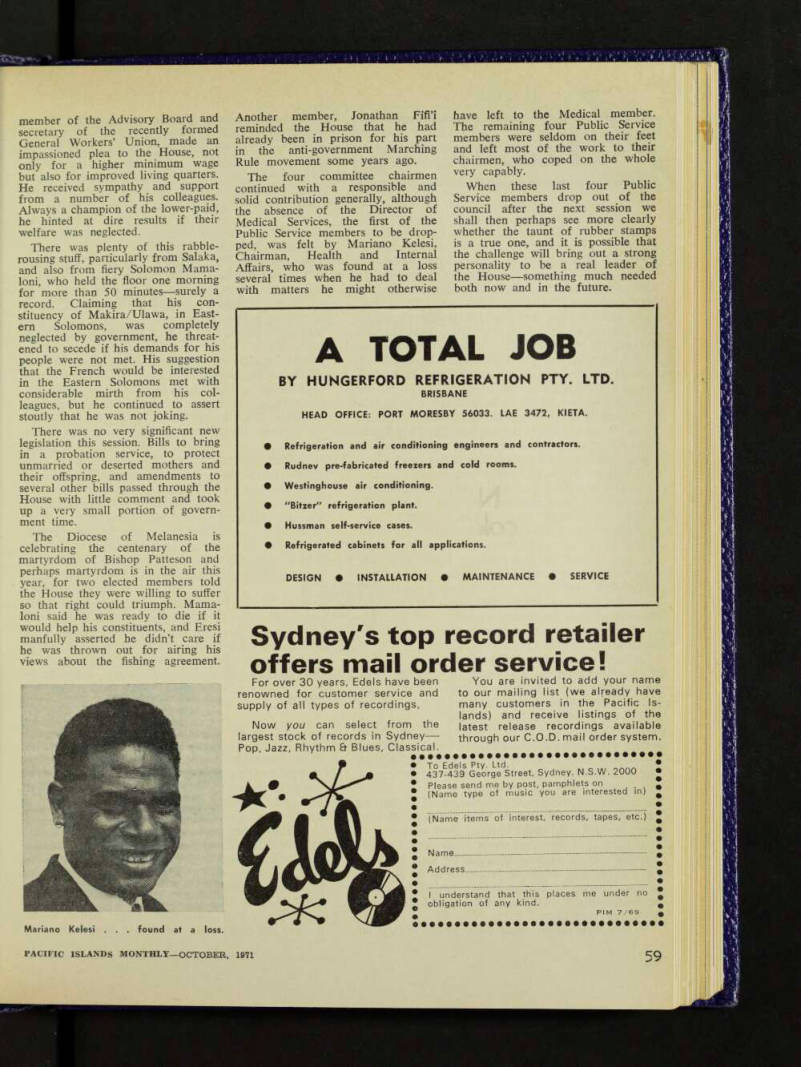
The four committee chairmen continued with a responsible and solid contribution generally, although the absence of the Director of Medical Services, the first of the Public Service members to be dropped, was felt by Mariano Kelesi, Chairman, Health and Internal Affairs, who was found at a loss several times when he had to deal with matters he might otherwise
have left to the Medical member, The remaining four Public Service members were seldom on their feet and left most of the work to their chairmen, who coped on the whole ver y capably, When these last four Public Service members drop out of the council after the next session we shall then perhaps see more clearly whether the taunt of rubber stamps is a true one, and it is possible that the challenge will bring out a strong personality to be a real leader of the House—something much needed both now and in the future.
Mariano Kelesi . . . found at a loss.