Half-Forgotten Western Isles
pp. 51-54 · Read in the full issue

By Sheree Lipton
Irving Wallace wrote an absorbing novel about a group of islands called the Three Sirens, populated by a Polynesian group of people who spoke good English—thanks to a few early contacts—but, somehow, were un touched completely in modern times by the White Man’s world.
When I read the Three Sirens, I wondered, romantically, letting my imagination wander, if such a group of islands could still exist. And last month, in the remote Ninigo Islands of New Guinea I found them—al most. Unfortunately, the missionaries, Catholic and SDA, had got there be fore me, but since they only bother to show up every six months, the islands are still relatively untouched by most, and often damaging, influ ences of the European and his peculiar personality habits.
While little has been written about these far-flung islands away in the Bismarck Archipelago, they have an interesting, though somewhat vague history. During the three weeks I spent in the Ninigo Islands—it’s a 37-hour trip by copra boat from Madang I asked the islanders, who call themselves Seimats, about the legends relating to their background. 1 got little good colour, or pearls of wisdom, out of the many discussions.
Even the oldest man could remember nothing of that long-forgotten turn buna time, though there were a few interesting legends about the forma non of several of the 50, or so, scat tered atolls of the group.
A *J e °i wnttei ? background I could find was contained m a century
old diary kept by a German sea captain, Alfred Tetens, Among the Savages of the South Seas; Memories oj Micronesia, 1862-68.
Tetens reckoned that the Seimats were of Micronesian stock and had sailed down from the Carolines, He reported that they were “excellent sailors”—and they still are today— and practitioners of cannibalism— which they’re not any more.
In more recent years two missionary groups have got a strong hold in the Ninigoes, a Catholic order of American priests based on Manus Island—famous as Margaret Mead’s old stamping ground ( Growing Up in New Guinea )—and the Seventhday Adventists, who provide much of the schooling for the islanders. There is a considerable difference in the mode of living between the islands, which are influenced by the SDAs and those where the Catholics hold sway.
A short canoe ride will take you from one world to another, from a place where grog, turtles and pigs are the daily bill of fare, to another island where all this is forbidden.
Amik, a tiny atoll, which was my base for three weeks, was entirely Catholic, peopled by enthusiastic churchgoers who rose at sunrise to attend mass and then, at sunset, fervently said their rosaries. Yet, a few paddling miles away, on Pihon Island, they are all Seventh-day Adventists, Saturday is the Sabbath and smoking, drinking and betel nut chewing are tabu. The same goes for eating pigs, turtle and fish without scales, which narrows the menu somewhat so that there’s a bigger intake of starchy roots crops. As a result, you can tell
their beliefs at a glance. There are more plump Pihonans than overweight Amiks.
In the old days, differing beliefs meant something more than avoirdu pois. They supplied another of the many excuses for war and many a time people had to leave their homes and make a quick getaway to the Her mits. Today, of course, ecumenism has reached out even to this fringe of Papua New Guinea so that the old animosities have disappeared and there are good relations between all the is lands.
When the coconut radio brought word to the Seimats of the possible sale of the 43 islands owned by trader Cliff Batt, and of moves towards the independence of Papua New Guinea, some of the islands’ leaders and the young men who had tasted the dubi ous delights of mainland life became a little concerned. Led by the tall, handsome luluai of Pihon, Emil Daniel, the Seimats are forming their own organisation with which to safe guard their future, It seems unlikely to me, however, that there will be much change in the Ninigoes unless the PNG Govern ment wakes up to their problems, for with their homes far distant from the mainland, the Seimats have hardly been on the map, let alone having had much say in their country’s affairs.
A senior Administration officer has just made a trip through the group and it’s hoped that his visit will bring some recognition of the islanders’ existence and problems. For instance, they would like to have their own government school. While the mis-
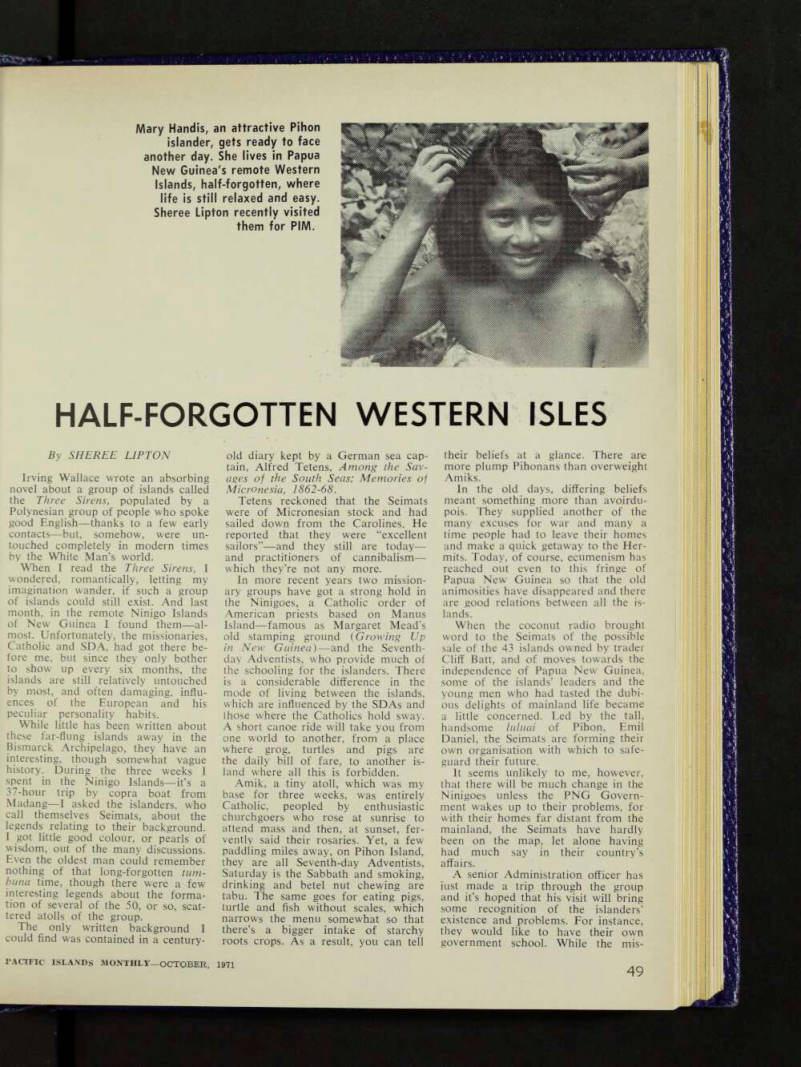
Mary Handis, an attractive Pihon islander, gets ready to face another day. She lives in Papua New Guinea's remote Western Islands, half-forgotten, where life is still relaxed and easy.
Sheree Lipton recently visited them for PIM.
sions provide adequate education, the siting of the schools forces the young people to live away from their homes for long periods on Manus or the mainland.
Currently, the people of the Nini goes, as well as their neighbours on other atolls in the Western isles, in cluding Aua and Wuvulu (total population 2,000) are represented in the House of Assembly as part of the Manus electorate, but the common voice among the Seimats is calling for its own representation within the House of Assembly, for the Seimats are a Micronesian minority in a Melanesian country.
But what they are hoping for at the moment and the most they feel thev can hope for is the chance of an early visit by their representatives to the Administrator, Mr. Johnson, to talk over their problems.
But, basically, politics aside, life is relaxed and easy for the Seimats. The surrounding waters teem with fish and the Seimats are marvellous fishermen, imbued with that natural instinct that comes with birth on the atoll fringe of a great tropical aquarium.
Since the New Guinea Government already has a programme of projects based at Kavieng, where young New Guineans are being trained for work in the tuna fishing industry, perhaps the government might consider ex tending the training to include some of the Seimats in the Ninigoes as well.
Like their cousins in other parts of the Pacific, the Seimats are becoming aware of the potentials of tourism.
Should the industry be developed in the area, either by Batt, who is con sidering rebuilding his castle on
Maron as a tourist resort, or by the, as yet, unknown customer for Batt’s 43 islands, the Seimats would un doubtedly find some employment and an additional source of income.
They are natural interior decorators already. They build their neat, airy houses of sago palm and bamboo with fancy, intricately-stitched partitions, ante rooms, storage room and kitchen.
Tourism would give the women and young girls the opportunity to boost sales of their finely-woven baskets, hats and bottle-holders. While the Western Isles handicrafts are minute in range compared with the Sepik, I suspect that a steady income from sales would encourage the innate art istic gifts of the Seimats, who seem to want to decorate everything and anything they own. Even the betel nut lime gourds are hand-decorated.
While unsophisticated and having had little real contact with Europeans —less than 40 whites have visited the Ninigoes since World War ll—the islanders are not the least bit primi tive in habits or outlook as compared, for instance, with the Big Nambas of the New Hebrides, who have had about the same amount of contact with the European.
The Seimats’ natural cleanliness, their attractive appearance and will ingness to please the outsider are im mediate realisable assets. Many of the women are quite fair-skinned, with long, wavy hair and finer facial attri butes than their sisters on the main land, a legacy of their Polynesian an cestry.
There are others who look like Fijians, with darker skins and short cropped halos of black curls showing
the results of the introduction of the Buka strain in the early 1900 s.
Unlike the mainlanders, the Seimats are not bedevilled by the old tabus, except those introduced by the mis sionaries. They are free to travel where they will and even spend weeks away from home visiting relatives on other atolls.
The outside world is making its im pact, of course. The Seimats have some idea of money and its uses, hav ing a regular but small income from the sale of copra to Cliff Batt and to the Catholic mission ship Margaret, which calls in twice a year from Manus.
Amik Island has a close-knit com munity of about 40 souls, living com munally with everything shared, each with his own task as his contribution to the community. The fishing is done by those best skilled at it and it is their job to provide that food for the whole community, reminding me much of the gonedau system of Fiji where the skilled exponents of a par ticular art of pursuit provide for the whole community. Yet, unlike those countries which are steadily robbing nature of its gifts, the Seimats have a great respect for the sea and its bounty.
Once, I watched Laita, a wiry, little man of Amik, teeth stained from chewing betel nut, with almost Mon golian-type features, skilfully spear a turtle. When it was the in the canoe, a girl examined it and pointed out that its shell was a bit too soft. Out came the spear and Laita returned the turtle to the sea. The Seimats are natural conservationists and they had plenty of time to wait for the turtle to mature.
Canoe-building is dying in the South Pacific. There are few such builders in Fiji, but the people of the Western Isles have not lost the art.
They have no put-put-powered punts.
Their canoes are well built, though not as fancy as Teten reported in his diary 100 years ago. Measurements are taken with a coconut frond and wooden pegs and the Seimats have found a natural glue with which to bind the sections—the sap of the breadfruit tree.
With a good wind filling the sail, the canoe skims over the water. I have sailed in many canoes in the
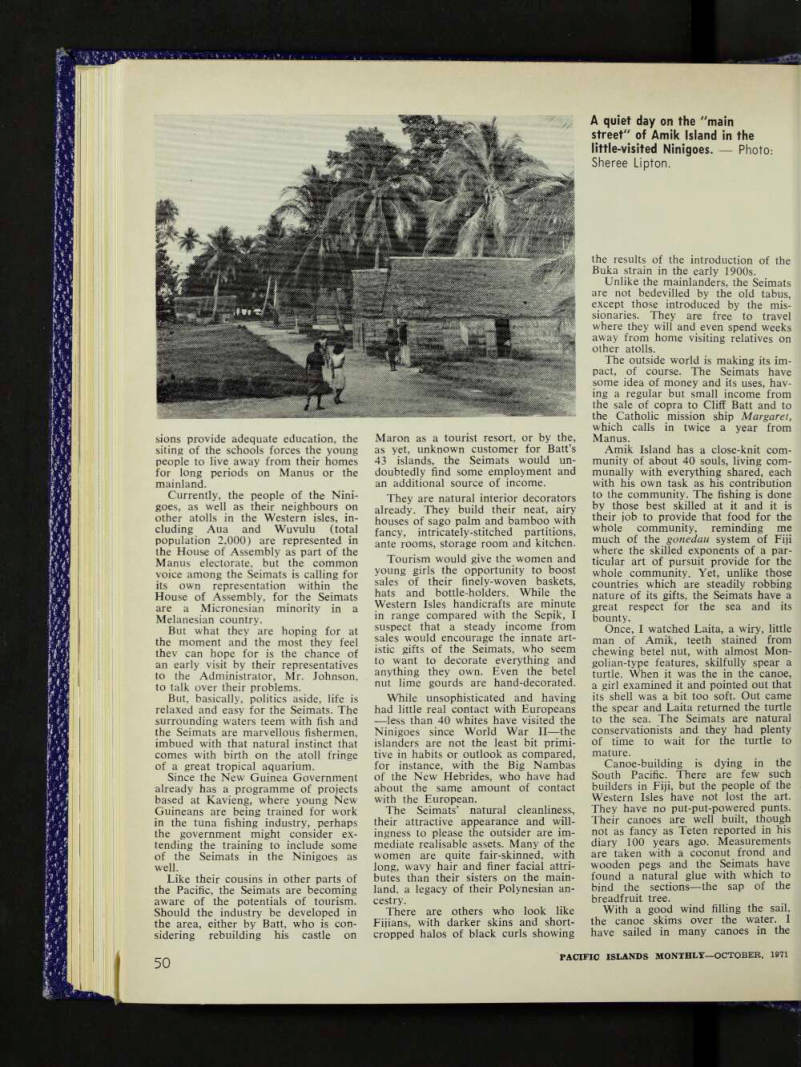
A quiet day on the "main street" of Amik Island in the little-visited Ninigoes. -Photo: Sheree Lipton.
South Pacific, but Laita in his canoe gave me the fastest ride I’ve ever had. We were once caught in a storm, but I had no cause for fear as I watched Laita’s wife, tall, stately Liok, balance herself precariously on the thin ribs of the outrigger and respond to her husband’s commands, making the canoe breast the waves and glide like a flying fish in the strong wind.
As the black clouds silhouetted her figure, I caught the imagery of the scene and 1 shall never forget the sense of security I felt in the biting rain and the huge seas, knowing I was safe in the hands of these two skilled sailors.
An interesting sidelight on to the canoe-builder’s art in the Ninigoes is that he has to rely on a generous sea to bring him his building materials.
The canoes are built of driftwood for there are no trees big enough on the soil-poor atolls. There’s no shortage of wood. Huge logs drift from Indo nesia and the Sepik River to find their way as gifts of Providence to the Western Isles.
The night before I left my friends on Amik, I watched the last streaks
of an orange sunset dabble like fingers in the sea as it rolled onto the beach and I thought that life in the Ninigoes was simple and good; the daily pattern of canoe-building, of fishing, cooking, gardening and even helping a restless American like me to slow down—a satisfying, almost spiritual experience, an exercise in self-discipline and Quietude for anyone, And then I remembered with a cold
shudder the young man I met in Port Moresby, a would-be leader, who frankly described his group as a Black Power movement. When I talked about the Western Isles and their problems, he replied: “We don’t give a damn about the Western Isles.
When we get independence, we will move the people to Manus and offer the islands to the Americans as a strategic base —or the Russians.”