political
pp. 47-49 · Read in the full issue

New Hebrides gets a political voice
By a staff writer
Politics have at last come to the New Hebrides. If you had mentioned the word three or four years ago people would have wondered what you were on about, but now politics have arrived with a bang; the explo sion caused by the startling new land laws in August is still reverberating round the islands and a chain reaction seems sure to follow.
Real evidence of the change is the emergence of an embryo Press. It could hardly be coincidence that pro duced the first issues of two new magazines within weeks of each other and within weeks of the “big bang”, particularly since they are taking opposite sides of the land issue.
Nakamel (Meeting House) is a monthly which first appeared in July Nicely laid out and printed, its format seems to owe something to Time or Newsweek, though the editorial stan dard can hardly be expected to be as high. It is published by the Societe de Presse et d’Editions Neo-hebridaise a company whose shareholders include most of the larger business houses in Vila, mostly French, but a few British.
Managing editors are Pierre Bourgeois, the New Hebrides’ biggest and bright est entrepreneur, and Philipe Dela croix manner of the Imprimerie Hebndaise (which logically prints It I( ?? r ° a P and a member of the Hebrides Advisory Council.
Nakamel’s line is essentially right wing It is for anything that will give big business and vested interests a bigger say in things, and against any thing that might reduce the chances of making a dollar.
“WANTED” says the notice nailed to the cover of the August issue, Dead or Alive. Junior staff of the French and British Residencies who are responsible for subversive legisla tion published by mistake in the Con dominium Gazette.” The legislation referred to is of course the contro versial new law against speculative land subdivision. (Curious that the
“junior staff” are held responsible.
Joint regulations are made by the Resident Commissioners for their re spective High Commissioners and have also to be approved by London and Paris).
Inside, the greater part of the jour nal is devoted to angry, or sorrowful, or contemptuous, denunciation of the new land legislation by Messrs, Bour geois and Delacroix and Mrs. Tessa Fowler, the latter writing in English. (To Nakamel’s credit, most of the articles are published in both langu ages with good translations.) Other articles call for reform of the Ad visory Council and accuse the Resi dent Commissioners of raising the spectre of bloody revolution to justify their actions.
One Vila resident has described Nakamel as being “of the colons, for the colons and by the colons” and it does seem that the only thing New Hebridean about Nakamel, in the eth nological sense, is the title.
All the more importance then was lent to the appearance of the second new journal in August, a quarterly called New Hebridean Viewpoints.
Amateur in appearance (it is cyclo sty led) it is published by the recently founded New Hebrides Culture Asso ciation. The first editorial says that the paper “does not aim to hurt any-
one, but hopes to project problems which are evidenced in the thinking of the New Hebrideans today and which if not dealt with at this stage will lead into a nasty future.”
Its real significance is that it is 100 per cent. New Hebridean, written, edited, printed and published by New Hebrideans and is as outspoken from their point of view as Nakamel is for private enterprise. The first issue was printed in English only, but says it will welcome articles in Pidgin—no mention of French. Spelling and
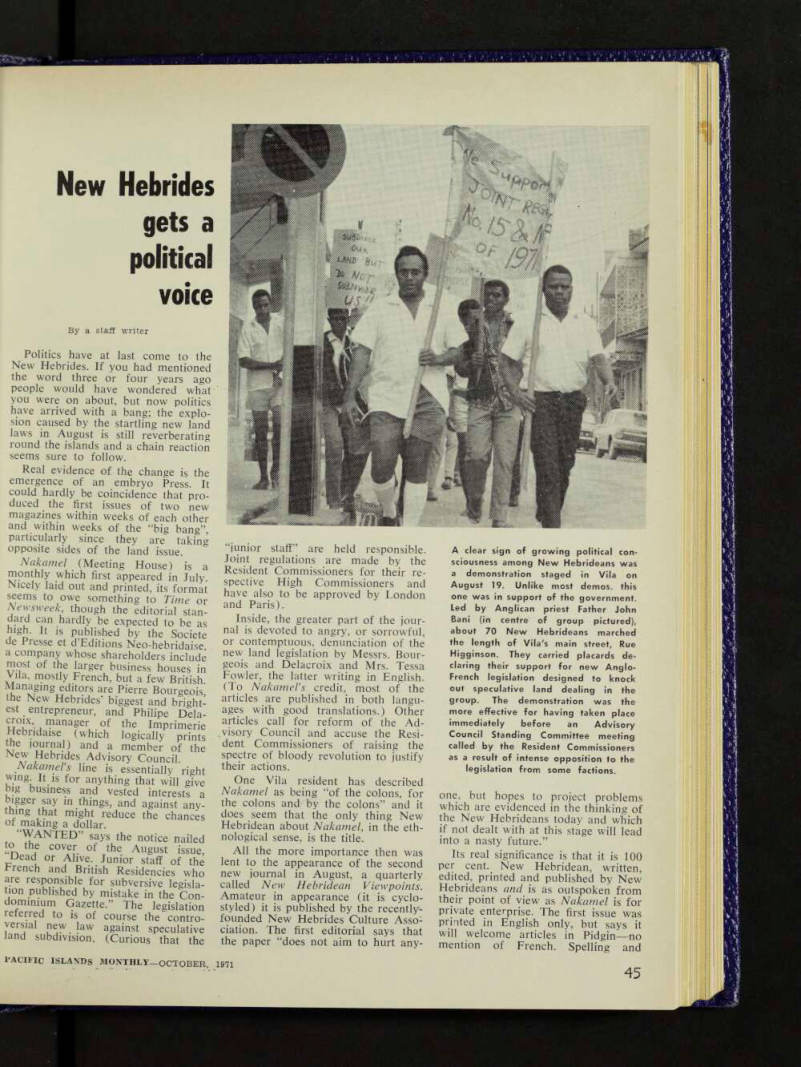
A clear sign of growing political con sciousness among New Hebrideans was a demonstration staged in Vila on August 19. Unlike most demos, this one was in support of the government.
Led by Anglican priest Father John Bani (in centre of group pictured), about 70 New Hebrideans marched the length of Vila's main street, Rue Higginson. They carried placards de claring their support for new Anglo- French legislation designed to knock out speculative land dealing in the group. The demonstration was the more effective for having taken place immediately before an Advisory Council Standing Committee meeting called by the Resident Commissioners as a result of intense opposition to the legislation from some factions.
typography tend to be a bit on the rough side (so they sometimes are in Nakamel, too) but these serve if anything to emphasise the pleas put across—“ What is the future of the New Hebrides?” “Preserve our culture,” “Decentralise development.”
Editor of the quarterly is the Rev.
W. Hadye Lini, an Anglican priest who lives a long way from Vila on Aoba. Aoba is the centre of the Anglican mission in the group whose head is Archdeacon D. A. Rawcliffe, another Advisory Council member, who usually speaks for the New Hebridean viewpoint.
Some tasters:
• Nakamel —“Can it be envisaged that one day this country will be “de colonised?” Those who hope for that day are nourishing mythologies so ill thought out as to be perhaps abomin able” (trans. from the French), • New Hebridean Viewpoints— “ Will the New Hebrides be another New Caledonia or Tahiti? If this is what France is aiming to do in the New Hebrides then as a New Hebri dean I can say that I am utterly dis appointed. I do hope and pray that there will never be another Algeria or Vietnam.”
Strong stuff!