Tropicalities
pp. 43-45 · Read in the full issue
Death Of
The Taaone
Ten years ago, when tourism was just beginning to be taken seriously in Tahiti, the Hotel Taaone competed with the Hotel Tahiti for the honour of being Tahiti’s top hotel. There was little between them, and the growing tide of Americans fought for bookings, sipping martinis around the beachside pool, listening to the top bands that played every evening to a crowded dance floor. The Taaone was elegant French, the Tahiti, elegant American.
In September the handful of guests at the Taaone found themselves con fronted with a blackboard in the foyer, with the chalked message, “End of the season. This hotel will close at the end of the South Pacific Games, September 19”.
Within the week it had closed, its last function being a noisy and nos talgic Mad Hatter’s Night, attended by many of the clients who had patronised the hotel in its hey-day, and had watched it sink—its service dropping off, its rooms becoming shabbier, its bar girls smiling even less.
The French syndicate which owns the Taaone decided at short notice to close it and cut its losses. Nobody in Papeete in September knew what was to happen to it, and there were reports that it would be demolished and the beautiful site made available to somebody else. Workmen already were removing the furnishings and fittings.
What happened to the Taaone?
There are many opinions in Tahiti, including the belief that the Taaone dealt a death blow to its prestige by encouraging personnel from nearby Army establishments to make use of it. But there are probably many reasons for its failure.
Bad management, which allowed service to deteriorate, is one. The most important was failure to recog nise the change in the tourist picture in Papeete. In one five-months’ period in 1969 Papeete got two new first-class hotels, the PanAm
supported Tahara’a, and UTA’s Maeva Beach. These hotels doubled Papeete’s hotel accommodation over night from 400 to 800 rooms, but the air services into Tahiti have not increased proportionately and many of the remaining hotels have had a hard time.
There are those in the tourist in dustry who believe that the Taaone, and other of the small hotels, should have reduced tariffs to attract those visitors not prepared to pay for the high standards of the Tahara’a and Maeva. They should have recognised that they are not now top hotels, that they can’t expect the package tours that have been so lucrative in the past, and that they have to follow new policies.
The tragedy of the Taaone is that although it couldn’t afford to survive, the tourist industry will sorely miss it during the forthcoming January peak, when beds in Papeete are always hard to get.
Meanwhile in late September the Taaone’s staff of 70, still shocked at the speed of the closure, were looking for jobs.
Boost to
Pacific cultures
Fiji is not yet fully aware of the importance of hosting the first-ever South Pacific Arts Festival, says executive director of the organising committee, Mr. Victor Carell.
“This festival will be the first time so many cultures and countries have come together in one small area—the first time in the whole history of the world,” he remarked in Suva recently. “Fiji doesn’t quite appreciate this yet.”
Australian Mr. Carell (in the absence of a more succinct descrip tion for his varied interests and talents, one thinks of him as a kind of cultural entrepreneur extra ordinaire) has been whipping the festival into shape for several months now.
Expected to attract more than 2,000 other Islanders as well as many thousands of tourists, the festival will take place in Fiji between May 6-20 next year.
The organisers including Fiji’s Minister for Social Services, Mr.
Jonati Mavoa, forsee no lack of
enthusiasm from the 19 countries taking part. They are a bit worried about money.
“We’re asking business and tourist interests to contribute as generously as possible, because they’re the ones who will benefit the most financially,” said Mr. Carell. “This is the way festivals around the world are run.
Our theme is Give Generously Because We Need It!”
In August - September, he made visits to the New Hebrides, Solomons and Papua New Guinea on the last leg of his round-the-Islands tour. He has visited everywhere else except Niue, Pitcairn and Norfolk Island— and Niue is scheduled for early next year. It seems likely that his wife Beth Dean will make the trip instead of Mr. Carell.
“I won’t be able to visit Pitcairn or Norfolk—but they’ve promised to send what they can. Pitcairn’s con tribution for instance will include stamps, children’s art and wood carvings,” he said.
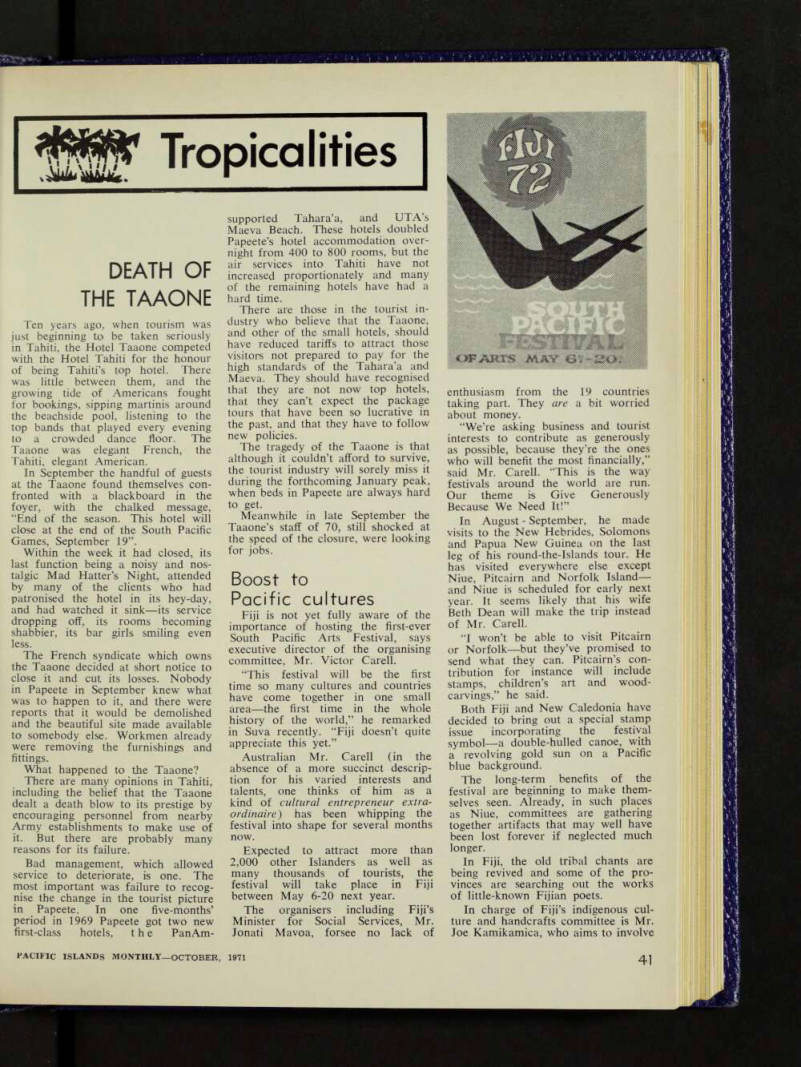
Both Fiji and New Caledonia have decided to bring out a special stamp issue incorporating the festival symbol—a double-hulled canoe, with a revolving gold sun on a Pacific blue background.
The long-term benefits of the festival are beginning to make them selves seen. Already, in such places as Niue, committees are gathering together artifacts that may well have been lost forever if neglected much longer.
In Fiji, the old tribal chants are being revived and some of the pro vinces are searching out the works of little-known Fijian poets.
In charge of Fiji’s indigenous cul ture and handcrafts committee is Mr.
Joe Kamikamica, who aims to involve
as many people from as many pro vinces as possible.
“We see the festival as the begin ning of a cultural surge in Fiji,” he says enthusiastically. “1 hope we can use this opportunity to continue utilising and encouraging the arts.”
During the next three months, all Fiji’s provincial councils will hold mini-festivals, with the best per formers being selected to take part in the big event. Indian settlements in each province have also been invited to take part and the Indian High Commissioner, Mr. Bhakwan Singh, is taking a keen interest.
Chinese dancing is planned at the festival on a large, massed scale.
A “cultural village” representing all the Islands will be built in the grounds of the University of the South Pacific. Tahiti, New Cale donia and Fiji have already agreed to build traditional dwellings and it is hoped that these will remain at the university—and perhaps be maintained by the students them selves.
Thousands of books dealing with the Islands have been promised by other countries. A full-length play will be performed by one of Aus tralia’s national drama companies.
A French drama company will perform a classic French play (as a New Caledonian or perhaps Tahitian contribution) and a chief making ceremony will be re-enacted on a Tahitian marae. The list is already very long.
The Fiji Association of Architects is co-ordinating efforts to decorate central Suva, from the Civic Centre to Gumming Street, and artist Robi Wilcock (winner of the festival symbol contest) is spearheading plans to turn the Civic Centre into a place where visitors can wander at leisure, absorbing the arts . . . from live demonstrations of children’s finger painting and the creation of a huge mural to photography, wood carving and paintings from all over the Islands. Mr. Wilcock has appealed to other territories to have their paintings in to him by March.
There will be 15 or more dancing, singing, drumming groups from Samoa, Tonga, Tahiti, Nuie and New Zealand with the Cook Islands National Arts Theatre giving its first theatre performance after their tre mendous success in Australia and New Zealand last year and before they go on a projected world tour. There will be groups from New Hebrides, Solomons, New Caledonia and New Guinea, while Micronesia will show their wonderfully stylised dances from the Gilbert Islands and others.
Bikinians want
$99 million damages
The people of Bikini Atoll, exiled by the A-bomb and living a dis gruntled existence on Kili Island in the Ralik Group, are talking about suing the United States Government for SUS 99 million damages.
Taro Lokebol, one of a three-man delegation representing the Bikinians which called on TT Deputy High Commissioner Peter Coleman to talk about financial help for the people on Kili, is reported to have said that damage caused by the atomic tests was great. Part of Nam Island was blown away by a blast and one of the small islets near Nam was com pletely obliterated. The islands west of Bikini were considered unsafe for habitation and coconut crabs could not be eaten anywhere in the lagoon.
They had been told that they would be able to return to Bikini before very long but, said Lokebol, it would be years before they would be able to return. Some of them had been work ing on Bikini and knew that it would be a long time before the atoll was able to support a community.
The Bikinians thought that SUS 99million was a fair settlement for the damage and their displacement.
Lokebol and his companions said they had been told that the Marshalls District Administrator Oscar De Brum had described the figure of SUS 99 mil lion as unrealistic and that the gov ernment was considering a more realistic sum like SUSI million.
Lokebol said an offer of SUSI mil lion was not worth considering.
Fiji government's
life extended
Fiji’s first general election since independence will probably be held next April.
April 29 is the provisional date to which the Electoral Commission is working. Supervisor of elections, Mr.
Don Dunckley, has said that by shortening the registration period by two weeks, it should be possible to complete the election by that date.
April 29 would be the day on which most of the polling would take place, but voting would begin earlier in the outer islands and more isolated areas.
An earlier election programme pro vided for the election to be completed by May 13—but this was considered unsuitable because it coincides with the South Pacific Arts Festival.
Fiji went into independence with out an election, but the Independence Order provided that Parliament should be dissolved by November 11 this year—unless the Electoral Commis sion foresaw difficulties in holding an election by that date. The Prime Minister, Ratu Sir Kamisese Mara, moved a parliamentary extension motion in the House “with some regret”, because it had been hoped to have the election by November 11.
It was decided to extend the life of parliament until March 17, after
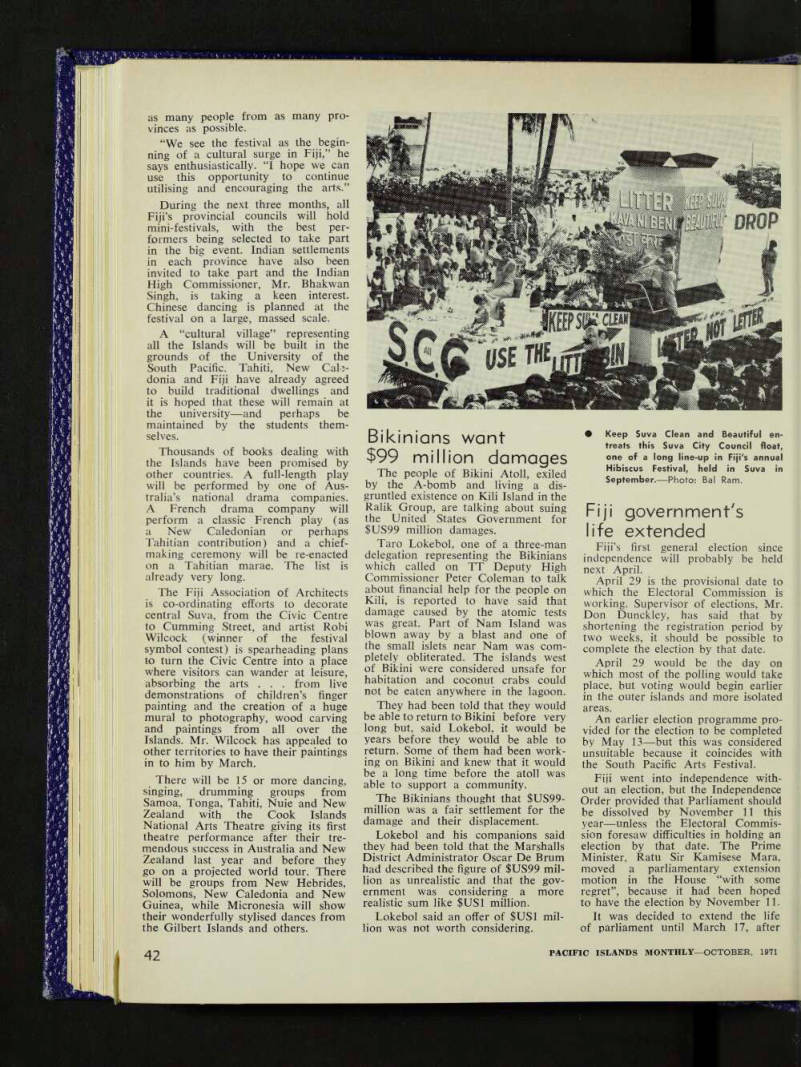
Keep Suva Clean and Beautiful en treats this Suva City Council float, one of a long line-up in Fiji's annual Hibiscus Festival, held in Suva in September.— Photo: Bal Ram.
the Prime Minister read a letter to the House, in which the Electoral Commission indicated that its work would not be finished in time for the November deadline Leader of the Opposition, Mr. S.
M. Koya, said he was not prepared to accept that the delay in bringing the matter to parliament was due to the fact that there was delay in the work of the Boundaries Commission.
“If they had done their job as they should have, I am sure this would have been done in the last session,” he added. However, reality had to be faced, he said. He supported the resolution to extend the life of parliament.
Meanwhile, the governing Alliance Party has confirmed that the contract of its secretary, Mr. R. W. Smith, would be renewed. Mr. Smith joined the Fijian Association as an official early in 1969 and became secretary of the Alliance Party a year later. He handed in his resignation earlier this
year, but withdrew it later. The move led to much speculation about dis integrating morale in the Alliance, Hardworking David Seidler, editor of the Alliance Party’s newsmagazine Nation, will not be staying, however.
Under his editorship, the magazine became a hard-hitting publication and had an important niche in Fiji’s pohti cal life. The fact that it existed at all in Fiji was a very healthy sign, par ticularly since Mr. Seidler was not afraid to take a poke at the govern ment itself when he felt the urge, Land laws—or their lack—have been among his favourite hobby horses, It’s believed that influential Alliance officials objected to his offbeat— though stimulating—approach to news. They want to see more stories about government and its achieve ments, say observers. Mr. Seidler is said to feel that he couldn’t continue the job if too many pressures were to be imposed.
King wins an
important round
Jake King, managing editor of the Samoa News, seems to have won his fight against deportation (PIM, Sept., p. 36).
Associate Justice Leslie Jochimsen ruled in the High Court towards the end of August against an Immigration Board order that King be deported because he was alleged, among other things, to be an undesirable character.
King challenged the order on con stitutional grounds, but Justice Joch imsen, who had only been two weeks in the territory when he heard the case, said in his judgment that he had not considered the constitutional grounds, whether a United States citi zen could be deported from American Samoa, He ruled that the charges were not sufficiently supported by evidence to warrant deportation.
The real issue at stake—whether the Code of American Samoa, giving the Governor the right to deport any US citizen he chooses, is unconstitu tional—is still undecided, or rather as Governor John Haydon said after the judgment, the immigration laws are left intact.
He added that the laws now in effect will be strictly enforced to limit immigration and protect jobs and the Samoan culture for the Samoan people.
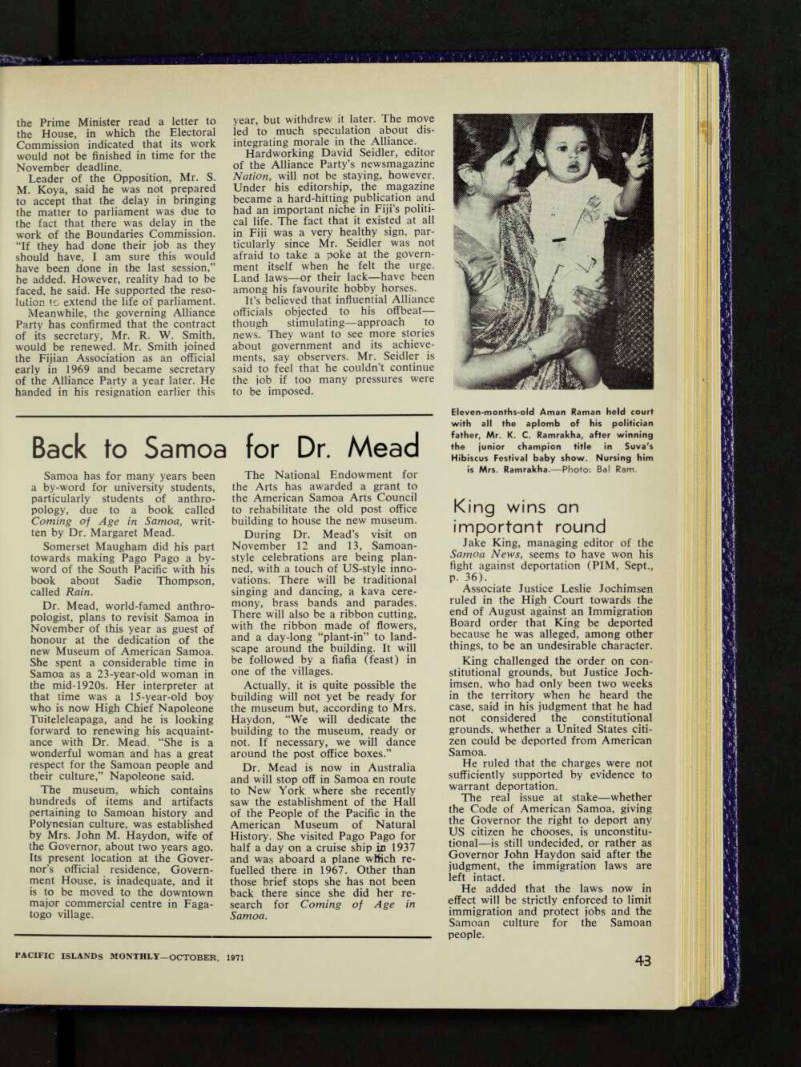
Eleven-months-old Aman Raman held court with all the aplomb of his politician father, Mr. K. C. Ramrakha, after winning the junior champion title in Suva's Hibiscus Festival baby show. Nursing him is Mrs. Ramrakha.— Photo: Bal Ram.