Sour Power In
pp. 36-38 · Read in the full issue
The Judo Hall
When judo was first introduced to the Games in 1969 the New Cale donians made a clean sweep of the golds in all divisions, but the best they could do in Papeete was one gold. The only New Caledonian left over from Port Moresby to make any sort of mark in Papeete was L.
Letaud, gold medal winner in the lightweight division in Port Moresby, who got the silver in the same divi sion.
It was Guam which figured prominently in Tahiti, with seven medals in the six divisions, two of them gold.
Standards were not high, and the judging and organisation were the subject of hot controversy, some times even uproar. The trouble is that Islands judo clubs are smalltime, not equipped to efficiently manage international competitions such as this.
The Guam judo men who touched off the controversy and kept it going, made themselves unpopular because of what was considered to be their “know-all” attitude. They continually leminded all and sundry that they bad had Japanese training and probably knew more about the rules than anybody present. The fact is that they probably did.
The fuss started on the opening
night of the judo when the Gua manians complained of confused arrangements. They said it was im possible for them to identify officials running the judo from other officials, and they didn’t know who to ap proach about anything. They said all the approaches they made were in vain because nobody would speak English to them and they felt they were at a serious disadvantage.
Their ire exploded when one of the three Guamanian Bias brothers, Ricardo Bias, had to play off for the bronze medal when—Guam claimed —he should have been allowed to play for the silver.
Already that night Guam’s Rain
ardo Santos had won a silver in the light-heavyweight division, and when the time came for him to get his medal he stood on the podium giving a clenched-fist salute while the French anthem was being played in honour of Pierre Domard, of French Poly nesia.
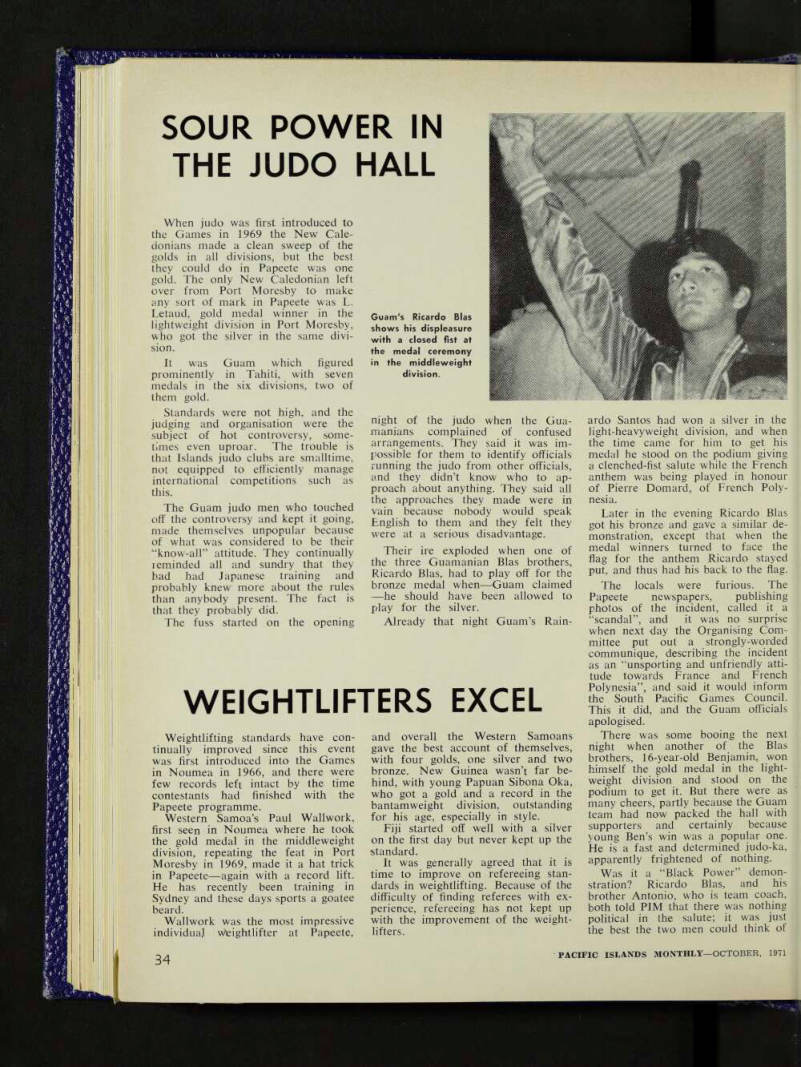
Later in the evening Ricardo Bias got his bronze and gave a similar de monstration, except that when the medal winners turned to face the flag for the anthem Ricardo stayed put, and thus had his back to the flag.
The locals were furious. The Papeete newspapers, publishing photos of the incident, called it a “scandal”, and it was no surprise when next day the Organising Com mittee put out a strongly-worded communique, describing the incident as an “unsporting and unfriendly atti tude towards France and French Polynesia”, and said it would inform the South Pacific Games Council.
This it did, and the Guam officials apologised.
There was some booing the next night when another of the Bias brothers, 16-year-old Benjamin, won himself the gold medal in the light weight division and stood on the podium to get it. But there were as many cheers, partly because the Guam team had now packed the hall with supporters and certainly because young Ben’s win was a popular one.
He is a fast and determined judo-ka, apparently frightened of nothing.
Was it a “Black Power” demon stration? Ricardo Bias, and his brother Antonio, who is team coach, both told PIM that there was nothing political in the salute; it was just the best the two men could think of
Guam's Ricardo Bias shows his displeasure with a closed fist at the medal ceremony in the middleweight division.
to show their displeasure at the poor organisation.
Ted Nelson, the man in charge of the Guam delegation, said, “There was nothing political. They are young kids, they worked hard, and they felt pretty mad about the conditions they had to play under. This was their way of protesting.
“At one point they said they didn’t even want to accept their medals, but I changed their minds on that. The night after our protest all the official arrangements were much-improved— the officials were put up on the stage, separately, where they belonged. I’m sorry about the official condemnation.
Naturally we are not pleased about that.”
The surprising thing is that even after the fuss, none of the people from Guam involved seemed fully aware of the fact that you can’t ex pect to demonstrate against a host’s national flag and anthem and escape general denigration. Young or not, Guam’s team obviously needed dis cipline.
Ricardo Bias and Rainardo Santos had some kind of vengeance on the last night of the judo when they took the gold and bronze medals respectively in the open class. But by this time the American flag had dis appeared from a wall of the hall— presumably at the hands of angry French Polynesians.
N'Godrella,
the greatest!
There was greater encouragement for tennis players at Papeete than at any previous Games, for more medals were awarded. But the new arrange ments merely served to underline the fact that New Caledonia has com plete control of tennis through the brilliant Wanaro N’Godrella, who was head and shoulders above every body else.
N’Godrella led, everybody fol lowed. The division between the standard set by this man and the standards of The Rest mean that there was no real competition at Papeete, and probably neither the New Caledonian star nor the also rans got any worthwhile benefit.
N’Godrella took out the gold in the men’s singles, men’s doubles, mixed doubles and the international, and in the women’s matches the New Caledonians completed the sweep.
French Polynesia and New Guinea were the only other territories to put up some kind of showing.
Fast, bright
table tennis
For the first time there were seven gold medals instead of three for table tennis in Papeete, and this gave everybody a better chance of dis covering trends—which have been confused over the four Games.
They are still not clear, but in a sentence, at Papeete, Fiji had the depth in men’s and women’s teams to take both golds for teams, but individually Fiji couldn’t match the skill, experience and consistency of New Guinea’s Bill Jones or French Polynesia’s Victor Lau. What Fiji had was sheer determination. Jones and Lau dominated individually, and Lau, at 17, was probably the most out standing single player, with enormous potential yet.
Standard was the highest yet, with contestants favouring the fast, modem method, close to the table. This fast counter-hitting and attacking style makes for more interest for spectac tors.
Most people agreed that PNG was unlucky in not getting the gold for the men’s teams (Fiji scraped in 5 to 4) but French Polynesia was un luckier in not getting a place at all in the men’s teams. Although Victor Lau was unbeaten in the teams he didn’t get enough solid support.
There is still a great shortage of indigenous players in table tennis, and a need for younger players. New Caledonia appeared to hold out the best prospects for improvement.
Hardworked
archers
Archery appeared for the first time among the events at the Tahiti Games —and then only because of the dedication of archers from Fiji and Tahiti who got their heads together to get it into the programme, where it is now likely to stay.
One would expect New Guinea Highlands warriors to be good archers, but there were no natives among the four teams taking part in Papeete (French Polynesia, New Cale donia, Papua New Guinea and Fiji).
This is because archery is an ex pensive sport; it costs about SSOO to outfit yourself properly, including the high duty which Islands govern-
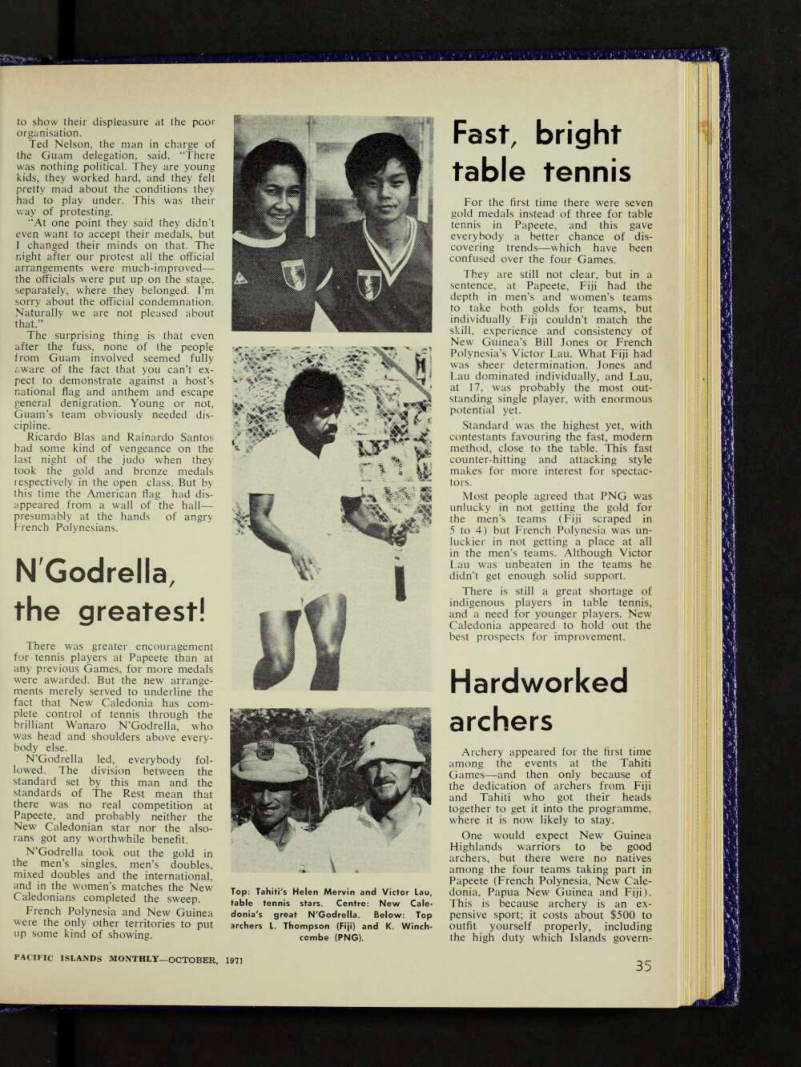
Top: Tahiti's Helen Mervin and Victor Lau, table tennis stars. Centre: New Cale donia's great N'Godrella. Below: Top archers L. Thompson (Fiji) and K. Winch combe (PNG).
ments seem to impose on equipment from abroad. Fiji imposes 50 per cent, on equipment from America, for instance. The four-man Fiji team, by the way, comprised an American, Englishman, Indian and a New Zea lander—all left-handed.
In Papeete the archers were handi capped by a range which faced the wrong way (so the targets were always in shadow), built on the edge of a gulley so that wind eddies gave the archers trouble, and placed in what was undoubtedly the noisiest area of all the Papeete Games venues, so that trucks, auto-cycles and honking horns continually shat tered the archers’ concentration.
Some of the visitors described it as the worst archery field they had ever shot on and gave its condition as the reason why the shooting results were hardly up to club standard. Despite these well-founded complaints, the esprit de corps among the archers was probably the best of all sports at the Games, as they concentrated on the task of shooting 300 arrows each over 20 hours of actual shooting time. As each arrow requires a 40 lb pull on the bow to fire, the archers did more physical work than the weightlifters.
Fiji slowly took the lead in both the individual and teams events, and stayed there, and there was an exciting struggle between New Cale donia and Papua New Guinea for the silver medal in the teams. New Caledonia took it by only nine points in a total of 5,317. Keith Winch combe, of PNG, who had taken up the bow only five months ago after a break of 10 years, followed up Fiji’s superior Les Thompson to take the silver in the individual tally from Emile Shan, a good-tempered archer from Tahiti.
Cycling pros.
The closest the Games got to pro fessionalism including professional times was in the popular cycling events. There were always noisy crowds on hand, well-informed on techniques, to see the French terri tories—Polynesia, New Caledonia and Wallis and Futuna give each other curry.
The New Caledonians were superior, as they were in Noumea in 1966, which is the only other time that cycling has been part of a Games programme. The French take their cycling as seriously as the British take their golf.
The New Caledonians took the first gold medal of the Games in the 74 km teams road race, followed by Tahiti and Wallis and Futuna with the silver and bronze—and that line up seemed to set the pattern for the rest of the cycling events, with French Polynesia showing superiority in the individual sprint. This was just the way it was in Noumea. In the 4 km Olympic pursuit in Papeete the New Caledonians were within only 20 seconds of world times.
A team from Guam was outclassed.
Port Moresby surveyor Charlie Williams, 32, turned out to be the cat among the pigeons, unexpectedly breaking complete French dominance by taking the bronze for New Guinea in the 4 km individual pursuit. The New Caledonians were so impressed that they invited him to take part in some events in Noumea on the way home—a generous invitation he couldn’t accept only because there was no plane seat available.
There are no cycle training facili ties in Port Moresby, nor is there any interest in cycling in Papua New Guinea, so Charlie had taken two months off work, without pay, before the Games to go to Brisbane for
riding experience. And, being Papua New Guinea’s complete cycling “team”, he had to raise his own money to get himself to Papeete— most of it coming out of his own pocket.
Charlie doesn’t consider himself a threat to the French, but he enjoyed the competition, and that’s what sportsmanship is all about.
Lost drama
of soccer
Soccer (association football) was one of the crowd-pleasing events in Papeete—sharing honours in popu larity with cycling and boxing. But the pool system robbed the competi tion of much of its drama, and here is one sport where the Games Council should seriously consider establishing the round robin.
The French have been superior at each of the four Games, but only at Noumea has there been a French Polynesia v New Caledonia final.
In Papeete New Caledonia met the New Hebrides in the final, for a 7 to 1 result in New Caledonia’s favour. The New Hebrideans were lucky to have got there, but they surprisingly beat Fiji 6 to 4 after having been 4 to 1 down, playing better football than Fiji.
Fiji put on a much poorer display at Papeete than anybody had expected —morale seemed to be low. New Guinea played tenaciously and enthusiastically— much improved as a result of a German coach. The Cook Islanders took a real hammering —losing 16 to 1 to PNG in the first game, and 30 to nil to Tahiti in the second!
As usual, New Caledonia and French Polynesia played a faster, more professional type of game, with quick and accurate interchanges, and the long ball.
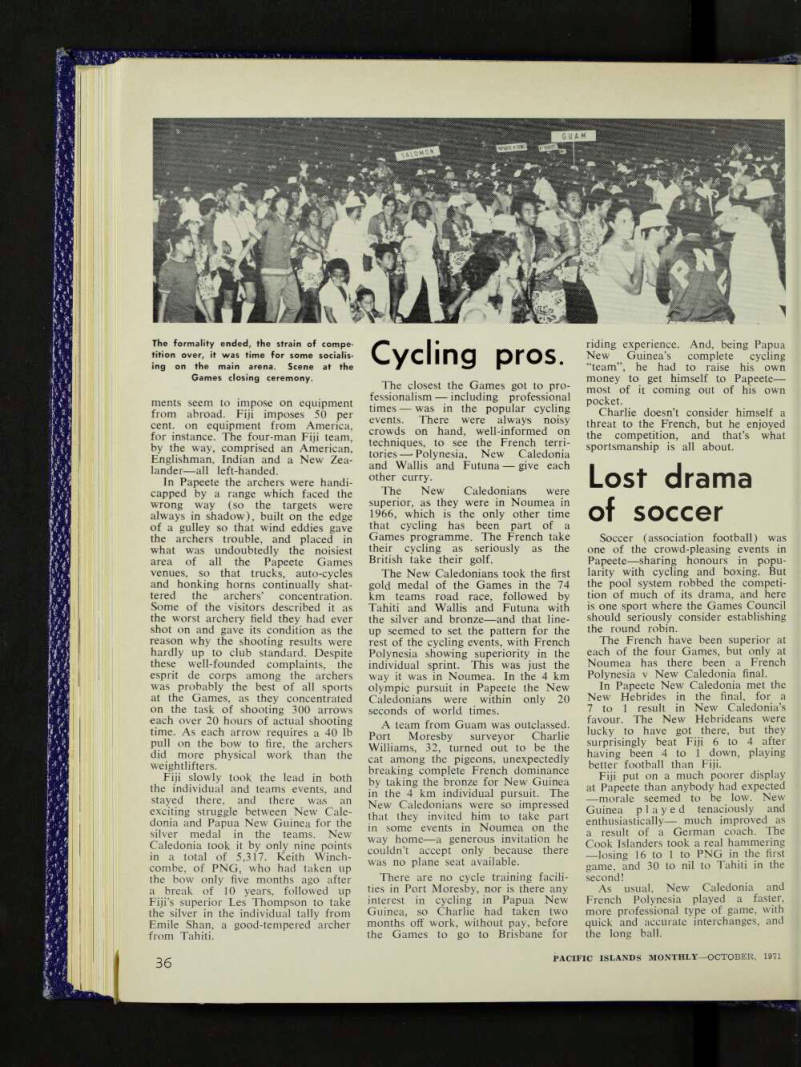
The formality ended, the strain of compe tition over, it was time for some socialis ing on the main arena. Scene at the Games closing ceremony.