How They Did At The Games
pp. 30-31 · Read in the full issue
Caledonians Dominate
Field Events
A study of the athletics results will show that New Caledonia continues to dominate the throwing and jump ing events at the South Pacific Games, with Caledonians taking place after place in both men’s and women’s events. Although in Papeete they also provided the fastest man— Joseph Wejieme, who took the 100 metres in 10.7 s—the track events are still nevertheless the preserve of Fiji and Papua New Guinea, with Tonga making a strong claim.
A feature of the athletics events at this Games was the way in which French Polynesia improved, with an attractive girl runner named Daniele Guyonnet beginning to do for the women’s events what Jean Bourne has done for so long, and continued to do at Papeete, for men’s athletics.
The athletics field provided Fiji with no less than 20 of its 46 medals, 10 of them gold. It provided PNG with 30 of its 77 medals, six of them gold, and it gave Tonga six of its 11 medals, three of them gold.
Compare these performances on
track and field with those of the mighty New Caledonia, which cap tured only 24 of its 92 medals there, 10 of them gold, even taking into account its strength in the field events. New Caledonia boosted its enormous medal tally in the swim ming pool, where a tiny group of swimmers took no less than 31 medals, nine of them gold.
The athletics field is still a place for the smaller territories to shine, and there were some shining per formances from them in Papeete.
The little Solomons got three girls into the finals of the 800 metres run, and took second and third, Lucia Likonia and Elizabeth Tito. They are sisters, from Malaita, aged 19 and 11—yes, 11—and the October
issue of PIM showed Lucia being crowned Miss Charity Queen of the Solomons.
As Charity Queen she raised $6,000 of the $lB,OOO it took to get the small BSIP team of 24 to the Games.
Even that wasn’t enough, as the team had to cut short its stay and go home before the money ran out.
Lucia Likonia also took the bronze in the 1,500 metres, with two other Solomons girls fourth and fifth. She just missed a bronze in the 400 metres.
Perseverance paid off for Tonga’s Peni Tuipulotu, who set a record for the 400 metres hurdles in Noumea, 1966, equalled it in Port Moresby in 1969 and finally broke it convincingly at Papeete.
Record breaking was a feature of the track and field events at Papeete.
Out of 22 events in men’s athletics, no less than 17 of them were new records. As one coach lamented, “It’s no use using previous Games’ times as your training yardstick— that’s only false security. You’ve got to assume dramatic increases in per formances will occur in the mean time—and even then you will badly underestimate them.”
One looks back at the highlights.
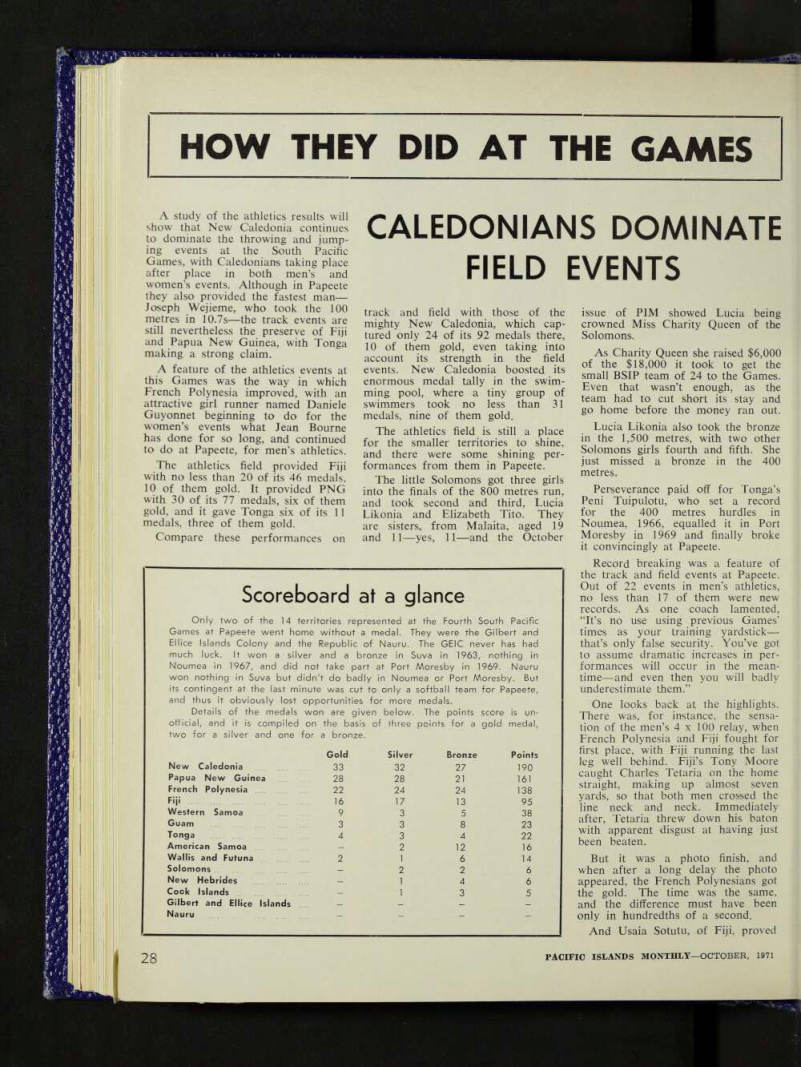
There was, for instance, the sensa tion of the men’s 4 x 100 relay, when French Polynesia and Fiji fought for first place, with Fiji running the last leg well behind. Fiji’s Tony Moore caught Charles Tetaria on the home straight, making up almost seven yards, so that both men crossed the line neck and neck. Immediately after, Tetaria threw down his baton with apparent disgust at having just been beaten.
But it was a photo finish, and when after a long delay the photo appeared, the French Polynesians got the gold. The time was the same, and the difference must have been only in hundredths of a second.
And Usaia Sotutu, of Fiji, proved
yet again that he’s approaching world standard by taking triple long distance honours in the 5,000 and 10,000 metres, and the 3,000 metre steeplechase—all in record times.
This was a hat trick he wanted.
But those who were there for his triumph will recall the picture of the 15-year-old Papuan, Ala Loi, unheard of until these Games, who ran behind the great Fijian, literally dogging Sotutu’s heels in each of those three long distance races— bringing home two silvers and a bronze for his persistence and stamina.
Much impressed, Sotutu would like to arrange for the Papuan to get the kind of college scholarship he himself has (in the United States), so he can improve on his natural ability.
Ala, who will be 16 on December 3, and who is doing a course at a
Port Moresby technical college, started running seriously only last year and says he loves running “and hopes to become a really good long distance runner”. For the experience, he also entered the marathon and came a commendable seventh out of 12 who finished it (a number abandoned it).
New Guinea’s 19-year-old Salatia Pipit, who is at teachers’ training college, covered herself with glory and was voted outstanding woman
athlete at the Games. As an example of her Stamina, On one occasion she ran in the semi-final of the 200 metres, five minutes later ran in the heat of the 800 metres, and an hour afterwards won the final of the 200 metres.
There was a feverish “wog” going around (it had already decimated Tahiti before the Games contestants arrived), which affected times in many events and put some contestants out altogether, Tonga’s star, 24-year-old Keta longi, virtually finished three days ahead of time because of illness, and others, such as Peni Tuipulotu, had spells in hospital.
Thrilling photo finish to the 4 x 100 relay, with Tony Moore of Fiji and French Poly nesia's Charles Tetaria on the line to gether. It was Tetaria by a nose.
Pictured left, Papua's young distance run ner, Ala Loi.
Solomons' Charity Queen, Lucia Likonia (left) and PNG's Salatia Pipit, on the victory dais with their silver and gold medals for the 800 metres. Lucia's little sister took the bronze.