Rather like
pp. 29-133 · Read in the full issue
a wake at the SPC
From JOHN CARTER, in Noumea for the South Pacific Conference.
Any outsiders listening to the open ing to the Eleventh South Pacific Conference in Noumea on September 21—that’s if any were allowed in, of course—could have been pardoned for thinking they were attending a wake. Was the commission folding up?
It wasn’t, but Mr. Gala Oala- Rarua, conference chairman, a mem ber of Papua New Guinea’s House of Assembly and a contender for the secretary-general’s job with the SPC, almost sounded as if he didn’t think it would last longer than the life of the conference when he gave the opening address. And not only Gala.
Mr. Claude E. Reseigh, Australia’s senior commissioner, who followed, seemed to be a bit worried lest the delegates were thinking of ending the SPC once and for all.
Gala underlined the value of the conference —“It is not just a gather ing for political leaders of the Pacific like so many others where politicians make speeches and then dash off. It is a gathering where leaders meet and lay down policy, guide-lines. We have in bur hands the responsibility to carve the future of the Pacific peoples. Time will tell whether the decisions we make are sound ones for our heirs”.
He said he couldn’t see the SPC becoming RIP, and his sentiments were just the ones to expect from somebody who thought the job of secretary-general was worth having.
It was almost like electioneering.
As it happened, he later withdrew from the race (see box, this page).
Mr. Reseigh listed the commis sion’s virtues, which is what people do at a wake but maybe it was a good thing to do in case there are those who think that, with the Island territories independent or nearly so, there’s no need for the SPC to con tinue. What were the commission’s achievements, Mr. Reseigh asked, and answered that there were three main ones—it had given them an in creased sense of community; had done much worthwhile in the tech nical field and fostered the growing competence and assurance of the
(Continued on p. 131)
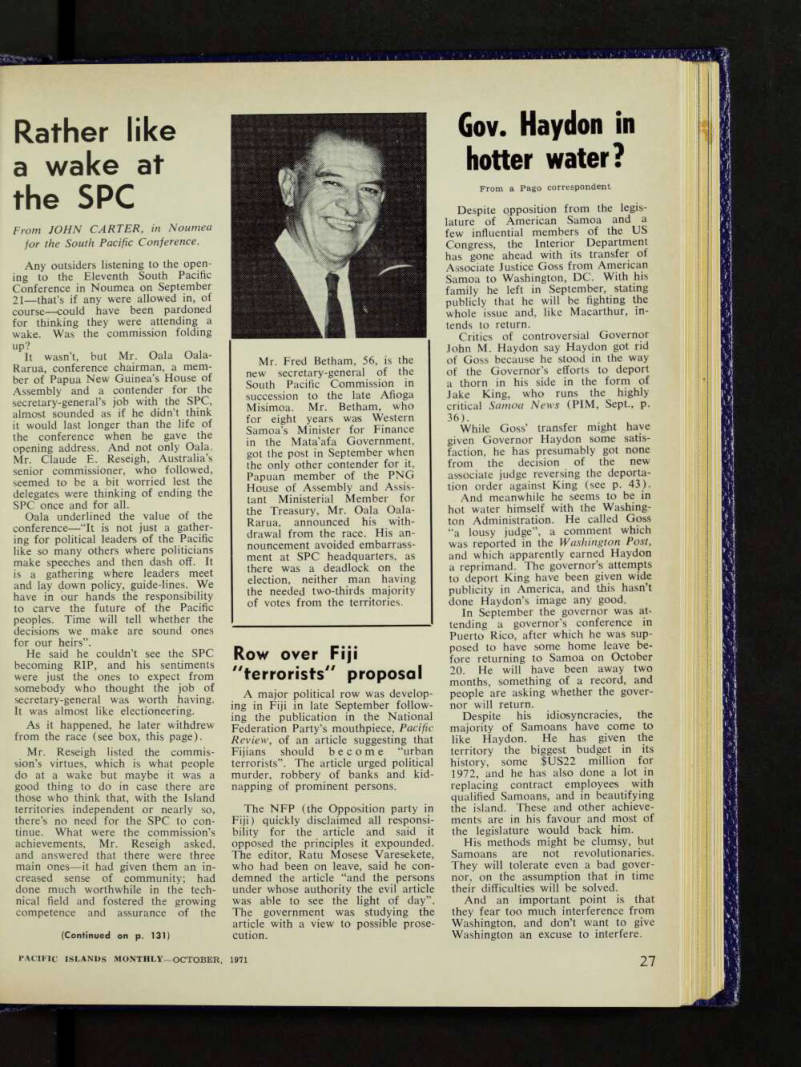
Mr. Fred Betham, 56, is the new secretary-general of the South Pacific Commission in succession to the late Afioga Misimoa. Mr. Betham, who for eight years was Western Samoa’s Minister for Finance in the Mata’afa Government, got the post in September when the only other contender for it, Papuan member of the PNG House of Assembly and Assis tant Ministerial Member for the Treasury, Mr. Gala Oala- Rarua, announced his with drawal from the race. His an nouncement avoided embarrass ment at SPC headquarters, as there was a deadlock on the election, neither man having the needed two-thirds majority of votes from the territories.
Islands people in debate and the exercise of power.
He also asked what the SPC’s future role should be and what must guide it so it could be effective, and said it wasn’t his place to answer that.
“That is what we will be doing here at this conference, but for my own part I can’t believe that, with so many similar problems facing us— problems of economic advancement, of social change, of health and educa tion—the SPC cannot make a valu able continuing contribution.”
Then he added: “I found it hard, moreover, to believe that we should lightly discard a tool ready to hand rather than to sharpen it, if that is what it needs.”
With national pride at stake how ever, France, almost at the close, looked as if she was prepared to dis card the tool. Her senior commis sioner, Mr. Henri Nettre, did what he did at Suva last year. He walked out, but it was more than just a gesture this time. It was a threat to leave the conference for all time. He had clashed several times with Mr. Henri Bouvier, of French Polynesia, autono mist, and the clashes climaxed to a flaming row when Bouvier pilloried the government over the choosing of conference delegates. Nettre de manded withdrawal of an offending resolution, stormed out and threat ened, when he came back on the final day, that unless he got his way France would “draw its own conclusions”. He told PIM it could mean France’s withdrawal. He got his way. The resolution was sacrificed.
But any ideas anyone might have had that they were assisting at a wake were dispelled when the governments and territories indicated what their
contributions would be to the budget.
Almost all, to a man, promised an increase. It was obvious they’d gpt their heads together on this. Australia set the ball rolling by declaring; “We will increase the Australian contribu tion by 15 per cent, on the under standing, of course, that the other governments forming the commission increase their contributions by 15 per cent.” The others were prepared.
They were almost all ready to com mit their governments to the same increase.
France made two provisos, one similar to the Australian one, and the other that the increase would be spent on selected programmes. The UK, New Zealand and the United States all weighed in with 15 per cent., although the UK delegate really fogged the issue by getting bogged down over percentages. His would be 15 per cent, but less the 1 per cent, which Fiji was paying; no, it would be 17 per cent, less 1 per cent., but really only 15 per cent, on last year’s figure.
Then he gave up.
The smaller member countries, except Nauru with its moneybags, Fiji and Western Samoa said they would stick at their original contribu tion of 1 per cent, of the total budget.
The acting secretary-general, Mr.
John deYoung was jubilant at the increases. He waxed lyrical, saying, “We have been in the position of the Red Queen in Alice in Wonderland who had to run as fast as she oould simply to stay in the same spot. I am happy to say now that our situ ation has considerably improved . . .
It appears we have close on 528.000 pledged from the territories’ adminis trations to add to our income this year which will enable us to be one up on the Red Queen and, I hope, get a little bit ahead in the years to come.”
There will be a full report on the conference in November PIM.