French Polynesia
pp. 26-27 · Read in the full issue
France lays it on the line for French Polynesia
From JAMES BOYACK, in Papeete
French Overseas Territories Minister Pierre Messmer was in Tahiti for one week in early Septem ber. Ostensibly, he was here to open the Fourth South Pacific Games on September 8, but the real purpose of his visit was to open a dialogue be tween the Paris-based central govern ment and local elected authorities about the economic, social and political future of this French Pacific territory. pie local Territorial Assembly majority, which favours “autonomic interne” greater self - government short of independence had tried in vain for more than four years to initiate such debate, according to assembly President lohn Teariki.
The assembly was interested particu larly in talking about the heretofore taboo subject of “autonomic interne”.
Until Mr. Messmer’s visit, the only thing the French Government had been willing to say about “autonomic interne” was “no”.
Unlike previous ministers in his position, Mr. Messmer not only in vited debate on the subject of self government, he started it himself in an unexpected and dramatic speech to members of the Territory Assembly during a special public session. Mr. Messmer’s schedule had included closed-door debate with the assembly, but it did not mention a major French Government policy statement on this territory’s future.
The minister waited until the day he arrived here, a Friday, to announce the speech he would make on Mon day morning.
Assembly President Teariki opened the Monday session by thanking Mr.
Messmer for taking the occasion of his first official visit here as Overseas Territories Minister to open “a frank, fair and sincere dialogue . . . without excluding any of the prob lems which concern us”.
Mr. Messmer proceeded to tell the assembly members that French Poly nesia’s most urgent problems were economic and social, and that it was in concerted effort with the French
Government that they could pinpoint and solve these problems. He indi cated that as these problems were solved, as the Polynesians became more self-sufficient, political evolu tion would be natural. Discussions of newer forms of political self reliance could begin immediately (and did begin immediately after his speech, when the minister met the assembly in private for several hours).
Mr. Messmer made it clear, how ever, that the French Government had no plans to replace the current political statute under which the islands are administered, nor did it intend to grant complete indepen dence to Polynesia. Nevertheless, the forthright minister said that additions and changes in the current statute were certainly possible and desirable in the context of honest, realistic discussion of what was best for French Poly nesia.
Mr. Messmer’s speech was signifi cant because it was the first public attempt by the French Government to debate with those here who would modify the political setup. For the first time, France’s position on “autonomic interne” was stated in other than a completely negative context.
The minister’s speech laid the ground-work for effective talks about the future- here. Both sides now know what the other is thinking.
Mr. Messmer’s trip set up a frame of reference in which each side can build on or take away from the more or less static position it was forced to cling to, because of an absence of debate, in the past.
Mr. Messmer’s first words struck the heart of the French argument that priorities are economic, not political. He said that current pros perity here is based on a “world record” 12.5 per cent, rate of yearly economic growth, but that this “growth” is largely the result of money poured in here by the Pacific Experiments Centre (CEP), and the French Government itself. For example, Mr. Messmer noted that 60 per cent, of the salaries paid in Polynesia in 1970 came out of the government’s pocket.
After asserting that the CEP has already begun to cut back expendi tures in connection with a winding down of the atomic test programme, Mr. Messmer warned that the gov ernment must not always play the determinant role in the economy.
French Polynesia’s “principal prob
lem” was to replace the mostly artificial economy of today with “a natural economy” which has “a solid and durable base”. He said the Sixth Plan (1971 to 1975) commits the French Government to this end.
Tourism will be the mainstay of such a natural economy, according to Mr. Messmer’s view. About 50 per cent, of the SUS4O million pledged by the central government to Sixth Plan investment will directly assist Polynesia’s budding tourist in dustry.
Mr. Messmer also said Paris would help develop tourism here with easy
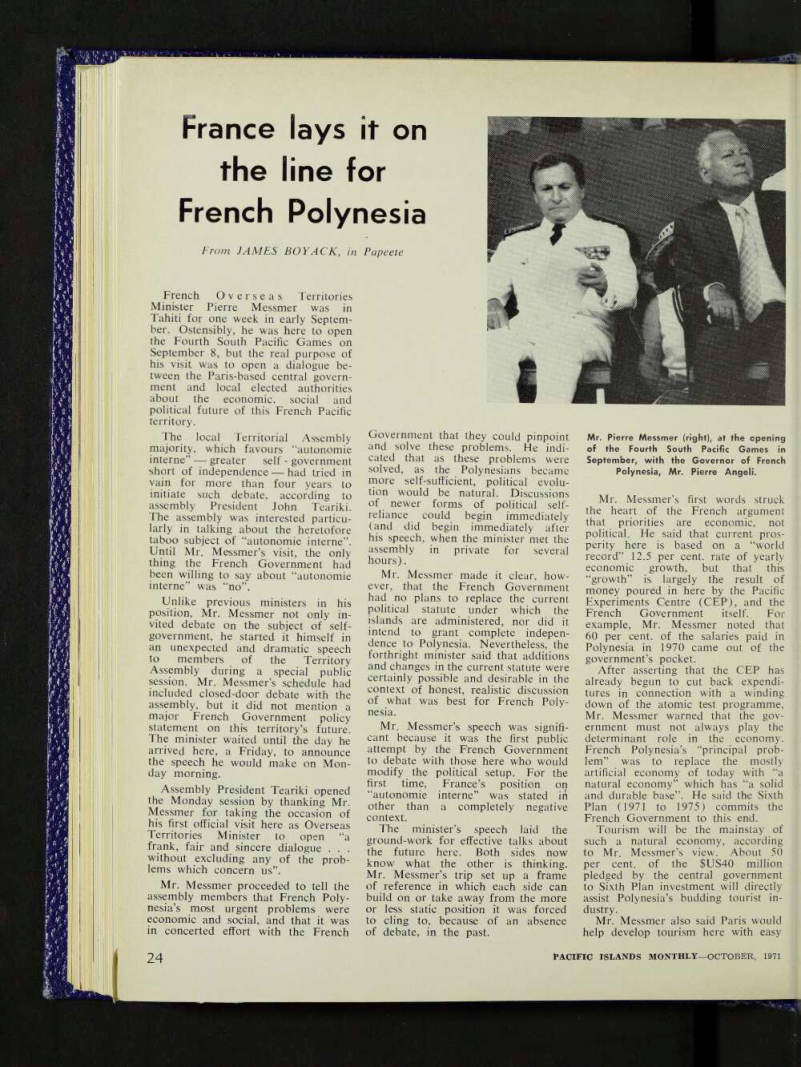
Mr. Pierre Messmer (right), at the opening of the Fourth South Pacific Games in September, with the Governor of French Polynesia, Mr. Pierre Angeli.
credit as well as no-strings-attached subsidies. Government banks were ready with funds for all worthy touristic enterprises, and the minister raised to the level of national policy a trend already visible here when he said, “These loans will be open with out discrimination as to nationality.”
The minister mentioned other ways Paris is financing the development of local tourism. One of these is a cash bonus to hotel promoters. Mr.
Messmer concluded these islands could greet 150,000 tourists by 1975.
Exploitation of the ocean (fishing, scientific research, mineral produc tion) will be another part of the natural economy which Mr. Messmer proposed for Polynesia’s future. The minister announced the French Gov ernment has decided to build a CNEXO research centre here begin ning in 1972. The first work of this National Centre for the Exploration of the Ocean laboratory would be to study metallic nodules along the Polynesian coasts. The eventual aim would be to commercialise these metals.
Finally, agriculture and traditional exports would be encouraged. Copra production would be sufficient to supply the copra oil refinery here.
After speaking at length about each one of these economic perspec tives, Mr. Messmer added. “These are the fundamental problems which, this minute, call out for reflection and action ... I hope that you fully exercise your rights (under the pre sent statute — author’s note) and that those of goodwill in this territory don’t polarise themselves debating legalities . . .”
This was the minister’s main message.
He went on to say that no matter what pressing demands may be felt in the assembly for a complete change in the statute as it now exists, these demands can find satisfaction within the large bounds of the existing political setup. He said that the already existing division of power between the state and the territory “could not be more liberally con ceived and, to my knowledge, has never seriously been contested”.
He recalled that the assembly majority had written a bill which would soon be debated before the National Assembly in Paris. This bill if adopted would replace the current statute with one creating “autonomic interne” (PIM, Aug., p. 14).
The minister said that part of his job was to warn those who supported the bill about the “responsibilities and risks” that they are taking, although he said he realises that their
position does not, nor do they, en visage a Polynesia independent of the French Republic.
His principal warning was that the new law as written would create “a kind of government by assembly, of which all democracies know the dangers”.
After so making his and the French Government’s rejection of the pro posed “autonomic interne” statute as comprehensible but as final as pos sible, the minister did something of an about-face when he said the current statute was not static.
It is open to evolution, to change, he said.
He blamed the French mentality as bound to written law for the belief that all evolution implies a change in legal structure.
“More pragmatic people,” he said, “know that customary evolution can lead to the same result as a change in institutions.” He pointed to the
parliamentary monarchy of “our neighbours, the British” as a case in point.
Although he did not intend that such evolution in French Polynesia would change the spirit of the govern ing statute. Mr. Messmer did con clude—very importantly, because it was the first French Government sug gestion in this direction—that “a study in common, conducted in the spirit of mutual comprehension, should inspire a relationship be tween your assembly and the adminis tration to permit useful clarifica tions”.
Thus did Overseas Territories Minister Pierre Messmer state the French case for a continuation of the essential political ties between Metro politan France and French Polynesia as they now exist, at the same time that he admitted political evolution is inevitable, and can be the result of mutual goodwill.