Pacific Shipping
pp. 97-102 · Read in the full issue
Freight
Rise
Reaction
The one-sided freight rate war was ‘till the biggest news in Pacific ship 3ing last month, as it was the month before (PIM, Aug., p. 89). One-sided, because the shippers were slapping on he increase and the Islanders seemed ible to do little about it. But some vere fighting back.
The increases were an important iibject for informal debate at the iouth Pacific Forum in Wellington, n August, when Island leaders got to gether to discuss matters of common nterest. The increased charges trengthened the Islanders’ determina ion to organise a regional shipping ervice that would, ostensibly, benefit hem all. But they decided to go care ully (see p. 54) because obviously here are plenty of traps to running our own shipping line—as the Nauruans have already learned.
The recent increases in freight rates rom Australia to New Guinea (two n six months) have produced a sharp eaction in the territory. The Ad ainistrator, Mr. L. W. Johnson, com aenting on the latest increases said hey would be very difficult for firms i the territory to absorb.
Excluded from unfavourable com lent, both official and unofficial, was lauru Pacific Shipping Lines, which ept its rates below those of several ther shipping companies. (PIM mg., p. 89.) Now an attempt will be made to icet the shipping companies head-on irough the formation of a shippers’ auncil for Papua New Guinea. All sporting organisations have been sked to attend a meeting in Lae for u’s purpose on September 29.
Such a council could be quite effec ve in dealing with shipping com
panics which unilaterally apply higher charges. Recently in Australia an ex porters group won a battle with a shipping conference which tried to in crease freight rates.
The PNG Trade and Industry De partment has arranged for an officer from the Australian Trade and Indus try Department, with experience in the establishment and operation of shippers’ councils, to visit PNG about the end of September.
The PNG Minister for Trade and Industry, Mr. Angmai Bilas, said that a recent deputation to him from various exporter organisations had ex pressed concern over the recent in creases.
Meanwhile, in Fiji, recent increases in freight rates from both Australia and New Zealand, and internally, are haying an immediate effect on the price of consumer goods.
The Fiji Government has found it impossible to resist price rises follow ing freight increases. It announced on August 14 that the price control list was being amended to provide for rises of up to Si on a 150 lb bag of flour or sharps and about half a cent a pound. Dairy products were also expected to be dearer.
Since August 1 freight rates be
tween Australia and Fiji have gone up by 15 per cent. The increases within the dominion have been greater. Between Suva and Vanua Levu the freight rate has risen by 25 per cent.; between Suva and Levuka 33 per cent., and between Suva and Lau 12} per cent.
Fiji Defines Her
Sea Limits
Fiji’s proposal to establish a 12mile buffer zone around all the islands in the dominion should have the sympathy of the other Pacific territories now beginning to see the need to protect territorial fishing and undersea mineral rights.
Fiji’s case was presented at a United Nations Seabed Committee
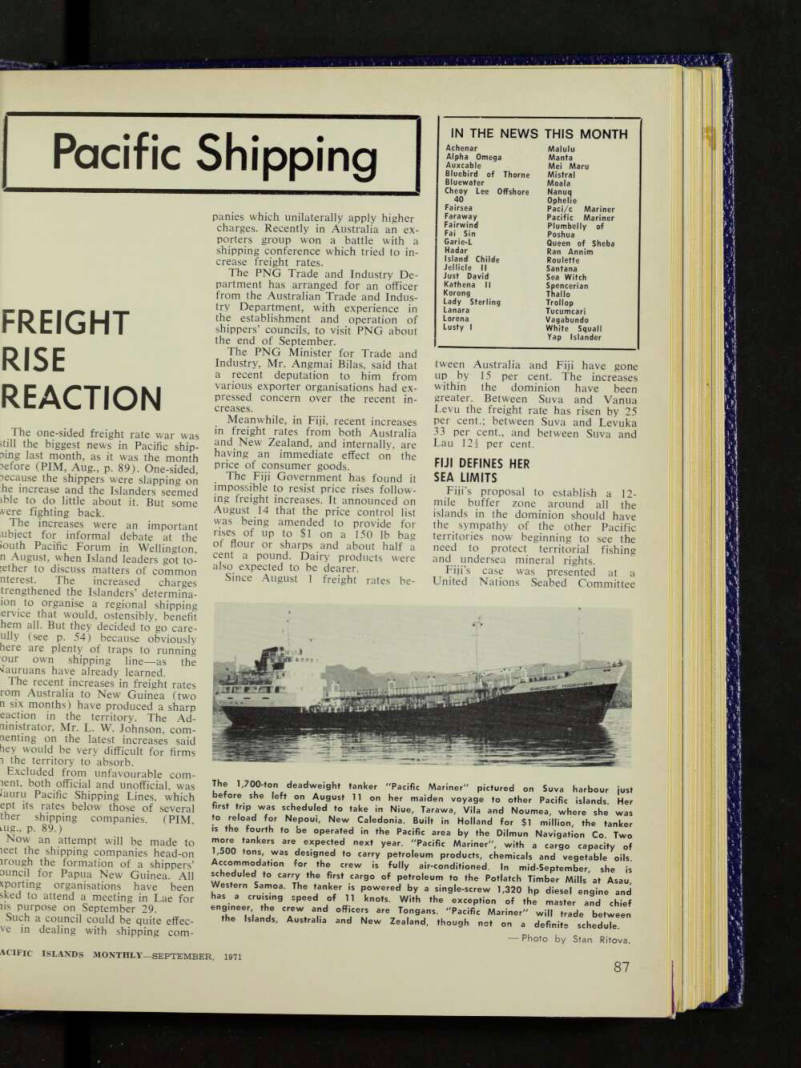
The 1,700-ton deadweight tanker "Pacific Mariner" pictured on Suva harbour just before she left on August 11 on her maiden voyage to other Pacific islands. Her first was scheduled to take in Niue, Tarawa, Vila and Noumea, where she was to reload for Nepoui, New Caledonia. Built in Holland for $1 million, the tanker is the fourth to be operated in the Pacific area by the Dilmun Navigation Co. Two more tankers are expected next year. "Pacific Mariner", with a cargo capacity of 1,500 tons, was designed to carry petroleum products, chemicals and vegetable oils.
Accommodation for the crew is fully air-conditioned. In mid-September, she is scheduled to carry the first cargo of petroleum to the Potlatch Timber Mills at Asau, Western Samoa. The tanker is powered by a single-screw 1,320 hp diesel engine and has a cruising speed of 11 knots. With the exception of the master and chief engineer, the crew and officers are Tongans. "Pacific Mariner" will trade between the Islands, Australia and New Zealand, though not on a definite schedule.
Photo by Stan Ritova.
conference in Geneva by the Solici tor-General, Mr. Don McLoughlin, in preparation for an international conference on the laws of the sea.
The aim, he said, was to establish the dominion’s territorial limits as an archipelagic state. The proposal was to draw a baseline in the form of a polygon around the outer ex tremity at low-water mark of all the islands or drying reefs of the Fiji group with the exception of the Rotuma group, the Ono-i-Lau group, the island of Vatoa and Con way Reef.
“We propose that the limits of the territorial sea should be at a dis tance of three miles outward from these baselines and that an exclusive fisheries zone should be established at a distance of 12 miles outward from these baselines,” Mr. Mc- Loughlin said.
He added that Fiji would estab lish territorial waters and fish zones on the same basis at Rotuma, Ono i-Lau, Vatoa and Conway Reef.
Establishment of the continental shelf limits posed a separate prob lem, mainly in the deep waters of the Koro Sea, the chasm between Viti Levu and Kadavu and the sub marine ridge running south-west to Conway Reef.
Mr. McLoughlin acknowledged that account must be taken of the need to keep open shipping channels.
“We consider that this can be achieved by acceptance of the prin ciple that the waters so enclosed are to be regarded as territorial waters subject to the right of inno cent passage,” he said.
He told the conference that Fijians were traditional seamen and navigators, whose ocean-going panoes were once the largest vessels in the Pacific. They must now com pete with fleets of foreign-owned vessels on the high seas within the Fiji archipelago, but outside the three-mile limit of territorial waters.
He pointed also to the growing jrbanisation in Fiji and the demand :or fish outstripping the supply, so that now the dominion imported ibout 10,000 tons of fish a year, nainly canned.
The Solicitor-General said that as veil as fostering the development of :ommercial fisheries, the Fiji Gov ernment had encouraged intensive "nineral exploration programmes Jndertaken in the shallow offshore ireas.
“A petroleum exploration pro gramme is underway over a large )art of the submerged platforms ipon which the islands of the group based,” he explained.
Concessions have been granted
over a total of 15,000 square miles of offshore areas and applications are under consideration for a fur ther 12,000 square miles, with an additional 6,000 square miles open for application.”
They "Drew" For
Fishing Boats
When two of the five 28 ft fishing boats built for the Cook Islands Fishermens’ Co-operative Society by the Niedermeyer-Martin Company of Portland, Oregon, USA, arrived at Rarotonga in mid-July, their ownership was determined by draw ing slips of paper out of a hat.
The winners of this unusual
“draw” were Rarotonga’s most suc cessful fishermen, Don Beer and Tekake William. Some years ago Tekake was the Cook Islands greatest skin diver and in 1960 be came world-famous after making dives at Manihiki of between 26 and 30 fathoms without the aid of an aqualung or other gear. In 1962, Tekake made three officially recorded dives of 27 fathoms in Manihiki’s lagoon. For several years now he has lived in Rarotonga and supports his wife and large family by fishing, and by making and selling doughnuts when the weather is unsuitable for fishing.
Three more boats were expected to arrive via Tahiti and local fishing
crews will buy the vessels from the society and operate them themselves.
Especially designed for local con ditions, the boats are delivered com plete with radio-telephones and direction finders, but the new owners have to provide fishing gear. Powered by 160 hp diesels, the marine ply wood boats, covered with a fibre glass-like cloth, will have a top speed of 18 knots.
45 Knots Through
Heavy Weather
With its profits seriously depleted and massive staff retrenchments con tinuing due to the serious downturn in aircraft and aero-space contracts, the giant Boeing Company of Seattle is now beginning on a diversification programme that will take it into the marine business in a big way. Its experience with aerodynamics has got it into hydrodynamics—and it has now produced an exceptional hydrofoil which it plans to sell worldwide, including the Pacific.
A PIM staff man who visited Seattle in August to join the delivery flight to Australia of the first Qantas Jumbo jet, saw a film of one of the new Boeing hydrofoils in operation. Prototype of the new
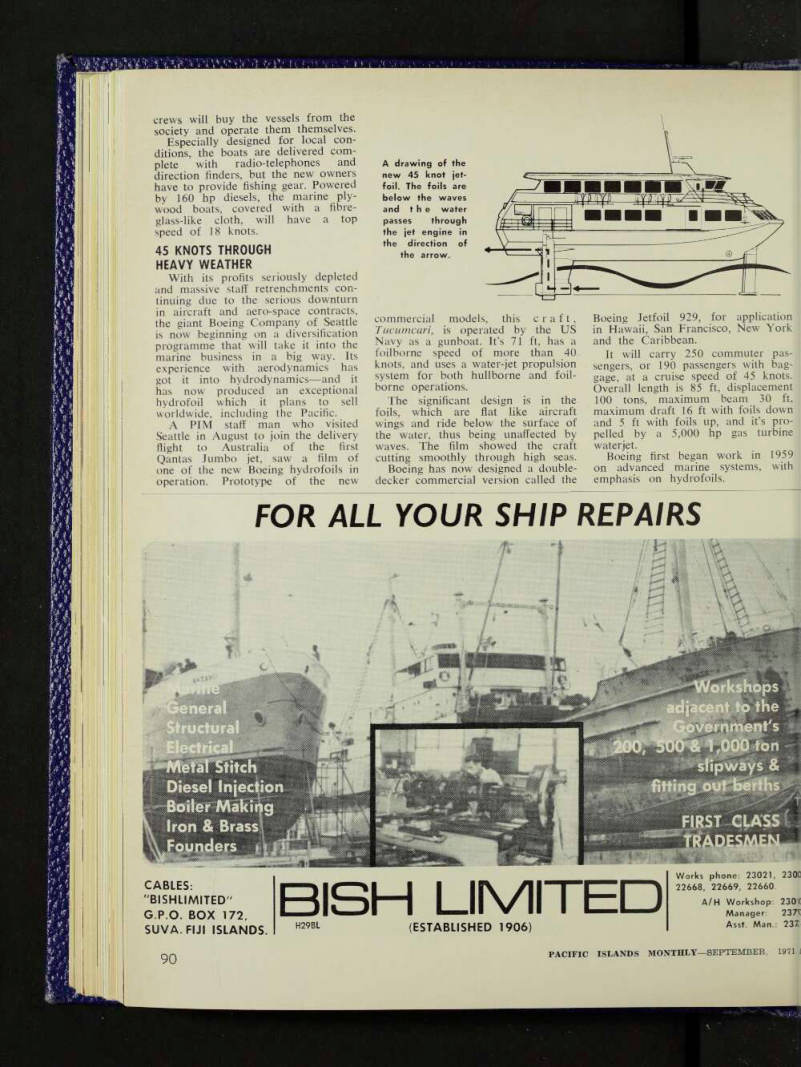
commercial models, this craft, Tucumcari, is operated by the US Navy as a gunboat. It’s 71 ft, has a foilborne speed of more than 40 knots, and uses a water-jet propulsion system for both hullborne and foil borne operations.
The significant design is in the foils, which are flat like aircraft wings and ride below the surface of the water, thus being unaffected by waves. The film showed the craft cutting smoothly through high seas.
Boeing has now designed a double decker commercial version called the
Boeing Jetfoil 929, for application in Hawaii, San Francisco, New York and the Caribbean.
It will carry 250 commuter pas sengers, or 190 passengers with bag gage, at a cruise speed of 45 knots.
Overall length is 85 ft, displacement 100 tons, maximum beam 30 ft, maximum draft 16 ft with foils down and 5 ft with foils up, and it’s pro pelled by a 5,000 hp gas turbine waterjet.
Boeing first began work in 1959 on advanced marine systems, with
emphasis on hydrofoils.
A drawing of the new 45 knot jet foil. The foils are below the waves and the water passes through the jet engine in the direction of the arrow.
Thallo's' Successor
Is Chosen
The MV T hallo, which runs between Auckland and Rarotonga, is expected to have as her successor the MV Lorena, a modern, refri gerated freighter with a speed of 14 knots and double the cargo capacity of the Thallo.
The Thallo was chartered for the Auckland-Rarotonga run by the Cook Islands Shipping Company Ltd. and the charter expires in September.
Lorena is 248 ft long with a dead weight tonnage of 1,000 tons and 74,000 cu. ft cargo capacity. There are four fully-refrigerated cargo compartmems, three hydraulic cranes and hydraulically-operated cargo hatches that can be opened and closed in a couple of minutes.
The cranes are expected to speed up cargo handling in Rarotonga and the vessel was selected partly because of her ability to operate out of Rarotonga’s Avatiu harbour.
Lorena has been carrying fruit and vegetables in Europe, is expected to load cargo in the USA in August, and to start operations from New Zealand in mid-September.
New Cruise Venture
For Tonga
Tonga plans to “steal” some tour ists from Fiji with a new cruise ven ire, operated by a former Peace -orps director, Mr. Layton Zimmer, and Australian Mr. Peter Warner.
Hiey will specialise in providing acuities for small groups interested n boating, fishing and diving. „ The partnership, known as Ma’afu enterprises after King Ma’afu of the :econd half of the 19th century, is auildmg a houseboat, to be known is Just David. Other equipment in cudes a glass-bottomed boat, scuba living rigs and a compressor for re :hargmg diving cylinders.
Shipping Company
Las No Ship
The Yap Shipping Co-operative Association is a shipping company without a ship, but only temporarily lopes manager Rafael Dabuchiren. fhe co-op. is the terminal operator or the port of Yap, and also handles wo T agencies—Air Micronesia and 41LI. Originally all shipping was the esponsibility of the Yap Co-op. As ociation’s marine department.
In 1964 this department’s functions yere co-ordinated in a separate com •any, Yap Shipping Co-operative As ociation. This company operated the ;overnment ship Yap Islander.
After six years under the aegis of ap Shipping Co-op., the Yap Islander /as transferred to Majuro. Yap was o receive as a replacement the Ran
Annim. But then Ran Annim was offered for tender, and later it was announced that the successful ten derer was a Palauan company, West ern Carolines Trading Co., of Koror.
Yap Shipping Co-op. hopes to start another shipping operation—when it can find a suitable ship.
Tonga To Create
A Navy!
Flagrant disregard by foreign fish ing vessels for Tongan sovereignty over her lands and seas, and a health hazard by seamen, have made it neces sary for Tonga to arrange to buy a small gunboat. The gunboat, 35 ft long, and carrying a heavy calibre machine-gun, will be used to patrol territorial waters.
A Nukualofa correspondent reports: This course of action, “foreign to the nature of the kingdom”, was forced on Tonga. Tonga was not so much concerned that foreign fish ing vessels took a substantial part of their catch in Tongan waters, as she was for fishermen ignoring Tongan sovereignty.
Foreign fishermen never showed passports of health certificates to in specting authorities. It was reasonable to assume that some were carriers of such disease as smallpox, bubonic plague and yellow fever. Some fisher men were in the habit of landing on sparsely-inhabited islands to trade for food and water.
Sitmar Launches
Floating Hotels
With hotel-type apartments instead of cabins, and beds replacing bunks, two new luxury liners will enter the sea cruising business next year. The “floating hotels”, the Fairwind and the Fairsea will fly the house flag of Sitmar Cruises, a new company floated by the Sitmar Line.
The Fairwind will enter service on March 18 with her first cruise begin ning from Sydney, and her sister ship Fairsea will start on her first cruise from Los Angeles on December 17 this year. .
Sitmar will operate 17 cruises from Sydney to the Pacific Islands in 1972 with the Fairwind and the Fairsea.
They will call at 12 ports in eight different groups and will also circum navigate Norfolk Island on one cruise. On three cruises there will be calls at either Brisbane or Auckland.
There will be 15 visits to Suva; other ports to be visited are Vavau, eight times; Pago Pago and Nukua lofa, seven each; Lautoka, five; Vila and Apia, four each; Noumea, Papeete, Raiatea, Madang and Lae, one each.