There'll be
pp. 45-51 · Read in the full issue
no hari kari on this little isle
By Sue Wendt
Next year, the lonely New Zealand dependency of Niue Island will receive its first visit from members of the United Nations’ Special Committee on Decolonisation. Those worthy gentlemen are “fdyto uncover any yearning for independence among the island’s 5,000 Polynesian inhabitants.
I hey 11 fand the handsome Niue islander far too sane and practical an individual to contemplate eco nomic hari kari.
After 70 years under New Zea land’s wing however, Niue is facing up to the fact that an act of self determination must come. Naturally enough the people want the best of both worlds and they’re in a pretty good position to end up get ting just that. In the meantime they hasten slowly, cautious lest they make the less advantageous choice.
Newcomers to Niue lying 300 miles east of Tonga, 350 miles south east of Samoa are often unpre pared for its sheer remoteness, and the fact that it bears faint resemb lance to the more romanticised ver sions of the South Seas. The up thrust coral island boasts no quaint native dwellings, sweeping beaches or crystal lagoons brimming with fish. Nor does it have hotels, rois tering bars, milling tourists.
What Niue does have a-plenty is peace. Not quiet the 355 stutter ing, spluttering motor-cycles and 217 cars and government vehicles have put a stop to that. But peace, in the sense of being a million miles from the vicissitudes of other, more pres surised places. Only the affairs of the island seem real.
From Mondays to Fridays, start ing at 7.30 a.m., civil servants sur round themselves with mountainous files “paperwork is the founda tion of government” quipped one and, on the surface of it at least, appear to get a surprising amount done.
In the villages, life proceeds at typical Islands pace. All the younger children are at school; other mem
bers of the family pursue various rural activities (it’s compulsory to spend at least one day a week tend
ing the family food plantation, or fishing or weaving). On Saturdays, the young men and the not-so-young play Niue’s fascinating brand of cricket 30 to a side with the womenfolk sitting under the trees and cheering them on. On Sundays church. Most of the people ad here to the Ekalesia Niue, formerly the London Missionary Society, and they take the Sabbath very seriously indeed. Even fishing is frowned upon, for it is considered work.
The peaceful life doesn’t appeal to everybody of course and some 3,000 Niueans, exercising their rights as New Zealand citizens, have departed for the bright lights and better-paid jobs of Auckland and other NZ cities. And therein lies Niue’s dilemma.
New Zealand calls, like some leg endary land of promise and for lornly empty houses, ugly relics of the Niue hurricane rehousing scheme, bear mute memorial to those who’ve gone south to settle.
Statistics aren’t encouraging.
More than 60 per cent, of the stay at-homes are under 21 and in a sur vey for the South Pacific Commis sion, youth worker J. M. Bazinet estimated that 83 per cent, of young people would eventually want to sample the good times. The recently inaugurated weekly Polynesian Air lines service will encourage the trend to travel. Most who leave are unlikely to return.
Reasons for the mini-exodus are complex, but the main lure is un doubtedly money. Life on Niue is
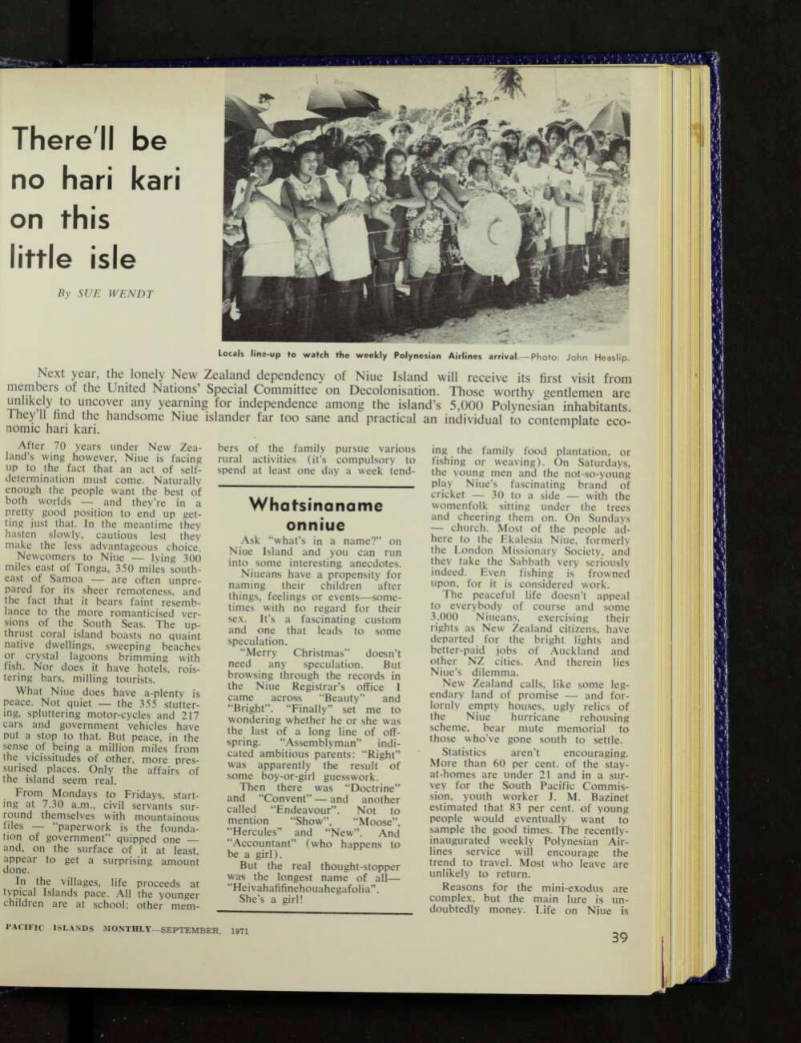
Locals line-up to watch the weekly Polynesian Airlines arrival. Photo: John Heaslip.
not easy for the villager, with no electricity (except for Alofi), no sewerage and in half the villages, no piped water. There are not enough jobs to go around (admittedly, not everyone wants to work); there is little organised social activity. Theatres and clubs are in short supply although there’s now one smart new restaurant in the main village of Alofi. Luxury items are almost non-existent. Fishing is an arduous past-time, because the traditional Niuean canoe must be carried down steep cliffs and working the copra plantations holds little attraction for the new generation.
On the other side of the coin, however, Niue has some marvellous advantages, not the least being its pleasant climate. The 100 square mile island is uncrowded, unpolluted
and scenically attractive; it enjoys an excellent health service (as an interesting sidelight, venereal dis ease is completely nil a happy state of affairs other South Pacific territories might envy) and a high level of education. Everyone has a reasonable standard of housing, no one is hungry. Above all, there is that passport to New Zealand, Niueans will never willingly re linquish the benefits of their long established ties with New Zealand, which currently pays out more than SI million a year towards develop ment projects for the island, Some of the people, intensely sus picious of change, would prefer to maintain the status quo, A large group holds staunchly to the goal of internal self-government. About the same number are committed to
the cause of integration, which they envisage (too optimistically) as bringing New Zealand-style wages, salary scales and social security benefits to their isolated island home.
Even some Niuean politicians ad mit to being in two minds about the future. “I don’t know whether I’m in favour of integration or self-gov ernment it depends on what my people want,” one confided. “It’s a very confusing time for us, even those of us who understand the workings of government. There has been a tendency for New Zealand to think things out for us, though this is changing now. I don’t think spoonfeeding by New Zealand is de sirable for my people, but we are not really sure which is the best course.”
This political caution is directly related to the Niuean social system; Niue has no tribes or chiefs and hereditary rank is of no importance.
Hence there are no traditional lead ers amongst their own people and in the past, the lead has been taken from New Zealand. The new poli ticians are feeling their way and are very much attuned to the mood of their electors. Political discussions are held at village level, and interest is keen. For election to the Assem bly, there are no political parties, no election campaigns, virtually no lobbying. Present Leader of Gov ernment Business, dapper, urbane Mr. Robert R. Rex, is nearing the end of his second three-year term.
His ‘mana’ is said to be strong still.
New Zealand is encouraging the islanders to work towards self-de termination, but is leaving the choice to them. The government and people of Niue have been assured that fin ancial and other help will always be forthcoming and that they will always have free access to NZ, whatever the decision. In other words, Niue is not being asked to give up self-government or New New Zealand support. It is an im portant point that there has never been any promise of financial bonus in the form of NZ-style benefits should the people plump for inte gration, but they would have a say in the NZ Parliament.
In his report on the constitutional development of Niue, Professor R. 0- Quentin-Baxter (Professor of Jurisprudence and International Law
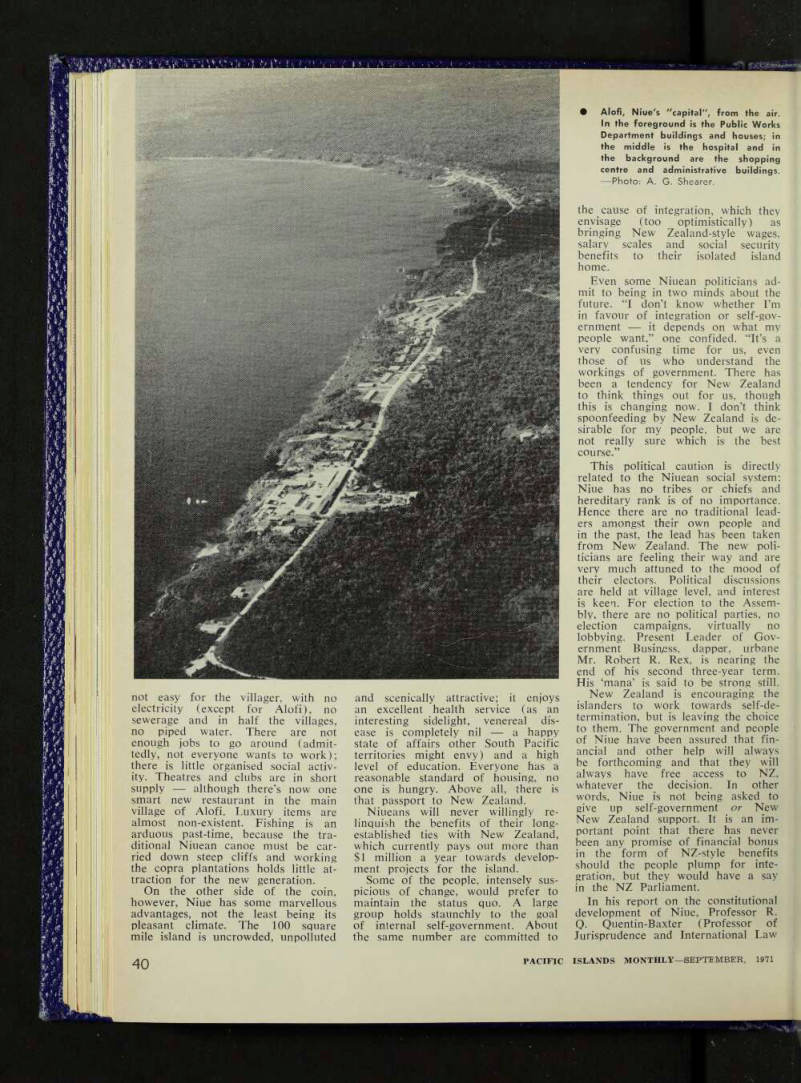
• Alofi, Niue's "capital", from the air.
In the foreground is the Public Works Department buildings and houses; in the middle is the hospital and in the background are the shopping centre and administrative buildings.
Photo: A. G. Shearer.
at Victoria University) explains the difference: “To bring to an end Niue’s de pendent status, one of two things must happen; either the inhabitants of Niue must become enfranchised as New Zealand voters, or the New Zealand Parliament must assign to the Niue Island Assembly all powers to make law for Niue. The first alternative is integration; the second alternative is self-government,”
After considering Quentin-Bax ter’s very thoroughly researched and simply presented report in February this year, assemblymen moved seve ral resolutions designed to strength en the islanders’ control over local decisions. They are expected to be approved during the current session of the NZ Parliament.
Members also decided to set up a Select Committee to investigate the issues the Assembly will even tually wish to discuss with the NZ Parliament concerning Niue’s future status.
The role of the Resident Com missioner currently Mr. Selwyn D. Wilson, a tall, helpful, precisely spoken man with a deep knowledge of things Niuean is changing, be coming more a “figurehead” posting.
This is mirrored in the February resolutions, one of which recom mends that the Resident Commis sioner should continue to preside over Assembly meetings and express New Zealand’s wishes but not exercise a casting vote on any local policy matter, as in the past.
Mr. Wilson is the first to remark on the wisdom of such changes.
“These resolutions mean that
through :tie Assembly the people of Niue are being not pushed but help ed towaids making their own deci sions. This is imperative for them,” he said. “Self-determination must come. Perhaps a sensible course might be for Niue to achieve some degree of integration, while keeping its identity intact.”
The expatriates called palangis on Niue comment often on lack of initiative among locals. “They are intensely pragmatic and individual istic,” commented one, “but they could do more to help themselves.
“A telling reflection of Niuean practicality is the fact that no one talks of independence here. But it is fatuous to talk about self-govern ment or any other term you might use unless young people here are
able to make decisions and use initiative.”
An important move is this direc tion, according to Director of Edu cation, Mr. Wally Christie, will be to help Niuean teachers to make some decisions of their own in rela tion to curriculum.
“We’re at the stage where we’re ready for a cautious transition from set assignment programmes to a situation where teachers are free to employ their initiative,” he said. “It’s important too to get expatriate teachers to follow a pattern of teach ing within the Niuean situation. How do you teach a modern concept of art within the four walls of a Niuean classroom, for instance?”
In an attempt to give expatriate teachers a greater understanding of
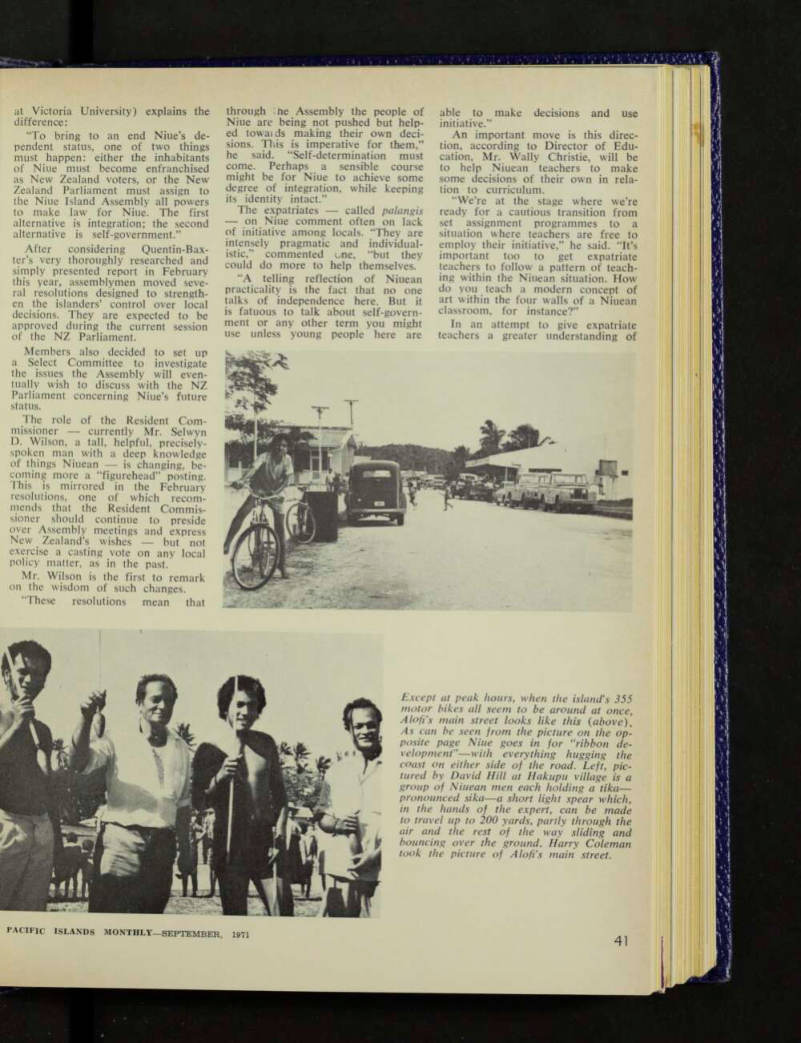
Except at peak hours, when the island’s 355 motor bikes all seem to be around at once, Alofi’s main street looks like this (above).
As can be seen from the picture on the op posite page Niue goes in for “ribbon de velopment”—with everything hugging the coast on either side of the road. Left, pic tured by David Hill at Hakupu village is a group of Niuean men each holding a tika— pronounced sika—a short light spear which, in the hands of the expert, can be made to travel up to 200 yards, partly through the air and the rest of the way sliding and bouncing over the ground. Harry Coleman took the picture of Aloft’s main street.
their task, a group of high school teachers are now preparing a Niuean social studies book, includ ing legends and important historical information.
To facilitate communication in the schools, a decision has been made to bring the teaching of read ing, writing and spelling in English forward to class 3, instead of class 4 as previously. Outside school, Niuean is spoken almost exclusively.
Even some court cases are con ducted wholly in Niuean.
Generally speaking (there are im portant exceptions, particularly among the long-term expatriates and the more educated Niueans) social contact be tween the 150-odd palangis and the locals is sadly lacking. The fault prob ably lies on both sides. Some young Niueans see the newcomers as being too quick to give advice on Niuean matters and too quick to criticise Niuean attitudes. The newcomers themselves are frequently non-plussed by the Polynesian tendency to “tell the palangi what he thinks the palangi wants to hear.” Which gets every one nowhere fast!
Niueans have an independence of character that sets them apart from most other Islanders. They certainly have no intention of becoming sub servient to tourism, should any sort of boom result from the recently established weekly air service. Some politicians, such as Mr. Young Viv ian, Member for Education, have certain reservations about visitors, en masse.
“If they’re going to come in, boots and all, into the villages, I’m not in favour of it,” he said. “Isolation does have its advantages after all, that’s the true concept of a tropi cal island.
“Sometimes I think tourism is like a two-way zoo they think we’re
funny and we think they’re funny.
Tourism will have to be on our terms.” Mr. Vivian is on the Niue Tourist Board, so will be able to keep a close eye on the way things develop.
But tourism would never make Niue economically independent of New Zealand and although agricul tural projects are proceeding well, particularly in relation to the grow ing of limes and passionfruit ($70,000 has been set aside for the establishment of a processing fac tory), there’s little chance of the island becoming agriculturally self sufficient.
The cold reality of the situation is that Niue could almost depopulate in 10 years. The biggest political de cision is whether to deliberately ac celerate the departure rate, or im prove conditions so that those who choose to stay can maintain a high standard of living.
Many observers consider that the strength of Niue’s case for continued NZ assistance in fact depends on its people’s willingness to put the in terests of their community first.
Professor Quentin-Baxter puts the choices clearly in his report: “If Niueans simply want for themselves the conditions of life they find in New Zealand, their remedy is to go to New Zealand; but if they are trying to build a life on their island in the face of NZ competition, they have a much more charitable claim to New Zealand’s financial support.”
Niue's only
telly fan
Three years ago (PIM, June, 1968) we reported that long-time Niue Is land identity Mr. Harry Coleman spent part of his spare time watch
ing television—a highly unusual occu pation on Niue, which is a long way from having its own TV station.
Harry is still the only man on the island with a goggle box—and he’s still picking up signals from both Hawaii and Pago Pago on his 11 in. set, on loan from the Stanford Re search Institute, California.
Stanford is interested in recording television signals emanating from Hawaii, part of a study being con ducted in conjunction with the Uni versity of Hawaii and the University of Canterbury, “I spend quite a lot of my nights watching TV, and now and again I get a pretty clear picture or good sound. One night I got the Dean Martin show—both sound and pic ture—from Pago Pago. I put the clarity down to a meteor shower,”
Harry told PIM. “The signals come through strongest between April and September. When Pago Pago comes through, you don’t get Hawaii—and vice versa, according to the different atmospheric conditions.
“Given the right equipment, includ ing high antenna and booster, I’d say we could pick up Pago Pago quite well here on Niue.”
Similar experiments recording the reception of TV transmission from Hawaii have been carried on in the Cooks for the past five years.
Harry Coleman has contributed much to communications on Niue
Resident Commissioner Mr. S. D. Wilson.
Photo: Harry Coleman.
This is any lunch-time or any other break in the working day, or any weekend in Alofi; the place comes alive with—so it seems—all of Niue's motor cyclists zoom ing all over the place. Here, a few line up outside Burns Philp's store which is to be converted into a supermarket (see P. 45).
itself. It was through his efforts that the Niue Broadcasting Service was established in 1967, when he was Community Development Officer.
The Niue station is on the air be tween 12-1.30 p.m. Monday to Fri day and between 6-9 p.m. Monday to Saturday.
Niue to get a
supermarket
There are some who say Niue Island will depopulate in five or 10 years, with all the islanders taking off to New Zealand. Others predict that the reverse will happen and that if Niue is given some more home com forts and job opportunities, the 3,000 Niueans in New Zealand will re turn.
Burns Philp for one is prepared to take the gamble. The old fashioned store in tiny Alofi, the island’s main town, is to be well and truly upgraded. Unbelievable though it seems to the locals, Niue is to have its first supermarket!
The new manager, Mr. John Payne, told PIM that the cost of the reconstruction and equipment would be around $50,000.
“We’re hoping to start moving the present bulk store in the near future and see the supermarket completed in January or February next year,” he said.
The present building, a dusty, friendly, haphazard kind of place, was erected in the mid 50’s after the previous store was burnt down.
About 2,000 square feet of space will be converted into the super market with an extra 500 square feet of freezer space.