Tropicalities
pp. 38-42 · Read in the full issue
Peru gets into
the act again—
with a bang!
In November, 1567, when Alvaro de Mendana left Callao in two ships to discover and settle the large con tinent which was reputed to exist in the South Pacific, Peru became the first Pacific Basin country in histori cal times to get involved in the South Seas.
During the next 39 years, two other expeditions—one under Men dana and one under Quiros —left Callao with more or less similar motives.
Then Peru lost interest in the South Seas and had little, if any, connection with it until the sixties of last century when ships out of Callao began making their infamous blackbirding raids on isolated islands in Polynesia in search of slaves for the guano islands off the Peruvian coast. The Peruvian slave raids were eventually stopped, largely through diplomatic intervention by the French, who had a protectorate over the islands now known as French Polynesia.
Now the boot is on the other foot.
The Peruvian Government is using the processes of diplomacy to try to stop the French from continuing what they regard as a sort of pir atical one-upmanship—the holding of nuclear experiments in the Tuamotu Archipelago of French Polynesia, some 4,000 miles from the Peruvian coast.
Meanwhile, Peruvian scientists (and others) are threatening to in vade Mururoa atoll in the Tuamotus where the French tests are taking place.
Peru’s President Velasco sent a cable to President Pompidou ip mid- August in which he said his country would break off relations with France unless the nuclear tests were halted.
Professor Bernardo Batievsky, of the Peruvian Geophysical Institute, followed this up by saying that 500 scientists from Latin America and Japan would invade Mururoa next
year as a protest against them if they continued.
The French Foreign Ministry countered by stating that it would lodge a formal complaint with Peru’s Ambassador to France against what it regarded as an unjustified, offic ially-inspired campaign in Peru against the tests. A Foreign Office spokesman said the Peruvian Press “and even certain authorities” had accused the French of causing earth quakes in Peru, despite all scientific proof to the contrary.
France has so far exploded five atomic devices at Mururoa this year, and is scheduled to make two more tests in September despite diplo matic protests from countries all around the Pacific and in it.
The question now is: Can Peru’s hotted-up diplomacy against the French achieve something similar to what diplomacy by the French man aged to do when Peru got into the South Seas act last time?
STOP PRESS: It was announced in Papeete on August 29 that the Sep tember tests would be cancelled.
Tests blamed for
islanders' plight
The French hydrogen bomb tests over Mururoa atoll may have brought added prosperity to Tahiti in the shape of a free-spending military force, but to one small community the tests have spelt disaster, accord ing to the story told by a yachtsman who sailed into Rarotonga towards the end of July.
The yachtsman, American Charles Peet, skipper-owner of the 55 ft ketch Santana, was one of the few outsiders permitted by the French to stay at Mangareva Island in the Gam biers for more than two days. For the last three years callers have been allowed to stay for no more than 48 hours.
He was there for eight days repair ing his yacht which was badly dam aged in a hurricane between Pitcairn and the Society Islands. While he was there he talked to the islanders whose home is about 100 miles from Muru roa.
What they told him, he said when he arrived at Rarotonga, was that the nuclear tests were ruining their lives.
They resented the tests very much, Peet said. They had robbed them of
their main income from fishing; had J left the island with very little safe ; drinking water and very few edible ; fish —presumably through the fall-out. .
In addition, the island’s population i had decreased from more than 1,000 ( to 494, plus 150 French military and 1 scientific personnel. Very few of the e islanders were able to make a living < from fishing and had turned to farm- ing.
The French authorities have ridi culed the story, denying that the fall out has affected the islanders. Con tamination through fall-out, they said,J was well below the accepted safety \ limit.
The people of Mangareva are notf the only ones to blame the tests fon affecting their lives. Pitcairn hasz added its grumble to the growings crowd of protesters which includes Australia, New Zealand, Japan, Fiji„i and the South Pacific Forum whichri met in Wellington in August.
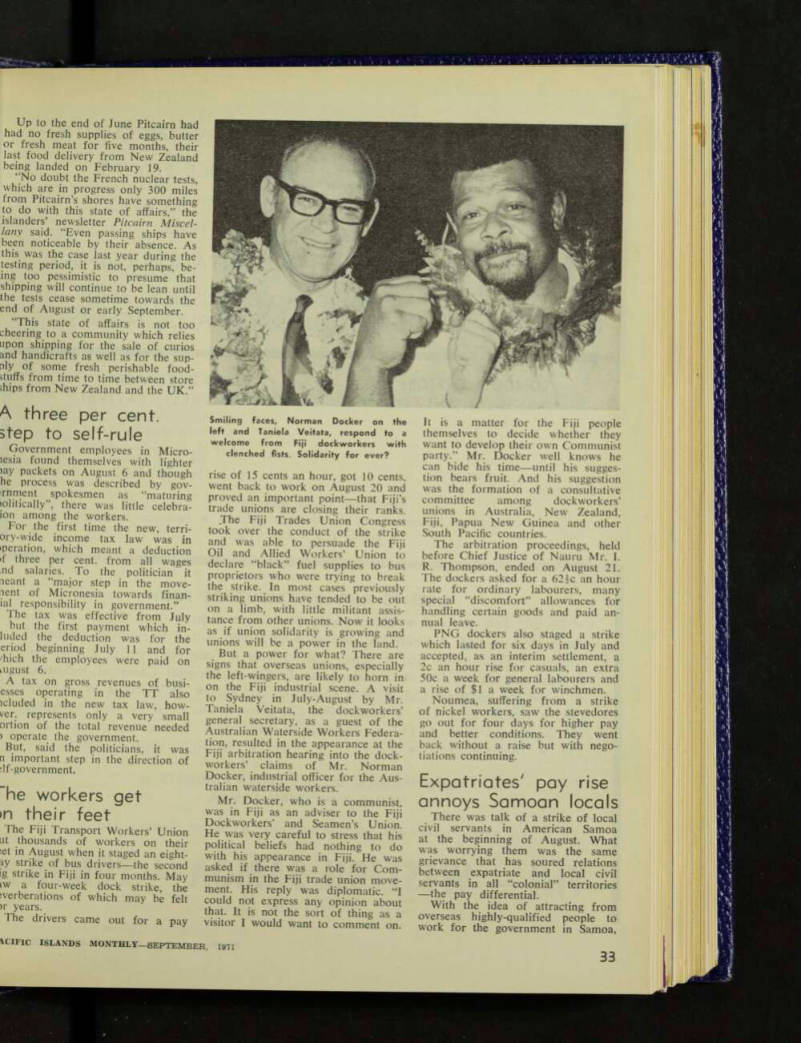
Fiji's reputation as a good spot for the big 'uns received a boost in August when a New York visitor Colin Offenhartz landed this blue marlin, a 384 Ib whopper with a 130 Ib test line. It was the biggest blue marlin ever recorded in Fiji waters.
Fishing from the "Susan Jane" out of the Fijian Hotel at Yanuca, Mr. Offenhartz fought his prize for 20 minutes and is claiming the world's all tackle record.
Up to the end of June Pitcairn had had no fresh supplies of eggs, butter or fresh meat for five months, their last food delivery from New Zealand being landed on February 19.
“No doubt the French nuclear tests, which are in progress only 300 miles from Pitcairn’s shores have something to do with this state of affairs,” the islanders’ newsletter Pitcairn Miscel lany said. “Even passing ships have been noticeable by their absence. As this was the case last year during the testing period, it is not, perhaps, be ing too pessimistic to presume that shipping will continue to be lean until the tests cease sometime towards the end of August or early September. ‘This state of affairs is not too cheering to a community which relies upon shipping for the sale of curios and handicrafts as well as for the sup ply of some fresh perishable food duffs from time to time between store ships from New Zealand and the UK.”
A three per cent,
step to self-rule
Government employees in Micro lesia found themselves with lighter jay packets on August 6 and though he process was described by gov rnment spokesmen as “maturing lolitically”, there was little celebra ion among the workers.
For the first time the new, terri ory-wide income tax law was in •peration, which meant a deduction ►f three per cent, from all wages nd salaries. To the politician it leant a “major step in the move ment of Micronesia towards finan ial responsibility in government.”
The tax was effective from July but the first payment which in luded the deduction was for the eriod beginning July 11 and for 'hich the employees were paid on mgust 6.
A tax on gross revenues of busi esses operating in the TT also icluded in the new tax law, how ver, represents only a very small ortion of the total revenue needed ) operate the government.
But, said the politicians, it was n important step in the direction of ;lf-govemment.
he workers get
>n their feet
The Fiji Transport Workers’ Union at thousands of workers on their ;et in August when it staged an eight ay strike of bus drivers—the second ig strike in Fiji in four months. May iw a four-week dock strike, the werberations of which may be felt >r years.
The drivers came out for a pay
rise of 15 cents an hour, got 10 cents, went back to work on August 20 and proved an important point—that Fiji’s trade unions are closing their ranks.
The Fiji Trades Union Congress took over the conduct of the strike and was able to persuade the Fiji Oil and Allied Workers’ Union to declare “black” fuel supplies to bus proprietors who were trying to break the strike. In most cases previously striking unions have tended to be out on a limb, with little militant assis tance from other unions. Now it looks as if union solidarity is growing and unions will be a power in the land.
But a power for what? There are signs that overseas unions, especially the left-wingers, are likely to horn in on the Fiji industrial scene. A visit to Sydney in July-August by Mr.
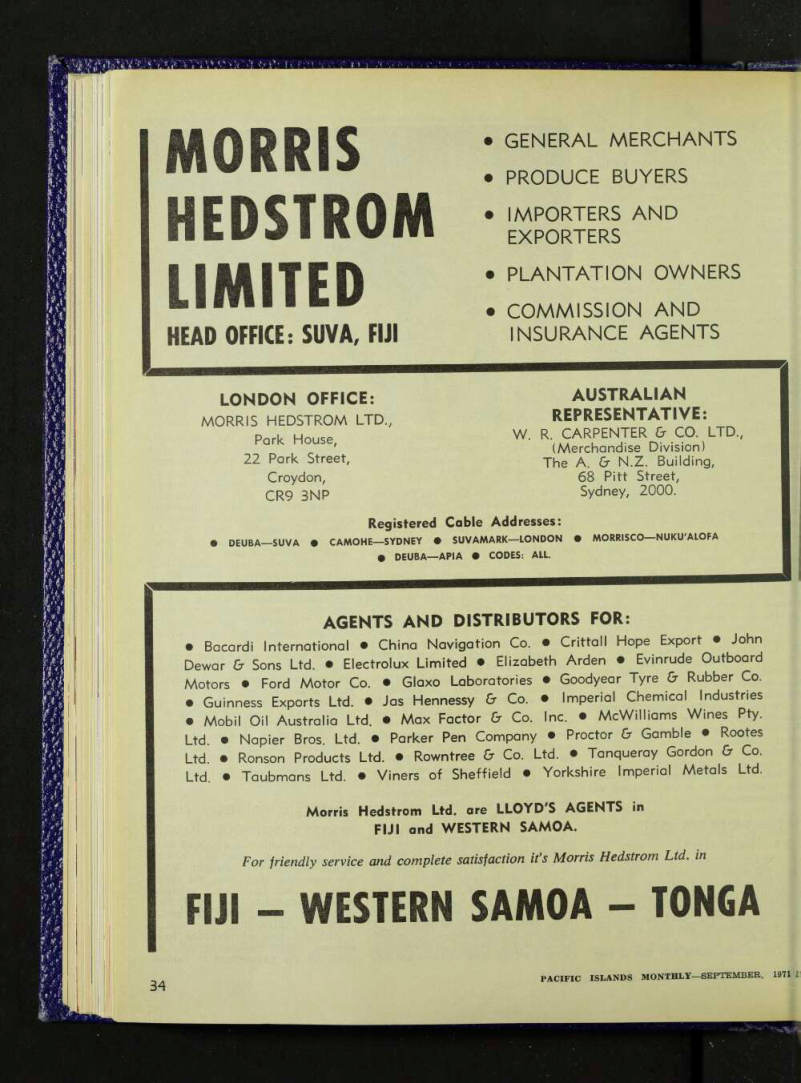
Taniela Veitata, the dockworkers’ general secretary, as a guest of the Australian Waterside Workers Federa tion, resulted in the appearance at the Fiji arbitration hearing into the dock workers’ claims of Mr. Norman Docker, industrial officer for the Aus tralian waterside workers.
Mr. Docker, who is a communist, was in Fiji as an adviser to the Fiji Dockworkers’ and Seamen’s Union.
He was very careful to stress that his political beliefs had nothing to do with his appearance in Fiji. He was asked if there was a role for Com munism in the Fiji trade union move ment. His reply was diplomatic. “I could not express any opinion about that. It is not the sort of thing as a visitor I would want to comment on.
It is a matter for the Fiji people themselves to decide whether they want to develop their own Communist party.” Mr. Docker well knows he can bide his time—until his sugges tion bears fruit. And his suggestion was the formation of a consultative committee among dockworkers’ unions in Australia, New Zealand, Fiji, Papua New Guinea and other South Pacific countries, The arbitration proceedings, held before Chief Justice of Nauru Mr. I.
R. Thompson, ended on August 21.
The dockers asked for a 62? c an hour rate for ordinary labourers, many special “discomfort” allowances for handling certain goods and paid an nual leave.
PNG dockers also staged a strike which lasted for six days in July and accepted, as an interim settlement, a 2c an hour rise for casuals, an extra 50c a week for general labourers and a rise of $1 a week for winchmen.
Noumea, suffering from a strike of nickel workers, saw the stevedores go out for four days for higher pay and better conditions. They went back without a raise but with nego tiations continuing, now rico
CXpa mdTeS pay MSG
QnDOyS Samoan locals
There was talk of a strike of local c ; v ;i servants in AmpnVnn a t the beginning of Aueust What
was worrying "Lm was® the e
grievance that has soured relations between expatriate and local civil servants in all “colonial” territories t he pay differential.
With the idea of attracting from overseas highly-qualified people to work for the government in Samoa,
Smiling faces, Norman Docker on the left and Taniela Veitata, respond to a welcome from Fiji dockworkers with clenched fists. Solidarity for ever?
the contract employees’ pay scale has been lifted. There are big in creases for many positions but no corresponding increases for “locals”, scores of whom are doing jobs pre viously held by contract personnel.
Now scores of Samoan civil ser vants are threatening to strike if the government doesn’t adjust salaries to whittle down, if not wipe out, the differential.
By August’s beginning they had already held four meetings to dis cuss the best course of action and a committee from the aggrieved group has seen Governor Haydon.
He told them the executive could not back down over its commit ments to contract employees, and they should contact legislative com mittees such as Ways and Means and Government Operations.
The trouble there, however, was that as the legislature was so busy, what with budgets and whatnot, the legislators couldn’t spare the time.
So, as the Fono is too busy to meet the civil servants, the civil ser vants will go to see them as a dele gation to both houses, Representa tives and Senate.
Governor Haydon told them the question of salaries was being in vestigated by a special committee comprising senior Samoans and Palagis, and the committee was ex pected to have its report ready by November 1.
His reminder that over the past five years average Samoan salaries have increased by 100 per cent, and that already this year salary in creases have amounted to $U5230,000, bodes ill for any chances of a steep upgrading for “locals”.
The price of of a
coconut tree
How much is a coconut tree worth? Up to $lO, said the GEIC Government. No, up to $3O, said members of the GEIC Legislative Council, meeting at Tarawa in August.
The argument began when Mrs.
Tekarei Russell, Member for Urban Tarawa, introduced a motion asking the government to raise to $3O a tree compensation for coconut trees cut down by the government. Com pensation now varied from nothing to $lO, depending on the persistence of the landowner and how lucky he was, she said. To have no standard for compensation was unreasonable and people were dissatisfied. Some trees were worthless, but a young tree with a life of 60 to 70 years could be worth $lOO.
Member for Funafuti Benjamin Kofe quoted $3O as the price paid
by the British Petroleum Co. at Funafuti for each tree felled, but the Director of Agriculture, Mr. R.
T. Harberd, argued that $3O was not a fair price. Trees in the colony bore a total of 10,000 tons of nuts a year which averaged 23 nuts per tree or 23 cents a tree. At $3O a tree com pensation would be $1,630 an acre.
Despite government opposition Mrs.
Russell’s motion won the day.
Another member’s motion which, however, failed to get much support was a novel idea produced by Paul Binatake Tokatake, Member for Kuria, who wanted the government to amend the law so that a person accused of murder should be forced to surrender a “good piece of land” to the family of the murder victim as recompense (te nenebo ) regard less of whether the accused were found guilty or innocent.
Mr. Tokatake did get some sup port for the idea of trying to equate the law with native customs and as a means of providing support for a family whose breadwinner had been murdered, but there the support ended. No one could see that it was fair to penalise a man who was found innocent of the crime, or a man who had killed in self-defence.
One subject which produced a wordy battle was that of payment to elected members, the council debat ing and approving the recommenda tions made by a select committee that members’ daily allowance (paid when the council is in session) should be replaced by a taxable sal ary of $1,200 plus a subsistence al lowance of $3 a day while on Tarawa.
Assistant Resident Commissioner D. G. Cudmore put three questions for the council to answer—was the increase, which would mean an ad
dition of $15,000 to $16,000 to the recurrent budget, justified; was the salary a fair reward for the mem bers’ work and would their constitu ents think so, and would payment of such a salary attract the wrong type of person to the council?
Member for Social Services Bwe bwetaako Arieta suggested it would be wrong to take such a salary when members had just approved a big cut in the price of copra. He also doubted whether the work of council members justified such a high salary.
As an executive council member he suggested that the figure should be halved, in which case he would be prepared to take a cut of $6OO in his executive council salary.
Mrs. Russell said if executive council members could afford to re duce their salaries they should have done it sooner. They were now using the offer to convince ordinary mem bers to reduce their salaries.
The council approved the report without any amendments about sal ary cuts.
In search of
history
There may be searches made for what is left, if anything, of two his toric vessels in Solomons waters.
The vessels are one of Mendana’s four ships, Almiranta, which disap peared in September, 1595, with 182 people on board, and the late Presi dent Kennedy’s wartime PT boat, PTIO9, which was cut in half and
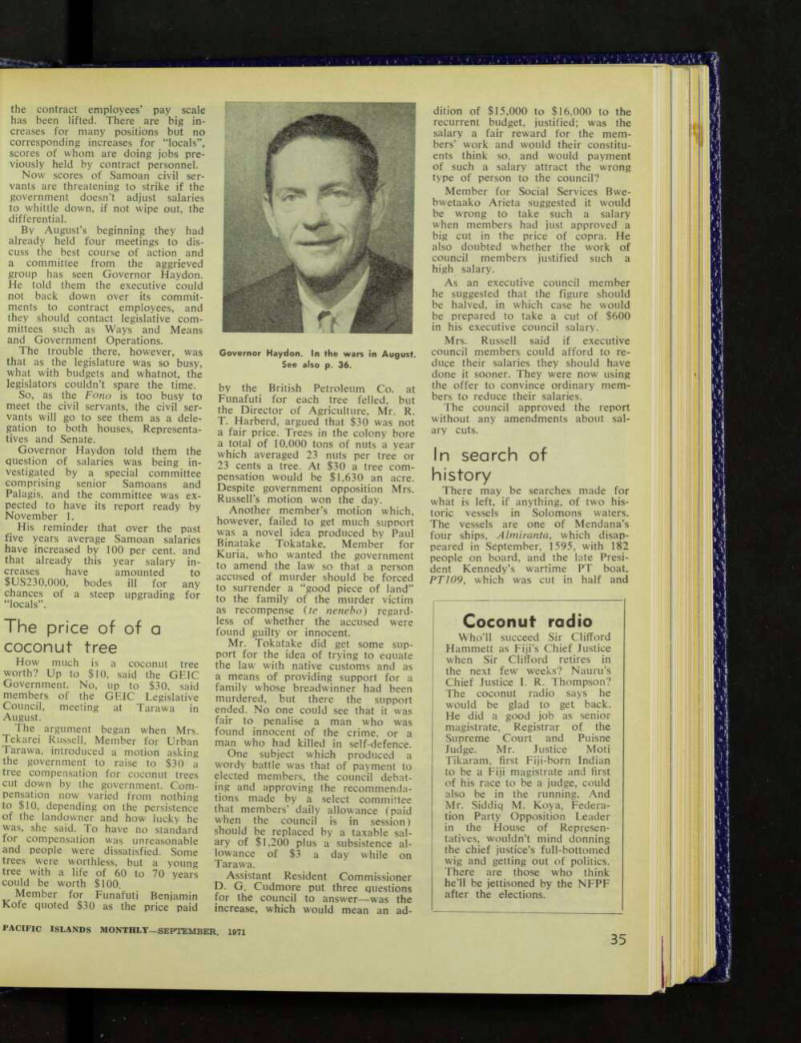
Governor Haydon. In the wars in August.
See also p. 36.
sunk by a Japanese destroyer in 1943.
Dr. Roger Green, of Auckland University, mentioned the possibility of a search for the Almiranta in a lecture he gave in Honiara in Aug ust. Dr. Green believes he has found the camp site of Mendana’s second expedition, at Graciosa Bay, Santa Cruz (PIM, Dec., 70, p. 39). He has also found what appears to be evi dence of Spanish occupation on San Cristobal, near Pamua school, and he told his Honiara audience he felt there was a strong possibility the Almiranta sank there. Although there was only a slight chance that anything of the vessel would remain after 400 years, he was looking at the possibility of some kind of under water search.
The search for FT 109 might al ready have finished if had not a vessel which the search party in tended to charter for the task hit a reef recently. Plans at the moment are uncertain.
When PTIO9 was cut in two, the rear section blew up, but the for ward section drifted away, and “Boats” Newberry, of Memphis, USA, founder of the Memphis PT Boat Museum, thinks he might be able to find its grave. He has got together some enthusiasts willing to help, including Rev. Father Giles A.
Webster, OFM, staff chaplain with the PT boats, Commander Valencia, of Southern California, and Reg Evans, the Australian coastwatcher involved in Kennedy’s rescue, who lives in Sydney. We might hear more when the team finds another vessel.
Team looked for
turtles, found Reds
It may not boil up into a major international incident, but some Rus sian seamen caused a fluttering in the United States and Trust Terri tory dovecotes in July by an “inva sion” of the Marshall Islands.
A team of men was sent from Majuro to uninhabited Bikar Atoll, about 300 miles north-east of Kwa jalein, to make a turtle survey. Using a chartered ship, Evaneline, the sur vey team went ashore on the atoll while three other men including District Economic Development Of ficer Zebedy Tarkwon took the ship’s motor launch to the northern tip of the atoll.
As they approached two sandbars they saw about a dozen men on the sand bars loading something into large bags. When the motor launch made towards them, the “invaders” got into a small boat and made for a large ship which sailed close in to the atoll and picked them up. The
ship then made off, but not before Tarkwon had seen the familiar “hammer and sickle” painted on the smoke stack.
Tarkwon then went ashore and found a large number of footprints in the sand on the main island of Bikar and an empty shotgun shell clearly labelled “Made in USSR”.
A Samoan
tug of war
“We want Goss” was the cry in American Samoa early in August as a tug of war developed between Samoans and Washington over the territory’s Associate Justice Joseph W. Goss.
Washington wants John Goss back in the United States for a desk iob as attorney adviser to the Office of Hearings and Appeals. His friends, both in the Fono (legislature) and in the community are coming to the rescue. They don’t want to lose him.
Goss, they say, knows how to settle their land and title cases and, any way, “He’s a great guy.”
The fight to retain him is being waged in official circles, for the Fono has thrown its weight into the affray, approving a resolution urging the US Secretary of the Interior to leave him in Samoa.
The resolution said that Associate Justice Goss had spent many years in the Pacific he was a judge in the Trust Territories for several years and was familiar with Samoan customs; was a very able, honest and industrious judge; had the confidence of the Samoan people and was held in high esteem by them.
Goss has already written to Rich ard S. Bodman, the assistant secre tary for administration, asking for a delay in his transfer presum ably so that he would have more time to persuade Interior officials to let him stay in American Samoa.
Some people in American Samoa see the attempt to transfer Judge Goss as having sinister overtones. A decision by Judge Goss enabled Jake King, an American who is managing
editor of the Samoa News, to defeat a deportation order against him pend ing a court trial, soon to be held.
His deportation was sought because, among ohter reasons, he was alleged to be an undesirable character.
The hand of Governor John Hay don is seen in the transfer, because Governor Haydon would dearly love to get rid of Jake King, whose raucous little newspaper is a most violent critic of Haydon’s. Haydon’s critics now accuse him of wanting to suppress press freedom.
The Jake King case itself has been making even more headlines in Samoa and Stateside than the Goss case.
In the words of former American Samoa government information officer, Tom Kaser, writing in the Honolulu Sunday Star-Bulletin in August, the “Jake King case is as tangled as the noodles in a bowl of saimin, and at least three unfortunate conditions are being illuminated by it”.
These are, said Kaser, “the im proper influence of the territory’s executive branch on the judicial branch ... the inconsistent enforce ment of American Samoa’s law for bidding unauthorised non-Samoans from living there . . . and the govern ment’s monopoly of news dissemina tion”.
But the real issue involved in the attempt to deport King is a consti tutional one. The Code of American Samoa gives the Governor the right to deport any US ctizen he chooses —and the forthcoming court case will challenge this right.
If King wins, then presumably American Samoa will be open to un controlled immigation from the States, and nobody wants that.
Meanwhile Governor Haydon is having the bucket tipped on him from many quarters over the whole press freedom deportation judiciary mess.
A resolution was even introduced into the Samoan legislature in August charging him with disrespect for Samoan customs and traditions and asking for his removal as governor.
But that’s another story.
This is the three
engined Trislander,
which is expected to prove as popular in the South Pacific as the now famous Britten-Norman Is lander. It went into
full production
earlier this year.