predictions
pp. 35-143 · Read in the full issue
Last-minute predictions for South Pacific Games
An outbreak of dengue, an acute irus disease transmitted by the bite >f a certain mosquito, was causing oncern to health officials in Tahiti n August only a few weeks be ore the Fourth South Pacific Games /ere due to begin on the island on eptember 8.
The epidemic broke out in July, ringing fever, eruptions and severe ains in the joints to those unlucky iiough to catch it.
A health and hygiene committee, jmprising representatives of various üblic services, was due to meet on .ugust 17 to decide what action lould be taken against it.
At one stage there was talk of »ing a helicopter or small plane to ’read insecticide to kill the disease irrying mosquitoes. But this was dd to be potentially dangerous in i urban area of the size of Papeete id a spraying campaign from the ound seemed likely.
Meanwhile, Tahiti’s athletes who caped the epidemic were training ird to bring themselves to top form T Ihe Games; and championships :ld m late July and early August obably revealed most of the poten d medal winners.
In men s athletics, the best pres ets seemed to be sprinters Alex idre Aunoa and Jean Bourne, med m distance runner Michel Faille d high jumper John Salmon. On e distaff side, Dominique Chaze smed to have an excellent chance winning a gold medal in the imen’s 200 metres after establish ? a local record of 26.35.; and miele Guyonnet seemed a cer nty for a medal in the high jump len she came within half an inch the South Pacific Games record ’ the event.
Because the Tahitians are general lighter in build than islanders in ; Western Pacific, their efforts in ; events requiring great strength discus, javelin and shot put—were Derally well below the Games ree ls, and they appeared to have le hope of matching their heavier ponents.
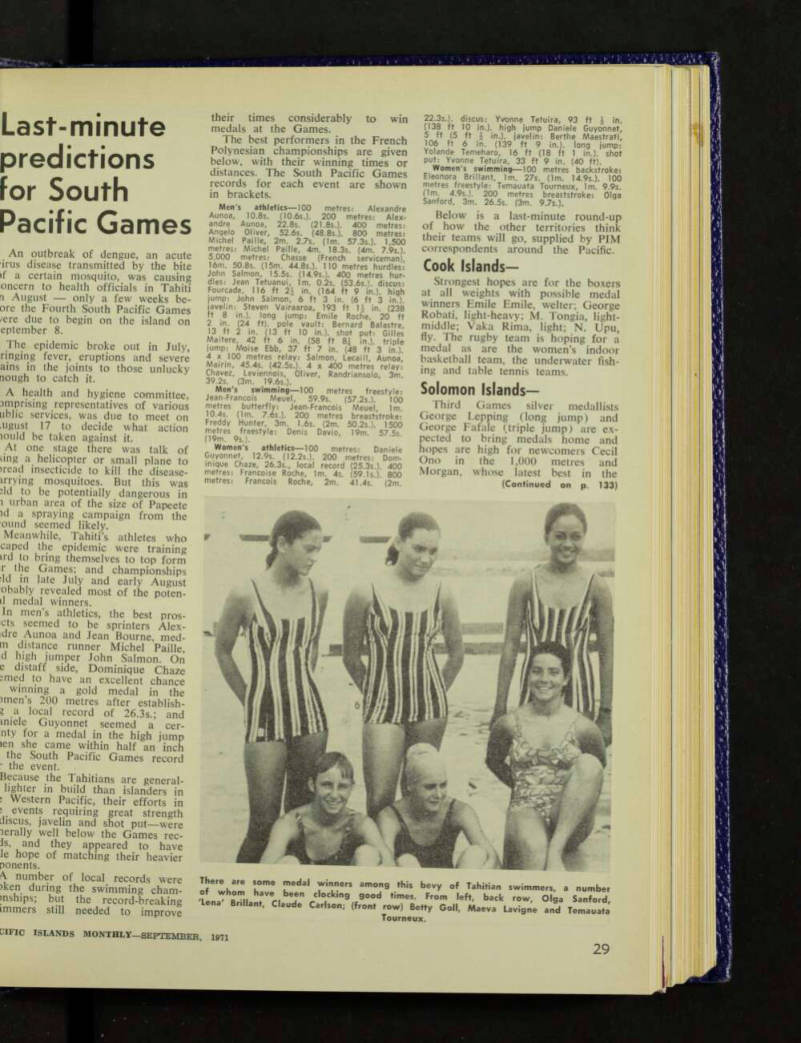
A. number of local records were >ken during the swimming cham inships; but the record-breaking immers still needed to improve
their times considerably to win medals at the Games.
The best performers in the French
Polynesian championships are given
below, with their winning times or distances. The South Pacific Games records for each event are shown in brackets.
Men's athletics—loo metres: Alexandre Aunoa, 10.8 s. (10.65.). 200 metres: Alex andre Aunoa, 22.85. (21.85.). 400 metres: Angelo Oliver, 52.65. (48.85.). 800 metres: Michel Faille, 2m. 2.75. (lm. 57.35.). 1,500 metres: Michel Faille, 4m, 18.35. (4m. 7.95.). 5,000 metres: Chasse (French serviceman), 16m. 50.85. (15m. 44.85.). 110 metres hurdles: John Salmon, 15.55. (14.95.). 400 metres hur dles: Jean Tetuanui, lm. 0.25. (53.65.). discus: Fourcade, 116 ft 2\ in. (164 ft 9 in.), high jump: John Salmon, 6 ft 3 in. (6 ft 3 in.), javelin.- Steven Vairaaroa, 193 ft 1£ in. (238 ft 8 in.), long jump: Emile Roche, 20 ft 2 in. (24 ft), pole vault: Bernard Balastre, 13 ft 2 in. (13 ft 10 in.), shot put: Gilles Maitere, 42 ft 6 in. (58 ft 84 in.), triple lump: Moise Ebb, 37 ft 7 in. (48 ft 3 in.). 4 x 100 metres relay: Salmon, Lecaill, Aunoa, Mairin, 45.45. (42.55.). 4 x 400 metres relay: Chavez, Leviennois, Oliver, Randriansolo, 3m 39.25. (3m. 19.65.).
Men's swimming—loo metres freestyle: Jean-Francois Meuel, 59.95. (57.25.). 100 metres butterfly: Jean-Francois Meuel, lm. 10.45. (lm. 7.65.). 200 metres breaststroke: Freddy Hunter, 3m. 1.65. (2m. 50.25.). 1500 metres freestyle: Denis Davio, 19m. 57.55. (19m. 95.).
Women's athletics—loo metres: Daniele Guyonnet, 12.95. (12.25.). 200 metres: Dom inique Chaze, 26.35., local record (25.35.) 400 metres: Francoise Roche, lm. 4s. (59.15.). 800 metres: Francois Roche, 2m. 41.45. (2m
22.35.). discus: Yvonne Tetuira, 93 ft \ in. (138 ft 10 in.), high jump Daniele Guyonnet, 5 ft (5 ft \ in.), javelin: Berthe Maestrati, 106 ft 6 in. (139 ft 9 in.), long jump: Yolande Temeharo, 16 ft (18 ft 1 in.), shot put: Yvonne Tetuira, 33 ft 9 in. (40 ft).
Women's swimming—100 metres backstroke: Eleonora Brillant, Im. 275. (Im. 14.95.). 100 metres freestyle: Temauata Tourneux, lm. 9.95. (lm. 4.95.). 200 metres breaststroke: Olga Sanford, 3m. 26.55. (3m. 9.75.).
Below is a last-minute round-up of how the other territories think their teams will go, supplied by PIM correspondents around the Pacific.
Cook Islands—
Strongest hopes are for the boxers at all weights with possible medal winners Emile Emile, welter; George Robati, light-heavy; M. Tongia, light middle; Vaka Rima, light; N. Upu, fly. The rugby team is hoping for a medal as are the women’s indoor basketball team, the underwater fish ing and table tennis teams.
Solomon Islands—
Third Games silver medallists George Lepping (long jump) and George Fafale (triple jump) are ex pected to bring medals home and hopes are high for newcomers Cecil Ono in the 1,000 metres and Morgan, whose latest best in the (Continued on p. 133)
There are some medal winners among this bevy of Tahitian awimmers, a number of whom have been clocking good times. From left, back row, Olga Sanford, 'Lena' Brillant, Claude Carlson; (front row) Betty Goll, Maeva Lavigne and Temauata Tourneux.
1,500 metres was only two seconds off the Games record. Girls are ex pected to succeed in long distance events especially Luisia Lakonia.
New Caledonia—
Champion territory in the third Games, New Caledonia is again hopeful of making a good show.
Swimmers Marie Jose Kersaudy, who had seven golds, and Dolores Anewy, boxers N. Kaoutch Berlioz and Kaloi, tennis players Mrs Anne Marie Morault and N’Godrella Wanaro, are all expected to do well.
Favourites in athletics are Wejieme, Kaddour, Lacabanne and Beer. As the French specialise in cycling and soccer, New Caledonia expects to have Tahiti as the only serious rival for medals in these sports. The judo team is also regarded as being strong.
Tonga—
With travel funds assured, Tonga has hopes of making a comparatively bigger impact with her boxers and athletes, the latter being a stronger team than in past Games. Once again the kingdom’s hopes centre round record-holding hurdler Tuipulotu and women’s pentathlon winner and holder of 80 metres hurdles record Keta longi.
Fiji-
Despite exclusion of Tamani, holder of the 400 metres and 800 metres records, through a foot in jury, the dominion is fielding a strong athletic team with medal hopes pinned on Yavala, 400 and 200 metres, Sotutu, 3,000 metres steeple chase, Bula Tora, triple jump, hurdlers Saumatua and Gukilau and Miriama Kadavu, women’s long jump gold medallist. Olive Picker ing’s exclusion is a blow to the women’s swim team but it is still considered the strongest Fiji has yet entered with Lyndall Probert the most promising entrant. The table tennis team is considered the best Fiji has ever had.
New Hebrides—
Main hopes in the 21-strong athletic team are sprinter Charles Godden, although he’s suffering from hamstring trouble, decathlon David Naupa, 400 metres hurdles Kanam, long jump and triple jump Jonas and Silas, women’s javelin Leisale Man gawai, discus Didin and the 4 x 100 relay team. The soccer team is
fancied for a medal as is the women’s basketball team, but the men’s team is not considered very strong. Five tennis players should give a good ac count of themselves and among the six boxers hopes centre round lighter weights Alexei and George Timity, Also in the team are six judo men, six cyclists and four golfers.
Papua New Guinea—
The team of 132—86 males and 45 females—is smaller than the team at the Port Moresby Games by 102 but its athletes are hoping for as many medals as were won at the last Games.
That, at least, is the guess of athletics team manager Jim Dunn.
But it’s a cautious guess. As Jim pointed out, not a great deal was known about the performances of competitors from other territories.
Athletics and basketball, each with 21 entries, have contributed the big gest teams followed by soccer with 18. There is one sport with a lone competitor—a cyclist.
The athletes are pinning their main hopes on Salitia Pipit, their woman 800 metres star and gold medal win ner at Port Moresby, and swimmer Nigel Cluer, four times gold medallist in the third Games.
Team managers in tennis, basket ball, weightlifting, golf and yachting are all confident that their charges will match their previous performances.
American Samoa—
Boxing is American Samoa’s strong point. Of the 10 boxers Vea Atimala in the heavy-weight class and Fetu Nuuvali in the middleweight are likely gold medal winners. The terri tory can also expect at least four more gold medals in boxing.
Western Samoa—
Is particularly strong in boxing and weightlifting and expects the 11
boxers covering every category to win at least six gold medals. Middleweight lifter Paul Wallwork is certain to win a gold with three other possible winners in the team of seven. The rugby team could win a gold and there are possible golds in yachting and the decathlon.
Geic-
With only a small contingent, the colony is not expecting medals. It is strongest in tennis and hopes to reach the semi-finals. Team manager Mori Garbutt has been training for the 5,000 metres, the 10,000 metres and marathon but is not expecting a medal.
Nauru—
Is represented by a softball team only.
Right, George Panel, representing the BSIP as a light-welter weight at the Tahiti Games, gives a young Honiara boxer (left) a few tips.
Below, Miss Luisia
Likonia, Honiara's
Charity Queen in a contest which raised more than $6,000 for the BSIP team.