Uproar
pp. 31-146 · Read in the full issue
Land
Tax
The New Hebrides as a haven for the adventurous (Judy Tudor’s com ments in August PIM, p. 47) was short-lived. At least for some of them. In August joint regulations from the Condominium Government cracked down on land speculation by requiring that, firstly, subdivision schemes involving more than two lots have the consent of French and British Resident Commissioners; and, secondly, imposing a 50 per cent, tax based on the “added value” of the land at the time the new land pur chase is registered.
Ten days later another joint regu lation tightened up the immigration legislation. This was obviously de signed to prevent any heavy influx of people from overseas who have bought New Hebrides land, and merely emphasises the fact that, con trary to popular belief, entry to the New Hebrides is not an open go.
Immediate reaction to the new subdivision laws in Vila and Santo was protests from interested groups —among land speculators, would-be land speculators and those who felt the legislation unworkable on the one hand; and from New Hebri deans, who naturally approve the legislation, on the other.
In the middle are a lot of people, in the New Hebrides and out of it, who, with no axe to grind, have looked askance at what has been going on in land speculation in the NH for a long time and would wel come some workable legislation.
It has seemed incredible to anyone versed in Pacific Islands affairs and the now sensitive question of land, that speculators have been permitted
to make vast, untaxed sums out of New Hebrides land subdivisions, the end result of which could possibly be the implantation of large “for eign” colonies in the condominium.
The time when this sort of thing could be done without consulting the wishes of the indigenous dwellers ended a generation back in most Pacific territories.
Nonetheless, the joint administra tion is not blameless in the seven day furore that the new legislation created. It should have acted when land speculation first began about 1967, and not waited until thousands of people, scattered half-way round the world, were involved.
The British Administration has never made any secret of the fact that it did not like the subdivision boom and one can therefore only suppose that it has taken all this time for the administrations and their respective metropolitan govern ments to sort it out and agree on policy.
Further, in any other Pacific ter ritory but the New Hebrides, the regulations would be debated by the local legislature before they were promulgated instead of after, as in this case.
Certainly, the New Hebrides Council is an advisory council and has no comeback but in recent years the Condominium Government has attempted not to fly in the face of what the council thinks.
It was obvious in this instance, from what came out of the debate of the council in its August meeting, that members were confused about the whole thing.
There were, at that time, quite a number of points about the new regulations that needed clarification, if not amendment. The formula for calculating “added value”, for ex ample, is far from clear.
How can you calculate the added value of land newly subdivided when that land was originally purchased 70 years ago and perhaps for “kind”, not cash. In this sort of case, the legislation seems unworkable and for this and other reasons some legal opinion is that in the joint regula tions the condominium has gone off half-cocked and that there will need to be many amendments before they are workable. Again, there appears to be a loophole in the fact that sub divided land becomes taxable only when it is registered but that there is no law to compel registration.
Some people can see greater confu sion than ever over NH land mat ters, with money changing hands for land, but the land remaining in some sort of limbo to escape paying the tax.
Thousands of blocks of New Hebrides land have been sold to out siders, mostly Americans, but a large proportion of these transactions are on long term purchase and it is be lieved that only 300 lots have been registered. All registrations in future will, of course, attract the 50 per cent, tax, which theoretically will be paid by the developer, but will no doubt be taken into consideration when he fixes the price to the cus tomer.
Following the August joint regu-
Continued on p. 136
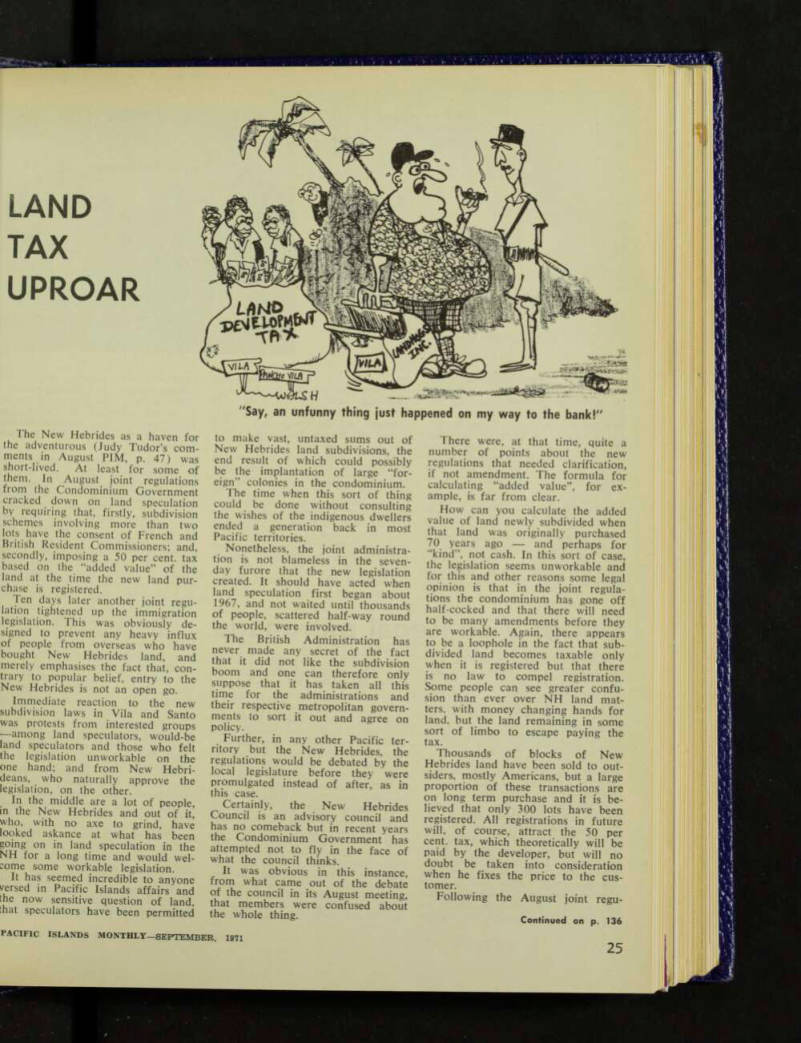
"Say, an unfunny thing just happened on my way to the bank!"
lations, 70 New Hebrideans staged a demonstration in Vila, whole heartedly in favour of the legisla tion. Major business interests re cently established in Vila for tax haven purposes gave general ap proval—one manager of an import ant trust company saying that he welcomed it as beneficial and didn’t see any detrimental effect on the condominium as a haven.
The developers and other inter ested parties, however, formed a body calling itself the Citizens’ Com mittee, called for public meetings, presented petitions to the British and French Resident Commissioners, sent cables to Paris and London pro testing at the measure and to Wash ington complaining of discrimination against US citizens. They alleged, amongst other things, that the new legislation would set black against white and therefore disturb present racial harmony; and would achieve nothing else, as land that is already registered (and won’t attract tax) will become even more valuable.
At the end of August there was no indication that their pleas were
receiving much consideration either at home or abroad although the Resident Commissioners had agreed to consider amendments to reduce the tax bill’s effect on landowners of long standing.
Most of the speculators are not residents of long standing, and, ac cording to Archdeacon Rawcliffe, a member of the Advisory Council, their profit will merely be reduced from 1,000 per cent, to 500 per cent.!
By August 26, the excitement had largely died down with everybody waiting to see if the legislation had the desired effect of (a) discourag ing unproductive speculation in land; (b) regulating subdivisions; and (c) raising revenue for the condo minium.
Following the Advisory Council meeting, its Standing Committee sub mitted half a dozen minor amend ments to the joint regulation and the Resident Commissioners undertook to consider them. • Dr. Pavel Kolish, a graduate of a Czechoslovakian university, has been appointed Nauru’s Medical Officer. He goes to Nauru from Papua New Guinea where he was employed by the government.