No politics now
p. 113 · Read in the full issue
in Fiji sugar
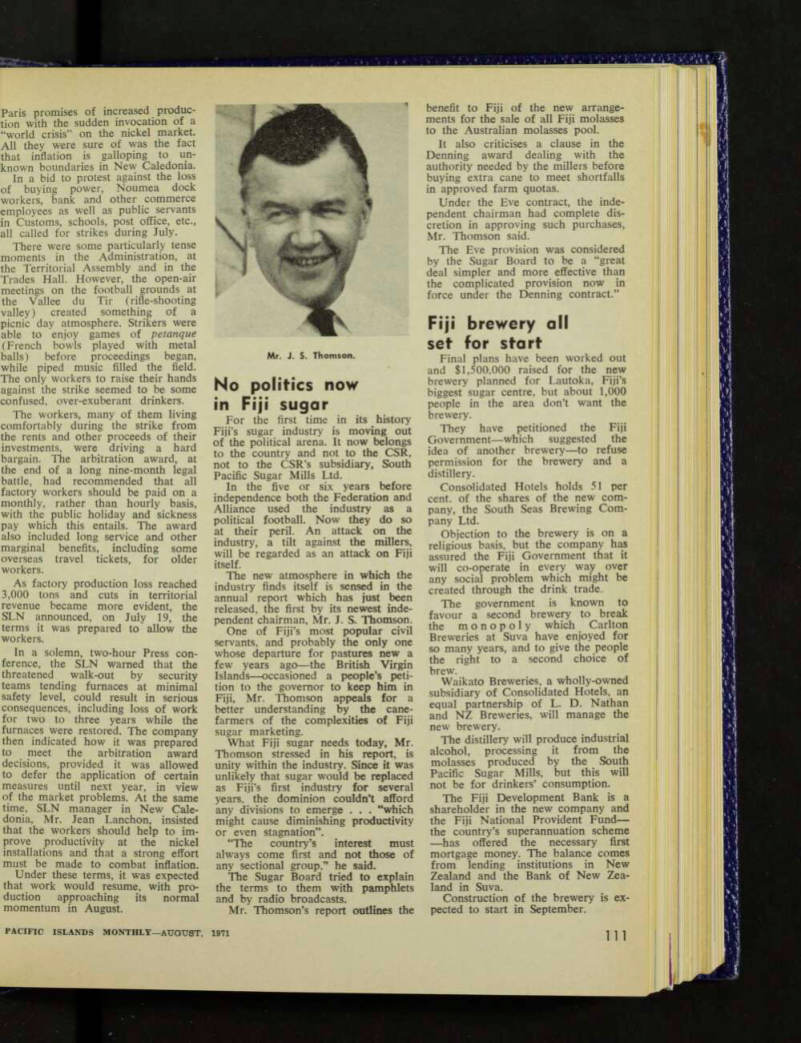
Mr. J. S. Thomson.
For the first time in its history Fiji’s sugar industry is moving out of the political arena. It now belongs to the country and not to the CSR, not to the CSR’s subsidiary, South Pacific Sugar Mills Ltd.
In the five or six years before independence both the Federation and Alliance used the industry as a political football. Now they do so at their peril. An attack on the industry, a tilt against the millers, will be regarded as an attack on Fiji itself.
The new atmosphere in which the industry finds itself is sensed in the annual report which has just been released, the first by its newest inde pendent chairman, Mr. J. S. Thomson.
One of Fiji’s most popular civil servants, and probably the only one whose departure for pastures new a few years ago—the British Virgin Islands—occasioned a people’s peti tion to the governor to keep him in Fiji, Mr. Thomson appeals for a better understanding by the cane farmers of the complexities of Fiji sugar marketing.
What Fiji sugar needs today, Mr.
Thomson stressed in his report, is unity within the industry. Since it was unlikely that sugar would be replaced as Fiji’s first industry for several years, the dominion couldn’t afford any divisions to emerge . . . “which might cause diminishing productivity or even stagnation”.
“The country’s interest must always come first and not those of any sectional group,” he said.
The Sugar Board tried to explain the terms to them with pamphlets and by radio broadcasts.
Mr. Thomson’s report outlines the
benefit to Fiji of the new arrange ments for the sale of all Fiji molasses to the Australian molasses pool.
It also criticises a clause in the Denning award dealing with the authority needed by the millers before buying extra cane to meet shortfalls in approved farm quotas.
Under the Eve contract, the inde pendent chairman had complete dis cretion in approving such purchases, Mr. Thomson said.
The Eve provision was considered by the Sugar Board to be a “great deal simpler and more effective than the complicated provision now in force under the Denning contract.”