Business and Development
pp. 111-112 · Read in the full issue

Strains On
An Infant
Industry
By Norman Baxter
Several question marks hang over the future of New Guinea’s infant, but multi-million dollar, tea industry.
By the mid-1970’s tea could be the furth biggest agricultural enterprise in the territory, following coconut products, cocoa and coffee.
Three or four years hence there should be an annual production of 8,400 tons, which would make it an $8 million upwards industry annu ally, with more than 15,000 people depending on it.
World tea prices recently started to rise after a period of recession.
New Guinea tea growers have had their first returns from their planta tions, but these have been of little consequence as the industry is still in the establishment stage.
In fact, the industry still calls for substantial investment of capital over a number of years before any adequate return is achieved. The first few years of a tea industry represent ploughing money into the ground, while a tea factory, when required, costs $250,000 or more. All this represents an investment of at least $lO million so far.
It takes a tea plant eight years or more to come into full bearing. As the first commercial plantings were made in 1964 and 1965, it will be 1973 before there’s any brew. In the establishment years costs are natur ally much higher than in running a fully-developed tea plantation.
Tea is a labour intensive industry.
Labour is required all the time for weeding, draining and fertilising when the plants are young. When the plants come to fruition a fairly large labour force is required simply to pick tea, while fertilisation and drainage, and weeding, to some degree, must be continued.
The “big four’ of the New Guinea tea industry—W. R. Carpenter,
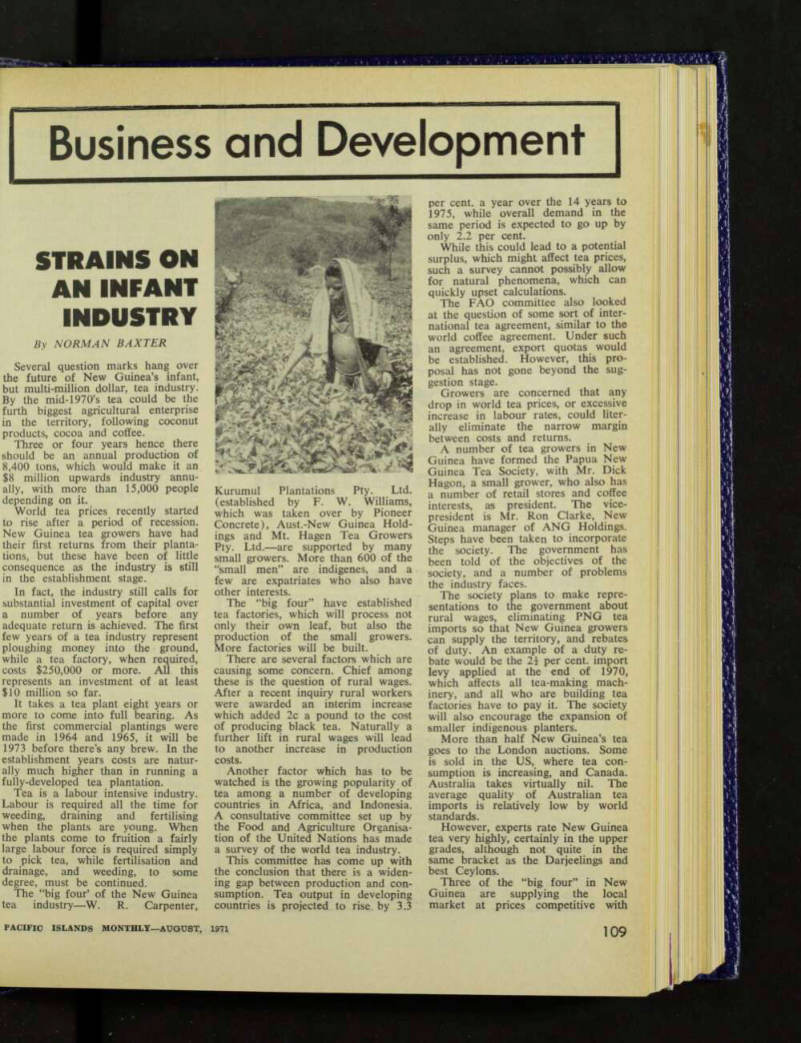
Kurumul Plantations Pty. Ltd. (established by F. W. Williams, which was taken over by Pioneer Concrete), Aust.-New Guinea Hold ings and Mt. Hagen Tea Growers Pty. Ltd.—are supported by many small growers. More than 600 of the “small men” are indigenes, and a few are expatriates who also have other interests.
The “big four” have established tea factories, which will process not only their own leaf, but also the production of the small growers.
More factories will be built.
There are several factors which are causing some concern. Chief among these is the question of rural wages.
After a recent inquiry rural workers were awarded an interim increase which added 2c a pound to the cost of producing black tea. Naturally a further lift in rural wages will lead to another increase in production costs.
Another factor which has to be watched is the growing popularity of tea among a number of developing countries in Africa, and Indonesia.
A consultative committee set up by the Food and Agriculture Organisa tion of the United Nations has made a survey of the world tea industry.
This committee has come up with the conclusion that there is a widen ing gap between production and con sumption. Tea output in developing countries is projected to rise by 3.3
per cent, a year over the 14 years to 1975, while overall demand in the same period is expected to go up by only 2.2 per cent.
While this could lead to a potential surplus, which might affect tea prices, such a survey cannot possibly allow for natural phenomena, which can quickly upset calculations.
The FAO committee also looked at the question of some sort of inter national tea agreement, similar to the world coffee agreement. Under such an agreement, export quotas would be established. However, this pro posal has not gone beyond the sug gestion stage.
Growers are concerned that any drop in world tea prices, or excessive increase in labour rates, could liter ally eliminate the narrow margin between costs and returns.
A number of tea growers in New Guinea have formed the Papua New Guinea Tea Society, with Mr. Dick Hagon, a small grower, who also has a number of retail stores and coffee interests, as president. The vice president is Mr. Ron Clarke, New Guinea manager of ANG Holdings.
Steps have been taken to incorporate the society. The government has been told of the objectives of the society, and a number of problems the industry faces.
The society plans to make repre sentations to the government about rural wages, eliminating PNG tea imports so that New Guinea growers can supply the territory, and rebates of duty. An example of a duty re bate would be the 21 per cent, import levy applied at the end of 1970, which affects all tea-making mach inery, and all who are building tea factories have to pay it. The society will also encourage the expansion of smaller indigenous planters.
More than half New Guinea’s tea goes to the London auctions. Some is sold in the US, where tea con sumption is increasing, and Canada.
Australia takes virtually nil. The average quality of Australian tea imports is relatively low by world standards.
However, experts rate New Guinea tea very highly, certainly in the upper grades, although not quite in the same bracket as the Darjeelings and best Ceylons.
Three of the “big four” in New Guinea are supplying the local market at prices competitive with
tea imported from Australia. This is possibly because of freight and other charges which apply to Australian packed tea.
The ultimate production of black tea is still something of an unknown factor. It could reach an annual minimum of 1,500 lb to the acre, and could go as high as 2,000 lb.
In the Mt. Hagen area, there are more than 10,000 acres under tea, and there is room for more.
Attempts are now being made to establish tea in the nearby Southern Highlands.
The PNG Ministerial Member for Agriculture, Stock and Fisheries, Mr.
Tei Abai, announced recently that official approval had been given to
a profit-sharing scheme, proposed by W. R. Carpenter, for tea growers in the Wahgi Valley.
The scheme covers green leaf bought from small holders who de liver their leaf to the Carpenter pro cessing factories. Under the proposed scheme, there is an initial payment of 3c a pound for green leaf, pro vided the world price of tea remains constant. This would be followed by a final annual payment, which would represent a pro-rata distribu tion, on the basis of quantities sup plied by the growers of one-half of the factory processing profit for the same period. W. R. Carpenter has offered to date this arrangement back to January 1, 1970.