Pacific Shipping
pp. 91-93 · Read in the full issue
Rates Rise
Tidal Wave
The cost of living in Fiji is expected to go up sharply in the wake of in creases in shipping charges—one applied by overseas companies servicing the dominion, and the other by local Fiji companies on outer island services.
With Fiji using more imported foodstuffs (PIM, July, p. 84) the double hike in freight rates will hit the pocket hard. Customs duties are imposed on a cif basis, so duties will rise automatically.
Three companies, Karlander, Fiji- Australia Line and Messageries Mari times, which operate regular services from Sydney to Fiji, lifted their rates for the first sailing after August 1.
The CSR Co. will apply the in crease with the September sailing of the Rona to Fiji. The increase for these four companies is 15 per cent, —from $27.50 a ton to $31.60. The reasons are increased stevedoring charges in Australia and Fiji, and increased port charges in Australia.
While leaving its PNG rates alone Nauru Pacific Shipping Lines has lifted its rates by 221 per cent, on the Australia-Fiji service, but they are still cheaper than the other four companies. Its previous charge was $23.90 a ton, or for 40 cubic feet.
The new rate will be a little more than $29.
The Tonga Copra Board, which operates the Niuvakai five-weekly be tween Nukualofa, Apia, Samoa, Suva, Lautoka and Sydney, plans to stay on the $27.50 a ton rate for Sydney- Fiji cargo, with rates to the other ports also unchanged. This will give it an advantage, but it will hardly be able to capitalise on it with such a ship as small as the Niuvakai.
However, there is talk that the Tonga Copra Board is looking at the possi bility of buying another ship for the service to Australia.
Cargo rates from areas other than Australia are also expected to rise— some already have. Royal Interocean
Lines has warned that all cargo originating from Far East ports is to be subject to a stevedoring surcharge of SUSI.SO a ton. Several companies put on a SUSI.3O a ton surcharge on freight from London to Fiji in July (PIM, July, p. 77).
The rise in Fiji’s inter-island freight rates averages 121 per cent. They vary from 5 per cent, to 25 per cent., with the higher rate applying to the best cargo routes and the lowest to the remote, thinly populated islands.
Mr. Gerald Barrack, a director of Carpenters (Fiji) Ltd., a spokesman for Fiji shipowners, said the increases had been under consideration before the April dock strike. The last in creases were in April, 1969, and since then there had been a number of rises in costs. The new rates apply from July.
About the same time as the inter island charges were raised, a number of customs agencies and cartage com panies dealing with marine freight lifted their rates by 10 to 15 per cent. —because of higher costs.
Lord Howe Island and Norfolk Island have also been caught in the cost increases. Karlander, which services both Lord Howe and Nor folk, announced that it was several years since any adjustment had been made in freight charges to those, islands. For the same reason as freights to Fiji were lifted, it had been decided to lift charges by 221 per cent, from August 1.
Thus • the charge from Australia for Lord Howe cargo rose from $37.50 a ton to $46, and for Norfolk Island from $3O to $36.
Messageries Maritimes, which ser vices the New Hebrides with the chartered Dorotea, so far has made no announcement about higher charges for that group. The current rate is $37.10 a ton.
The Holm Shipping Co. and the Union Steam Ship Co. have increased their cargo rates from various New Zealand ports to the Pacific Islands.
Holm rates went up by 10 per cent, on August 2 to Tahiti, Rarotonga, Norfolk Island and Noumea.
The USS Co. lifted its rates by 15 per cent, to Fiji, 61 to Apia, Tonga and Niue and 5 per cent, to Pago Pago.
The NZ Government got into the act with the Cook Islands trader, Moana Roa, lifting the charges by 10 per cent. The Cook Islands Shipping Co., which operates the Thallo, also
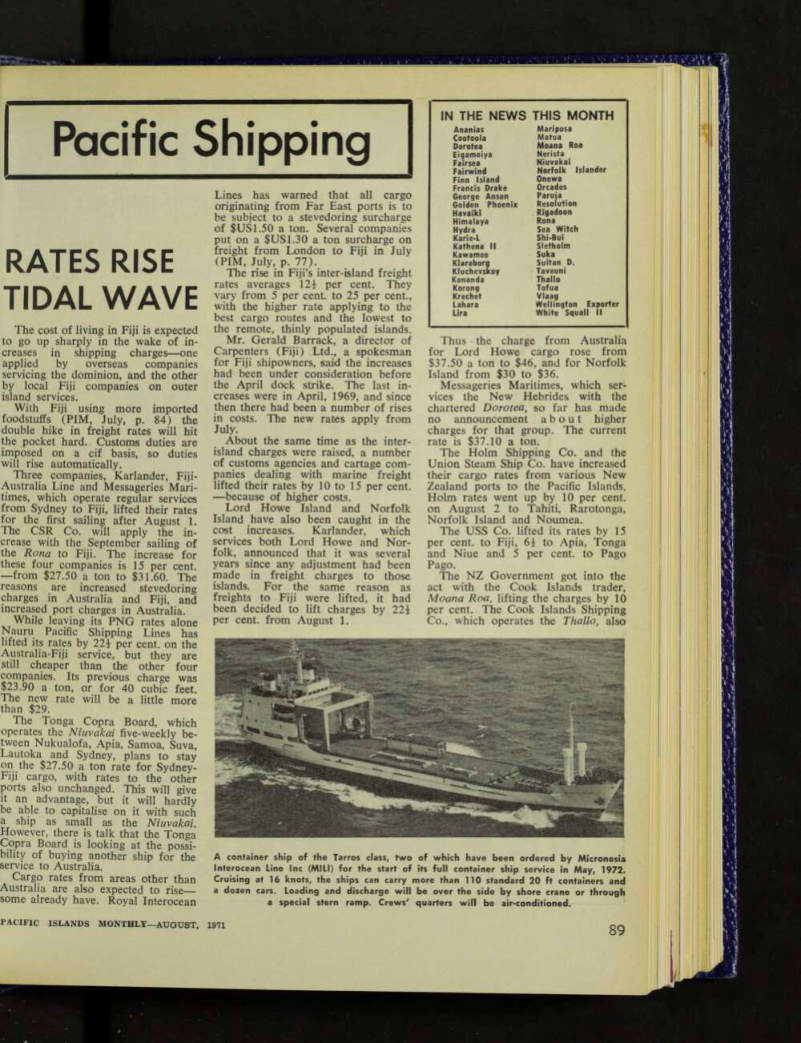
A container ship of the Tarros class, two of which have been ordered by Micronesia Interocean Line Inc (MILI) for the start of its full container ship service in May, 1972.
Cruising at 16 knots, the ships can carry more than 110 standard 20 ft containers and a dozen cars. Loading and discharge will be over the side by shore crane or through a special stern ramp. Crews' quarters will be air-conditioned.
lifted its rates to the Cooks by a similar amount.
The French-owned Sofrana Line was doing its best to delay increases as long as possible on its NZ-Pacific Islands services, and had been suc cessful to mid-July.
New Zealand manufacturers were unhappy about the increases. They claimed they faced problems enough trying to build up a substantial trade with the Pacific Islands without the additional burden.