Complacency could addle
pp. 54-61 · Read in the full issue


tourism's golden eggs
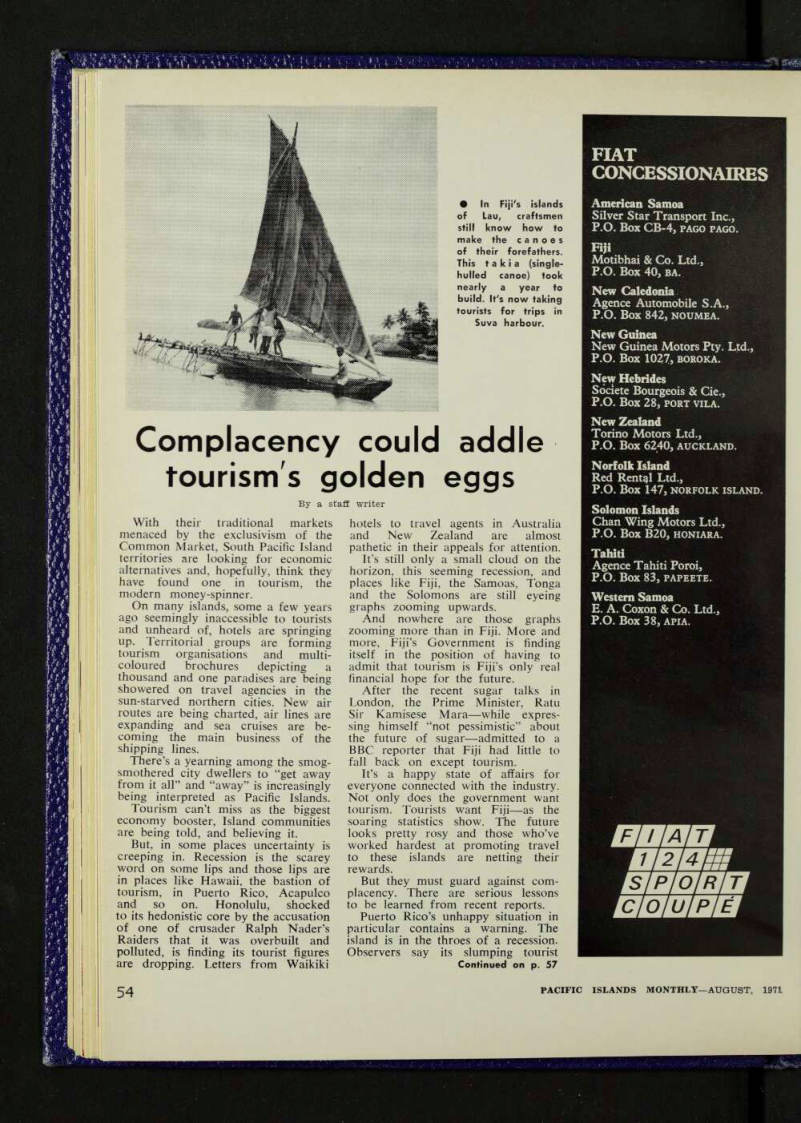
In Fiji's islands of Lau, craftsmen still know how to make the canoes of their forefathers.
This takia (single hulled canoe) took nearly a year to build. It's now taking tourists for trips in Suva harbour.
By a staff writer
With their traditional markets menaced by the exclusivism of the Common Market, South Pacific Island territories are looking for economic alternatives and, hopefully, think they have found one in tourism, the modern money-spinner.
On many islands, some a few years ago seemingly inaccessible to tourists and unheard of, hotels are springing up. Territorial groups are forming tourism organisations and multicoloured brochures depicting a thousand and one paradises are being showered on travel agencies in the sun-starved northern cities. New air routes are being charted, air lines are expanding and sea cruises are becoming the main business of the shipping lines.
There’s a yearning among the smogsmothered city dwellers to “get away from it all” and “away” is increasingly being interpreted as Pacific Islands.
Tourism can’t miss as the biggest economy booster, Island communities are being told, and believing it.
But, in some places uncertainty is creeping in. Recession is the scarey word on some lips and those lips are in places like Hawaii, the bastion of tourism, in Puerto Rico, Acapulco and so on. Honolulu, shocked to its hedonistic core by the accusation of one of crusader Ralph Nader’s Raiders that it was overbuilt and polluted, is finding its tourist figures are dropping. Letters from Waikiki
hotels to travel agents in Australia and New Zealand are almost pathetic in their appeals for attention.
It’s still only a small cloud on the horizon, this seeming recession, and places like Fiji, the Samoas, Tonga and the Solomons are still eyeing graphs zooming upwards.
And nowhere are those graphs zooming more than in Fiji. More and more, Fiji’s Government is finding itself in the position of having to admit that tourism is Fiji’s only real financial hope for the future.
After the recent sugar talks in London, the Prime Minister, Ratu Sir Kamisese Mara—while expres sing himself “not pessimistic” about the future of sugar—admitted to a BBC reporter that Fiji had little to fall back on except tourism.
It’s a happy state of affairs for everyone connected with the industry.
Not only does the government want tourism. Tourists want Fiji—as the soaring statistics show. The future looks pretty rosy and those who’ve worked hardest at promoting travel to these islands are netting their rewards.
But they must guard against com placency. There are serious lessons to be learned from recent reports.
Puerto Rico’s unhappy situation in particular contains a warning. The island is in the throes of a recession.
Observers say its slumping tourist
Continued on p. 57
trade is a prime cause of its economic malaise.
Unlike Fiji, Puerto Rico’s income from tourism is declining. The casinos are quiet, hotels are actually closing down. Palm-fringed beaches are deserted, except for litter. The drop off in visitors has been blamed on the US recession and competition from cheap group-rate fares to Europe, plus increasing violence between those for and against Puerto Rican independence.
But most of the blame, says Time magazine in a recent article, belongs to the hotelmen, “who during the boom days boosted prices exorbitantly and genially ignored visitors’ outraged complaints.
“Hotel employees did little to help, treating tourists indifferently and often with undisguised ill-humour.
The hotel workers had little to grumble about; their hourly wages and benefits soared an estimated 143 per cent, between 1959 and 1970.
During the same period, consumer prices rose by 40 per cent.”
By comparison, Fiji hotel tariffs are not exorbitant—but they are creeping up. Except for one resort which charges Fss2 a day a double, the highest rates are around $2O a day for two people. Good accom modation is still available for around $lO-$ 12 a day per double. Un fortunately there are not enough of these rooms to meet the demand. n?^ rta^ y ’ m ore rooms are planned.
Work has started on the Flagship Beachcomber hotel—to be operated by the American Airlines subsidiary Flagship Hotels. Intercontinental Hotels have also announced plans to build m Fiji—and at least half a dozen more hotels are on the draw ing boards.
With building costs on the up and up and local workers demanding higher wages, it’s doubtful whether mese new super-luxurious establish ments will be charging in the $lO a day range. Will Americans and Canadians continue to come if they have to pay Caribbean-type prices on top of the high Pacific air fare? Many local tourism experts think not.
Another thing that worries me is all this talk about establishing a room tax in Fiji,” said one tourism !? an ’ .commenting on the fact that the Fiji Government has been con sidering imposing a special tax on hotel rooms.
“If the tax meant an extra 30 cents a day at this end, you can bet your lite that by the time it was passed on to the traveller, it would become something like 45 cents. Most tourists
wouldn’t know they were paying it, because it would be added on to the top of their pre-paid accommodation.
But it would make a Fiji holiday that much more expensive.”
And that much less attractive.
One section in Fiji which got very few kudos out of tourism until recently was the Fijian people, but they are now looking for a greater share, mainly through the one valuable asset they possess, their land.
One mataqali was made a share holder in one hotel, The Fijian, about four years ago and others are fol lowing, mainly because the best land remaining for hotel sites is Fijian owned. Thanks to the efforts of the Native Land Trust Board, which administers the land, more native owners are being included in the privileged circle of hotel owners.
Dr. Rusiate Nayacakalou, the NLTB manager, spelled out the board’s position and responsibilities when he spoke at the fifth Waigani Seminar in Port Moresby recently. He said that between 1969 and April this year six leases for hotel purposes were issued over Fijian land. Between them they would provide about 1,900 hotel rooms. There were seven proposals e °P t ’ on stage, adding another 970 rooms, and three more applica tions for sites which had not reached the option stage.
The tourism boom with its in satiable demand for land has com pelled the Native Land Trust Board to—m the words of Dr. Rusiate— reassess its approach to its respon sibilities and in the face of a highly increased demand for native land it has been forced to consider the best way of taking advantage of the situation.
“It has been brought directly face to face with the stark reality that if a map of the business life of the w™!ij y tO f day were drawn ’ Fi i ians would not appear on it. The usual explanation given for this lack of participation by the Fijians in the bus,n ® ss life of their country is that whh- d °V haV l the ca P ital to start W J e - th u y own 83 per ce nt. or the land m the country, which is very valuable capital indeed. The r the NLTB was how to capital. I’’ 1 ’’ Va Uable capital into business How they’re doing their job was by i Dr Rusiate - Using the Irak formula employed by the US hnrtT^ en U n the leasing of native for a government hotel, the board has based rental on the gross receipts of the hotel.
There are six terms set out for the
granting of leases—under the present -l U nd?h?se F^e n ' and CannOt be S ° ld • A developer must apply for an option with fees ranging between $l,OOO and $3,000 and during the
XZ f lo^ m mS
Site . P 'i a £ n th a e nd deXZ g exe e rcZ the option the board may then issue, a lease after being satisfied with site plans and financial arrangements; • Leases will be for 99 years generally with no renewal provision; • The board requires that the landowners should be given the right to acquire a minimum of 10 per cent. of the shares in the developer com pany, completely or partly free of charge in lieu of a premium on the land, and at least one seat on the board of directors, • Fall compensation for the owners for land improvements; • A two-part rental charge; at first a development rent for the period up to the end of the second year of the hotels operation fixed at 5 per
cent of the land s unim P roved capital value; after the development period, a rental of 21 per cent, of the gross receipts provided the amount actually
*?han‘zFpe'XnXnheXnd"
unimproved capital value Q6O° Pt f ed bi ! ? n October,l969, at least
a yXZfheZrs"
Zxxizxx/Xts 000 T
a y f ar Wlth a ceiling of $75,000 according to the venture s success.
The second lease is attracting an annual rental of $14,000 and the landowners look forward confidently to a maximum income of $300,000 a year. In each case more than 200 owners are involved.
Dr. Rusiate sees in tourism’s rise “an entire change in the pattern of economic life of the Fijian from subsistence to employment for wages in the tourist industry.” One threat he doesn’t see.
He asks, “Will Fiji get another Waikiki with its concrete jungle?” and he answers himself, “On present indications this is hardly likely.”
Hotel developers are searching for good beach-front lands and these are scattered, particularly along the 135 miles between Nadi and Suva. o Su , ch development, Dr. Rusiate
j? or * |X m ™‘’th‘
for employment appear very good.
Already he said the Fiiians have hit ho^abZ P th * he bUSh!
Fijian culture and traditions?" 51 ” °"
Dr v us ; ate „: ves t awav ; n terms * „ There jf little of the Fijians preserving their culture and traditions as they are known today let alone as they were known 50 years ago.
“And even without this importation the amount of improvisation that one already sees as one watches tradi tional dances performed or hears songs sung indicates that the main culprit in changing Fijian culture is likely to be the Fijian people them selves.”
He adds, “What the youth of 20 years ago used to like and value is no longer regarded in the same light by the youth of today.”