There Are Ripples In The Quieter
pp. 47-133 · Read in the full issue

Pools Of Melanesia
By Judy Tudor
Between the instant independence of Fiji and the phrenetic politicking of Papua New Guinea, come the outpost lands of the New Hebrides and Solomons. If not exactly bottomless pools of tran quility any longer, they do retain enough of their old style to provide the Pacific voyager, who has travelled long in miles and cynicism, some measure of relief.
Of the two,, the New Hebrides is, in human terms, the personality kid.
This is due as much to the leavening of French on British as to the peculiar political set-up that makes purists beat their breasts in despair, but provides fine background for latter-day buccaneers plus some of the flavour of the South Pacific Islands as they once were.
Not that the New Hebrides is living in the past. It’s up and running, full of ideas and new enterprises of a sort, with land prices soaring into the stratosphere and a steady if small stream of people seeking either a haven for their funds or a piece of land away from the three cursed “P’s” of the Seventies politics, pollution and protesters.
Basically, this state of present New Hebrides euphoria is brought about by the general belief that while Papua New Guinea will get self-government in the next four or five years, and the Solomons soon after, in the New Hebrides it is at least 10 years away and more, probably 15 or even 20.
Certainly, current commercial /oze de vivre isn’t based on any New
Hebrides Panguna of copper or even a Rennell of bauxite. Forari manga nese continues but the present opera tors are producing at a much lower rate than the original French com pany. At the same time, traditional agriculture, such as coconuts and cocoa, is declining or static and al though beef production is growing, the labour situation, always a problem in the NH, has worsened.
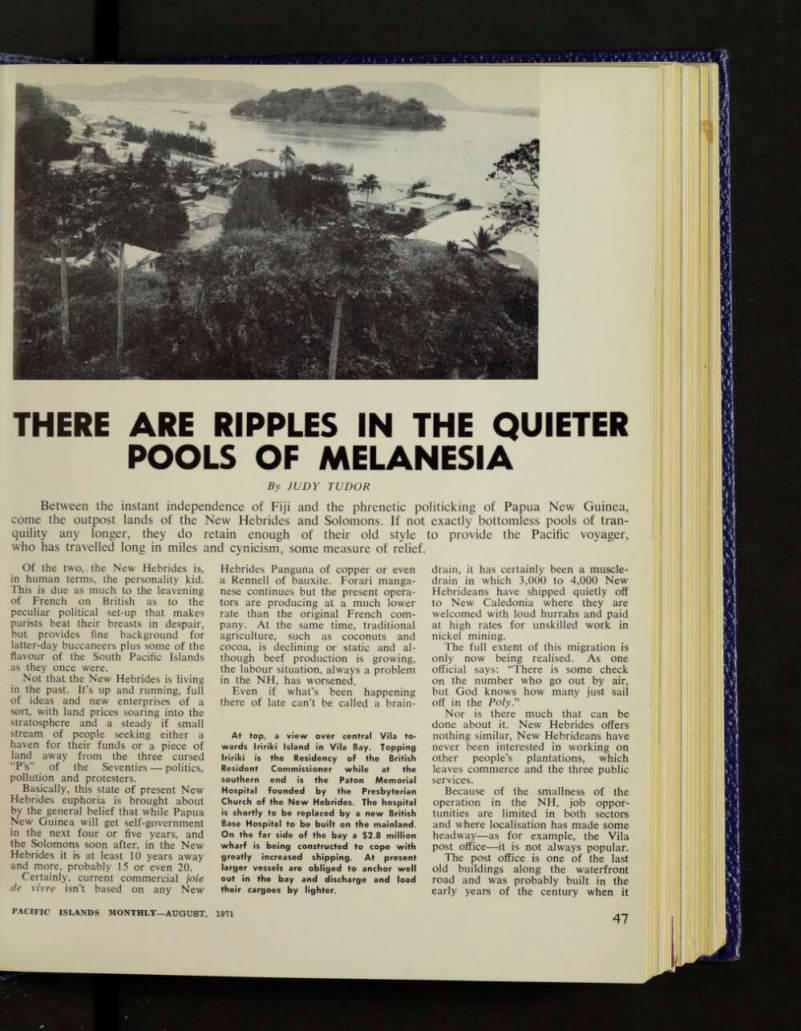
Even if what’s been happening there of late can’t be called a brain- At top, a view over central Vila to wards Iririki Island in Vila Bay. Topping Iririki is the Residency of the British Resident Commissioner while at the southern end is the Paton Memorial Hospital founded by the Presbyterian Church of the New Hebrides. The hospital is shortly to be replaced by a new British Base Hospital to be built on the mainland.
On the far side of the bay a $2.8 million wharf is being constructed to cope with greatly increased shipping. At present larger vessels are obliged to anchor well out in the bay and discharge and load their cargoes by lighter.
drain, it has certainly been a muscle drain in which 3,000 to 4,000 New Hebrideans have shipped quietly off to New Caledonia where they are welcomed with loud hurrahs and paid at high rates for unskilled work in nickel mining.
The full extent of this migration is only now being realised. As one official says: “There is some check on the number who go out by air, but God knows how many just sail off in the Poly.”
Nor is there much that can be done about it. New Hebrides offers nothing similar, New Hebrideans have never been interested in working on other people’s plantations, which leaves commerce and the three public services.
Because of the smallness of the operation in the NH, job oppor tunities are limited in both sectors and where localisation has made some headway—as for example, the Vila post office—it is not always popular.
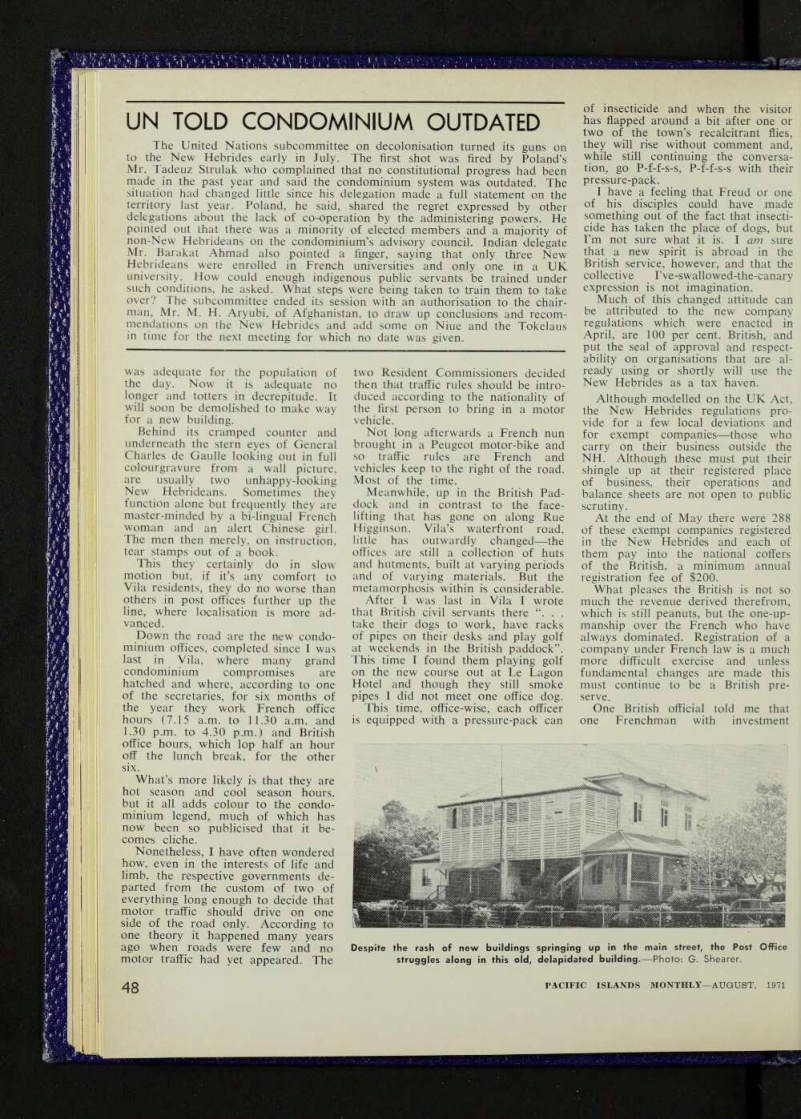
The post office is one of the last old buildings along the waterfront road and was probably built in the early years of the century when it
was adequate for the population of the day. Now it is adequate no longer and totters in decrepitude. It will soon be demolished to make way for a new building.
Behind its cramped counter and underneath the stern eyes of General Charles de Gaulle looking out in full colourgravure from a wall picture, are usually two unhappy-looking New Hebrideans. Sometimes they function alone but frequently they are master-minded by a bi-lingual French woman and an alert Chinese girl.
The men then merely, on instruction, tear stamps out of a book.
This they certainly do in slow motion but, if it’s any comfort to Vila residents, they do no worse than others in post offices further up the line, where localisation is more ad vanced.
Down the road are the new condo minium offices, completed since I was last in Vila, where many grand condominium compromises are hatched and where, according to one of the secretaries, for six months of the year they work French office hours (7.15 a.m. to 11.30 a.m. and 1.30 p.m. to 4.30 p.m.) and British office hours, which lop half an hour off the lunch break, for the other six.
What’s more likely is that they are hot season and cool season hours, but it all adds colour to the condo minium legend, much of which has now been so publicised that it be comes cliche.
Nonetheless, I have often wondered how, even in the interests of life and limb, the respective governments de parted from the custom of two of everything long enough to decide that motor traffic should drive on one side of the road only. According to one theory it happened many years ago when roads were few and no motor traffic had yet appeared. The
two Resident Commissioners decided then that traffic rules should be intro duced according to the nationality of the first person to bring in a motor vehicle.
Not long afterwards a French nun brought in a Peugeot motor-bike and so traffic rules are French and vehicles keep to the right of the road.
Most of the time.
Meanwhile, up in the British Pad dock and in contrast to the face lifting that has gone on along Rue Higginson. Vila’s waterfront road, little has outwardly changed—the offices are still a collection of huts and hutments, built at varying periods and of varying materials. But the metamorphosis within is considerable.
After I was last in Vila I wrote that British civil servants there “. . . take their dogs to work, have racks of pipes on their desks and play golf at weekends in the British paddock”.
This time I found them playing golf on the new course out at Le Lagon Hotel and though they still smoke pipes I did not meet one office dog.
This time, office-wise, each officer is equipped with a pressure-pack can
of insecticide and when the visitor has flapped around a bit after one or two of the town’s recalcitrant flies, they will rise without comment and, while still continuing the conversa tion, go P-f-f-s-s, P-f-f-s-s with their pressure-pack.
I have a feeling that Freud or one of his disciples could have made something out of the fact that insecti cide has taken the place of dogs, but I’m not sure what it is. I am sure that a new spirit is abroad in the British service, however, and that the collective Fve-swallowed-the-canary expression is not imagination.
Much of this changed attitude can be attributed to the new company regulations which were enacted in April, are 100 per cent. British, and put the seal of approval and respect ability on organisations that are al ready using or shortly will use the New Hebrides as a tax haven.
Although modelled on the UK Act, the New Hebrides regulations pro vide for a few local deviations and for exempt companies—those who carry on their business outside the NH. Although these must put their shingle up at their registered place of business, their operations and balance sheets are not open to public scrutiny.
At the end of May there were 288 of these exempt companies registered in the New Hebrides and each of them pay into the national coffers of the British, a minimum annual registration fee of $2OO.
What pleases the British is not so much the revenue derived therefrom, which is still peanuts, but the one-up manship over the French who have always dominated. Registration of a company under French law is a much more difficult exercise and unless fundamental changes are made this must continue to be a British pre serve.
One British official told me that one Frenchman with investment
Despite the rash of new buildings springing up in the main street, the Post Office struggles along in this old, delapidated building.— Photo: G. Shearer.
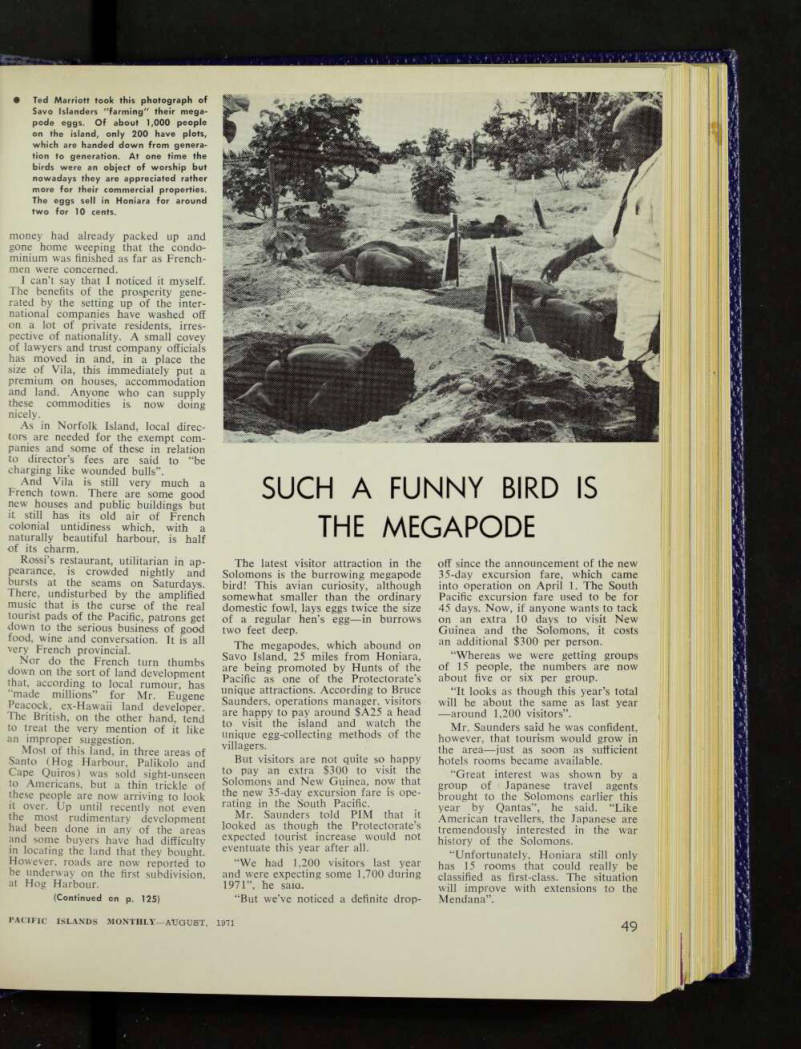
Ted Marriott took this photograph of Savo Islanders "farming" their mega pode eggs. Of about 1,000 people on the island, only 200 have plots, which are handed down from genera tion to generation. At one time the birds were an object of worship but nowadays they are appreciated rather more for their commercial properties.
The eggs sell in Honiara for around two for 10 cents.
money had already packed up and gone home weeping that the condo minium was finished as far as French men were concerned.
I can’t say that I noticed it myself.
The benefits of the prosperity gene rated by the setting up of the inter national companies have washed off on a lot of private residents, irres pective of nationality. A small covey of lawyers and trust company officials has moved in and, in a place the size of Vila, this immediately put a premium on houses, accommodation and land. Anyone who can supply these commodities is now doing nicely.
As in Norfolk Island, local direc tors are needed for the exempt com panies and some of these in relation to director’s fees are said to “be charging like wounded bulls”.
And Vila is still very much a French town. There are some good new houses and public buildings but it still has its old air of French colonial untidiness which, with a naturally beautiful harbour, is half of its charm.
Rossi’s restaurant, utilitarian in ap pearance, is crowded nightly and bursts at the seams on Saturdays.
There, undisturbed by the amplified music that is the curse of the real tourist pads of the Pacific, patrons get down to the serious business of good food, wine and conversation. It is all very French provincial.
Nor do the French turn thumbs down on the sort of land development that, according to local rumour, has “made millions” for Mr. Eugene Peacock, ex-Hawaii land developer.
The British, on the other hand, tend to treat the very mention of it like an improper suggestion.
Most of this land, in three areas of Santo (Hog Harbour, Palikolo and Cape Quiros) was sold sight-unseen to Americans, but a thin trickle of these people are now arriving to look it over. Up until recently not even the most rudimentary development had been done in any of the areas and some buyers have had difficulty in locating the land that they bought.
However, roads are now reported to be underway on the first subdivision, at Hog Harbour.
(Continued on p. 125)
This whole land subdivision ques tion was covered thoroughly in PlM’s January report by John Griffin, who visited the New Hebrides last year.
Local attitudes haven’t changed since tie left.
Some people like the idea of the money Americans might bring in, but the majority seem to take the view that, while the French-British-Hebri dean hodge-podge is one thing, haying had 70 years to get used to it, it is quite another if there is to be a great influx of Americans. So far they have nothing concrete to worry about—as Griffin says, it is still just an Ameri can dream.
But in these days when so many people are fed up with what social revolutionaries have done to West ern democracy, anything is likely to happen. Even to the extent, incredible as it might have seemed a few years ago, of an American colony in the remote New Hebrides.
The land developments have had the effect of making the NH think tourism, which is already making its contribution to national income, but they have also had the reverse effect □f stultifying hotel building because of the astronomical prices owners now want for land.
Asking price for hotel sites around Vila come as high as $250,000, al though, if tourism is to grow, new hotels are badly needed.
The Vate and Rossi’s (which has some excellent new air-conditioned bedrooms) still operate in Vila town, but most of the tourists are channelled through Le Lagon Resort Hotel some miles out.
It is owned by a French company which bought the land when it was comparatively cheap and the hotel sprawls over many acres, with the golf course on one side and the lagoon pn the other.
Accommodation is in large blocks □r in individual thatched cottages scattered along the lagoonside and far away from the organised confusion of reception, bar and restaurants.
New air-conditioned bedroom blocks and a swimming pool are being added to the establishment this year.
A faint smell of sulphur pervades the area at low tide, but it all has about it a wonderful tranquility that grows on you.
It is particularly beautiful in the early morning and, as a frenzied Syd ney commuter for part of my time, I remember with pleasure my breakfast half-hour at Le Lagon. While eating you can look out from the restaurant onto the lagoon, satin smooth at that
hour, disturbed only by the girls who work in the hotel and paddle across from the village opposite to park their canoes on the sandy beach.
If extra entertainment is required this is provided daily by Australian and American executive types who don’t think that fruit, coffee and toast make a breakfast and, red faced and impatient, try to hurry the process of getting scrambled eggs or bacon from a staff that obviously doesn’t think that they are necessary.
Honiara, British Solomon Islands Protectorate, seems after Vila to be neat, clean and staid in its manners, as befits the capital of a territory which intends nothing dodgy in the way of earning its living. No tax havens here, or planned expatriate colonies of get-away-from-it-allers.
But BSIP too, according to local opinion, is soon to be up and away economically.
Because I once said that there was nothing in the BSIP that a good mine wouldn’t fix, the Mitsui deal (PIM iuly, p. 51) over bauxite was quickly rotted out for my inspection. But this sn’t all—there is the s6+ million lalm-oil project between the Com nonwealth Development Corporation md the government which aims to de velop 8,000 acres of Guadalcanal ilains in this crop. Further, Japan ese experts were to assess the tuna ishing potential; and it is still hoped o be able eventually to produce suf icient rice for home and export.
Three years ago the rice project of he late Ken Hay’s Guadalcanal ’lains Ltd. was the big hope of local :ommerce, but it since has had its iroblems, including drought and irmy-worms. Both can be controlled >y irrigation and work on getting vater to some parts of the project were under way in early June. With rrigation two crops of rice per year an be grown.
With the exception of rice, none of he benefits of the hopeful new in lustries are likely to be immediate, t will probably be 1974 before there s much result from Rennell, and oil ialm, like most tree crops, is a long erm process.
Still, things do look more hopeful n the Solomons than they did three ears ago and there is a chance that, >y the time Britain hands over to the Melanesians, the economy will be loser to being viable.
But if something should go wrong /ith the new, promising industries, nd this has been too often the fate f grand BSIP schemes, I wonder will lose super-optimists, the top expatri te public servants, still come up with
the oft-expressed hope that all will come right in the end?
The Solomons have been different from other Pacific territories in that top officials have stayed longer, mostly because there is no other place to go and localisation has not pro ceeded very far.
Many of these have withstood suc ceeding expectations and failures and can still come back with the predic tion that “this time the Solomons are really going to take off”.
Now time for producing the eco nomic rabbit out of the hat appears to be running out. Official policy is that the British will carry on until the people want to take over, but un officially it is said that once Papua New Guinea gets independence, the BSIP can’t be far behind.
The administration sets great store oy its present system of government oy committee, every elected member of the Governing Council belonging to one of the five that have been set up. This is designed to give all nembers a direct experience of gov ernment and is the BSIP answer to the Westminster variety upon which jo many ex-colonial countries have foundered. It is obvious, however, that the BSI experiment will be suc cessful only if the experience gained oy members of one council is not cancelled out in the next ballot-box.
If the electorate follows the Papua New Guinea example few members will survive more than one term in office. They are usually tossed out by /oters for failing to get central gov ernment to produce enough bridges or oads or other development for the lome electorate.
Although in the protectorate there ire not as many different opinions as to the shape future government should take as there are in PNG, where there ire hundreds of divergent ones, there ire conflicting views. One school sees no hope for independence unless some local dictator can be produced be tween now and then, and there is no sign of any such person at pre sent.
There is also some disillusion and mpatience amongst public servants. 3ne man I’ve always regarded as a op advocate of a Solomons-for-the- Solomon Islanders platform tells me tie is soon getting out because he can no longer stand the “absolute piffle” that comes out of the Governing Council and can see nothing there that augurs well for the Solomons under self-government.
Meantime the protectorate some how manages to appear economically flourishing. Private enterprise, al though it continues to complain that
it is either receiving too much or not snough attention from authority, is prosperous. There is much new pri vate and public building and there is a small but slowly growing tourist industry left largely to a few en thusiasts.
Although Honiara will probably lever be a tourist destination point as Vila already is, it has a good deal ?oing for it for a short stay as part >f a Pacific package deal.
Americans like to visit the old battlefields that are close by; the lapanese will probably want to do he same once that source is tapped; md there is a diversity of Islands jeople right there in the town, in cluding Micronesians from the Gil berts and Polynesians from the BSIP nitliers.
One of the pleasantest evenings I ;pent there lately was in the Tikopian rillage where impromptu dances and ongs were performed under the stars, rhe Tikopians moved into Honiara ome years back when their remote itoll became overcrowded, and their ancing and chanting is unique enough o send experts in this art-form into scstacies.
In June, Travelodge hotel/motel hain was still negotiating for a piece if land on Honiara’s waterside and xtensions were planned for Mendana nd Honiara hotels. Nonetheless, those vho are trying to increase the tourist low say they get little support from he government and the industry is Iso handicapped by the usual Pacific lifficulties over hotel staff.
In 1970, all three existing hotels ot together and sponsored a train ig course for staff. By mid-1971 there vas not one of the trainees still in he hotel business.
Hotels now try to train their own taff from raw recruits, ex-bush. How asic this has to be is indicated by he efforts at the Mendana. In a room sed for waiter orientation there’s a irge blackboard with 18 “Dos and )on’ts” written on it. It starts off by aying: It is tabu to . . .
Pick your nose; Scratch yourself in public . . . nd it goes on to admonish all aspir nts to swim every day; powder under le arms; not to lean on pillars and to eep walking.
It occurred to me that the final istruction. suitably paraphrased, light do for the coat-of-arms of an idependent Solomon Islands. I can :e it now—entwined under an oil alm rampant and a Mitsui shield, ie words: DO NOT LEAN—KEEP