democracy'
pp. 39-43 · Read in the full issue


Norfolk's 'Scandalous abuse of democracy'
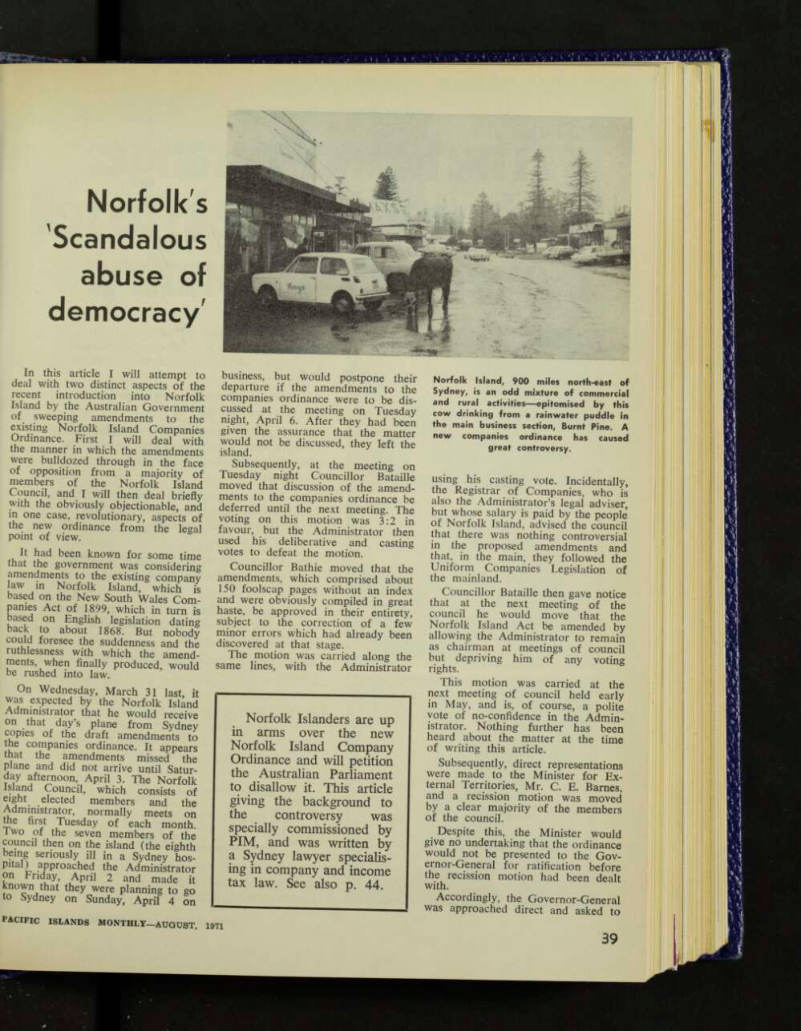
Norfolk Island, 900 miles north-east of Sydney, is an odd mixture of commercial and rural activities—epitomised by this cow drinking from a rainwater puddle in the main business section, Burnt Pine. A new companies ordinance has caused great controversy.
In this article I will attempt to deal with two distinct aspects of the recent introduction into Norfolk Island by the Australian Government of sweeping amendments to the existing Norfolk Island Companies Ordinance. First I will deal with the manner in which the amendments were bulldozed through in the face of opposition from a majority of members of the Norfolk Island Council, and I will then deal briefly with the obviously objectionable, and in one case, revolutionary, aspects of the new ordinance from the legal point of view.
It had been known for some time that the government was considering amendments to the existing company law in Norfolk Island, which is based on the New South Wales Com panies Act of 1899, which in turn is based on English legislation dating back to about 1868. But nobody could foresee the suddenness and the ruthlessness with which the amend ments, when finally produced, would be rushed into law.
On Wednesday, March 31 last, it was expected by the Norfolk Island Administrator that he would receive on that day’s plane from Sydney copies of the draft amendments to the companies ordinance. It appears that the amendments missed the plane and did not arrive until Satur day afternoon, April 3. The Norfolk island Council, which consists of eight elected members and the Administrator, normally meets on the first Tuesday of each month.
Iwo of the seven members of the council then on the island (the eighth being seriously ill in a Sydney hos prtal) approached the Administrator on Friday, April 2 and made it Known that they were planning to go to Sydney on Sunday, April 4 on
business, but would postpone their departure if the amendments to the companies ordinance were to be dis cussed at the meeting on Tuesday night, April 6. After they had been given the assurance that the matter would not be discussed, they left the island.
Subsequently, at the meeting on Tuesday night Councillor Bataille moved that discussion of the amend ments to the companies ordinance be deferred until the next meeting. The voting on this motion was 3:2 in favour, but the Administrator then used his deliberative and casting votes to defeat the motion.
Councillor Bathie moved that the amendments, which comprised about 150 foolscap pages without an index and were obviously compiled in great haste, be approved in their entirety, subject to the correction of a few minor errors which had already been discovered at that stage.
The motion was carried along the same lines, with the Administrator
Norfolk Islanders are up in arms over the new Norfolk Island Company Ordinance and will petition the Australian Parliament to disallow it. This article giving the background to the controversy was specially commissioned by PIM, and was written by a Sydney lawyer specialis ing in company and income tax law. See also p. 44.
using his casting vote. Incidentally, the Registrar of Companies, who is also the Administrator’s legal adviser, but whose salary is paid by the people of Norfolk Island, advised the council that there was nothing controversial in the proposed amendments and that, in the main, they followed the Uniform Companies Legislation of the mainland.
Councillor Bataille then gave notice that at the next meeting of the council he would move that the Norfolk Island Act be amended by allowing the Administrator to remain as chairman at meetings of council but depriving him of any voting rights.
This motion was carried at the next meeting of council held early in May, and is, of course, a polite vote of no-confidence in the Admin istrator. Nothing further has been heard about the matter at the time of writing this article.
Subsequently, direct representations were made to the Minister for Ex ternal Territories, Mr. C. E. Barnes, and a recission motion was moved by a clear majority of the members of the council.
Despite this, the Minister would give no undertaking that the ordinance would not be presented to the Gov ernor-General for ratification before the recission motion had been dealt with.
Accordingly, the Governor-General was approached direct and asked to
Councillors resign
use his discretion in favour of the people of Norfolk Island, in the event of the ordinance being placed before him before the recission motion had been dealt with.
At the May meeting of the council the recission motion was carried, as was the motion to deprive the Administrator of his voting rights.
The Administrator had warned the councillors that, if the recission motion were carried, it would mean technically that the ordinance would have been before the Norfolk Island Council for a period in excess of 30 days without a decision having been reached on it so that, under the strict terms of the Norfolk Island Act, the ordinance could be pro mulgated whether or not it was ap proved by the council.
Faced with this threat, the five members of the council (who are the same men who have subsequently resigned), moved that a special meet ing of the council be held at the first available date, which was early the following week.
The purpose of the meeting was to discuss the companies ordinance and the proposed amendments to it.
The first motion at that meeting, which was carried, rejected the draft amendments in their entirety. Council lor Bataille then attempted to move a motion which would have, in effect, appointed a sub-committee of the council to advise and report back on all aspects of the formation and administration of companies on Norfolk Island, with a view to making any necessary recommendations for any amendments considered desirable so these could be passed on to the parliamentary draftsmen for the pre paration of the appropriate draft legislation.
The Administrator promptly ruled this motion out of order, and Council lor Bataille immediately challenged him to obtain the ruling of the Attorney-General on it. The matter was in fact referred to the Attorney- General.
The Minister for External Ter ritories visited Norfolk Island at the end of May and on May 24 broad cast to the people (PIM, June, p. 16).
He made it very clear that, where the welfare of Australia was con cerned, the Commonwealth would not hesitate to legislate for Norfolk Island irrespective of the wishes of the Norfolk Island Council.
This in itself is a shameful and disgraceful state of affairs, especially when it is realised that the Norfolk
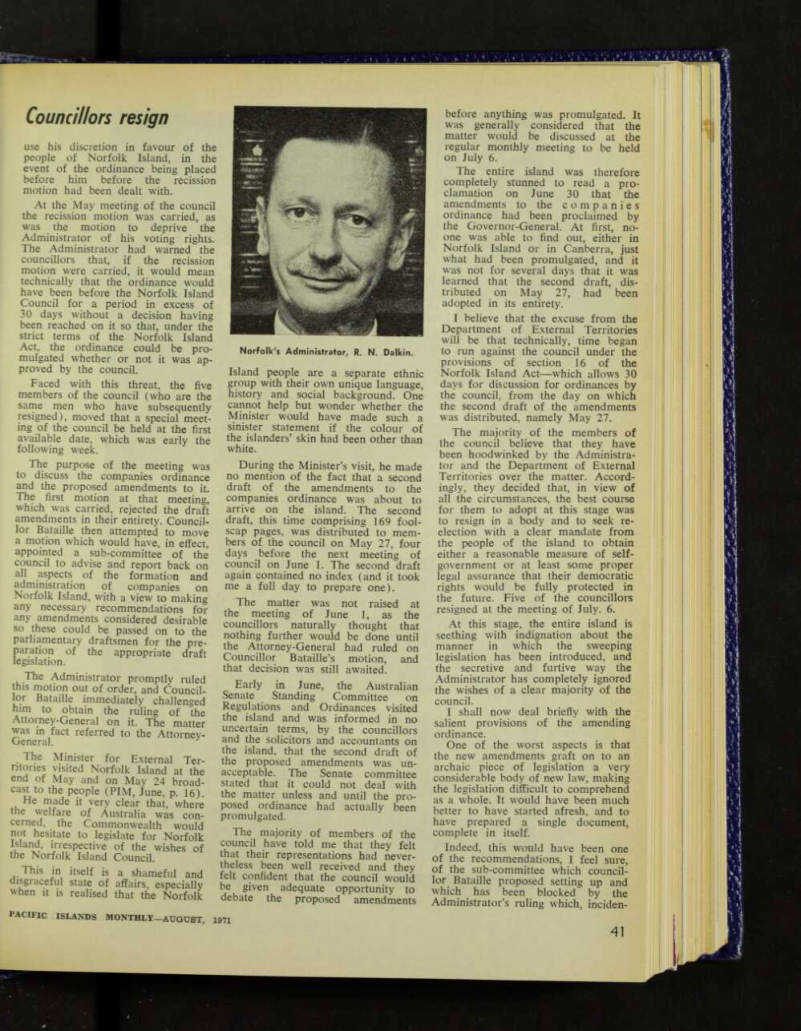
Norfolk's Administrator, R. N. Dalkin.
Island people are a separate ethnic group with their own unique language, history and social background. One cannot help but wonder whether the Minister would have made such a sinister statement if the colour of the islanders’ skin had been other than white.
During the Minister’s visit, he made no mention of the fact that a second draft of the amendments to the companies ordinance was about to arrive on the island. The second draft, this time comprising 169 fool scap pages, was distributed to mem bers of the council on May 27, four days before the next meeting of council on June 1. The second draft again contained no index (and it took me a full day to prepare one).
The matter was not raised at the meeting of June 1, as the councillors naturally thought that nothing further would be done until the Attorney-General had ruled on Councillor Bataille’s motion, and that decision was still awaited.
Early in June, the Australian Senate Standing Committee on Regulations and Ordinances visited the island and was informed in no uncertain terms, by the councillors and the solicitors and accountants on the island, that the second draft of the proposed amendments was un acceptable. The Senate committee stated that it could not deal with the matter unless and until the pro posed ordinance had actually been promulgated.
The majority of members of the council have told me that they felt that their representations had never theless been well received and they felt confident that the council would be given adequate opportunity to debate the proposed amendments
before anything was promulgated. It was generally considered that the matter would be discussed at the regular monthly meeting to be held on July 6.
The entire island was therefore completely stunned to read a pro clamation on June 30 that the amendments to the companies ordinance had been proclaimed by the Governor-General. At first, no one was able to find out, either in Norfolk Island or in Canberra, just what had been promulgated, and it was not for several days that it was learned that the second draft, dis tributed on May 27, had been adopted in its entirety.
I believe that the excuse from the Department of External Territories will be that technically, time began to run against the council under the provisions of section 16 of the Norfolk Island Act—which allows 30 days for discussion for ordinances by the council, from the day on which the second draft of the amendments was distributed, namely May 27.
The majority of the members of the council believe that they have been hoodwinked by the Administra tor and the Department of External Territories over the matter. Accord ingly, they decided that, in view of all the circumstances, the best course for them to adopt at this stage was to resign in a body and to seek re election with a clear mandate from the people of the island to obtain either a reasonable measure of self government or at least some proper legal assurance that their democratic rights would be fully protected in the future. Five of the councillors resigned at the meeting of July. 6.
At this stage, the entire island is seething with indignation about the manner in which the sweeping legislation has been introduced, and the secretive and furtive way the Administrator has completely ignored the wishes of a clear majority of the council.
I shall now deal briefly with the salient provisions of the amending ordinance.
One of the worst aspects is that the new amendments graft on to an archaic piece of legislation a very considerable body of new law, making the legislation difficult to comprehend as a whole. It would have been much better to have started afresh, and to have prepared a single document, complete in itself.
Indeed, this would have been one of the recommendations, I feel sure, of the sub-committee which council lor Bataille proposed setting up and which has been blocked by the Administrator’s ruling which, inciden-
Debate 'not allowed'
tally, has now apparently been upheld by the Attorney-General.
The old ordinance made no dis tinction between public companies and private companies, all being treated in the latter category. This distinction was first introduced in New South Wales in 1936, following the English Companies Act of 1925.
The new ordinance imposes all sorts of onerous restrictions on public companies, in the main along those provided by the Uniform Com panies Legislation in Australia.
However, the latter, of course, exempts private or proprietary com panies from many of these provisions, because they are not advertising for money from the general public and are private in nature.
The new amendments make no distinction, and will make it expensive and onerous for all companies on Norfolk Island to continue in the future. The amount of red tape involved will be enormous. As all but one or two of the approximately 1,500 companies at present on the island are essentially private in character, this alone proves that the amending ordinance is not suited to the needs of Norfolk Island.
The second unsatisfactory feature about the amending ordinance is the abnormally high scale of fees which it introduces, which must be paid each year by all but a handful of companies incorporated on the island.
The annual fee has nothing to do with the cost of administering com panies and is quite obviously a tax on companies.
Wh en a similar fee was introduced m the Bahamas a few years ago it was openly admitted that it was a tax. It is interesting to note that the annual fee in the Bahamas, which incidentally is one of the most ex pensive places in the world, is the ®S len k in Australian currency of &89.00. The annual fee under the $250 00 81 Slat Norfolk Island is This figure, together with the onerous accounting requirements and other restrictions imposed on com pames by the new ordinance, makes Norfolk Island one of the most ex pensive tax havens in the world, with much less to offer than most of its rivals.
One would have thought that the matter of the appropriate fees to be charged should have been carefully discussed by the council, in the light of expert advice. I think that every one would agree that the island is entitled to benefit as much as reason ably possible from being a tax haven,
The Administration of Norfolk Island is conducted from these sets of old colonial buildings, convict-built and now historic. The building seen inside the wall at right was the colonial officers mess and it was gutted by fire last year. It is to be restored. Increased revenue from company registrations is to be spent on Norfolk.
but at the same time, the field is highly competitive and it is clearly against the interests of the island to price itself out of what could other wise be a very lucrative market.
The worst feature of the new ordinance (and I could go on for page after page) is the new section 71R. This applies to all companies which have at any time, now or in the past, been incorporated on Norfolk Island. It is accordingly, retrospective.
It enables the Administrator, with out giving any reasons whatsoever, to call upon any person or persons, including solicitors, who may have or have had an interest in the com pany, whether pecuniary or other wise, to furnish to the Administrator full details of the ownership and control of the company or the shares and debentures therein.
Expressed in plain language, the section requires solicitors, or any one who has ever acted for a Norfolk Island company in the capacity of a solicitor, to break the fundamental privilege which exists between a solicitor and his client in relation to his affairs. This is made even more serious by the fact that the legislation is retrospective.
The sanctity of the privilege between solicitor and client in English law is one of the bulwarks upon which our democracy has been founded. To remove it, under the pain of threat of gaol, without allow ing any reasonable opportunity for debate, is a scandalous abuse of the democratic process.
I find it hard to believe that the Australian Government would have acted in this way. It is difficult to
find words strong enough to condemn the introduction of such legislation by backdoor methods.
Just what effect the introduction of the amending ordinance will have in Norfolk Island is difficult to gauge at this stage. Already a substantial number of companies is going into liquidation and I have no doubt that this trend will continue. Accordingly, as a means of raising revenue, there seems to be no doubt that the amend ments will be a dismal failure.
There will be a secondary effect upon the economy because the busi ness and professional people who were using Norfolk as a tax haven were wont to spend fairly heavily in the duty free stores, the hotels and the superb restaurant.
I anticipate that the cream of this trade will be lost as a result of the introduction of the amending ordinance.
It may well be that the above factors will be sufficient to convince the Australian High Court at some stage in the future that the new law has nothing to do with the “peace, order and good government of Norfolk Island” and is hence invalid.
However, even if this were to happen, a lot of the companies would never return, especially as the Con dominium of the New Hebrides is going out of its way to fill the vacuum created by the Australian Government with the introduction of the new companies ordinance.
PIM in June published an excellent article entitled “Whither Norfolk?”
In the light of what has happened since its publication, the question “whither Norfolk?” is now even more pertinent.