*Footnotes
pp. 32-33 · Read in the full issue
What's In This
Dream For
Paguineans?
rpHE House of Assembly has been criticised for A not finding a neater solution to the national name problem. Personally, although in the past I have tried to promote “Niugini” in this column, and have even given “Pagini” an airing, I do not consider that the House’s choice of “Papua New Guinea” (no “and” please, and no hyphen) is unduly cumbersome, and I suspect that it comes closer to the real wishes of the majority of the people than any of the alternatives sug gested so far.
Our troubles begin when we want to talk about the people and are stuck with “Papuans and New Guineans”, and even with such sentences as, “He is the first Papuan or New Guinean to be appointed to this position.”
I, therefore, propose for the future in this column (did I hear Stuart Inder growl, “Who says it has a future?”) to use “Paguinean” as a
convenient piece of shorthand for “Papuan and/or New Guinean”.
The June meeting of the House of Assembly saw the government’s controversial land bills aired, criticised and withdrawn. The withdrawal was gracefully done; the follow-up was perhaps less graceful.
Administration spokesmen claimed that the bills’ oppo nents opposed them because they did not understand them. That
was not the impression I got from listening to the debate. My impression was that the bills’ opponents did understand their implications with some clarity. On the other hand, the only Paguinean back-bencher to support them said, frankly, that he had not read them and did not understand them.
However, that was the administration’s story, and to it was added the rider that between now and next year, when a new group of bills will be presented to a new House, a massive programme of “explanation” must be carried out by the ad ministration’s propaganda machine—the Depart ment of Information and Extension Services.
In other words, an exercise in face-saving is to be followed by an exercise in brain-washing.
Opponents of the bills have also been reproved
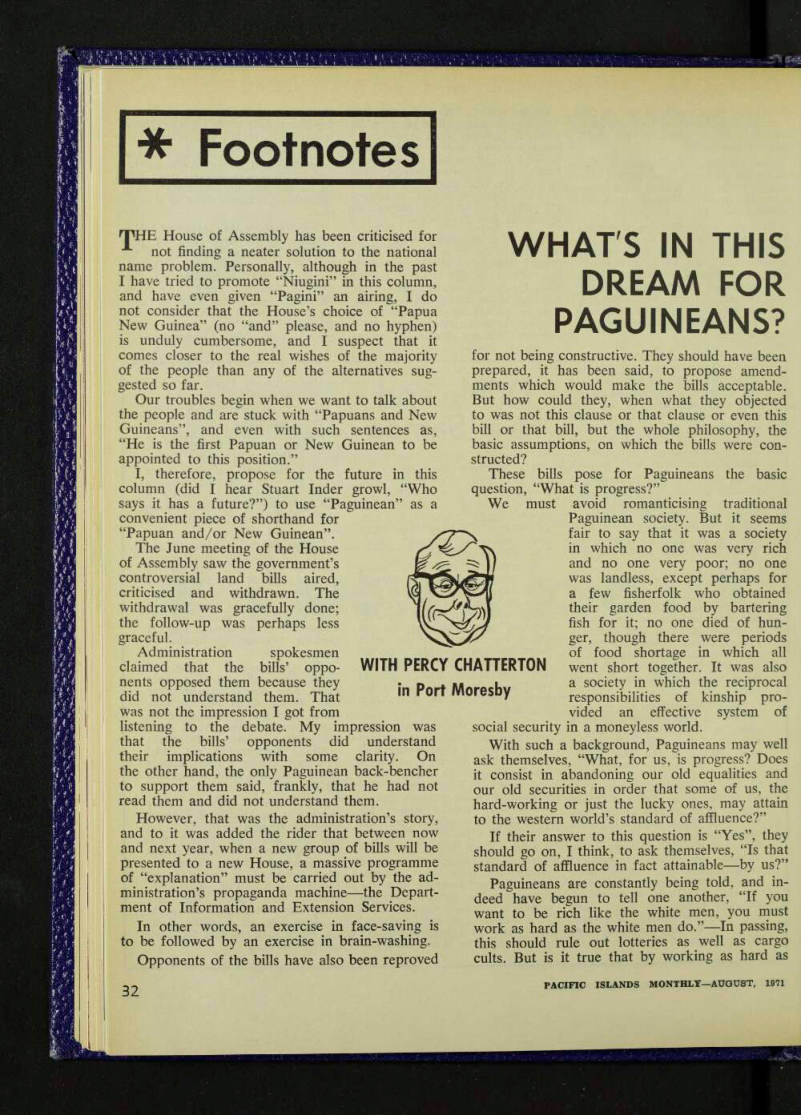
With Percy Chatterton
in Port Moresby
for not being constructive. They should have been prepared, it has been said, to propose amend ments which would make the bills acceptable.
But how could they, when what they objected to was not this clause or that clause or even this bill or that bill, but the whole philosophy, the basic assumptions, on which the bills were con structed?
These bills pose for Paguineans the basic question, “What is progress?”
We must avoid romanticising traditional
Paguinean society. But it seems fair to say that it was a society in which no one was very rich and no one very poor; no one was landless, except perhaps for a few fisherfolk who obtained their garden food by bartering fish for it; no one died of hun ger, though there were periods of food shortage in which all went short together. It was also a society in which the reciprocal
responsibilities of kinship pro
vided an effective system of
social security in a moneyless world.
With such a background, Paguineans may well ask themselves, “What, for us, is progress? Does it consist in abandoning our old equalities and our old securities in order that some of us, the hard-working or just the lucky ones, may attain to the western world’s standard of affluence?”
If their answer to this question is “Yes”, they should go on, I think, to ask themselves, “Is that standard of affluence in fact attainable—by us?”
Paguineans are constantly being told, and in deed have begun to tell one another, “If you want to be rich like the white men, you must work as hard as the white men do.”—ln passing, this should rule out lotteries as well as cargo cults. But is it true that by working as hard as
the white men Paguineans can become as rich as they are?
Last year, in October, 1970, PIM, I quoted these words from Keith Buchanan’s book The Transformation of the Chinese Earth: “The con ditions which made possible the contemporary affluence of the West, conditions which included and include the plundering of a great deal of the world, are not going to be repeated—that we should imply that our levels of wealth are attainable by the peoples of the emerging coun tries is either downright dishonest or irresponsibly naive.”
Now comes a voice from nearer home.
Dr. lan Maddocks was Dean of the Papuan Medical College when it was a government insti tution. Now that it has been transmuted into a faculty of the University of Papua New Guinea, he is one of the faculty’s foundation professors.
In an effort to understand the problems of health services in Papua New Guinea, he and his family have lived in a Papuan village for the past three years.
In his inaugural lecture, after speaking of the aims and achievements of Western scientific tech nology, he goes on, “In what can only be de scribed as a massive confidence trick, the poorer countries of the world have accepted this grotesque Western dream as their own, and are pursuing it along with the rest of the world, but from a position of no advantage. Their major contribution to the dream is to offer their natural resources of oil and metals for consumption by the West. They derive little benefit from this.”
Pat on cue, though unintentionally so, comes that staid journal, the Australian Financial Re view. As quoted by the PNG Post-Courier, it says, “Concerned are the British, who effectively
control the Bougainville operation; the Japanese, who have signed up to buy what it produces; the Australians, who are doing the work; and the Americans. It is now clear that the main plums in what is ranking as one of the world’s biggest mining construction projects of the 19705, are
falling to US suppliers.”
You will notice that there is no mention of the Paguineans, who may perhaps feel that they are doing some of the work too, and who will certainly have to repay, from their 1.25 per cent, royalty on the value of copper concentrate sold, the substantial loans by means of which their government is currently providing facilities for
Cra.
You will notice that there is also no mention of the Bougainvilleans, whose landowners in the actual mining area will receive a royalty of slightly more than 6 cents for every $lOO-worth of copper concentrate sold while the exercise is on, and when it is over will be left with a big hole and, in all probability, polluted fishing grounds.
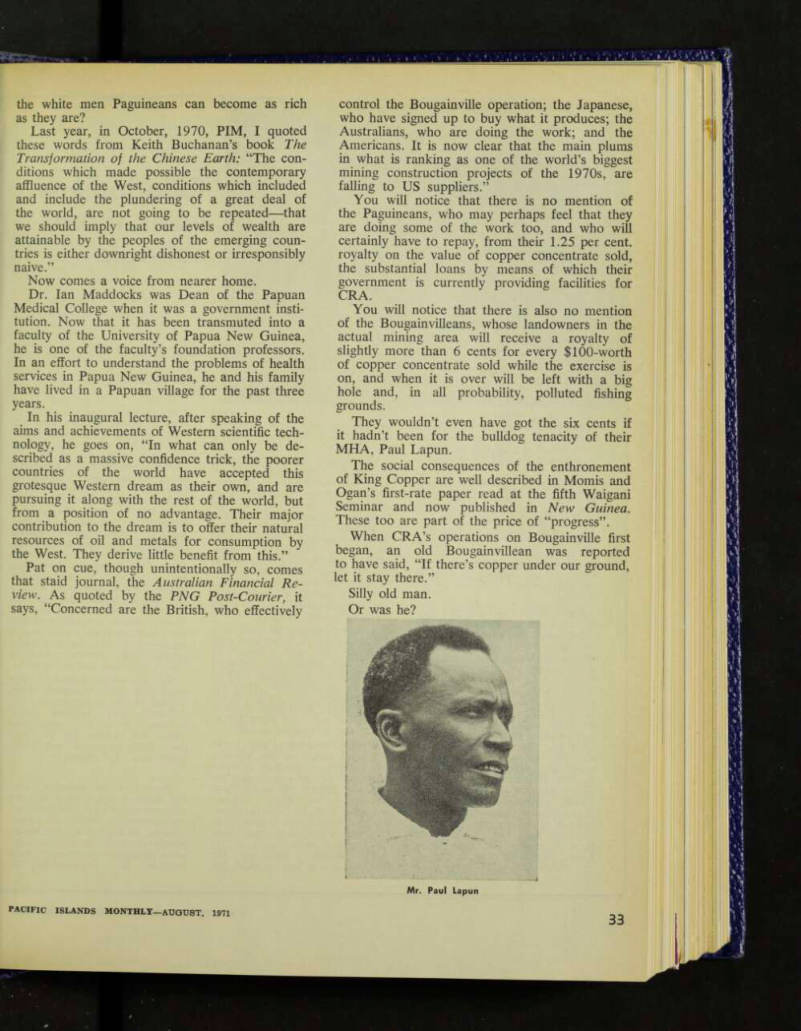
They wouldn’t even have got the six cents if it hadn’t been for the bulldog tenacity of their MHA, Paul Lapun.
The social consequences of the enthronement of King Copper are well described in Momis and Ogan’s first-rate paper read at the fifth Waigani Seminar and now published in New Guinea.
These too are part of the price of “progress”.
When CRA’s operations on Bougainville first began, an old Bougainvillean was reported to have said, “If there’s copper under our ground, let it stay there.”
Silly old man.
Or was he?
Mr. Paul Lapun