Niue
pp. 19-20 · Read in the full issue
enters the air age
From Sue Wendt
July was momentous for Niue Island, one of the few remain NiUe (meaning “ behold the
An Air Pacific HS 748 turbo-prop, bearing the name and colours of Fiji Airways and chartered by Polynesian Airlines landed us—the “pioneer” commercial passengers—at Niue’s new Hanan International Airport on July 5. Despite the confusion of names, there was no confusion about the importance of the event. . This was the first commercial flight into Niue. More than that—it was the beginning of another era for the isolated New Zealand protectorate, ibout which even New Zealanders mow virtually nothing.
Rising straight up from encircling ■eef, with a topping of scrubby vege ation and coconut palms, the 100 iquare-mile coral island seems to
float in the middle of nowhere. In reahty n is 300 miles east of Tonga, 350 miles south-east of Samoa. And it is surprisingly developed.
Niue has schools and very service able roads, a timber mill, a factory tor extracting passionfruit pulp a honey and dairy industry, a radio telephone service linking it with New Zealand and, from July, with Raro tonga. There are shops, including the übiquitous Burns Philp “all purpose”, and even a restaurant. n p ° V 7 i the j eXt three years, the W7^7 a ?n n n d A Governme nt will spend ? NZ 3,075,000 in aid to Niue— and tew New Zealanders will even know that its gone.
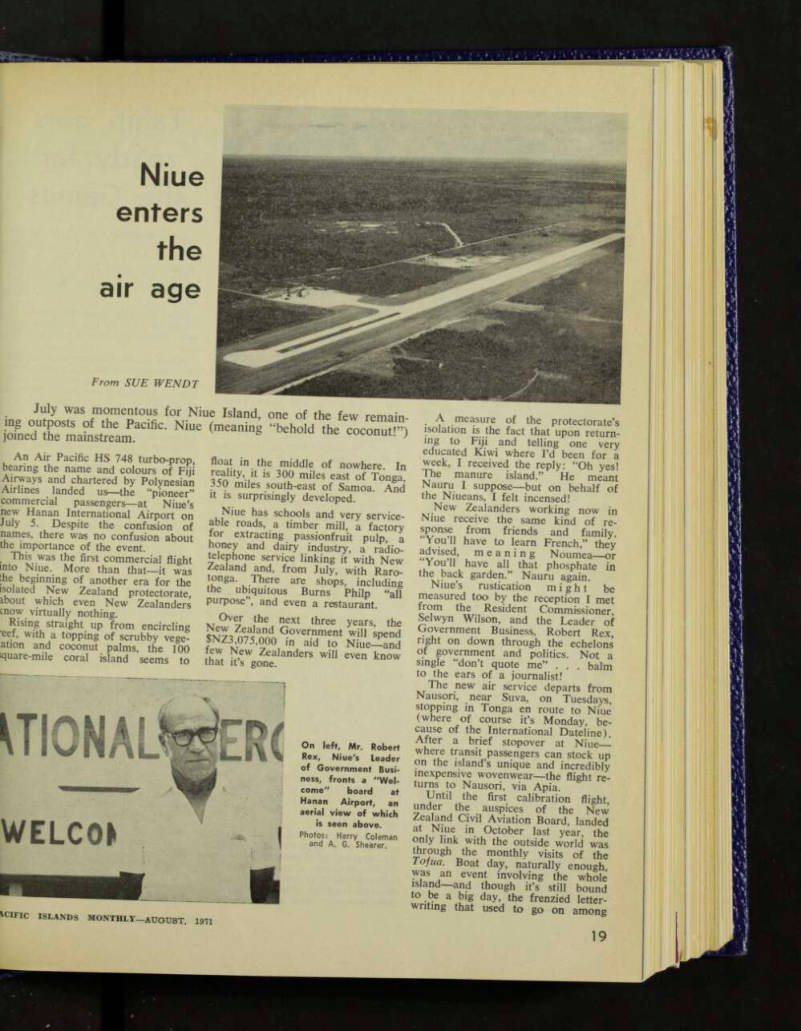
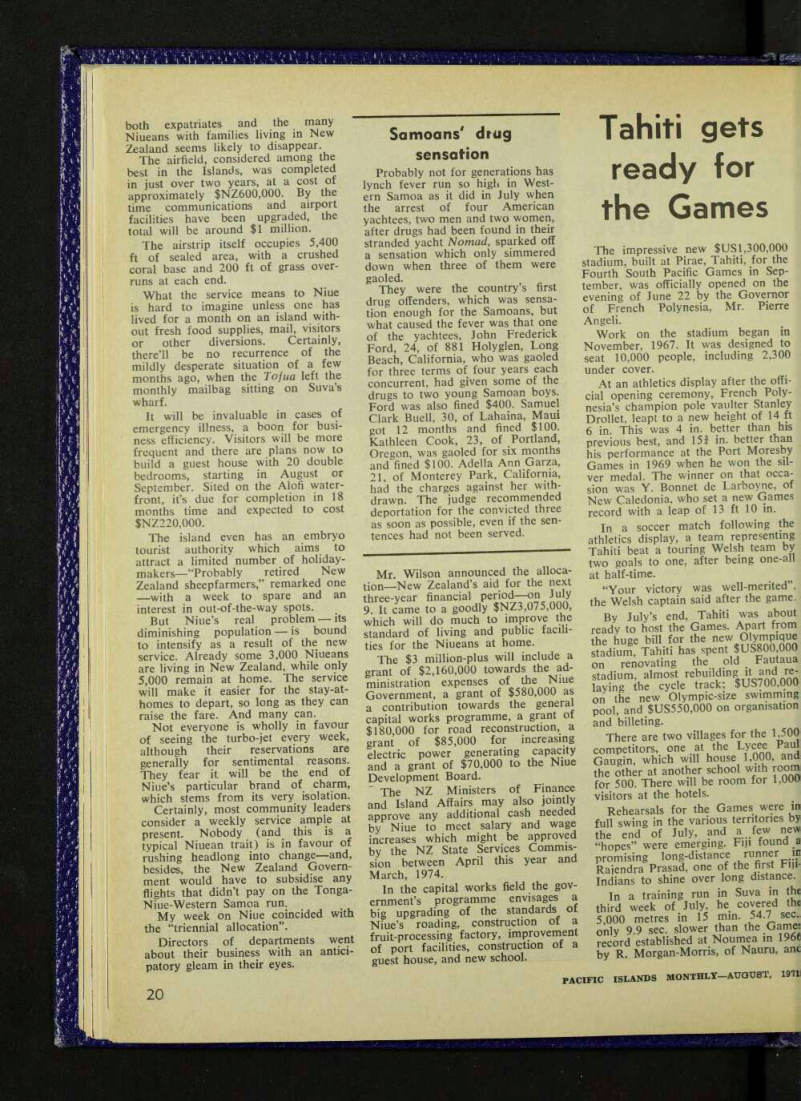
On left, Mr. Robert Rex, Niue's Leader of Government Busi ness, fronts a "Wel come" board at Hanan Airport, an aerial view of which is seen above.
Photos: Harry Coleman and A. G. Shearer.
. A measure of the protectorate’s isolation is the fact that upon return ing to Fiji and telling one very educated Kiwi where I’d been for a week, I received the reply: “Oh yes’
The manure island.” He meant Nauru I suppose—but on behalf of the Niueans, I felt incensed!
New Zealanders working now in Niue receive the same kind of re sponse from friends and family. j h ave to l earn French,” they advised, meaning Noumea—or You 11 have all that phosphate in the back garden.” Nauru again.
Niue’s rustication might be measured too by the reception I met from the Resident Commissioner, Selwyn Wilson, and the Leader of Government Business, Robert Rex right on down through the echelons of government and politics. Not a smgle “don’t quote me” . . . balm to the ears of a journalist!
The new air service departs from Nauson, near Suva, on Tuesdays, stopping in Tonga en route to Niue (where of course it’s Monday, be cause of the International Dateline) After a brief stopover at Niue— where transit passengers can stock up on the island’s unique and incredibly inexpensive wovenwear—the flight re turns to Nausori, via Apia.
Until the first calibration flight under the auspices of the New Zealand Civil Aviation Board, landed at Niue in October last year the only fink with the outside world was through the monthly visits of the lofua. Boat day, naturally enough was an event involving the whole island—and though it’s still bound to be a big day, the frenzied letter writing that used to go on among
both expatriates and the many Niueans with families living in New Zealand seems likely to disappear The airfield, considered among the best in the Islands, was completed in just over two years, at a cost of approximately SNZ6OO,OOO. By the time communications and airport facilities have been upgraded, the total will be around $1 million.
The airstrip itself occupies 5,400 ft of sealed area, with a crushed coral base and 200 ft of grass over runs at each end.
What the service means to Niue is hard to imagine unless one has lived for a month on an island with out fresh food supplies, mail, visitors or other diversions. Certainly, there’ll be no recurrence of the mildly desperate situation of a few months ago, when the Tofua left the monthly mailbag sitting on Suva’s wharf.
It will be invaluable in cases of emergency illness, a boon for busi ness efficiency. Visitors will be more frequent and there are plans now to build a guest house with 20 double bedrooms, starting in August or September. Sited on the Alofi water front, it’s due for completion in 18 months time and expected to cost $NZ220,000.
The island even has an embryo tourist authority which aims to attract a limited number of holiday makers—“ Probably retired New Zealand sheepfarmers,” remarked one —with a week to spare and an interest in out-of-the-way spots.
But Niue’s real problem —its diminishing population —is bound to intensify as a result of the new service. Already some 3,000 Niueans are living in New Zealand, while only 5,000 remain at home. The service will make it easier for the stay-at homes to depart, so long as they can raise the fare. And many can.
Not everyone is wholly in favour of seeing the turbo-jet every week, although their reservations are generally for sentimental reasons.
They fear it will be the end of Niue's particular brand of charm, which stems from its very isolation.
Certainly, most community leaders consider a weekly service ample at present. Nobody (and this is a typical Niuean trait) is in favour of rushing headlong into change—and, besides, the New Zealand Govern ment would have to subsidise any flights that didn’t pay on the Tonga- Niue-Western Samoa run.
My week on Niue coincided with the “triennial allocation”.
Directors of departments went about their business with an antici patory gleam in their eyes.
Mr. Wilson announced the alloca tion —New Zealand’s aid for the next three-year financial period—on July 9. It came to a goodly $NZ3,075,000, which will do much to improve the standard of living and public facili ties for the Niueans at home.
The $3 million-plus will include a grant of $2,160,000 towards the ad ministration expenses of the Niue Government, a grant of $580,000 as a contribution towards the general capital works programme, a grant of $lBO,OOO for road reconstruction, a grant of $85,000 for increasing electric power generating capacity and a grant of $70,000 to the Niue Development Board.
The NZ Ministers of Finance and Island Affairs may also jointly approve any additional cash needed by Niue to meet salary and wage increases which might be approved by the NZ State Services Commis sion between April this year and March, 1974.
In the capital works field the gov ernment’s programme envisages a big upgrading of the standards of Niue’s reading, construction of a fruit-processing factory, improvement of port facilities, construction of a guest house, and new school.